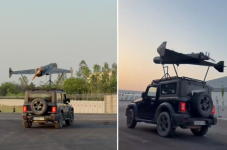
Indian drone manufacturer Hoverit has completed vehicle-mounted launch trials of its Divyastra Mk-2, a long-range one-way attack drone in the same class as Iran’s Shahed series.
The
ground trial milestone follows an earlier high-speed taxi trial, with the company confirming in its announcement that vehicle-based launch has now been completed. “After successful High Speed Taxi Trial. Now: Vehicle based launch completed. Next: Rocket assisted takeoff,” Hoverit stated.
The Divyastra Mk-2 is positioned as a next-generation tactical UAV built for deep strategic operations, carrying a payload of 50 to 100 kilograms across an operational range of 1,500 to 2,000 kilometers at a cruising speed of approximately 180 kilometers per hour, according to Hoverit’s specifications. Flight endurance runs from 8 to 12 hours. When it reaches its target, the drone accelerates to a terminal attack speed of 300 to 400 kilometers per hour — a significant increase over cruising speed that reduces the window available for defensive systems to engage it. Those numbers place the Mk-2 firmly in the same performance envelope as the Shahed-136 and similar loitering munitions that have reshaped how militaries think about long-range strike, except that the Divyastra is designed for considerably heavier payloads and substantially greater range than most of the Iranian systems that have been documented in combat.
The command and control architecture Hoverit has built around the Mk-2 reflects the lessons the drone warfare community has drawn from watching Shahed operations and Ukrainian counter-drone efforts over the past three years. The system incorporates AI swarm intelligence — the ability to coordinate multiple drones toward a common objective — along with encrypted sovereign control links and resilient data connections designed to function in GPS-denied environments. That last capability is particularly significant. GPS jamming and spoofing have become standard tools in the electronic warfare kits of any military expecting to face long-range drone attacks, and a drone that loses navigation accuracy the moment an adversary turns on a jammer is a drone with a fundamental vulnerability. Building GPS-denied navigation resilience into the system from the ground up rather than retrofitting it later is a design choice that reflects operational maturity.
The vehicle-mounted launch capability that Hoverit just demonstrated addresses one of the persistent operational limitations of fixed-wing long-range attack drones. A system that requires a prepared runway or a catapult installation tied to a fixed location is a system that can be targeted, denied, or destroyed before it ever gets airborne. Vehicle-based launch means the Divyastra Mk-2 can be deployed from essentially any location accessible to a truck — a dirt road, a field, a forward operating position — without advance preparation of the launch site. Rocket-assisted takeoff, the next milestone on Hoverit’s development timeline, will eliminate even the need for a runway run, allowing the drone to lift off vertically or at a steep angle from a standing vehicle, which further reduces the operational footprint and the warning time an adversary has before a strike is already inbound.
India’s indigenous drone development has accelerated significantly over the past several years, driven by a combination of national policy priorities around defense self-reliance, operational experience with drone threats along its borders, and the global demonstration effect of Ukraine showing what long-range drone strikes can achieve against conventional military infrastructure. The Divyastra Mk-2’s specifications — particularly the 1,500 to 2,000 kilometer range and the 50 to 100 kilogram payload — suggest a system designed with strategic depth in mind rather than purely tactical applications. A drone that can fly 2,000 kilometers with a 100-kilogram warhead and navigate without GPS covers a very large portion of the subcontinent from any given launch point, and the swarm intelligence capability suggests the intent to employ multiple systems simultaneously rather than in isolated single strikes.
Hoverit describes the Mk-2’s primary mission profiles as strategic deep strike operations, deep surveillance and reconnaissance, and long-range tactical missions. The dual strike-and-surveillance framing is consistent with how most modern one-way attack drone programs are structured — the same platform that can deliver a payload can also carry sensors and return intelligence from areas too dangerous or distant for manned reconnaissance. The difference in terminal approach speed between cruising and attack modes — from 180 to 300-400 kilometers per hour — is specifically designed to complicate point defense, giving a defending system less reaction time than it would have against a drone maintaining constant speed throughout its flight profile.