PAF SAM based Air Defense System - News, Discussion & Updates

There is some agreement on that notion but also another perspective of personal experience in working with particular suppliers and how that comes into play.

For example,
ACdre Sajjad Haider who is a celebrated/decorated officer in PAF in his book (based on his experiences) criticizes PAF officers for selecting an immature and inferior Chinese EW system (this is from the 1980s) for its Mirages instead of western ones which he implicitly points to contrived practices.

He also criticizes Swedish sellers for bribes but doesn’t deride them technically. His view ends in the 1980s when he retires.

We can take his experience for the point in time - take it as opinionated lessons - or apply that understanding completely broadly without allocating an iota of thought as to why his bias might exist.


Another example - disconnected from defense but illustrating why experiences matter.

I used to have an Alfa Romeo Giulia
The entire market reputation of Alfa Romeo is that they might be good cars to drive but are unreliable nightmares.

Yet, during my ownership I had zero problems even as a spirited driver and I would have bought another one if they had something that met my requirements.

The Audi prior to the current one I have was a stellar car with zero issues until it started giving signs of having an imminent catastrophic failure - and its replacement current audi is a catastrophic failure from the get go. Immediately my impression of audi changed. Should I blanket all German cars under that? Or do I reference the wider community for experience ? Then what my needs are - then what is available - then what I can afford - then grade if my experience and opinion should be this extreme?

I drove a Chery QQ back in 2009 - I thought it was a pathetic car. Is that valid for Chinese cars today? Was it valid then considering the QQ was a budget entry car back then?

Similarly and I have repeated this here before- I had an opportunity to work with Chinese suppliers for Software defined radio systems - both as complete kits and then ordering custom chipsets nearly 15 years ago.

My opinion on the full Chinese kit was that it was trash - the custom boards we ordered however were an interesting dilemma.
Our organization was quoted an initial price on the work and asked for a lower price - the resulting initial batch was thrown into the bin.

The factory head bluntly told us - we used quality and methods you provided for the price so you cannot expect perfection given the hours I am allocating to your work.
Still, after negotiations the next batches barely met but passed our QC - then as volume increased the quality improved further.

Who do we indict in this?
The factory in China?
The price haggling on both sides?

Today, Ive had the opportunity to test drive many Chinese cars in the middle east - and in terms of materials, technology and in some cases even driving mechanics I see them superior to ANY American manufacturer.

However, I am also told by the dealers when driving them that the cars don’t have many of the features you would find in China. Does that mean China is exploiting the Saudis or Pakistanis when they send these cars there?

No - and this is validation of what you said earlier. The reason why BYD or Huawei for that matter can offer better features and technology in China is that the cars were originally designed as part of the larger Chinese ecosystem of connected infrastructure and even roads.

So if the J-10CE for Pakistan is missing certain systems or the PL-16 it is perhaps not just that Pakistan is given inferior systems but also that certain prerequisite systems that enable the technology/system on Chinese J-10C or PL-16 to be truly employed efficiently are not present in Pakistan so the sale would be detrimental to the overall system reputation but also a mismatch for Pakistan.

to end it - your defensive response is both valid and invalid at the same time because those critical of China at times ignore the operational and cultural realities of your society and its mechanisms of business and manufacturing practices while your personal defense of China ignores additional factors that may have led to poor impression of Chinese goods and practices.
First, you have failed to grasp the core of the issue. I am referring specifically to those individuals who simultaneously level two contradictory accusations—not to those who are genuinely critiquing the problem at hand. There is a fundamental distinction between these two groups.

Second, regarding the issue of "Made in China" quality: this topic seems prone to significant digression. However, as you are the moderator, the decision rests with you. I am prepared to explain the full context and background of this issue in detail to our Pakistani friends, or I can terminate this digression at any moment.

The Chinese people, in their hearts, feel the impact of the "Made in China" quality issue far more deeply than you do.
============================
To truly understand the quality issues often associated with "Made in China," we must look beyond surface-level criticisms like "cheap labor" or "cutting corners." The real root cause lies in a profound narrative: a clash between two entirely different systems of economic evolution.

The modern international business order—including its commercial logic, legal frameworks, and product standards—was developed over centuries in the West. From the Renaissance and the Industrial Revolution to post-WWII globalization led by the United States, this system has been refined around the concepts of predictability, strict compliance, and standardized quality.

China, however, entered this global playground through a radically different historical path. When China began its deep integration into the global economy in the late 20th century, it was a latecomer facing massive pressure to survive. To catch up, the domestic market unleashed a form of competition so fierce that it resembled economic Darwinism. Central state firms, private entrepreneurs, and foreign ventures were thrown into a vast arena where the only rule was survival of the fittest. During this hyper-competitive era, market agility and cost-reduction moved at a lightning speed that far outpaced the development of regulatory and legal enforcement. It was an environment of "winner takes all."

Initially, foreign enterprises thrived on their established standards. But over time, Chinese enterprises, driven by an intense survival instinct, learned and adapted at an unprecedented pace.

This brings us to the core of the "Made in China" quality paradox: It is not a failure of capability, but a psychological disconnect between customer expectations and market reality.

International buyers judge products based on established global norms. But the Chinese domestic market, through brutal competition, has completely engineered a new definition of those products.

For instance, most consumers in developed countries have never worn a pair of factory-made, two-dollar leather shoes. But I have. To a Western consumer, the word "leather shoe" carries a static definition of material, durability, and a certain cost threshold. But the hyper-competitive Chinese market managed to reverse-engineer the very concept of a "shoe" to meet the lowest possible price point for mass survival. It wasn't done to deceive; it was the inevitable, emergent outcome of a market pushed to its absolute limits of cost-efficiency.

Ultimately, "Made in China" is a spectrum. It is capable of producing the world’s most sophisticated technology, but it also produced an ultra-low-cost survival ecosystem. As global consumers and partners, understanding this distinction is the first step to navigating the true reality of the modern global supply chain.

This pattern of intense competition and rapid adaptation applies across industries, including defense and military production.

Today, this evolutionary process is still wide awake, but the landscape has fundamentally stratified into two distinct worlds.

On one side, we see fully matured, consolidated Chinese giants. These enterprises have survived the domestic arena, scaled up, and fully integrated into the global compliance system. Their products strictly align with the international rules, predictability, and quality standards you are familiar with.

On the other side, the brutal, no-holds-barred battlefield still exists in many emerging industries and lower-tier manufacturing sectors. There, smaller firms are still locked in a fierce struggle for daily survival, and as a result, product quality remains highly volatile and uneven.

Therefore, when dealing with "Made in China" today, you are no longer dealing with a single entity, but with a multi-layered ecosystem at different stages of industrial evolution.
 
Didn't happen - however, i think the point being made is about importance of mobility - and special attention is being paid on this aspect.

Fixed assets are just sitting ducks - they sent lesser drones this time - next time perhaps they will send bigger waves or simply use stand off weapons - so the assets have to have customized mobility solutions.
Mobility for a radar system is very welcome, however it defeats the purpose when it has to relocate every time under enemy threat. Radars have to be re-calibrated again at the new location to become part of the system again and start providing early warning....
 
There is some agreement on that notion but also another perspective of personal experience in working with particular suppliers and how that comes into play.

For example,
ACdre Sajjad Haider who is a celebrated/decorated officer in PAF in his book (based on his experiences) criticizes PAF officers for selecting an immature and inferior Chinese EW system (this is from the 1980s) for its Mirages instead of western ones which he implicitly points to contrived practices.

He also criticizes Swedish sellers for bribes but doesn’t deride them technically. His view ends in the 1980s when he retires.

We can take his experience for the point in time - take it as opinionated lessons - or apply that understanding completely broadly without allocating an iota of thought as to why his bias might exist.


Another example - disconnected from defense but illustrating why experiences matter.

I used to have an Alfa Romeo Giulia
The entire market reputation of Alfa Romeo is that they might be good cars to drive but are unreliable nightmares.

Yet, during my ownership I had zero problems even as a spirited driver and I would have bought another one if they had something that met my requirements.

The Audi prior to the current one I have was a stellar car with zero issues until it started giving signs of having an imminent catastrophic failure - and its replacement current audi is a catastrophic failure from the get go. Immediately my impression of audi changed. Should I blanket all German cars under that? Or do I reference the wider community for experience ? Then what my needs are - then what is available - then what I can afford - then grade if my experience and opinion should be this extreme?

I drove a Chery QQ back in 2009 - I thought it was a pathetic car. Is that valid for Chinese cars today? Was it valid then considering the QQ was a budget entry car back then?

Similarly and I have repeated this here before- I had an opportunity to work with Chinese suppliers for Software defined radio systems - both as complete kits and then ordering custom chipsets nearly 15 years ago.

My opinion on the full Chinese kit was that it was trash - the custom boards we ordered however were an interesting dilemma.
Our organization was quoted an initial price on the work and asked for a lower price - the resulting initial batch was thrown into the bin.

The factory head bluntly told us - we used quality and methods you provided for the price so you cannot expect perfection given the hours I am allocating to your work.
Still, after negotiations the next batches barely met but passed our QC - then as volume increased the quality improved further.

Who do we indict in this?
The factory in China?
The price haggling on both sides?

Today, Ive had the opportunity to test drive many Chinese cars in the middle east - and in terms of materials, technology and in some cases even driving mechanics I see them superior to ANY American manufacturer.

However, I am also told by the dealers when driving them that the cars don’t have many of the features you would find in China. Does that mean China is exploiting the Saudis or Pakistanis when they send these cars there?

No - and this is validation of what you said earlier. The reason why BYD or Huawei for that matter can offer better features and technology in China is that the cars were originally designed as part of the larger Chinese ecosystem of connected infrastructure and even roads.

So if the J-10CE for Pakistan is missing certain systems or the PL-16 it is perhaps not just that Pakistan is given inferior systems but also that certain prerequisite systems that enable the technology/system on Chinese J-10C or PL-16 to be truly employed efficiently are not present in Pakistan so the sale would be detrimental to the overall system reputation but also a mismatch for Pakistan.

to end it - your defensive response is both valid and invalid at the same time because those critical of China at times ignore the operational and cultural realities of your society and its mechanisms of business and manufacturing practices while your personal defense of China ignores additional factors that may have led to poor impression of Chinese goods and practices.
My own two cents, based on working with a sub-system supplier, located in Lichtenstein, for Volvo/Geely: we had a dedicated, well-paid QC lead on the ground. That person brought basic qualification and commitement, and we resolved issues promptly. The investment in process and people—not just the unit price—paid dividends.

Now contrast that with the average AliExpress buyer. The majority sort by "cheapest first," then turn around and blame "Made in China" when the predictable happens. You don't get to haggle a factory to the bone, demand zero margin for QC, and then act surprised. The lesson scales from automotive components to fighter jets.

Which brings me to the J-10CE and this "iron brother" talk.

The last 10 years were a nightmare with CPEC security issues, Afghan border friction, the Chinese ambassador publicly telling Pakistan to get its house in order, and Islamabad offering up Pasni to the US. Yeah geo-politics in play but it's a two-way road.

So how much real trust is actually in the room?

I'd say PICK a side. Stop acting like a camel getting its nose into the tent—diplomatic hedging has a shelf life, and Pakistan's expired. China has moved from patron to stakeholder with expectations. If the PL-16 or certain subsystems aren't on the J-10CE, maybe it's not just missing prerequisites. Maybe it's also a signal: trust is earned, not inherited from the 1980s.
 
@side-winder

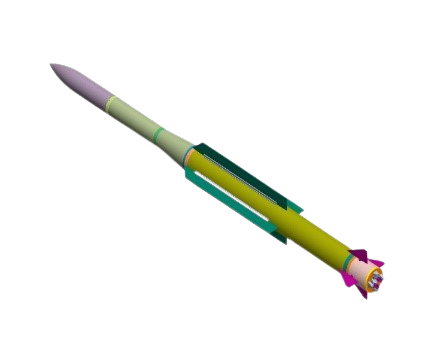
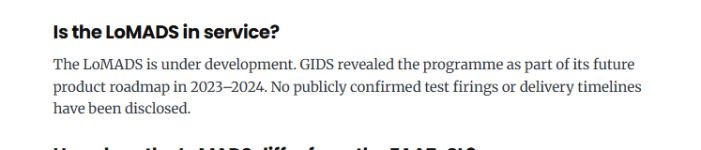
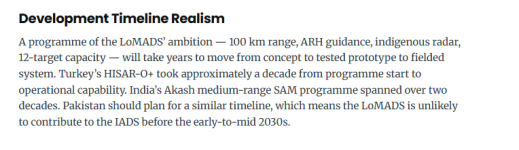
Is AM-350S a suitable replacement for TPS-77? Any AM-350S in active service? Also, should we expect GIDS LOMADS to materialise, or is it going the way of the Al-Khalid 2 tank?

A bit early to be talking about replacing the TPS-77's, they are not that old as far as radars go.
 
First, you have failed to grasp the core of the issue. I am referring specifically to those individuals who simultaneously level two contradictory accusations—not to those who are genuinely critiquing the problem at hand. There is a fundamental distinction between these two groups.

Second, regarding the issue of "Made in China" quality: this topic seems prone to significant digression. However, as you are the moderator, the decision rests with you. I am prepared to explain the full context and background of this issue in detail to our Pakistani friends, or I can terminate this digression at any moment.

The Chinese people, in their hearts, feel the impact of the "Made in China" quality issue far more deeply than you do.
============================
To truly understand the quality issues often associated with "Made in China," we must look beyond surface-level criticisms like "cheap labor" or "cutting corners." The real root cause lies in a profound narrative: a clash between two entirely different systems of economic evolution.

The modern international business order—including its commercial logic, legal frameworks, and product standards—was developed over centuries in the West. From the Renaissance and the Industrial Revolution to post-WWII globalization led by the United States, this system has been refined around the concepts of predictability, strict compliance, and standardized quality.

China, however, entered this global playground through a radically different historical path. When China began its deep integration into the global economy in the late 20th century, it was a latecomer facing massive pressure to survive. To catch up, the domestic market unleashed a form of competition so fierce that it resembled economic Darwinism. Central state firms, private entrepreneurs, and foreign ventures were thrown into a vast arena where the only rule was survival of the fittest. During this hyper-competitive era, market agility and cost-reduction moved at a lightning speed that far outpaced the development of regulatory and legal enforcement. It was an environment of "winner takes all."

Initially, foreign enterprises thrived on their established standards. But over time, Chinese enterprises, driven by an intense survival instinct, learned and adapted at an unprecedented pace.

This brings us to the core of the "Made in China" quality paradox: It is not a failure of capability, but a psychological disconnect between customer expectations and market reality.

International buyers judge products based on established global norms. But the Chinese domestic market, through brutal competition, has completely engineered a new definition of those products.

For instance, most consumers in developed countries have never worn a pair of factory-made, two-dollar leather shoes. But I have. To a Western consumer, the word "leather shoe" carries a static definition of material, durability, and a certain cost threshold. But the hyper-competitive Chinese market managed to reverse-engineer the very concept of a "shoe" to meet the lowest possible price point for mass survival. It wasn't done to deceive; it was the inevitable, emergent outcome of a market pushed to its absolute limits of cost-efficiency.

Ultimately, "Made in China" is a spectrum. It is capable of producing the world’s most sophisticated technology, but it also produced an ultra-low-cost survival ecosystem. As global consumers and partners, understanding this distinction is the first step to navigating the true reality of the modern global supply chain.

This pattern of intense competition and rapid adaptation applies across industries, including defense and military production.

Today, this evolutionary process is still wide awake, but the landscape has fundamentally stratified into two distinct worlds.

On one side, we see fully matured, consolidated Chinese giants. These enterprises have survived the domestic arena, scaled up, and fully integrated into the global compliance system. Their products strictly align with the international rules, predictability, and quality standards you are familiar with.

On the other side, the brutal, no-holds-barred battlefield still exists in many emerging industries and lower-tier manufacturing sectors. There, smaller firms are still locked in a fierce struggle for daily survival, and as a result, product quality remains highly volatile and uneven.

Therefore, when dealing with "Made in China" today, you are no longer dealing with a single entity, but with a multi-layered ecosystem at different stages of industrial evolution.
I think we are in agreement that there is a distinction in criticism which unfortunately nationalism clouds- so lets leave that issue there.

And Yes I agree that your explanation of the challenges I outline for people making impressions of Chinese manufacturing ignore the internal ecosystem that then drives those impressions.

Unfortunately, impressions can be lasting - for e.g Pakistan forever associated with terrorism which while a long term issue clouds the other 90% of the country’s offerring.
 
so lets leave that issue there.
As you wish! Let's get back to the main topic!
===============================
A matter requiring careful verification:

Has Pakistan truly deployed the HQ-16FE SAM system? (Is it merely an intended purchase? Has a contract already been signed? Has the shipment actually arrived?)

Although numerous Pakistani media outlets have reported on this development, I do not appear to have seen any actual photographs or absolutely definitive official confirmation. Can anyone verify this?

In official Chinese sources, the HQ-16FE SAM is confirmed to be a fourth-generation SAM system. This choice of terminology carries particular significance.
 
As you wish! Let's get back to the main topic!
===============================
A matter requiring careful verification:

Has Pakistan truly deployed the HQ-16FE SAM system? (Is it merely an intended purchase? Has a contract already been signed? Has the shipment actually arrived?)

Although numerous Pakistani media outlets have reported on this development, I do not appear to have seen any actual photographs or absolutely definitive official confirmation. Can anyone verify this?

In official Chinese sources, the HQ-16FE SAM is confirmed to be a fourth-generation SAM system. This choice of terminology carries particular significance.
How good is the HQ16FE?

Also members are reporting that PAF is in the process of acquiring it. It hasn't arrived yet in Pakistan.
 
As you wish! Let's get back to the main topic!
===============================
A matter requiring careful verification:

Has Pakistan truly deployed the HQ-16FE SAM system? (Is it merely an intended purchase? Has a contract already been signed? Has the shipment actually arrived?)

Although numerous Pakistani media outlets have reported on this development, I do not appear to have seen any actual photographs or absolutely definitive official confirmation. Can anyone verify this?

In official Chinese sources, the HQ-16FE SAM is confirmed to be a fourth-generation SAM system. This choice of terminology carries particular significance.
It would be great if you can weigh in on a confusion I highlighted on another thread specifically from a missiles perspective.

That designations for Chinese systems may not always correspond to what is assumed to be english or otherwise.

For eg (and I am giving a made up term)

FE does not mean “For Export”
Or that a aircraft with “G” at the end doesn’t mean the “G” refers to the same term/word
 
When are they being inducted? At what stage of development are they?

1779307440528.png

1779307472967.png
 
It would be great if you can weigh in on a confusion I highlighted on another thread specifically from a missiles perspective.

That designations for Chinese systems may not always correspond to what is assumed to be english or otherwise.

For eg (and I am giving a made up term)

FE does not mean “For Export”
Or that a aircraft with “G” at the end doesn’t mean the “G” refers to the same term/word
Regarding China's current weapon designation system, two distinct categories exist:

1. Export-Exclusive Designations: Examples include FC, LY, and CM. These letter codes are abbreviations derived from English terms. (Manufacturer-designated name)
2. PLA Domestic Designations: Examples include J, ZTZ, and PCL. These letter codes are abbreviations derived from Chinese Pinyin. (PLA-designated name)

Currently, the prevailing convention for new export models is to append the letter "E" to the PLA's domestic designation (e.g., "PLA Domestic Code + E"). If a specific weapon system's designation adheres to this rule—specifically, if its final letter is "E"—we can definitively identify it as an export-oriented weapon system. To date, no exceptions to this rule have been discovered. (In the past, certain PLA-issued weapons also featured the suffix "E"—such as the J-7E and Y-8E—but this practice is no longer in use today.)

But, the HQ-16FE SAM constitutes a special case. This is because the designation "HQ-16F" does not actually exist; the PLA has procured neither the HQ-16F nor the HQ-16FE. Nevertheless, relevant Chinese defense manufacturers have repeatedly marketed the HQ-16FE SAM to international clients at various global defense exhibitions, thereby confirming its status as an export-oriented weapon system.

Based on unofficial information compiled and analyzed from multiple sources—the veracity of which readers are advised to independently verify—the following details have emerged:

During the upgrade process for the HQ-16 series SAM systems, two entirely distinct development approaches were pursued:
A: Highly radical. This approach involved a revolutionary upgrade to the HQ-16 platform through the extensive incorporation of cutting-edge technologies. While technologically more advanced, it entailed higher technical risks and, naturally, significantly higher costs.
B: Relatively conservative. This approach retained many of the proven subsystems and architectures of the original HQ-16. It offered advantages in terms of ease of maintenance, lower technical risk, and reduced costs.

During the competitive evaluation of these two proposals, "A" received the PLA's endorsement and was selected for official induction into service. Given that the scope of its upgrades represented a revolutionary transformation, it was assigned an entirely new designation: HQ-20.

Following the failure of proposal "B" in the competitive bid, the defense manufacturer subsequently redesignated it as the HQ-16FE and began marketing it toward the international export market.

Regarding the HQ-16FE: while some of its subsystems share commonality with other surface-to-air missile (SAM) systems within the HQ-16 series, other subsystems share commonality with the HQ-20 SAM series. To put it simply—though not entirely accurately—one could view the HQ-16FE as a new system created by reconfiguring and combining select subsystems from the legacy HQ-16 platform with select subsystems from the HQ-20.
 
Last edited:

Users who are viewing this thread

Pakistan Defence Latest

Country Watch Latest

Latest Posts

Back
Top