Chinese Economy: General News, Updates and Discussions

https%3A%2F%2Fsubstack-post-media.s3.amazonaws.com%2Fpublic%2Fimages%2F1744b79b-a978-4aff-a0fd-75e43c2bffad_902x558.jpeg
 

Has the deep-green domino effect collapsed? Taiwan's "Joyful Island Alliance Party" posted an article suggesting "unification could be considered."


Straits Herald
F0CA5364C2EE44D3C30EB63ED29990CDE86D9D3F_size3_w100_h40.png


From Fujian Province , May 25, 2026, 12:46:33
According to a comprehensive report by the Straits Herald, the "Joyful Island Alliance Party," a staunchly pro-independence political party founded by Kuo Pei-hung, former chairman of Taiwan's "Formosa Television," and others, recently published an open letter to mainland China on its official website. The letter stated that it was willing to adjust its pro-independence stance under certain conditions and even "consider becoming part of the People's Republic of China," sparking heated discussions in Taiwanese political circles and online. Since the "Joyful Island Alliance" has always been considered a pro-independence group, this statement has been described by some media outlets in Taiwan as "the first domino to fall for Taiwan independence."

Guo Beihong

Guo Beihong

The "Joy Island Alliance Party" stated that if the mainland is willing to grant a legally binding commitment of "Taiwanese people governing Taiwan and a high degree of autonomy," it is willing to reconsider its stance on unification and independence under specific conditions and consider becoming part of the People's Republic of China.

Furthermore, the article also points the finger at the United States, claiming that its long-standing ambiguous policy in handling the Taiwan Strait issue is harming Taiwan and the entire East Asia region, and even describing it as an extension of "Western neo-imperialism" and "neo-militaristic order."

Public information shows that the "Joy Island Alliance Party" was founded in September 2019 and has long advocated "Taiwan independence" and proposed goals such as "independence referendum, name rectification and UN membership".


China dominates industrial robotics: 2 million machines in factories

Redazione RHC : 12 October 2025 08:07
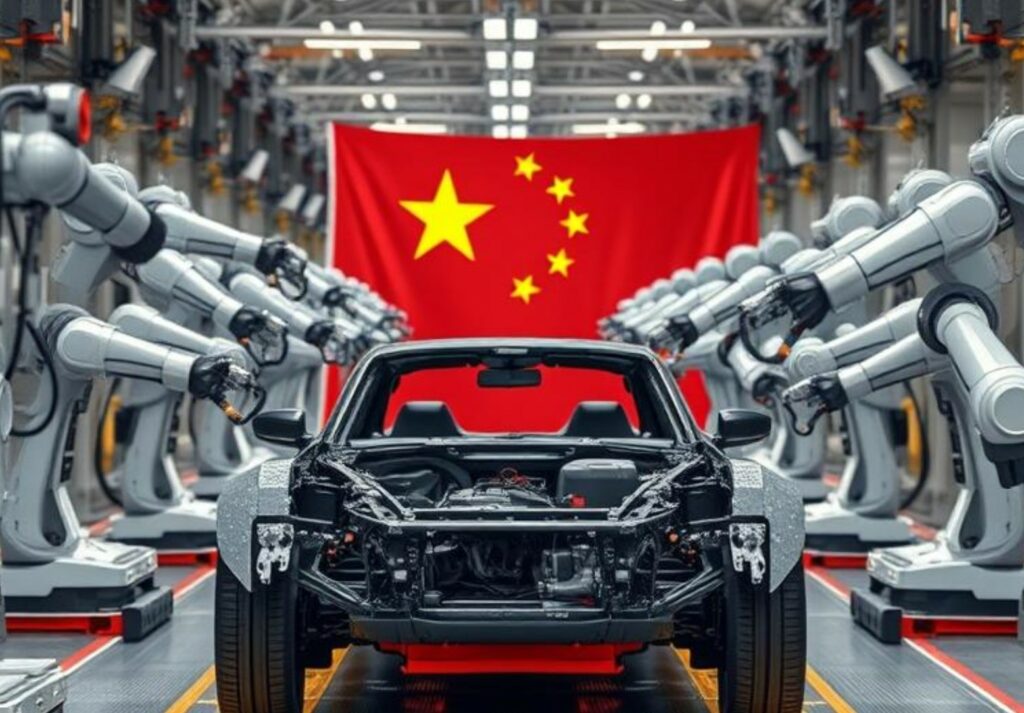
image-87-1024x713.jpg


China is consolidating its position as a global manufacturing powerhouse thanks to an unprecedented pace of production and installation of industrial robots. According to a report by the International Federation of Robotics (IFR) released Thursday, the number of robots operating in Chinese factories will surpass 2 million in 2024 , with nearly 300,000 new installations in just one year —more than the rest of the world combined. The United States , ranked third in terms of robot installations, has only 34,000 units .


Automation is now at the heart of Beijing’s industrial strategy, supported by public funds and government policies aimed at making Chinese companies global leaders not only in robotics, but also in semiconductors and artificial intelligence (AI) .

Over the past decade, a New York Times article reports, China has launched an intense campaign to integrate robotics into manufacturing processes, while developing a domestic industry of robots and advanced technological components. “Chinese companies have been investing in this sector for many years,” explained Su Lianjie , chief analyst at Omdia , emphasizing that the growth is not the result of chance but of long-term planning.

Since 2017 , the country has been consistently installing more than 150,000 industrial robots per year , an expansion that parallels the growth in manufacturing output. Today, Chinese factories produce nearly a third of the world’s goods , surpassing those of the United States, Germany, Japan, South Korea, and the United Kingdom combined.

Behind China, the countries with the highest robot usage are Japan, the United States, South Korea, and Germany . However, the number of new installations in these countries is declining. Japan , for example, installed 44,000 robots in 2024, a decrease from the previous year.

The Chinese government made robotics a priority back in 2015 with the “Made in China 2025” plan, aimed at reducing dependence on imported technology goods. Since then, strategic sectors have benefited from subsidized loans , acquisitions supported by state-owned banks , and direct injections of public capital . In 2021 , Beijing introduced a national robotics strategy , which has further boosted the sector’s growth.

According to the IFR, China’s share of global robot production rose to 33% in 2024 , up from 25% in 2023 , while Japan’s share dropped from 38% to 29% . Furthermore, nearly 60% of robots installed in China now come from local manufacturers, a reversal from previous years, when imports dominated.

Chinese factories now use five times more robots than American ones . At the Zeekr Auto plant in Ningbo , for example, automated trucks transport heavy materials completely autonomously.

The report does not include humanoid robots , which are still in the experimental stage, but government support has already fueled a vibrant network of startups in the sector . Among these, Hangzhou-based Yushu Technology Co., Ltd. has announced plans to go public by the end of the year. Its latest model, priced at 39,900 yuan , is significantly cheaper than products from international companies like Boston Dynamics .

Despite progress, China remains behind in the production of key components for humanoid robots, such as sensors and semiconductors , still dominated by manufacturers from Germany and Japan . “A high-end humanoid robot would still be made almost entirely of foreign parts,” Su Lianjie notes.

China’s strength in the industrial sector remains evident: the country has a large pool of specialized technicians and programmers . However, the demand for robot installers is so high that their average annual salaries have reached 430,000 yuan .

At the same time, the domestic artificial intelligence industry is helping to optimize factory management. According to Cameron Johnson , a supply chain consultant in Shanghai, “Chinese companies are using AI to analyze machine performance and identify inefficiencies in real time.” Outside China, he adds, this approach “is not yet as widespread as it is in Chinese factories.”


China's industrial robot exports surged by 90%​

According to data recently released by the General Administration of Customs, China’s industrial robot exports have shown strong momentum this year. In April alone, exports exceeded 25,000 units, marking a year-on-year increase of nearly 90%, with mobile robots demonstrating significant competitiveness.

According to data recently released by the General Administration of Customs, China’s industrial robot exports have shown strong momentum this year. In April alone, exports exceeded 25,000 units, marking a year-on-year increase of nearly 90%, with mobile robots demonstrating significant competitiveness. Data shows that the share of China’s mobile robot export orders rose rapidly from 25.87% in 2022 to 37.12% in 2024, and has already surpassed 40% in 2025. The competitiveness of Chinese mobile robots stems from capabilities honed in China’s leading e-commerce and logistics ecosystems, and they are now accelerating their transition from exporting standalone products to delivering integrated solutions encompassing technology, systems, and services.
 

China's major industrial firms' profits jump 18.2%

2026-05-27 13:20

Profits at China's major industrial firms maintained robust momentum in the first four months of the year despite mounting external uncertainties, with equipment manufacturing and high-tech sectors posting strong gains, official data showed on Wednesday.

In the first four months, industrial enterprises with annual main business revenue of at least 20 million yuan ($2.95 million) saw their total profits climb 18.2 percent year-on-year to 2.4358 trillion yuan, 2.7 percentage points faster than the growth recorded in the first quarter, data from the National Bureau of Statistics showed.

In April alone, major industrial firms posted a 24.7 percent year-on-year increase in profits, compared with 15.8 percent growth in March, the NBS said.

The strong performance in industrial profits, according to Yu Weining, a statistician with the bureau, was underpinned by more proactive macroeconomic policies.

"With more proactive macroeconomic policies effectively implemented, industrial production kept growing at a relatively rapid pace and industrial product prices continued to recover, thereby driving faster growth in industrial profits," Yu said.

Notably, strong gains in equipment manufacturing and high-tech sectors showed that new growth drivers played a key role in driving the improvement, signaling continued improvement in industrial firms' profitability, Yu said.

NBS data showed that profits in the equipment manufacturing sector grew 15.4 percent year-on-year in the first four months, contributing 5.4 percentage points to overall profit growth among major industrial firms. Meanwhile, profits in high-tech manufacturing jumped 44.8 percent, contributing 7.8 percentage points to overall industrial profit growth.

The raw material manufacturing sector also saw profit growth gather pace. Profits at major firms in the sector surged 88.1 percent year-on-year in the first four months, accelerating by 10.2 percentage points from the first quarter and contributing 10.3 percentage points to overall profit growth.

In the first four months, mining firms posted a 26 percent year-on-year increase in profits, while manufacturing companies recorded 20.4 percent growth. Profits at firms supplying electricity, heat, gas and water declined 1.9 percent, the NBS said.

Despite the strong profit gains, Yu cautioned that the external environment remains volatile, with the domestic imbalance between strong supply and weak demand still prominent and some enterprises continuing to face difficulties in production and operations.

Looking ahead, Yu called for stronger macroeconomic policy support to further expand domestic demand and optimize supply, in order to support the sustained and healthy development of the industrial economy.

 
CHINA ECONOMY

China industrial profits jump 24.7% in April, fastest gain in over two years despite headwinds​

PUBLISHED TUE, MAY 26 20269:51 PM EDT

KEY POINTS
  • Industrial profits hit their fastest growth since late 2023.
  • Electronics and mining sectors drove gains in factory earnings.
  • Weak retail spending and property woes continued to weigh on growth.
HUZHOU, CHINA - MAY 22: Employees work on the production line of automotive display chips at a workshop on May 22, 2026 in Huzhou, Zhejiang Province of China. (Photo by Xie Shangguo/VCG via Getty Images)

Employees work on the production line of automotive display chips at a workshop on May 22, 2026 in Huzhou, Zhejiang Province of China.
Vcg | Visual China Group | Getty Images
BEIJING — China’s industrial profits surged by 24.7% in April from a year earlier, according to official data released Wednesday, despite broader signs of slowing economic momentum.

The increase marked the fastest growth since November 2023, according to financial data provider Wind Information, and accelerated from a 15.8% rise in March.

For the first four months of the year, industrial profits rose 18.2%, up from 15.5% growth in the first quarter. Computing and electronics equipment manufacturing, the largest sector by profit amount, saw earnings more than double from a year ago, although the pace slowed slightly in April from March on a year-to-date basis.

Among the ten largest sectors by profit, the oil and gas extraction industry posted an 8.1% rise in profits in the first four months of the year, reversing a 1.4% decline in the first quarter.

Higher crude prices helped lift profits in the petroleum processing industry to 40.42 billion yuan ($5.96 billion) in the January-April period, nearly double the 22.94 billion yuan recorded as of March.

Profits for automobile manufacturers fell 16.8% in the same period from a year earlier, improving from a 17.7% decline in the first quarter.

Beijing’s efforts to address excessive competition in the automobile and other sectors are starting to bear fruit, EU Chamber of Commerce of China President Jens Eskelund told reporters on Tuesday, citing a survey of members earlier in the year. But he cautioned it would take another year or two to confirm the trend.

A fivefold increase in profits in the mining and related sectors also boosted overall industrial profit growth, while iron smelting and rolling swung to a profit for the year as of April, compared with a loss in the first quarter.

However, profit declines in furniture manufacturing steepened to 54.4% for the first four months of the year, worse than the 44.9% recorded as of March.

“China’s industrial profit growth accelerated sharply in April, driven primarily by rising producer prices amid the global energy shock,” Hao Zhou, head of research and chief economist at Guotai Junan International.

“However, the improvement in profitability appears uneven and potentially fragile. Profit gains are concentrated in upstream and high-tech sectors, while many other industries continue to struggle,” he said in a note.

China reported slower economic growth in April, with a 4.1% increase in industrial output and a 0.2% rise in retail sales from a year ago. Fixed asset investment fell for the first four months of the year as the real estate drag steepened.

Exports remained strong, climbing 14.1% in April from a year ago in U.S. dollar terms. Imports surged by 25.3%, data released earlier in May showed.

The producer price index in April jumped 2.8% from a year ago, the most since July 2022.

 
Modern growth surges. Or, why China's economic development is unique in human history
Adam Tooze
May 28, 2026

To the naked eye it is obvious that China’s spectacular growth surge from the late 1970s onward is the largest single transformation in world economic history. But how best to express and quantify this stark fact?

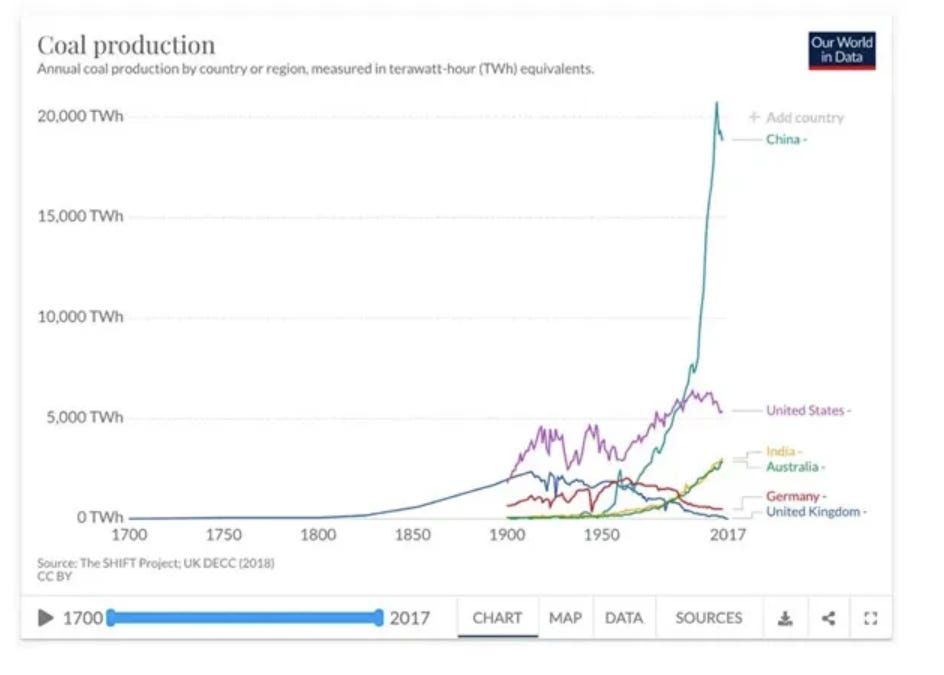
I’ve been spending a lot of time recently with the energy and climate question (Btw apologies for the newsletter slowdown. Normal service will resume in a few weeks time). The history of global coal consumption certainly tells a clear story.

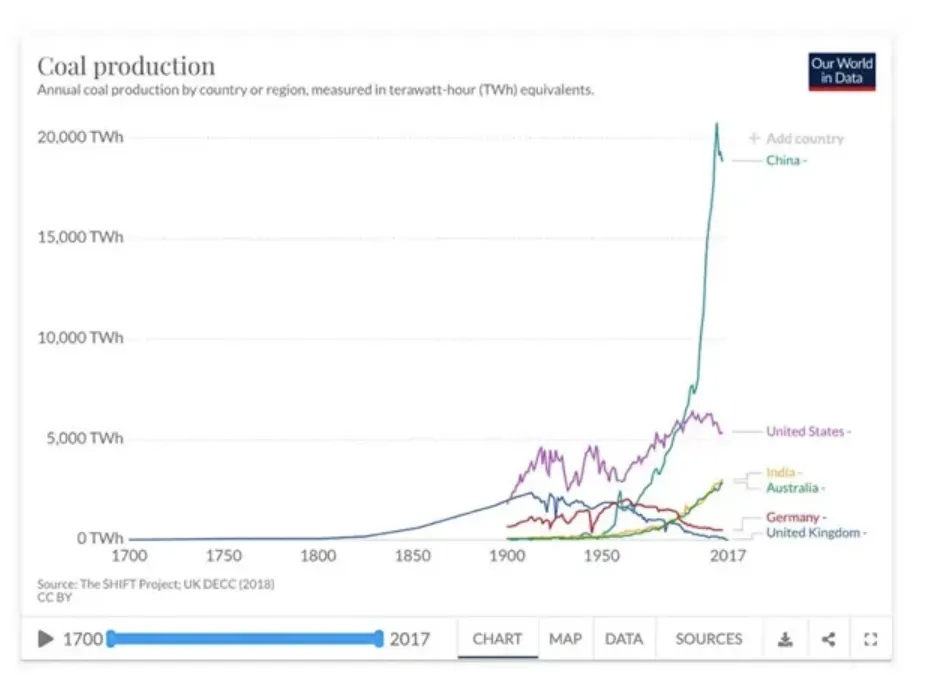
https%3A%2F%2Fsubstack-post-media.s3.amazonaws.com%2Fpublic%2Fimages%2F9649e641-978a-43c0-8638-2433928b1d48_944x696.png


Measured in coal, the history of our species falls into three phases. The first phase ran up to 1750, where the vast majority of human societies relied largely on a somatic, biological energy regime—firewood, human power, animal power. The second period stretched from the 1750s to the end of the 20th century. This was what we used to think of as the classic regime of industrialization, beginning with the industrial revolution of the 18th century and ending with the world as it stood in the 1990s. Over two centuries, heavy industry spread outwards from its origins in 18th century North Western Europe, to North America and Eastern Europe and extending, in the 20th century, to Japan. This was the world that defined the first phase of global climate politics and its North-South politics, the world of the Noordwijk conference of Rio in 1992 and the Kyoto Treaty of 1997. It continues to define the imaginary of much writing about the climate question down to the present day, especially in the United States. On this historical arc, the clean energy transition goes hand in hand with deindustrialization, inspiring talk of a “weightless” economy. But that was, from a global perspective, a local experience. Globally, the opposite is the case. In the 2000s, quite suddenly, China’s coal consumption soared vertically upwards to reach levels never seen before in human history – four times greater than the USA at its peak.

Coal is a physical measure, what about GDP?

Branko Milanović in his The Great Global Transformation (Out right now and highly recommended) offers this intuitive comparison:

China has ‘exploded’: from producing 2 per cent of global output in 1974, its share has risen to 22 per cent in 2022. This was achieved by a prowess unrecorded in world economic history. Between 1978 and 2022, China has grown at an average (compounded) annual rate of 8.1 per cent per capita. Never in history have so many people improved their incomes so much over such a long uninterrupted period. To illustrate that, we can compare China’s rise to the case of Japan. In the Chinese case, we have more than a billion people (the average number of Chinese citizens during the period 1978–2022 was 1.23 billion), growing at 8.1 per cent per annum over forty-four years. A simple calculation (1.081) on the 44th degree multiplied by 1.23 billion gives a total gain of 38 billion (people/income) units. Japan, during its most successful period, 1952–91, produced income growth of approximately 105 million people over thirty-nine years at an average rate of 7.1 per cent per capita per annum. The same calculation gives in turn 1.9 billion people/income units, i.e. one-twentieth of what we obtain for China. Finally, a calculation for the United States over the period of its economic take-off between 1865 and 1914 yields an average annual growth rate of 1.3 per cent per capita for an average population of 63 million, and thus an overall gain of 0.13 billion units. In other words, the gains created during China’s extraordinary rise were of an altogether different order of magnitude compared to those of Japan and the United States during their economic take-offs.
Measured in terms of population-weighted-growth points, China’s growth was 20 times larger than that of boom-time Japan and more than 290 times larger than the growth of gilded age America.

This is a beguilingly simple measure that is, however, strictly relative. I.e. it operates in terms of growth rates not levels of GDP. It is a measure of how many people “moved”, how fast for how long.

What if we, instead, use absolute measures of GDP? To do this we can refer to the Angus Maddison data set of GDP and population. If we take the same periods as Milanović - 1978 to 2022 for China, 1953 to 1991 for Japan and 1865 to 1914 for the US - we can ask: how much did their respective growth add to national GDP?

For the US, over the period 1865 to 1914 total GDP increased by $738 bn at 2011 prices.

Japan’s growth surge between 1953 to 1991 added $3.5 trillion to GDP at 2011 prices.

For China over the period 1978 to 2022 the increase in GDP was $25.3 trillion.

Because China’s GDP in 1978 was so low, in absolute terms the increment to GDP from its growth was “only” 7.2 times larger than that added by Japan and 34 times larger than that of the US during its takeoff phase.

The point stands: the world has never seen anything like China’s growth explosion.

You get a somewhat different judgement, only if you place these inflation-adjusted absolute growth figures in proportion to overall global GDP growth over the relevant periods.

Over the half century from the American civil war to World War I, world GDP increased, according to rough interpolation from the Maddison data set, by something like $2.3 trillion. US growth accounted for about 30 percent of that.

Between the early 1950s and 1990 global GDP increased by $34 trillion at 2011 prices. Japan’s contribution to that surge came to just over ten percent.

What about China and the 21st century?

Over the forty years between 1980 and the early 2020s the increase in global GDP was $100 trillion. If we trust the Maddison data, global GDP more than quadrupled. Of that staggering increase, China accounted for roughly one quarter.

Which brings us back to where we started. Though in relative terms the growth of the US economy in the late 19th century made an outsized contribution to global growth somewhat greater than that China over the last forty years, the rate of growth and the absolute numbers were far lower. The world economy in the late 20th and early 21st century was far bigger and growing faster than in the late 19th century. In scale and velocity there is nothing in recorded economic history to compare with the impact of China’s recent development.


The Double China Shock: How Beijing Is Disrupting Both Developing and Advanced Economies​

China intends to keep making low-tech goods alongside its push into advanced technology. That’s bad news for advanced and developing economies alike.

By Paulína Ovečková
May 29, 2026

Beyond embodied intelligence and fusion energy, China’s 15th Five-Year-Plan contains a segment which may get overlooked: the so-called traditional industries. This code-name represents the low-tech industries which helped China industrialize in the past, including the emblematic Made-in-China textile industry. The fact that traditional industries remain high in the new priorities suggests that China intends to keep making low-tech goods alongside its push into advanced technology.

The question this raises is whether there is still room for other countries. If China competes simultaneously with both advanced and developing economies, is there room left for the rest of the world?

Why China Keeps Making Everything

As countries move up the value chain, they typically move on from relying on labor-intensive industries to more capital-intensive industries. For instance, Britain does not export large quantities of textiles as it once did in the 19th century, having shifted its economy toward knowledge-intensive and consumer-focused service industries, such as finance.

Anyone expecting this transition in China is still waiting. As articulated by Xi Jinping himself, China’s strategy is not to downgrade these industries into the “low-end” bracket or abandon them, but transform and upgrade them so they remain relevant on the global stage. This reflects Beijing’s broader desire to avoid deindustrialization.

Moreover, China aims to upgrade rather than merely retain these industries. Two ministries and three state institutions recently published an action plan to help enterprises accelerate the transformation to the higher end of the value chain, from “Made in China” to “Chinese Brands.”

Although China now has the capital and expertise necessary to grow capital-intensive industries, Beijing is simultaneously continuing labor-intensive manufacturing. A likely explanation is that the scale of China’s economy and uneven development among its provinces allow Beijing to move these industries inland rather than abroad – something no previous industrializing nation could do at comparable scale.

Staying with textiles, China continues to globally dominate in both overall production and exports, accounting for over 35 percent of the global market share, the largest share held among China’s manufacturing sectors. There are not many signs of Beijing’s loss of interest, as the National Bureau of Statistics (NBS) recorded a 4.3 percent year-on-year increase in investment in the textile industry, 5.2 percent in the apparel industry, and 12.3 percent in the chemical fibers. This growth outperformed all other manufacturing sectors.

The End of the Virtuous Cycle

As countries move up the economic ladder, wages increase and labor-intensive manufacturing becomes uncompetitive. The industries eventually migrate to lower-wage countries, where the same process repeats. Over time, as those countries grow wealthier and their costs rise, they move on to more advanced production. In East Asia, this cycle has defined development since the 20th century and has been termed the “flying geese” paradigm. The region’s industrialization has long been led by Japan as the lead goose. As Japan grew rich, its labor-intensive industries migrated first to the Asian Tigers, and later to China and Southeast Asia.

This virtuous cascade of industrialization and development now appears to be over, as China’s light industry overall has been expanding in recent years, and the migration is not happening at the predicted scale. The light industry in China still accounts for a quarter of all exports, remaining the largest export sector. Thus, China’s continued competitiveness in low-tech manufacturing exports is harming established manufacturers in Southeast Asia, not supporting industrialization.

The Financial Times reported that Malaysian and Indonesian labor-intensive manufacturing companies are going out of business because of the strong competition from Chinese exports. In Indonesia’s textile industry, this has led to 250,000 lost jobs since 2021. In the case of the Malaysian plastic industry, even protective trade measures of the Malaysian government did not help the sector from getting into trouble. Southeast Asia is also increasingly dependent on China for both industrial inputs and finished goods like EVs and green tech.

The Two Shocks

It appears that the “first” China shock, which describes the low-cost, low-tech Chinese exports destroying manufacturing in advanced economies (mainly the United States) during the 2000s, continues to shock economies – and just not the advanced ones.

On top of that, both industrializing and advanced economies are now going through the second China shock, which is impacting medium and high-tech manufacturing through China’s advantage and scale of manufacturing. This prevents industrializing economies from upgrading their industrial base and displaces established industries in advanced economies. The result is a Double China Shock – hitting developing and advanced economies alike, from opposite ends of the value chain.

The European Union and ASEAN have been most affected. For Europe, which was less devastated by the first China shock than the U.S. and managed to keep its industrial base, the second one became a “life-or-death moment,” according to French President Emmanuel Macron. The second China shock is impacting mainly Europe’s car industry, but also green industries such as solar and wind energy. EY reported that Germany, Europe’s largest economy and industrial core, has lost 1 in 20 industrial jobs since 2019 – a consequence felt beyond Germany’s borders, as Central and Eastern European economies deeply integrated into German supply chains absorb the knock-on effects.

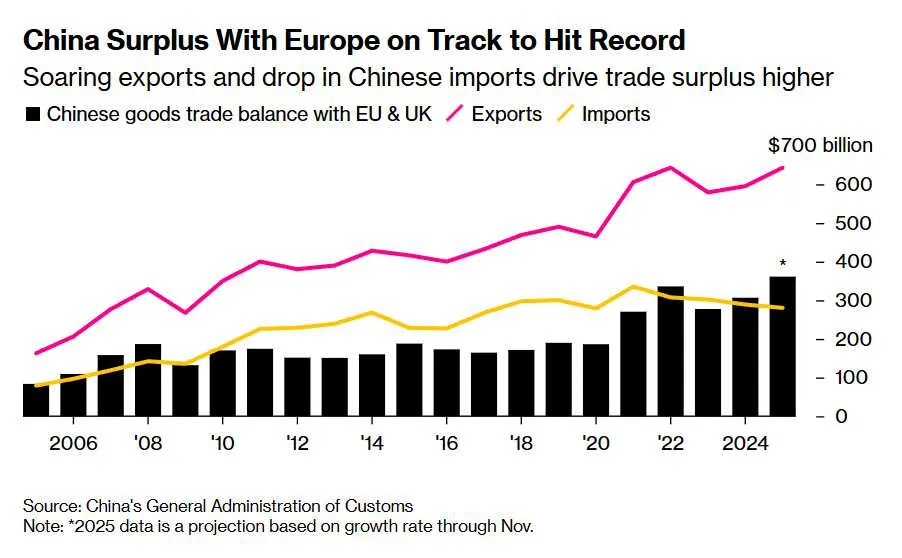
The first issue of this shock lies in China becoming more self-sufficient, meaning it imports less from advanced economies. In Germany’s case, exports to China have dropped by 23 percent since 2022, caused mainly by the 66 percent decrease in car exports in the same period.The second problem is the increasing Chinese competition in third markets, such as Southeast Asia. The final issue is Chinese competition arriving in the home market, where Europe is facing an unprecedented surge in Chinese EV imports. Together, these three pressures leave European industry with few safe markets remaining.

Could Change Come From China?

The pressure could ease if China were to invest in manufacturing abroad and support localization, effectively migrating some of its industries. Chinese outbound foreign direct investment (FDI) has doubled since 2020, and greenfield investment in Europe reached a record in 2025. However, Rhodium Group research showed that counterintuitively, China’s recent FDI expansion does not support industrialization in the countries receiving its investment. Rather than bringing the benefit of localization, the FDI reinforces their dependency on Chinese inputs, technologies, and other high-value activities that Chinese multinationals retain at home.

China’s domestic trajectory could also shift the outlook. Last week, Beijing announced it was relaxing the hukou system, which has long hampered the labor force in less developed provinces. Making it easier for Chinese workers to migrate to higher-wage areas could, over time, push up wages in low-tech industries and erode their competitiveness. Whether this materializes, however, is uncertain, as Beijing is already investing heavily in automation, which could offset rising labor costs and keep low-tech manufacturing competitive regardless.

Shared Problem, Shared Solution: The Case for a Europe-ASEAN Partnership
The very fact that the Double China Shock impacts almost everyone creates unexpected common ground. Europe and Southeast Asia find themselves facing a version of the same problem, and that shared pressure opens space for cooperation neither side has previously prioritized.

First, Europe should understand what the China shock means for Southeast Asian countries. The region has long been a low priority for the EU, which is evident from the low number of free trade agreements between the bloc countries. The Double China Shock creates a political window to accelerate free trade negotiations with impacted ASEAN countries such as Thailand and Malaysia, and open new ones with other potential partners.

But trade agreements alone are not enough. Through direct investment in local manufacturing capacity using European technology, Europe can support a genuinely mutual diversification strategy: ASEAN gains an alternative to Chinese goods and a more stable export destination, while Europe gains diversified supply chains and a new market.

The timing matters. Southeast Asia’s long reliance on the United States as an export destination is becoming increasingly uncertain under the Trump administration’s tariffs – and those same tariffs are redirecting Chinese exports toward ASEAN, compounding the pressure the region already faces. The window will not stay open indefinitely. Recognizing that Europe and Southeast Asia are facing different expressions of the same shock is the first step toward turning a shared problem into a shared strategy.
 

Even Non-Chinese Trade Depends on China | The Reason Why​

  • Swapnil Karkare
  • Economy
  • May 28, 2026 19:28 pm IS
Even Non-Chinese Trade Depends on China | The Reason Why

China dominates steel production, the main shipbuilding material, giving it cost and delivery advantages.

When the world talks about China's dominance in manufacturing, the discussion is around rare earths, pharmaceuticals, chemicals, EVs, and solar panels. But there is a deeper and more intricate layer beneath this: logistics.

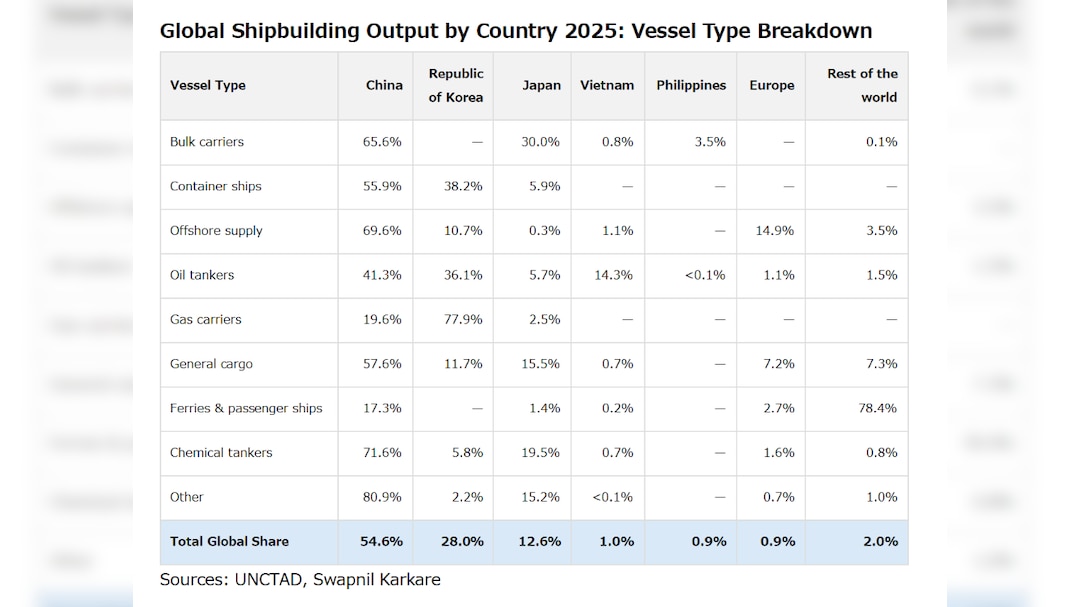
China realised early that being the world's factory means nothing if it cannot control the movement of its goods. Over the past two decades, it has built an extraordinary ecosystem of shipbuilding, ports, containers and tankers. Today, it produces more than half of all the global vessels.

lvtnl2ng_global-vessels_625x300_28_May_26.png


How China Built This Empire

At the turn of the century, China built under 10% of the world's ships. It used production, investment, and entry subsidies to expand capacity and overtake Japan and South Korea. Slowly, its share rose by 40%, largely at rivals' expense, thanks to CNY 624 billion spent between 2006 and 2013.

However, these policies helped global trade and consumers more than the Chinese state. Freight rates fell, and goods moved faster, while Chinese firms got 18 cents out of every dollar they spent.

The most important aspect of this journey was China's vertical integration and almost self-sufficiency, something other countries envy. China dominates steel production, the main shipbuilding material, giving it cost and delivery advantages.

Over time, the quality of the vessels improved, workers became more skilled, and the processes became more efficient, attracting orders from all over the world. In 2019, it also delivered the world's first smart very large crude carrier (VLCC).

The New Industrial Philosophy

Vertical integration in China is not new. BYD, the Chinese EV maker that overtook Tesla, illustrates it. A 2023 UBS analysis found that in one of BYD's popular models, 75% of the components are made in-house.

As Covid disrupted global supply chains, transporting those vehicles became more expensive and tedious. For instance, daily charter rates for a 6,500-unit car carrier jumped from around $10,000 in 2020 to nearly $110,000 by 2023. So in 2022, the company took a major strategic decision: build its own shipping fleet. Today, BYD processes lithium, makes batteries and chips, fits them into the car's body, and even exports them through its own fleet. That's complete control over the entire supply chain from raw materials to exports.

In May 2023, China's Ministry of Commerce urged carmakers and shippers to cooperate and deploy more car carriers to expand export capacity. In September last year, eight ministries unveiled a national plan to support the auto industry. They encouraged cross-shareholding and joint ventures between carmakers and shipping firms to secure long-term stability. However, not many deals have been made public as of today.

In short, China's EV giants are no longer just manufacturing cars. They are also trying to control the transportation. And even the government is trying to help them achieve it.

Hormuz Crisis Has Strengthened China's Position

As tensions escalated around the Gulf region, many Western shipping companies rerouted their vessels via the Cape of Good Hope. That added 10-20 extra days, more fuel, thousands of nautical miles and 30-50% higher freight costs. However, Chinese vessels navigated the sensitive Gulf region without much risk.

This situation exposes two important advantages for China.

First, longer journeys reduced global fleet capacity, driving demand for new vessels and pushing shipbuilding orders to a 17-year high. While China and South Korea dominate the industry, China secured over 90% of new VLCC

orders this year. Chinese yards can deliver large orders, sometimes ahead of schedule, while South Korean yards are booked until 2028.

China's integrated domestic supply chain gives it an edge over import-dependent Korea. As a result, shipowners that once relied on South Korean yards are shifting towards China.

Second, China's geopolitical position helped it operate through this region. As the largest buyer of Iranian crude, it faces less risk from Iran, and other regional actors do not view Chinese vessels as hostile. That gives China a commercial edge. While Western carriers reroute, Chinese fleets can keep moving through the same cheap route.

Final Take

China leads global shipbuilding in volume, while South Korea dominates high-value vessels such as LNG carriers and ultra-large container ships. But Korea faces labour shortages and long delivery backlogs. Japan remains confined to shrinking niche segments, while the US and India are trying to expand shipbuilding but continue to struggle with high costs, weak infrastructure, import dependence and skilled labour shortages.

Right now, there is no real alternative to China in maritime transport. Even if the world moves away from Chinese goods, it will still need Chinese ships, tankers and containers to move non-Chinese goods around the world.


China vs. America: Who the World Trades With Most

May 15, 2026

Trade-Partners_US-vs-China_02-web.webp


Key Takeaways​

  • In 2000, only 33 countries traded more with China than with the United States.
  • By 2025, China had become the top goods trading partner for most countries worldwide.
  • Only a handful of African countries still trade more with the U.S. than China.
Twenty-five years ago, the United States was the world’s dominant trading power. Today, China has overtaken America as the top goods trading partner for most countries globally.

This map compares whether countries traded more with the U.S. or China in 2000 and 2025, based on total bilateral imports and exports using International Monetary Fund Direction of Trade Statistics data.

China’s rise was fueled by its emergence as the world’s manufacturing hub and surging demand for commodities like oil, copper, iron ore, and soybeans.

When America Dominated Global Trade​

The United States entered the 21st century on a high note. Following the end of the Cold War, liberal democracy and open markets were expanding across the former Soviet bloc, while global trade centered primarily around the U.S. consumer market.

In 2000, only 33 countries traded more with China than the United States. Many of these countries were Chinese neighbors like Kazakhstan, Mongolia, Myanmar, and Vietnam. Others were states with strained or no relations with Washington, including Cuba, Iran, Libya, and North Korea.

Everything began to shift during the 2000s as China opened further to the world economy, highlighted by the country’s 2001 accession to the World Trade Organization. Alongside domestic economic reforms, WTO membership accelerated China’s rise as a global manufacturing powerhouse.

Over the years that followed, China became the top trading partner of major emerging markets including Brazil and Russia. Its cheaper manufacturing boosted exports worldwide, while its growing demand for key commodities fueled growth across developing economies.

Commodities Boom and Manufacturing Powerhouse​

The commodities boom of the 2000s and early 2010s helped solidify China’s central role in the global economy. By 2012, it had become the world’s second-largest economy while lifting many of its trading partners’ fortunes along the way.

Soaring Chinese demand for commodities like iron ore, soybeans, copper, and oil benefited many countries across the Global South that were rich in natural resources. Brazil, Iran, Nigeria, and Russia were among the many developing economies to benefit from rising commodity prices.

At the same time, Chinese manufacturing became the lower-cost alternative for firms across North America, Western Europe, and East Asia. Factories increasingly offshored production to China, while consumers benefited from cheaper goods.

China’s Global Trade Expansion​

By 2025, China had become the dominant trade partner across much of Asia, Africa, South America, and the Middle East. All of South America’s major economies except Colombia and Venezuela now trade more with Beijing than Washington, while only two African countries, Lesotho and Eswatini, still trade more with the United States.

The U.S. maintains a dominant position across much of North America, but Israel is the only major economy in the Middle East or Indo-Pacific that still trades more with Washington than Beijing.

Meanwhile, Europe remains split down the middle. France, Germany, Italy, and the United Kingdom still trade more with the U.S., while countries including Poland and Spain have deepened their trade ties with China.
 
In global trade, China's strength is on exporting, US' strength is on importing.
 
Traveling to China is no fun becoz all the sites you're accustomed to in the West (SDF etc.) are all blocked. Meaning, you're bored stiff when u back in ur hotel room.

China should use some measures to facilitate foreigners to bypass their firewalls. For example, if you installed Opera on your phone from an IP address outside of China, they should still allow you to continue to use its VPN when u travel to China. How else to boost the tourism industry?

Anyways, not all is lost. I was stuck without access to my favorite sites for 2 days. All the VPNs I tried to download from Huawei App gallery all failed to run becoz of CCP censorship. Then I downloaded Proton VPN APK directly to my phone. Now all is good. I can even access some illegal torrent sites used mostly by Chinese citizens to download Chinese donghuas and dramas. Not sure about the download speed though. I hope the CCP didn't ban the torrent trackers IPs used by those torrent files so I can download them with the VPN turned off... Getting those torrent files in the first place was half the battle won!

So, any of u is planning to travel to China, don't fret. I installed Proton VPN after all else failed and I was already in China before I even knew about Proton VPN!
 

Why China’s services trade matters for global imbalances

May 29, 2026
large_z1REUJX_-PLsokSv90RUN7pqyb9yuSumxc2DE16-fUY.jpg

As services become an increasingly important driver of China’s external position, the challenge of sustaining a balanced global economy will intensify.

  • China’s services trade deficit is set to narrow in the coming years, driven by growing services exports and peaking imports.
  • A narrower services deficit will make China’s current account surplus more persistent; resolving these persistent global trade imbalances ultimately requires stronger domestic demand and meaningful RMB appreciation.
  • How promising ideas become scalable impact is a key focus at the World Economic Forum’s Annual Meeting of the New Champions, also known as Summer Davos, in China from 23–25 June.
Debates over global imbalances have focused overwhelmingly on trade in goods. This emphasis is understandable in China’s case, given its position as the world’s largest manufacturing surplus economy. Yet this focus risks missing a quieter but increasingly consequential shift unfolding in services trade.
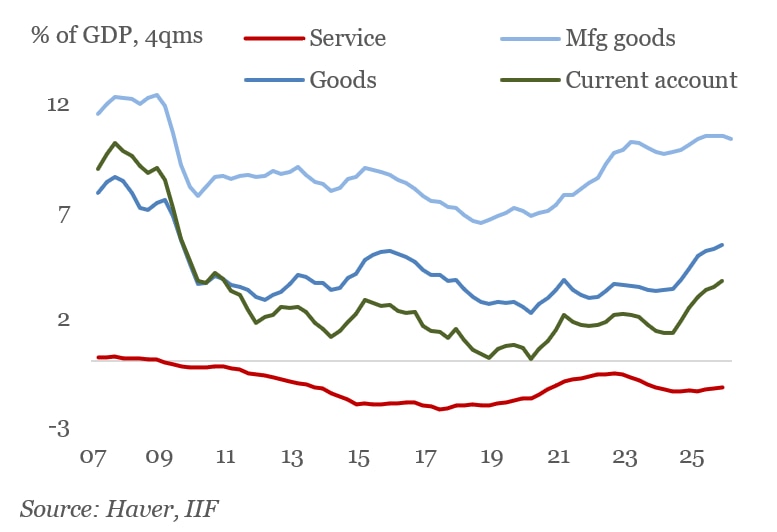
For decades, China’s large goods surplus has been partially offset by a significant services deficit, both the largest globally. Absent this services gap, estimated at 1.2% of GDP, China’s current account surplus could have approached 5% of GDP last year. This long-standing deficit, once a natural counterweight, is now set to narrow.
The implications are profound for both China’s macroeconomic rebalancing and the global trade landscape.
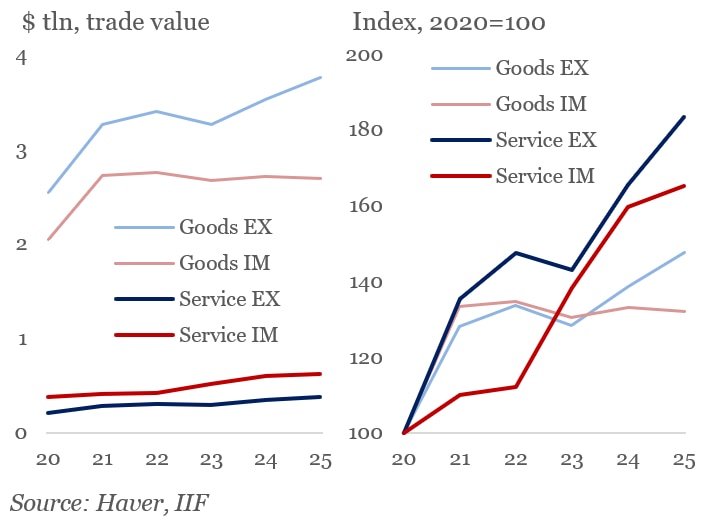
China’s services deficit offsets goods surplus (2007-2025)

China’s services deficit offsets goods surplus (2007-2025)
Goods trade still dwarfs services. Goods exports and imports are roughly ten and four times their services counterparts.
Yet the services trade is growing faster. Between 2021 and 2025, services exports rose by 83% and imports by 65%, far outpacing goods trade growth of 48% and 32%, respectively. As services exports continue to outperform imports, the narrowing deficit will make China’s external surplus more persistent, absent policy or exchange rate adjustment.
China’s relatively small but fast-growing services trades (2020-2025)

China’s relatively small but fast-growing services trades (2020-2025)

Why China’s outbound travel deficit is nearing a peak

Travel has long been the largest component of China’s services deficit. At $254 billion last year, it exceeded all other categories by a wide margin. Several forces now point to moderation. Overseas tuition payments are likely to peak as job prospects for graduates weaken both abroad and domestically. At the same time, diaspora spending is sensitive to exchange rate expectations. A less bearish RMB outlook should curb such outflows. Meanwhile, outbound tourism will continue to recover, but likely at a slower pace, constrained by weaker income growth and wealth accumulation.
At the same time, inbound tourism is rebounding strongly. China has expanded visa-free access to 75 countries, including most advanced economies except the US. Inbound visits have already surpassed pre-pandemic levels, reaching 155 million last year. Taken together, these trends suggest that while the travel deficit remains large, it is likely to peak.

How domestic logistics are shrinking China’s transport deficit

A similar, though less pronounced, shift is underway in transportation services. Historically, China’s vast merchandise trade did not translate into comparable transport revenues, as foreign carriers dominated global logistics.
This began to change during the pandemic, when supply disruptions boosted demand for Chinese carriers. Since then, China’s position across the maritime supply chain has strengthened: it produces roughly 90% of global containers and over half of ships, and owns more than 14% of global fleet capacity. As a result, transport exports have risen sharply, while imports have remained broadly stable. The deficit — estimated at $40 billion last year — is narrowing and likely to decline further. The expansion of cross-border e-commerce and the growing role of Chinese logistics providers reinforce this trend. What was once imported is increasingly supplied domestically.

Can China monetize innovation despite foreign IP constraints?

Intellectual property presents a more complex picture. China continues to run a sizable deficit, reflecting dependence on foreign technology.
However, this deficit is being reshaped by two opposing forces. On the one hand, export controls and investment screening by advanced economies are limiting access to cutting-edge technologies in sectors such as semiconductors and biotechnology. On the other hand, China is increasingly monetizing its own innovation. Patent licensing — especially in telecom, mobility and pharmaceuticals — has expanded rapidly, with outbound pharmaceutical licensing deals alone reaching $134 billion last year.

Driving the ICT surplus: The rise of Chinese digital services

Digital services are emerging as a key source of strength. China’s ICT services surplus has widened steadily, reaching $32 billion last year. This reflects both domestic policy and external demand. Data localization and regulatory barriers have constrained imports, while exports have been driven by cloud computing, data processing, digital content and services tied to cross-border e-commerce.
Yet important constraints remain. China’s digital services exports are still only about 40% of India’s. Moreover, geopolitical tensions — particularly concerns over data security — pose growing challenges. China’s efforts to join the Digital Economy Partnership Agreement highlight both its ambitions and the regulatory hurdles it faces.

How outbound corporate investment expands China’s business services

Business services, including R&D, consulting, legal, design and engineering, are also growing rapidly. This reflects China’s expanding global corporate footprint. As Chinese firms invest, operate and license technology abroad, they generate both demand for and supply of such services. In some cases, technology exports are themselves recorded as services, particularly when structured as R&D contracts rather than outright sales. This further boosts the measured expansion of services exports.

Why tariffs fail to fix global imbalances: The case for RMB appreciation​

Taken together, these developments point to a clear trend: China is capturing a growing share of the services embedded in global trade — across logistics, digital platforms and technology licensing — while reducing reliance on external providers. The result is a narrowing services deficit and a more entrenched current account surplus.
This shift has important policy implications. Much of the debate in the United States and Europe has focused on tariffs and trade restrictions. Yet tariffs primarily reduce bilateral goods exports from other countries. They do little to affect others’ imports, services trades, or the overall external imbalance.
Sustainable adjustment must therefore come from other channels. A durable rebalancing of China’s external position will require stronger domestic demand and, critically, a stronger currency. RMB appreciation would curb exports while boosting imports, affecting both goods and services trade.
Global imbalances are not static; they evolve with economic structure. In China’s case, the shift from goods to services is altering the mechanics of external adjustment. Focusing solely on manufacturing risks overlooking a deep transformation underway.
As services become an increasingly important driver of China’s external position, the challenge of sustaining a balanced global economy will intensify. Understanding this shift is essential for policy-makers — and for anyone seeking to grasp the next phase of global trade dynamics.


China Expands Global Lithium Dominance

As Africa emerges as a new hub for battery mineral production, China will consolidate its dominance in global lithium.
By José López on May 29, 2026

Las empresas australianas conservarían alrededor del 21% de la propiedad global del litio

Wood Mackenzie revealed in a new analysis that Chinese companies could control 39% of all global lithium extraction by 2030, further strengthening their influence over global supply chains for strategic battery minerals and the energy transition.

The report, prepared with data from the Lens Metals & Mining platform, shows a growing divergence between the countries where lithium is produced and the companies that own the mining assets.

The research particularly highlights Africa’s rapid growth as a new lithium-producing region, driven by foreign investments aimed at supplying tactical minerals.

Africa Emerges as a New Lithium Hub​

According to Wood Mackenzie’s projections, Africa’s share of global lithium extraction will increase from virtually zero in 2020 to approximately 13% by 2030, becoming one of the largest structural shifts within the global market for critical minerals.

Regional growth is primarily driven by hard-rock projects developed in countries such as Ghana and Mali. However, the analysis warns that despite the increase in production, African companies would control barely 1% of global lithium production by the end of the decade.

Allan Pedersen explained that African mining expansion is almost entirely financed by Chinese capital, a situation that raises questions about value capture, industrial autonomy, and strategic control of future supply chains.

Chinese Companies Strengthen Global Presence​

The report emphasizes that China has extended its influence far beyond its domestic production through acquisitions and stakes in international mining projects.

Notable operations include Huayou Cobalt’s proposed acquisition of Atlantic Lithium, as well as significant investments in the Ewoyaa project in Ghana and strategic assets in Australia and Mali.

Wood Mackenzie also recalled previous agreements such as Tianqi Lithium’s stake in the Greenbushes mine in Western Australia and Hainan Mining’s investment in the Bougouni project developed by Kodal Mining in Mali.

Australia and South America Lose Market Share​

Australia, historically a global leader in lithium extraction, accounted for approximately 43% of global production in 2020.

South America also faces increasing competitive pressure. Although countries in the so-called “Lithium Triangle” continue to attract investment, the report notes that brine-based production presents greater technical challenges and slower development times compared to hard-rock projects.

Meanwhile, Australian companies would retain approximately 21% of global lithium ownership thanks to their domestic assets and international stakes.

Lithium Becomes a Geopolitical Challenge​

The report reflects how lithium has become one of the most strategic resources for the global energy economy and the transition to low-carbon technologies.

As governments and manufacturers accelerate the electrification of transport and the deployment of energy storage, securing access to strategic minerals has become an industrial and geopolitical priority for multiple countries.

The increasing concentration of ownership around Chinese companies raises concerns in various Western economies, particularly regarding the potential impact on energy security, supply chains, and technological competitiveness in the coming decades.


Most Chinese provinces reach high level of human development: report​

Xinhua | Updated: 2026-05-30 22:00

BEIJING -- A report jointly released by the United Nations Development Programme (UNDP) and Tsinghua University on Friday found that most Chinese provinces have reached a high level of human development, while the number of prefecture-level cities attaining high or very high levels of human development has increased significantly.

The report, titled Monitoring China's Human Development: Assessing Economic and Social Progress, as well as Environmental Costs, across Chinese Regions and Cities, was jointly produced by the China Institute for Development Planning at Tsinghua University, the Institute for Circular Economy at Tsinghua University, and UNDP.

The report found that economic growth and improvements in education have been the main drivers of China's human development progress over the past decade.

Yang Yongheng, dean of the China Institute for Development Planning at Tsinghua University, said the report is the latest result of cooperation between Tsinghua University and UNDP in the field of human development, following the release of the China Human Development Report Special Edition in 2019.

Violante di Canossa, head of strategic partnerships and policy at UNDP China, said the study reflects a broader global discussion on the future of development, noting that human development and environmental sustainability can no longer be viewed in isolation, as the two are deeply connected.

According to the research team, the report makes three main contributions. It extends Human Development Index measurement to the prefecture level, offering a more detailed picture of China's human development landscape. It also calculates the Planetary Pressure-Adjusted Human Development Index at the provincial level in China for the first time, taking into account carbon emissions and material footprint. In addition, it provides a systematic, multi-scale assessment of human development at the national, provincial and prefecture levels over the past decade.

 
Traveling to China is no fun becoz all the sites you're accustomed to in the West (SDF etc.) are all blocked. Meaning, you're bored stiff when u back in ur hotel room.

China should use some measures to facilitate foreigners to bypass their firewalls. For example, if you installed Opera on your phone from an IP address outside of China, they should still allow you to continue to use its VPN when u travel to China. How else to boost the tourism industry?

Anyways, not all is lost. I was stuck without access to my favorite sites for 2 days. All the VPNs I tried to download from Huawei App gallery all failed to run becoz of CCP censorship. Then I downloaded Proton VPN APK directly to my phone. Now all is good. I can even access some illegal torrent sites used mostly by Chinese citizens to download Chinese donghuas and dramas. Not sure about the download speed though. I hope the CCP didn't ban the torrent trackers IPs used by those torrent files so I can download them with the VPN turned off... Getting those torrent files in the first place was half the battle won!

So, any of u is planning to travel to China, don't fret. I installed Proton VPN after all else failed and I was already in China before I even knew about Proton VPN!
ninja vpn is good too. Alot of branded hotels will offer free vpn for foreigners. The great firewall is meant for IT illiterate people so the West cannot spread mass propaganda. Educated people in China access VPN all the time and can make their own informed judgement on propaganda from the West.
 

Users who are viewing this thread

Latest Posts

Back
Top