Evaluation of Pakistan's Barter Trade Agreements with Iran, Afghanistan and Russia
Background and Launch
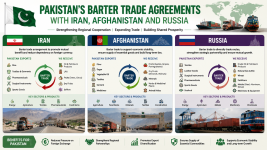
Pakistan's Barter Trade Mechanism was formally launched on June 1, 2023, designed to facilitate non-cash trade with neighbouring countries — primarily Iran, Afghanistan, and Russia — at a time when Pakistan was facing severe foreign exchange shortages, rapid rupee devaluation, and depleting reserves. The stated aim of the barter trade system was to stabilise Pakistan's economy by increasing foreign reserves and keeping trade flowing without spending scarce dollars.
Pakistan and Russia also signed a first-ever MoU on barter trade during an inaugural Pakistan-Russia Trade and Investment Forum in Moscow, where a delegation of over 60 Pakistani companies participated alongside over 100 Russian firms. This signalled serious political will on both sides to make the arrangement work.
Progress Made — The Positives
With Russia, some concrete barter transactions did materialise. Russian firm Astarta-Agrotrading agreed to export 20,000 tonnes of chickpeas, with Pakistan reciprocating by sending 20,000 tonnes of rice, alongside a parallel deal involving chickpeas and lentils exchanged for mandarins and potatoes from Pakistan. These early deals demonstrated that the framework could work at a practical level when both parties had complementary surpluses.
Trade with Russia also grew significantly in the broader context. The volume of Pakistan-Russia trade rose more than 100 percent to $1.81 billion from July 2023 to June 2024, when Pakistan was facing dollar shortages and imported discounted crude oil from Russia, marking a shift from its traditional reliance on Middle Eastern suppliers.
On the regulatory side, Pakistan showed willingness to improve the framework. Pakistan's Economic Coordination Committee approved amendments to the barter trade mechanism with Afghanistan, Iran, and Russia in October 2025, aimed at facilitating direct business-to-business exchanges.
Implementation Failures and Obstacles
Despite the promising start, actual barter trade volumes remained disappointingly low. Since the introduction of the B2B Barter Trade Mechanism in June 2023, a number of serious problems emerged in implementation. Business groups pointed out difficulties including restrictions on sanctioned products, a very limited list of items allowed for import and export, the requirement of having contracts certified by Pakistan's missions abroad, the condition of completing imports before exports could take place, and the obligation to settle accounts within ninety days — all of which slowed trade and created serious obstacles for businesses.
With Afghanistan, the situation deteriorated sharply. Pakistan's exports to Afghanistan fell to $219.5 million in July-December 2025 from $505.8 million in the same period a year earlier — a drop of more than 56% — due to prolonged border closures on the Afghan side and reduced momentum in Central Asian markets.
Pakistan-Russia trade also declined after the initial oil-driven peak. The two countries traded goods and services worth only $236 million from July 2024 to May 2025, compared with $1.04 billion in the same period the previous year — a massive contraction once dollar-denominated oil trade normalised.
Reforms Introduced in 2025
Recognising these failures, Pakistan revised its framework significantly. The earlier requirement for exporters to complete exports before initiating imports was removed, allowing simultaneous import and export transactions. Private companies were permitted to form consortia to facilitate trade, and the time limit for completing barter transactions was extended from 90 to 120 days. The ministry also abolished the restrictive list of specific tradable items and aligned the updated framework with Pakistan's general export and import policy orders.
How the Barter Framework Can Be Improved
Despite these reforms, significant gaps remain. The following improvements are essential for meaningful progress:
Establish a Bilateral Clearing House. A joint clearing mechanism between State Bank of Pakistan and counterpart institutions in Iran, Russia, and Afghanistan is needed to track running trade balances, calculate values using international benchmark prices, and carry forward credit rather than requiring transaction-by-transaction settlement.
Anchor Exchange Rates to International Benchmarks. All barter valuations must be tied to transparent international prices in the International Trading Exchanges — CBOT for agricultural commodities, LME for metals, Platts for energy — updated monthly and agreed in advance between both governments, removing room for arbitrary pricing disputes.
Resolve the Sanctions Problem Systematically. Iran and Russia both face international sanctions that make Pakistani banks and businesses nervous. Self-undertakings by private entities, as recently introduced, are insufficient. Pakistan needs a government-to-government legal framework that clearly defines permitted trade categories and protects Pakistani businesses from secondary sanctions risk.
Expand Beyond Agriculture. Current barter deals are concentrated in food commodities. Pakistan should push to include textiles, surgical instruments, pharmaceuticals, and engineering goods — sectors where Pakistan has genuine export strength — in exchange for Russian fertilizers, machinery, and energy, and Iranian petrochemicals and gas.
Fix the Afghanistan Border Problem. Barter trade with Afghanistan cannot grow while Torkham and Chaman borders face recurring closures and security disruptions. A dedicated secure trade corridor with guaranteed access for barter-designated cargo is essential.
Pilot a "Barter Corridor" with Iran and Afghanistan
Given the high informal trade volume with Iran, Pakistan should select one border crossing, as a pilot project for the formal barter mechanism. This would involve:
Deploying dedicated customs officials trained specifically in the new barter SRO.
Launching a targeted information campaign for local traders, explaining the benefits of using the formal channel (e.g., legal protection, official trade credit).
Aiming to convert a portion of the existing informal, undocumented barter into formal, recorded barter trade, which would boost official export figures and provide valuable data for policy refinement.
Conclusion
Pakistan's barter trade initiative with Iran, Afghanistan, and Russia was conceptually sound and politically courageous but has been poorly implemented in practice. Regulatory bottlenecks, sanctions anxiety, border instability, and the absence of a proper clearing mechanism kept actual volumes far below potential. The October 2025 reforms addressed some procedural hurdles but left the deeper structural problems unsolved.
Background and Launch
Pakistan's Barter Trade Mechanism was formally launched on June 1, 2023, designed to facilitate non-cash trade with neighbouring countries — primarily Iran, Afghanistan, and Russia — at a time when Pakistan was facing severe foreign exchange shortages, rapid rupee devaluation, and depleting reserves. The stated aim of the barter trade system was to stabilise Pakistan's economy by increasing foreign reserves and keeping trade flowing without spending scarce dollars.
Pakistan and Russia also signed a first-ever MoU on barter trade during an inaugural Pakistan-Russia Trade and Investment Forum in Moscow, where a delegation of over 60 Pakistani companies participated alongside over 100 Russian firms. This signalled serious political will on both sides to make the arrangement work.
Progress Made — The Positives
With Russia, some concrete barter transactions did materialise. Russian firm Astarta-Agrotrading agreed to export 20,000 tonnes of chickpeas, with Pakistan reciprocating by sending 20,000 tonnes of rice, alongside a parallel deal involving chickpeas and lentils exchanged for mandarins and potatoes from Pakistan. These early deals demonstrated that the framework could work at a practical level when both parties had complementary surpluses.
Trade with Russia also grew significantly in the broader context. The volume of Pakistan-Russia trade rose more than 100 percent to $1.81 billion from July 2023 to June 2024, when Pakistan was facing dollar shortages and imported discounted crude oil from Russia, marking a shift from its traditional reliance on Middle Eastern suppliers.
On the regulatory side, Pakistan showed willingness to improve the framework. Pakistan's Economic Coordination Committee approved amendments to the barter trade mechanism with Afghanistan, Iran, and Russia in October 2025, aimed at facilitating direct business-to-business exchanges.
Implementation Failures and Obstacles
Despite the promising start, actual barter trade volumes remained disappointingly low. Since the introduction of the B2B Barter Trade Mechanism in June 2023, a number of serious problems emerged in implementation. Business groups pointed out difficulties including restrictions on sanctioned products, a very limited list of items allowed for import and export, the requirement of having contracts certified by Pakistan's missions abroad, the condition of completing imports before exports could take place, and the obligation to settle accounts within ninety days — all of which slowed trade and created serious obstacles for businesses.
With Afghanistan, the situation deteriorated sharply. Pakistan's exports to Afghanistan fell to $219.5 million in July-December 2025 from $505.8 million in the same period a year earlier — a drop of more than 56% — due to prolonged border closures on the Afghan side and reduced momentum in Central Asian markets.
Pakistan-Russia trade also declined after the initial oil-driven peak. The two countries traded goods and services worth only $236 million from July 2024 to May 2025, compared with $1.04 billion in the same period the previous year — a massive contraction once dollar-denominated oil trade normalised.
Reforms Introduced in 2025
Recognising these failures, Pakistan revised its framework significantly. The earlier requirement for exporters to complete exports before initiating imports was removed, allowing simultaneous import and export transactions. Private companies were permitted to form consortia to facilitate trade, and the time limit for completing barter transactions was extended from 90 to 120 days. The ministry also abolished the restrictive list of specific tradable items and aligned the updated framework with Pakistan's general export and import policy orders.
How the Barter Framework Can Be Improved
Despite these reforms, significant gaps remain. The following improvements are essential for meaningful progress:
Establish a Bilateral Clearing House. A joint clearing mechanism between State Bank of Pakistan and counterpart institutions in Iran, Russia, and Afghanistan is needed to track running trade balances, calculate values using international benchmark prices, and carry forward credit rather than requiring transaction-by-transaction settlement.
Anchor Exchange Rates to International Benchmarks. All barter valuations must be tied to transparent international prices in the International Trading Exchanges — CBOT for agricultural commodities, LME for metals, Platts for energy — updated monthly and agreed in advance between both governments, removing room for arbitrary pricing disputes.
Resolve the Sanctions Problem Systematically. Iran and Russia both face international sanctions that make Pakistani banks and businesses nervous. Self-undertakings by private entities, as recently introduced, are insufficient. Pakistan needs a government-to-government legal framework that clearly defines permitted trade categories and protects Pakistani businesses from secondary sanctions risk.
Expand Beyond Agriculture. Current barter deals are concentrated in food commodities. Pakistan should push to include textiles, surgical instruments, pharmaceuticals, and engineering goods — sectors where Pakistan has genuine export strength — in exchange for Russian fertilizers, machinery, and energy, and Iranian petrochemicals and gas.
Fix the Afghanistan Border Problem. Barter trade with Afghanistan cannot grow while Torkham and Chaman borders face recurring closures and security disruptions. A dedicated secure trade corridor with guaranteed access for barter-designated cargo is essential.
Pilot a "Barter Corridor" with Iran and Afghanistan
Given the high informal trade volume with Iran, Pakistan should select one border crossing, as a pilot project for the formal barter mechanism. This would involve:
Deploying dedicated customs officials trained specifically in the new barter SRO.
Launching a targeted information campaign for local traders, explaining the benefits of using the formal channel (e.g., legal protection, official trade credit).
Aiming to convert a portion of the existing informal, undocumented barter into formal, recorded barter trade, which would boost official export figures and provide valuable data for policy refinement.
Conclusion
Pakistan's barter trade initiative with Iran, Afghanistan, and Russia was conceptually sound and politically courageous but has been poorly implemented in practice. Regulatory bottlenecks, sanctions anxiety, border instability, and the absence of a proper clearing mechanism kept actual volumes far below potential. The October 2025 reforms addressed some procedural hurdles but left the deeper structural problems unsolved.
Last edited:


