JF-17 - Updates, News & Discussion

I think there should be one standard block for JF-17s which is block lll. PAF doesn't have the financial capability to upgrade aircraft like the US does. They may have the capability but without the money it's a waste of time and effort. Hst block ll can be upgraded to block lll which would mean a 100 block lll aircraft.
Priority is being given to induct additional J-10CE aircraft.
View attachment 200155
Possible J-10CE seen in China. No Serial No.
Isn't this the one that was spotted over that cattle Mandi a few weeks back?

To view this content we will need your consent to set third party cookies.
For more detailed information, see our cookies page.
 
Sorry my friend, but why posting this again? We had loooooooooooong discussions about it a few weeks ago with the clear conclusion these are NOT new aircraft NOR a new delivery and even lesser a new unit!

Do you really want to start this mess all over again??
My bad
 
PAF and PAC don't agree with your comments even a bit. As mentioned with absolute clarity by PAF Spokesperson that Pakistan will be adding additional "upgraded JF-17s" along with J-10CE. There's no more discussion needed for potential exhausted or lifespan nearing its end. We kept Mirages for over 60 years. We added F-7 PGs not very long ago in 2002. We added JF-17s JUST RECENTLY in 2008 and people really think its coming to an end when PAF itself is announcing Upgraded JF-17s to be procured.


JF-17 is a backbone of the whole airforce right now. The whole eco-system, training, logistics, its local production, overhaul & maintenance facilities are most precious asset for the airforce.

Your "Analysis" as you often call your commentary as analysis, is sometimes very good when its context is all chinese. However, when its about Pakistan, you need to do Re-analysis of things from Pakistan's angle. The financial aspect which @Reichmarshal mentioned is absolutely REAL. You can't use the chinese philosphy or model at it that "financial problems" are not really a problem. In Pakistan they are the problem, with the kind of ruling elite, our approach, our way of doing things, and well its a different debate. You have to be realistic. I don't understand how you can't be realistic and ignore finances of a country.

J-10CEs & J-35s are going to be seriously expensive and these platforms will remain in modest numbers. JF-17s will remain a backbone for foreseeable future.
You haven't grasped the crux of the problem.

What you perceive as a financial problem stems from your thinking remaining within a framework. You haven't broken free from the constraints this framework places on your thinking.

There are many malicious attackers on this forum, so I don't want to go into a specific discussion about the JF-17 issue. I'll use another example to illustrate this problem.
1780657066154.png
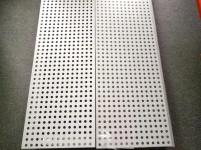
This is a very common perforated steel sheet in our daily lives. Many processing plants are engaged in this business. The process is also very simple; you just need to buy finished steel sheets from the market, and then use a machine tool to punch holes according to the customer's requirements to start production and shipping.

If you think this is a good business, you'll start doing it too. However, after you delve deeper, you'll find that the market price of these perforated steel plates is lower than the price of the raw materials (steel plates).

If you still think about this problem with traditional thinking, you'll be stuck in a dead end, never able to figure it out. But that's China today. This phenomenon isn't limited to this field; it's happening simultaneously in many other areas.

If you use the same thinking to consider the future of the JF-17, you'll still encounter this dead end.

Regarding the JF-17 upgrade issue mentioned by PAF, this forum analyzed it a long time ago. The current development plan perfectly aligns with that analysis. You can check the relevant historical records.
 
You haven't grasped the crux of the problem.

What you perceive as a financial problem stems from your thinking remaining within a framework. You haven't broken free from the constraints this framework places on your thinking.

There are many malicious attackers on this forum, so I don't want to go into a specific discussion about the JF-17 issue. I'll use another example to illustrate this problem.
View attachment 200256
This is a very common perforated steel sheet in our daily lives. Many processing plants are engaged in this business. The process is also very simple; you just need to buy finished steel sheets from the market, and then use a machine tool to punch holes according to the customer's requirements to start production and shipping.

If you think this is a good business, you'll start doing it too. However, after you delve deeper, you'll find that the market price of these perforated steel plates is lower than the price of the raw materials (steel plates).

If you still think about this problem with traditional thinking, you'll be stuck in a dead end, never able to figure it out. But that's China today. This phenomenon isn't limited to this field; it's happening simultaneously in many other areas.

If you use the same thinking to consider the future of the JF-17, you'll still encounter this dead end.

Regarding the JF-17 upgrade issue mentioned by PAF, this forum analyzed it a long time ago. The current development plan perfectly aligns with that analysis. You can check the relevant historical records.
Ok, your analogies are getting a bit strange now, we all get what you're trying to say, but you're looking at the JF17 from China's and the PLAF point of view, which may not see any value left in it, but for the PAF, there is plenty of potential they see. Yes, yes, we get all your analogies, no need for anymore, although I don't know how you can compare perforated steel plates to a fourth gen fighter aircraft.
 

JF-17 History | JF-17 Thunder​

China and Grumman (USA) signed a $550 million agreement to modernize 55 J-7 Fighters under the project called "Super-7". However the project was cancelled due to political problems and significant increases in the cost.

As a substitute to Super-7, China started the FC-1 project. In February 1992, CATIC (China Aero Technology Import and Export Corporation) invited the Pakistan to invest in the project in return for huge Transfer of Technology and participation in R&D of the project. Pakistan Accepted. The First Flight was planned in 1996, but it got delayed because Pakistan wished to upgrade the characteristics in response to India's acquisitions of Su-30MKI. The project began to Stagnate. But in 1998, Pakistani PM's visit to China resulted in the continuation of the Programme. In 1999, sanctions on Pakistan led to serious setbacks on the programme. Pakistan hoped to install Western Avionics on the plane, which was now not possible. Year 2001 saw the changes in approach to develop the fighter plane. The development of airframe was de-linked from the development of Avionics. The Comprehensive design was completed in September 2002 while the development of different aircraft systems progressed. The First Aircraft was assembled by May 2003.

A new redesigned prototype emerged in April, 2006, this was in response to flaws that were discovered in earlier flight tests. The main changes included re-designed air intakes, larger leading edge root extensions (LERX), longer ventral fins underneath the rear of the fuselage, a taller vertical stabilizer fin with a rectangular electronic warfare equipment housing at the tip.

From Super-7 to JF-17 Thunder

From Super-7 to JF-17

JF-17. Com
This is the "background " of the JF-17. It was never a Chinese priority but a PAF priority based on the aforementioned reasons.

It serves PAF needs twofold.

Upgrade on the A-5 , F-6, F-7 and F-7PG in numerous ways.
The numbers game - to ensure that PAF remains within the 1:2 ratio viz the lAF.

This is nothing new. Everyone knows it.
 
Last edited:
well u wont belive wt they have instore for the block 1.

ALL ur and others' suggestions are fine, but everyone seems to overlook one huge flaw in the argument n that is finances.
When you can achieve 80-90 % of the capability by investing less than 10 mil $ per ac, then why spend 60 -80 mil $ with minimal capability enhancement?
All this when PAF has to replace around 100 legacy 3rd-gen AC.
Even for some reason, let's say PAF does not upgrade the block 1, then still in its current form, it runs circles around 80% of the iaf fleet.

All in all block 1 is the least of our worries; we have other fish to fry
Where in my argument have I ignored finances - here is the sentence in my post

“airframes are simply not capable of supporting without investment that should only be done if it is a hobson’s choice.”

Once again -

“airframes are simply not capable of supporting without investment that should only be done if it is a hobson’s choice.”

Investment here means finances(along with other resources) -
Hobsons choice is an old english metaphor which is for the only choice due to circumstances.

So your argument is rather hollow in that it reiterates exactly what I said.

Those airframes especially the early Block-1s are at the twilight of their lives - it is an investment that would require extensive airframe rework and then some to bring them to some semi Block-3 radar over block-2.5 hodgepodge systems.

If tomorrow the PAF receives funds to put through an order for upgrading Block-2s to near block-3 capability vs these aircraft - what logic makes these airframes more attractive?
 

Users who are viewing this thread

Country Watch Latest

Latest Posts

Back
Top