China Science And Technology News

China takes back top spot in latest supercomputer ranking
LineShine' beat the USA's El Capitan system and exceeded 2 exaflops for the first time.

by Steve Dent
June 23, 2026 7:29 am EST
intro-1782214094.webp

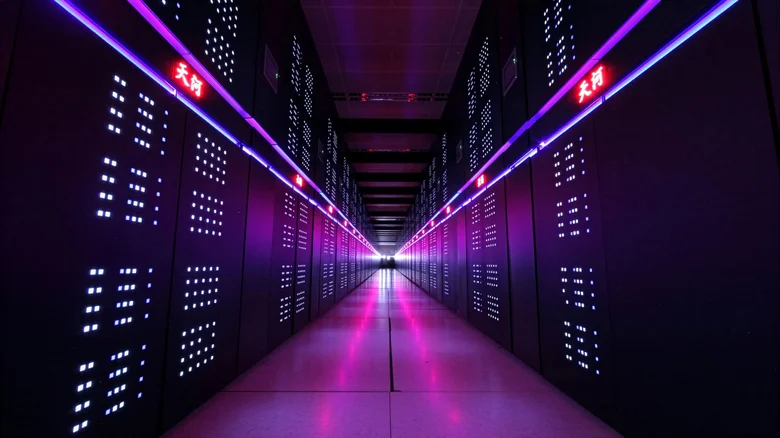
China Supercomputing Center

China has taken the world's fastest supercomputer crown for the first time since 2017. LineShine from the nation's National Supercomputer Center hit 2.198 Exaflops of performance, beating the previous champ El Capitan (1.809 Exaflops), located at Lawrence Livermore National Laboratory in the USA. Lineshine, a previously unlisted machine, is the first supercomputer to exceed two exaflops of "sustained double-precision performance using CPUs only," according to Top500.org.

China's new machine was able to beat its US counterpart despite technology embargoes because it doesn't rely on GPUs like other leading models. Instead, it's designed around a custom 304-core processor, with 13.79 million cores running at 1.55GHz and linked by a proprietary interconnect. It draws around 42.2 megawatts of power, for an efficiency of 52.07 Gigaflops per watt. "It's an impressive system," Top500 organizer Dr. Jack Dongarra told The New York Times. "They upped us by developing a system that is not reliant on GPUs.

Though China managed to seize the top spot, the new ranking now boasts five systems beating the exascale threshold, with one in China, three in the US and one in Germany. Oak Ridge National Laboratory's Frontier moves to No. 3 at 1.353 Exaflop while Aurora, at Argonne National Laboratory, holds No. 4 at 1.012 Exaflops. Jupiter Booster, at the Jülich Supercomputing Centre moves to No. 5 at exactly one Exaflop.

Top500 noted a great deal of architectural diversity with this year's list, with different supercomputer models using Intel, AMD, NVIDIA and other architecture. "There is no single dominant technology path to leadership-class computing; instead, vendors are pursuing a variety of CPU, GPU, APU, and custom-accelerator approaches," Top500 wrote.

China has often kept its supercomputer designs under guard due to government restrictions. However, LineShine was developed without public funding, so its designers felt that they could submit it to Top500's tests without issue, according to the NYT. The company didn't reveal certain details like which company manufactured the CPUs or the type of chip technology used.

 

China takes US crown for world’s fastest supercomputer​

China’s LineShine overtakes US-based El Capitan as most powerful supercomputer, according to the TOP500 list.

Listen (3 mins)
Save

Click here to share on social media
Share

Add Al Jazeera on Google
SC

A worker walks next to the MareNostrum5 supercomputer at the Barcelona Supercomputing Centre in Barcelona, Spain, on December 15, 2023 [File: Emilio Morenatti/AP]

By John Power
Published On 24 Jun 202624 Jun 2026
China has displaced the United States on an influential ranking of the world’s fastest supercomputers, underscoring Beijing’s growing capability to compete with the world’s leading superpower in cutting-edge technology.

China’s LineShine is the most powerful system on the planet, overtaking the US-based El Capitan, according to the biannual ranking announced in Hamburg, Germany, on Tuesday.

Recommended Stories​

list of 4 items
end of list
LineShine, located at the National Supercomputing Centre in Shenzhen, achieved a performance of 2.198 exaflops, carrying out more than 2 quintillion calculations per second – a 20 percent lead over El Capitan, according to the latest TOP500 list.

LineShine’s position marks the first time a Chinese system has topped the list since Sunway TaihuLight did so in 2017.

El Capitan, based at Lawrence Livermore National Laboratory in Livermore, California, had ranked as the top-performing system since November 2024.

Frontier at the Oak Ridge National Laboratory in Oak Ridge, Tennessee, ranked third, followed by Aurora at the Argonne National Laboratory in Downers Grove Township, Illinois, and Jupiter at the Julich Supercomputing Centre in Julich, Germany.

Other countries represented in the top 20 included the United Kingdom, Japan, South Korea, Italy, the Netherlands and Switzerland.

Jack Dongarra, an emeritus professor of computer science at the University of Tennessee who is one of the organisers of the TOP500 list, said LineShine’s performance showed China to be capable of holding its own in advanced computing despite US export restrictions on the most advanced chips.

Advertisement

“Export controls may slow China’s access to certain advanced components, but they also provide a strong incentive to develop domestic alternatives,” Dongarra told Al Jazeera, adding that he was “not entirely surprised” that China had taken the lead.

“LineShine suggests that China has responded through large-scale investment and hardware-software codesign,” Dongarra said.

“In the longer term, controls may both constrain China and accelerate its efforts to become technologically self-sufficient.”

SC
The HPE Cray Supercomputing GX5000 is on display at HPE Discover Las Vegas 2026 in Las Vegas, Nevada, on June 16, 2026 [Caroline Brehman/Reuters]
Unlike other supercomputers, LineShine runs entirely on general-purpose central processing units (CPUs), which have fewer processing cores and are slower at performing complex tasks than the graphics processing units (GPUs) indispensable to running artificial intelligence models such as ChatGPT and Claude.

LineShine is the first and only system to achieve more than 2 exaflops in performance using a CPU-only design, according to the TOP500 list.

The list has been published twice yearly since 1993 when computer scientists Erich Strohmaier and Hans Meuer first compiled statistics on supercomputers around the world in preparation for a conference on the topic.

The list ranks supercomputers’ performance using the LINPACK Benchmark, which measures the amount of time it takes to solve a dense system of linear equations.

China-based supercomputers once dominated the list, taking up nearly half the spots in 2019, but Chinese participation in the ranking dwindled in recent years amid souring relations between Washington and Beijing.

While the TOP500 list has been influential for decades, some experts consider the project to have become less relevant in recent years due to changes in computing processes since the advent of AI.

Although corporate tech giants such as Microsoft, Amazon, Meta and Alphabet are at the forefront of today’s advances in AI, the TOP500 list is largely made up of government and academic initiatives that volunteered to participate in the ranking.

In a 2015 paper, researchers at Cornell University estimated that El Capitan achieved only 22 percent of the computational performance of xAI’s Colossus supercomputing facility in Memphis, Tennessee.

Dongarra said the ranking assessed “one benchmark” and should not be viewed as a “complete measure of technological leadership.”

“Scientific application performance, energy efficiency, software maturity, reliability, ease of use and the ability to support a broad research community are equally important,” he said.

Advertisement

Addison Snell, cofounder of the computing industry consultancy Intersect360 Research, said he was not surprised by LineShine’s capabilities but it was noteworthy that Chinese developers had begun to re-engage with the ranking project.

“The ranking of LineShine as the world’s top supercomputer should have a ripple effect in the US, Europe and Japan as countries continue to vie for AI dominance,” Snell told Al Jazeera.

“The US still leads globally in terms of technology, but the gap is not wide,” Snell added.

“With the rapid pace of evolution, the global order could change quickly. Digital sovereignty is one of the key topics discussed in supercomputing and AI today, and every region is working to deploy its own resources and capabilities.”

Colossus
Workers at Elon Musk’s xAI facility, which houses a large supercomputer known as Colossus, used for Artificial Intelligence data processing, in Memphis, Tennessee, the US, on September 11, 2025 [File: Karen Pulfer Focht/Reuters]
China and the US have been locked in a fierce battle for global supremacy in leading technologies such as AI over the past decade, rolling out a slew of tit-for-tat sanctions and export controls to blunt each other’s advances.

The 2026 AI Index Report, released in April by Stanford University, found that China had “effectively closed” the AI model performance gap with the US.

While the US produces more top-of-the-line AI models, China holds the advantage in rolling out patents and industrial robot installations, the report said.

Intersect360 Research’s Snell that while hyperscalers such as Amazon and Microsoft would be able to the claim the top spots on the TOP500 list if they wanted to, the ranking remained an important indicator of the capabilities of supercomputers used for scientific applications.

“It is a mistake to assume ‘AI dominance’ will automatically translate to ‘science dominance,'” Snell said.

“Consumer applications like image generation, translation, or chatbots have relevance to high-end computing but are not sufficient in of themselves,” he added.

“Policy should reflect ‘AI for science,’ not ‘AI or science.’ To enable AI for science, governments must invest in both halves.”


Chinese supercomputer powered by homegrown chips tops US models in global ranking​

PUBLISHED JUN 24, 2026, 3:27 AM ET
CNN

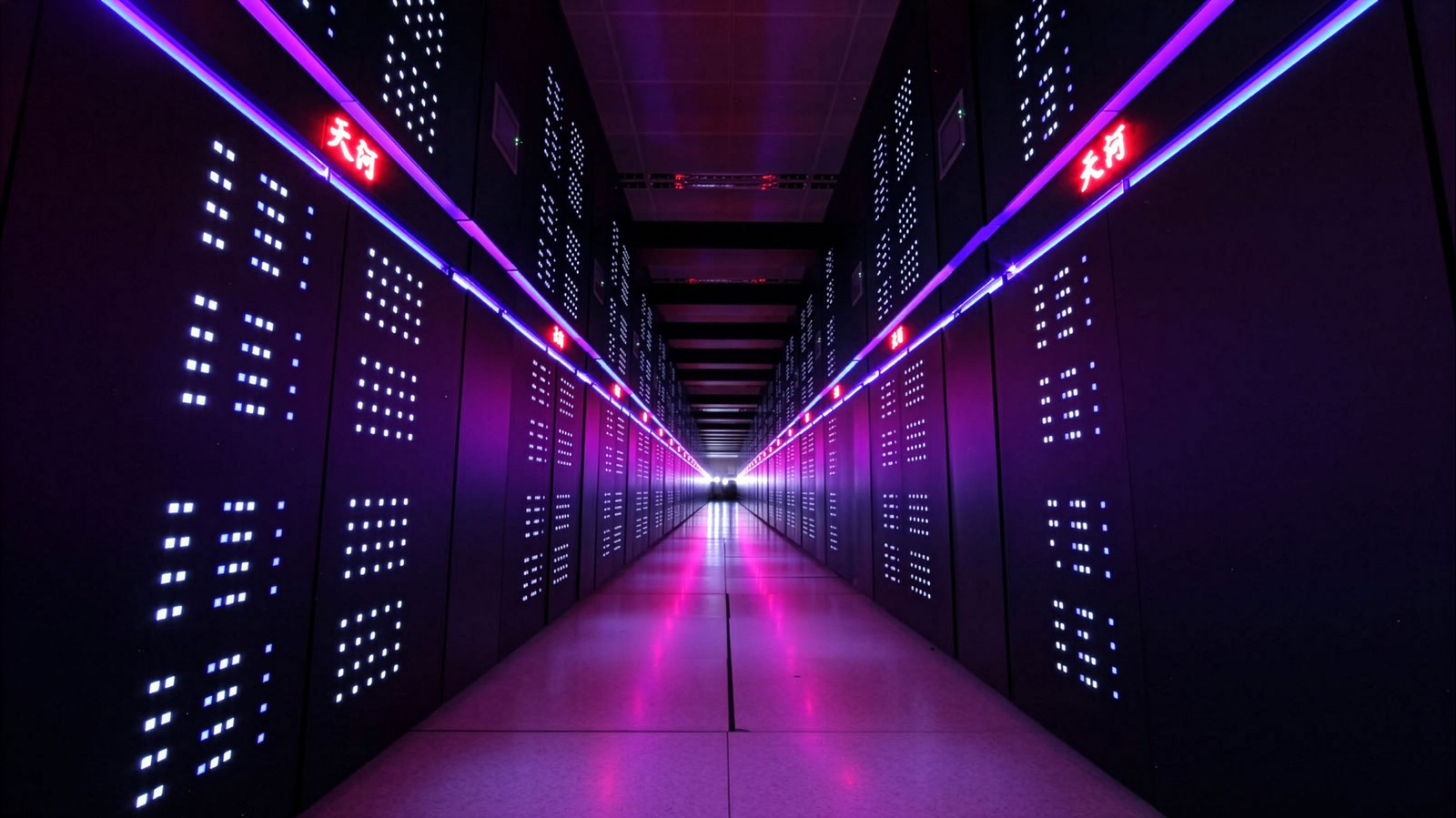
LineShine supercomputer.

LineShine supercomputer.
National Supercomputing Center in Shenzhen

China has clinched the top spot on a list of the world’s most powerful supercomputers, overtaking the United States for the first time since 2017 with a model powered by homegrown chips amid an intense race for tech supremacy between the two superpowers.

The LineShine machine, housed at the National Supercomputing Center in China’s tech hub of Shenzhen, replaced the American titleholder El Capitan in the latest biannual TOP500 ranking, which tracks the world’s most powerful supercomputers.

The ranking released on Tuesday showed the LineShine achieved a computing speed 20% faster than El Capitan, which is located at the Lawrence Livermore National Laboratory in California.

Supercomputers, designed for complex computations at unmatched speeds, are often used to discover and develop new drugs, forecast weather, train AI models and conduct a wide range of simulations.

The success of the LineShine comes as the US and China ratchet up their tech rivalry and Washington attempts to curb Beijing’s access to frontier technologies from AI to chips that could power its military.

Since President Donald Trump’s first term, the US has ramped up export controls and restrictions aiming to slow China’s advancement in these technologies.

China’s National Supercomputing Center said in an online statement that the LineShine is the “result of breakthroughs across a series of core technological bottlenecks.”

LineShine’s achievements “mark a historic leap for China’s supercomputing sector in overcoming foreign technology restrictions and building an independently controlled hardware and software ecosystem,” it said.

Notably, the LineShine relies entirely on CPUs – conventional computing chips often found in consumer electronics – instead of specialized GPUs – the highly sought-after chips that power most of the supercomputers today and are dominated by American suppliers like Nvidia.

Through a series of measures starting in 2022, Washington has cut off China’s access to the cutting-edge GPUs, throttling Chinese companies’ efforts in competing for the top AI models with US tech giants.

The moves forced Chinese companies to innovate around the restrictions. Last year, China-based AI startup DeepSeek released a model that delivered near industry-leading performance with far fewer advanced chips, surprising Silicon Valley and the wider industry.

Speaking at the TOP500 award ceremony in Hamburg, Germany, LineShine chief designer Lu Yutong said the machine broke through from the conventional hybrid architecture of using both CPUs and GPUs for supercomputers.

The system leverages domestically developed, full-stack computing infrastructure, including CPUs and high-bandwidth memory (HBM), for purposes of scientific, engineering and AI workloads, Lu said, according to the statement from China’s National Supercomputing Center.


China takes US crown for world’s fastest supercomputer​

China’s LineShine overtakes US-based El Capitan as most powerful supercomputer, according to the TOP500 list.

Listen (3 mins)
Save

Click here to share on social media
Share

Add Al Jazeera on Google
SC

A worker walks next to the MareNostrum5 supercomputer at the Barcelona Supercomputing Centre in Barcelona, Spain, on December 15, 2023 [File: Emilio Morenatti/AP]

By John Power
Published On 24 Jun 202624 Jun 2026
China has displaced the United States on an influential ranking of the world’s fastest supercomputers, underscoring Beijing’s growing capability to compete with the world’s leading superpower in cutting-edge technology.

China’s LineShine is the most powerful system on the planet, overtaking the US-based El Capitan, according to the biannual ranking announced in Hamburg, Germany, on Tuesday.

Recommended Stories​

list of 4 items
end of list
LineShine, located at the National Supercomputing Centre in Shenzhen, achieved a performance of 2.198 exaflops, carrying out more than 2 quintillion calculations per second – a 20 percent lead over El Capitan, according to the latest TOP500 list.

LineShine’s position marks the first time a Chinese system has topped the list since Sunway TaihuLight did so in 2017.

El Capitan, based at Lawrence Livermore National Laboratory in Livermore, California, had ranked as the top-performing system since November 2024.

Frontier at the Oak Ridge National Laboratory in Oak Ridge, Tennessee, ranked third, followed by Aurora at the Argonne National Laboratory in Downers Grove Township, Illinois, and Jupiter at the Julich Supercomputing Centre in Julich, Germany.

Other countries represented in the top 20 included the United Kingdom, Japan, South Korea, Italy, the Netherlands and Switzerland.

Jack Dongarra, an emeritus professor of computer science at the University of Tennessee who is one of the organisers of the TOP500 list, said LineShine’s performance showed China to be capable of holding its own in advanced computing despite US export restrictions on the most advanced chips.

Advertisement

“Export controls may slow China’s access to certain advanced components, but they also provide a strong incentive to develop domestic alternatives,” Dongarra told Al Jazeera, adding that he was “not entirely surprised” that China had taken the lead.

“LineShine suggests that China has responded through large-scale investment and hardware-software codesign,” Dongarra said.

“In the longer term, controls may both constrain China and accelerate its efforts to become technologically self-sufficient.”

SC
The HPE Cray Supercomputing GX5000 is on display at HPE Discover Las Vegas 2026 in Las Vegas, Nevada, on June 16, 2026 [Caroline Brehman/Reuters]
Unlike other supercomputers, LineShine runs entirely on general-purpose central processing units (CPUs), which have fewer processing cores and are slower at performing complex tasks than the graphics processing units (GPUs) indispensable to running artificial intelligence models such as ChatGPT and Claude.

LineShine is the first and only system to achieve more than 2 exaflops in performance using a CPU-only design, according to the TOP500 list.

The list has been published twice yearly since 1993 when computer scientists Erich Strohmaier and Hans Meuer first compiled statistics on supercomputers around the world in preparation for a conference on the topic.

The list ranks supercomputers’ performance using the LINPACK Benchmark, which measures the amount of time it takes to solve a dense system of linear equations.

China-based supercomputers once dominated the list, taking up nearly half the spots in 2019, but Chinese participation in the ranking dwindled in recent years amid souring relations between Washington and Beijing.

While the TOP500 list has been influential for decades, some experts consider the project to have become less relevant in recent years due to changes in computing processes since the advent of AI.

Although corporate tech giants such as Microsoft, Amazon, Meta and Alphabet are at the forefront of today’s advances in AI, the TOP500 list is largely made up of government and academic initiatives that volunteered to participate in the ranking.

In a 2015 paper, researchers at Cornell University estimated that El Capitan achieved only 22 percent of the computational performance of xAI’s Colossus supercomputing facility in Memphis, Tennessee.

Dongarra said the ranking assessed “one benchmark” and should not be viewed as a “complete measure of technological leadership.”

“Scientific application performance, energy efficiency, software maturity, reliability, ease of use and the ability to support a broad research community are equally important,” he said.

Advertisement

Addison Snell, cofounder of the computing industry consultancy Intersect360 Research, said he was not surprised by LineShine’s capabilities but it was noteworthy that Chinese developers had begun to re-engage with the ranking project.

“The ranking of LineShine as the world’s top supercomputer should have a ripple effect in the US, Europe and Japan as countries continue to vie for AI dominance,” Snell told Al Jazeera.

“The US still leads globally in terms of technology, but the gap is not wide,” Snell added.

“With the rapid pace of evolution, the global order could change quickly. Digital sovereignty is one of the key topics discussed in supercomputing and AI today, and every region is working to deploy its own resources and capabilities.”

Colossus
Workers at Elon Musk’s xAI facility, which houses a large supercomputer known as Colossus, used for Artificial Intelligence data processing, in Memphis, Tennessee, the US, on September 11, 2025 [File: Karen Pulfer Focht/Reuters]
China and the US have been locked in a fierce battle for global supremacy in leading technologies such as AI over the past decade, rolling out a slew of tit-for-tat sanctions and export controls to blunt each other’s advances.

The 2026 AI Index Report, released in April by Stanford University, found that China had “effectively closed” the AI model performance gap with the US.

While the US produces more top-of-the-line AI models, China holds the advantage in rolling out patents and industrial robot installations, the report said.

Intersect360 Research’s Snell that while hyperscalers such as Amazon and Microsoft would be able to the claim the top spots on the TOP500 list if they wanted to, the ranking remained an important indicator of the capabilities of supercomputers used for scientific applications.

“It is a mistake to assume ‘AI dominance’ will automatically translate to ‘science dominance,'” Snell said.

“Consumer applications like image generation, translation, or chatbots have relevance to high-end computing but are not sufficient in of themselves,” he added.

“Policy should reflect ‘AI for science,’ not ‘AI or science.’ To enable AI for science, governments must invest in both halves.”

Posted already
 

China accounts for 40% of world's 5G connections

40% of the world's 5G connections are in China, the country having reached 65% 5G adoption, according to new analyst data.


Mary Lennighan
June 24, 2026

5G_169_2_.jpg


China's share of the global market will shrink over the next few years as other countries catch up, but nonetheless it will boast 1.8 billion 5G connections by 2030, the GSMA predicts in its new The Mobile Economy in China 2026 report. By that date the figure will still represent more than 30% of the world's total.

And a decade further ahead China will be able to claim a similar percentage of 6G connections globally. China will likely be in the vanguard of 6G rollout; last month the government approved 6 GHz trial frequencies that will help it to push forward with research and technical trials.

The GSMA forecasts that there could be more than 5 billion 6G connections worldwide by 2040, or around half of all mobile connections, and that China will account for 1.6 billion of the total.

In the meantime though, there is still 5G-Advanced to consider. To date, the scale of deployment has arguably been disappointing, and even in China the number of users is not huge, relative to overall population size.

Five operators have launched commercial 5G-Advanced services across 330 million cities in mainland China, with users numbering north of 10 million by this time last year. The GSMA did not provide more recent figures. The big three in mainland China – China Mobile, China Telecom and China Unicom – have all launched 5G-Advanced, plus CTM in Macao and HKT in Hong Kong, while all three mobile operators in Taiwan have shared plans to do so.

China's telcos are reaping the rewards of their efforts, bringing in sizeable revenues, but they are also spending big too.

Operator revenues in the country will reach $222.8 billion annually by 2030, the GSMA predicts, up from $191 billion last year. Planned capex for the 2025-2030 period will come in at $194.1 billion.

But despite the size of the market, its rapid growth to date and projected expansion, and the money its telecoms operators are allocating for capital spending, there are still people falling behind in China.

Sustained investment in digital infrastructure means the coverage gap in the market stands at just 1%, but usage is not as widespread as coverage. 91% of the population is connected to the Internet, leaving a usage gap of 8%, the GSMA's report shows; there is clearly some rounding at play.

That might not seem like a huge percentage, but in a market the size of China 8% means a lot of people. Or as the GSMA puts it represents "millions of people yet to benefit fully from China's digital economy."

Mobile technologies and services in China generated $1.5 trillion in economic value last year, or 7.2% of GDP, the GSMA said. That figure is projected to reach $2.1 trillion by 2030.

Whichever way you look at it, China's digital economy represents a huge slice of the global market. And even with other countries catching up on 5G and many nations still keen to be in the first wave of 6G deployment, China's scale means it will continue to dominate. The numbers will always be impressive.

 
Just like EVs, EU losers are going to sanction Chinese drugs.

717298294_17969042667112872_5351485898444071336_n.jpg
 
Beyond Made in China 2025
China’s Future Industries plan, introduced in 2024 and reiterated in this year’s five-year plan, is the next chapter in Beijing’s long-running push to upgrade its industrial base. It targets six broad sectors — energy, materials, health, IT, space and manufacturing — several of which overlap directly with the priorities set out a decade ago under Made in China 2025. The underlying objective hasn’t shifted either: cut reliance on foreign inputs while building new domestic “productive forces.”

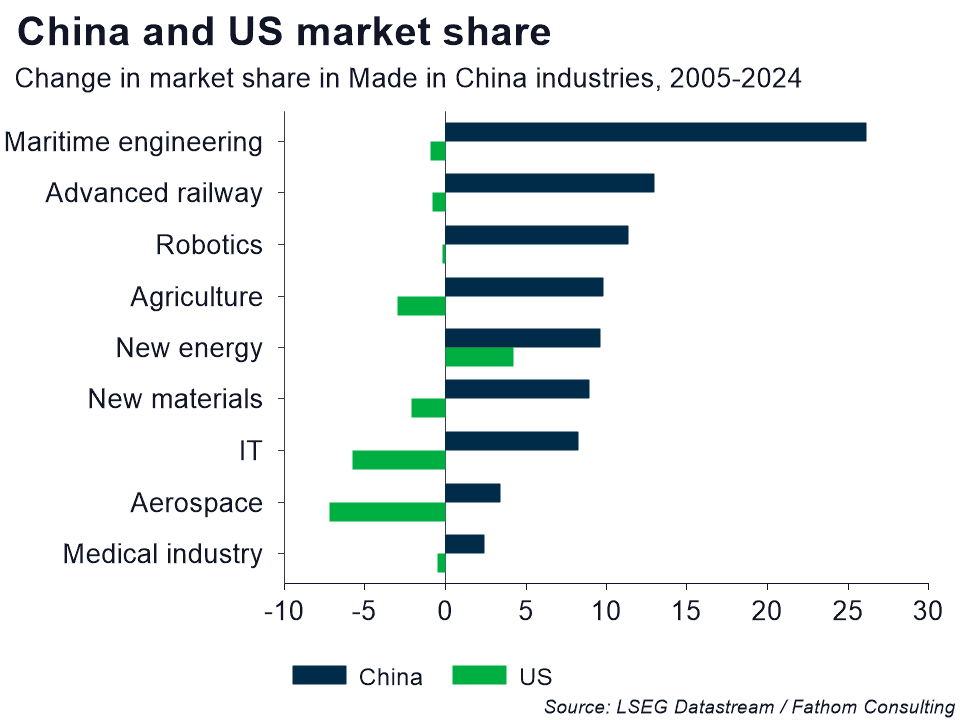
We have a real benchmark for judging how that earlier plan fared. Using our proprietary RiCArdo trade database, originally built to track China’s progress across the nine Made in China 2025 industries, we find that China has increased its global market share in every one of them over the past two decades, often at the US’s expense, and has moved up the value chain in the process. Yet gains in market share haven’t translated into trade surpluses: China still runs a sizeable deficit across these sectors, with IT the persistent sore point — the country remains heavily reliant on imported chips, particularly from Taiwan.

Where Made in China 2025 set out relatively clear, measurable goals, China’s Future Industries plan is more vague. That combination of indistinct ambition and immature technology makes progress inherently hard to track, perhaps deliberately so. We unpack what this ambiguity might be hiding.

Read on for our full assessment, including what a decade of trade data tells us about who’s actually winning the race so far.

Bar chart of change in China and US market share across Made in China industries, 2005–2024. China gained share in all nine sectors, most sharply in maritime engineering, advanced railway and robotics; the US lost share in aerospace, IT and new materials, with new energy the only sector where both gained.
 

Users who are viewing this thread

Back
Top