The Mecca Pact’s First Test Has Exposed Its Central Weakness

Seriously, this deal does impact to India.

Even if there was no deal - turkey would have supported Pakistan without the deal with indirectly.

Saudi stance might without the deal could have neutral but now only changes, they will do political support to Pakistan... This overall the impact before and after the agreement
So again your point being that the deal makes little to no difference to India, cos that helps u sleep easier. Ironic since the deal is thanks to India anyway. According to respected analysts like Sami Hamdi, only reason MBS signed the deal with Pakistan is because he was so impressed by the PAF shooting down so many top of the line IAF jets including Ra-fails without even appearing on Indian radars. Guess he got a detailed briefing from his intelligence on what went down and didn’t rely on Godi media. Explains why Turkey was so keen to formalise its cooperation with Pakistan too. Thank you Modi and Co you really are geniuses.
 
No, A ground invasion is not required for something to be considered a war. If two countries engage in sustained military attacks through missiles, drones, or airstrikes, it can be described as a war, even without occupying each other’s territory.

For example, if Russia and the US were fighting today using missiles, rockets, drones and air warfare, but neither side invaded the other’s territory, it would still be considered a war.

And if people start making excuses like, “You started the war, so we don’t have to support you,” then such a military treaty becomes practically useless, because there will always be some excuse to avoid honoring it.
Again your desperate quest you clutch at anything you can to try to show that the deal is a failure because that is what you hope for so badly. Where has a Pakistani official made any such obsurd comment? Go listen to the DGSPR’s actual latest comments on the subject. They are quite to the contrary.
The point you conveniently miss is that in the conflict with the Houthi’s does Pakistan and Turkey have anything to bring to the party that SA does not already have?? Men, ground vehicles, aircraft, bombs and misiles? Unless Ofcoarse you’re suggesting they want to nuke the Houthi’s? If at any point they are in a conflict with anyone / are attacked by anyone and they need something from Pakistan / Turkey to defend themselves/ strike back, they will request it and they will get it. The same works for Pakistan too, if Modi is ever again stupid enough to try ‘something big’ to get wa wa & votes.
 
those Halal dollars come with the risk of Pakistani blood that will be spilled in that meat grinder and further destabalisation inside Pakistan.
we just had another terror attack reminding us that we got BLA and Takfiri khawarij inside Pakistan that need dealing first before we go around offering our men to fight the Saudi wars.


IMO, if the scale of such income earners rise in a sub-society or system, if could also change the societal mindset which results in a cohesion, which is already very fragile.


but, these matters are hardly taken into any decision. Reality is, for 5 Bentleys (for instance), there are very few people, who would reject these offers!
 
Pact with Saudi Arabia threatens to draw Pakistan into Middle East conflict
Activation of mutual defence agreement by Riyadh as fighting with Houthis escalates would have wide-reaching repercussions for Islamabad

Hannah Ellis-Petersen in Delhi and Shah Meer Baloch in Islamabad
Sat 19 Sep 2026 08.00 BST
Share


Prefer the Guardian on Google

As he stood in Riyadh last September, the world looked like a very different place for Pakistan’s most powerful man, Gen Asim Munir.

The country’s army chief was there to witness the signing of a historic defence pact with Saudi Arabia, which he had personally orchestrated with the crown prince, Mohammed bin Salman.


To Munir, it appeared to be a highly strategic win: Riyadh would provide cash-strapped Pakistan with billions of dollars of life-saving investments and loans. In exchange, Pakistan agreed to train up the Saudi military, and Pakistan’s armed forces would defend Saudi Arabia in the unlikely event of an attack on its territory.

Analysts say it was clear that Pakistan presumed US-Iran relations would soon get back on track and the risk of a conflict sweeping across the Middle East and the Gulf was low.

But a very different scenario soon unfolded. By February, the Middle East was on fire after the US and Israel began bombing Iran – and Iran began firing missiles at the Gulf states, including Saudi Arabia, in retaliation.

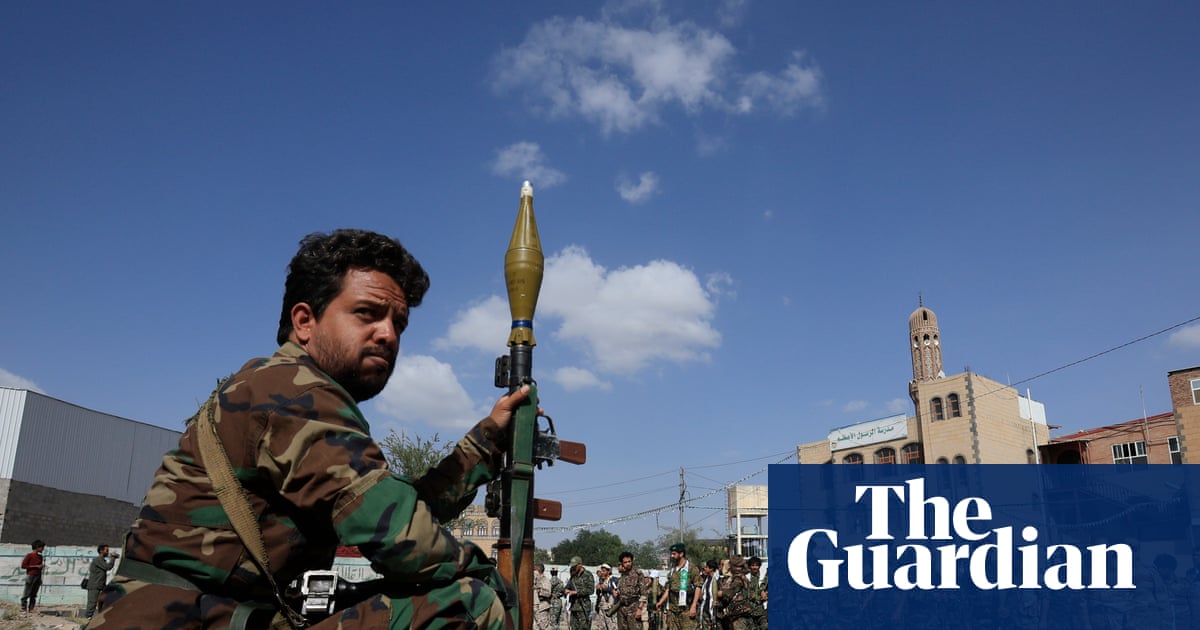
It did not take long for the war to reinflame Saudi’s conflict with the Houthis, the Iran-backed rebel group based in Yemen, and for their fragile truce to collapse. Earlier this month the Houthis made unprecedented territorial gains in Yemen and hit Saudi territory with strikes and drones. Saudi Arabia has responded by pounding Yemen with airstrikes. Some believe a return to full-scale war is on the horizon.

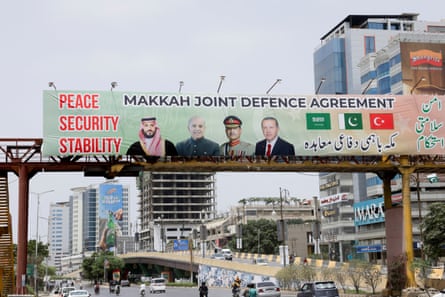
The pressure is now mounting on Pakistan, and particularly Munir. In August, the defence pact with Saudi Arabia was extended to include Turkey and renamed the Mecca joint defence agreement. The countries agreed that an armed attack on any one of them would be treated as an attack on all three.

A billboard above a busy road in Karachi. The sign says ‘Peace, security, stability’ and ‘Makkah joint defence agreement’ and shows pictures of the Saudi crown prince, Pakistan’s prime minister, Gen Asim Munir and the Turkish president
View image in fullscreen
A billboard in Karachi, Pakistan, marks the signing of the Mecca joint defence agreement in August. Photograph: Akhtar Soomro/Reuters
Ayesha Siddiqa, a defence analyst and senior fellow at King’s College London, said: “I don’t think Asim Munir properly calculated the threats the region was facing – and that Pakistan might need to put its troops on the line quite so soon.”

Saudi Arabia has tens of billions of dollars in fighter jets and war machinery, but it does not have any warfare experience to fight the Houthis, who have proved to be tough, resilient fighters. Pakistan’s forces, trained to deal with the constant menace of India, would be highly valuable on the frontline.

Analysts say that if Saudi Arabia decided to activate the Mecca pact to fight the Houthis, Pakistan would have no choice but to send in its troops, including thousands who are already deployed in Saudi Arabia for training. As well as being a defence partner, Pakistan is almost totally economically and geopolitically dependent on Saudi Arabia, which has recently given the country a lifesaving $8bn (£6bn) in funds and investments.

Last week, Pakistani government ministers and senior military figures gave increasingly bullish statements, confirming their “unconditional” commitment to the pact and saying Islamabad would go to “any extent” to defend Saudi Arabia.

But privately, officials in Pakistan are deeply worried about being dragged into the never-ending war unfolding across the Middle East. The country is already economically crippled, in a de facto war with the Taliban in Afghanistan, and facing an uncontrollable surge in militancy in its border areas.

To many, an activation of the Mecca pact would be perceived as Islamabad taking a clear stance against Iran. Before the US and Israeli strikes on Iran, Pakistan had good relations with its neighbour – ties that Munir utilised to bring Tehran to the negotiating table in his attempt to secure a lasting ceasefire. But as the war has dragged on, Pakistan has become increasingly infuriated with Iran, while Tehran has little trust left in Islamabad.

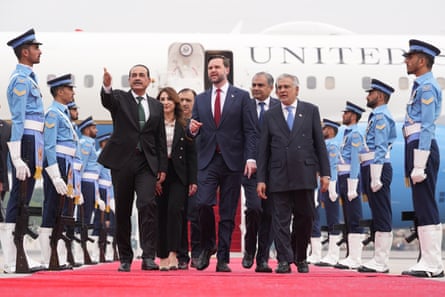
Gen Asim Munir walks alongside JD Vance on a red carpet by a plane, with ministers and officials alongside and Pakistani soldiers standing in lines on either side
View image in fullscreen
Gen Asim Munir welcomes the US vice-president, JD Vance, to Islamabad in April during diplomatic efforts to end the US-Israeli war with Iran. Photograph: Jacquelyn Martin/AP
As Siddiqa emphasised, Pakistan joining the fight against the Houthis “would come with major repercussions”. After Iran, Pakistan is home to the second-largest population of Shia Muslims, who would probably rise up in protest against any involvement in strikes on the Houthis.

Iran also maintains good relations with the Taliban in Afghanistan, posing the risk of further provoking one of Pakistan’s biggest security threats and driving militancy and security problems along the Afghanistan-Pakistan border to even deadlier levels.

It also risks inflaming the situation in Balochistan, Pakistan’s unstable border region with Iran, which is home to a long-running and uncontrollable insurgency.

Raja Nasir Abbas, the opposition leader in Pakistan’s senate, said that only the very few at the top of Pakistan’s military even knew what conditions and agreements had been made in the Mecca pact. With the military as Pakistan’s de facto rulers, the decision to join was not even put before parliament.

“It will be a disaster for the country if Pakistan jumps into war,” said Abbas. “We are already facing two lethal insurgencies; our economy is in a shambles and inflation has rocketed. If we take Saudi Arabia’s side in this conflict, the country will face chaos, instability and religious division.”

So far, no one has been able to pinpoint what the “red line” would be that would force the pact to be activated. Analysts said Pakistan appeared to be banking on Riyadh’s reluctance to enter into open warfare with Iran by escalating its fight with the Houthis. Turkey has also made it clear it does not want to enter the fray.

“Pakistan will do its best not to get involved in any incursion on Yemeni soil,” said Muhammad Amir Rana, the director of the Islamabad-based Pak Institute for Peace Studies.

Speaking privately, one senior official said he did not think the Saudi crown prince “wants to activate the pact now”.

“If the kingdom plans to send its ground forces, Pakistan would support that,” he said. “But I don’t think Saudi Arabia would start a full-fledged war against the Houthis without American approval and Trump has snubbed them. Right now, the US does not want to open up another front; they prefer talking to Houthis.”

He added: “You can’t predict the future though.”

Understanding what is happening in the Middle East is more important than ever​

It’s the Guardian’s job to keep a close focus on events in the region for our global audience.

With reporters sharing live updates around the clock, we’re well-placed to provide comprehensive, fact-checked reporting and to help our audience understand every major development. But we can’t do it without your support.

We rely on the generosity of our readers, whose backing helps to keep our correspondents on the ground and our reporting free from commercial or political influence.

We appreciate that not everyone can afford to pay for news, but if you can, can we count on your support? Here are three good reasons to make the choice to fund us today:

1. Our quality, investigative journalism is a scrutinising force.

2. We are independent and have no billionaire owner dictating what we do – your money directly powers our reporting.

3. It doesn’t cost much, and takes less time than it took to read this message.

 
Forget Mecca pact. The war in Europe is about to start and sooner or later USA Europe and Russia will killing each other.
Right at that time, Arabs will have clear chance to clean Palestine. Mark my words, attacks from yemni side and Iraqi side are being exclusively carried out by Israelis and Americans.

 
Forget Mecca pact. The war in Europe is about to start and sooner or later USA Europe and Russia will killing each other.
Right at that time, Arabs will have clear chance to clean Palestine. Mark my words, attacks from yemni side and Iraqi side are being exclusively carried out by Israelis and Americans.


Russia cannot take on Ukraine right now, the idea it can take on the rest of Europe is absurd beyond belief...... truly absurd.

Europe will make kebabs out of Russia's much "vaunted military"...
 
When Saudi Arabia, Pakistan and Türkiye signed the Makkah Joint Defence Agreement on August 7, 2026, its central promise sounded formidable: an armed attack against one member would be regarded as an attack against all three. The Saudi government described the agreement as a mechanism for strengthening “collective deterrence,” while Turkish officials compared its basic concept to NATO’s Article 5. (My Government)


Barely a month later, however, the renewed Saudi-Houthi confrontation has exposed a fundamental problem. An alliance intended to deter adversaries ultimately depends less on the capabilities its members possess than on whether potential opponents believe those capabilities will actually be employed on one another’s behalf.


So far, the Mecca Pact has struggled to establish that credibility.


An Alliance Without a Clearly Defined Enemy


One of the pact’s greatest weaknesses was embedded in its construction. Unlike NATO during the Cold War, the Mecca agreement did not identify a specific common adversary. Turkish Foreign Minister Hakan Fidan explicitly stated that Iran—or any other state—had not been designated as a common threat. He also explained that assistance was not necessarily automatic: the attacked member would request help and specify what form of assistance it wanted. (Al Jazeera)


That flexibility is diplomatically useful. Militarily, however, ambiguity can weaken deterrence.


Pakistan, Türkiye and Saudi Arabia do not necessarily perceive threats in identical ways. Islamabad’s principal conventional security concern remains its rivalry with India. Türkiye’s major strategic disputes include Israel and Greece, as well as security problems surrounding Syria and the Eastern Mediterranean. Saudi Arabia’s most immediate concerns are concentrated around the Gulf, Iran, Yemen and the security of its energy infrastructure and maritime approaches.


An agreement binding three militarily capable states together therefore does not automatically produce a unified strategic bloc. Without an agreed adversary, agreed thresholds for intervention, detailed rules of engagement and clearly demonstrated mechanisms for collective military action, the pact risks becoming three overlapping security relationships rather than a genuine integrated alliance.


That distinction matters enormously to deterrence.


Yemen Has Become the Pact’s First Credibility Test


Ansar Allah has provided exactly the sort of test that could demonstrate whether the Mecca Pact represents an operational military alliance or primarily a political commitment.


The Houthis have attacked Saudi territory and energy infrastructure while simultaneously expanding their position along Yemen’s Red Sea coast. Pakistan’s Defence Minister Khawaja Asif publicly stated that unprovoked aggression against Saudi Arabia could make the Mecca agreement operational. Yet Pakistan’s government subsequently said that no Pakistani military response had been discussed under the pact. (Al Jazeera)


Pakistan has instead emphasized diplomacy, including communicating with Iran in an effort to restrain the Houthis. Its Foreign Ministry has reiterated its commitment to Saudi security while simultaneously stressing dialogue and regional stability. (Ministry of Foreign Affairs Pakistan)


There is an important qualification here: Riyadh has apparently not formally invoked the agreement and demanded that Pakistani and Turkish forces enter Yemen. That means it would be inaccurate to say that either country has technically violated the pact. The agreement itself remains young, and its operational structures are still developing. (Al Jazeera)


But deterrence is not merely a legal question.


An adversary watching events does not need to determine whether Article X, paragraph Y has technically been activated. It asks a simpler question: If I attack one of these countries, how likely is it that I will find myself fighting all three?


The Yemen crisis has not yet produced a convincing answer.


The 2015 Precedent Never Really Disappeared


Pakistan’s reluctance to become directly involved in Yemen also has deep precedent.


When Saudi Arabia sought Pakistani military participation against the Houthis in 2015, Pakistan’s parliament unanimously called for neutrality rather than committing troops, aircraft and ships to the Saudi-led campaign. (Al Jazeera)


That history matters because the Mecca Pact was supposed to transform longstanding Saudi-Pakistani and Saudi-Turkish relationships into something institutionally stronger.


Yet Yemen demonstrates that national interests remain capable of overriding alliance symbolism.


Pakistan may be willing to defend Saudi territory without wanting Pakistani forces fighting an open-ended war inside Yemen. Türkiye likewise has little incentive to inherit the enormous political and military costs associated with another Yemeni intervention.


Those positions may be entirely rational from Islamabad’s and Ankara’s perspectives. But rational restraint and credible collective deterrence are not necessarily the same thing.


Saudi Arabia Cannot Simply Purchase an Alliance


There is also a deeper historical problem with Saudi expectations about coalition warfare.


For decades, Saudi Arabia’s enormous financial resources have allowed it to acquire sophisticated weapons, finance partner governments and obtain foreign military manpower. During the earlier Yemen intervention, however, Saudi Arabia and the UAE discovered that money could not automatically generate capable and politically committed ground forces.


Research by Germany’s SWP notes that Riyadh and Abu Dhabi initially hoped countries including Pakistan and Egypt would provide significant forces. When that did not materialize, Saudi Arabia and the UAE increasingly relied on foreign manpower. Sudan and Senegal supplied personnel for compensation, while the UAE employed a mercenary force containing substantial numbers of Latin American veterans. (Stiftung Wissenschaft und Politik (SWP)) Brookings similarly documented Saudi recruitment of thousands of Sudanese troops and Emirati employment of Colombian mercenaries during the Yemen war. (Brookings)


The distinction is important: much of the best-documented Latin American mercenary recruitment was Emirati rather than directly Saudi. Nevertheless, the broader Saudi-led coalition repeatedly relied upon externally supplied manpower.


The Mecca Pact cannot operate on the same principle.


Pakistan and Türkiye are sovereign regional powers with their own strategic interests, domestic politics and military doctrines. Saudi financing may facilitate arms purchases, joint exercises, basing arrangements and defense-industrial cooperation. It cannot transform Pakistani or Turkish soldiers into forces that Riyadh can automatically deploy whenever Saudi interests require them.


An alliance is not a military labor contract.


The Turn Back Toward Washington—and Reportedly Israel


Perhaps the most damaging development for the pact’s image is where Riyadh has looked as the situation deteriorated.


Reuters reported that Crown Prince Mohammed bin Salman sought U.S. military support as the Houthis expanded along Yemen’s Red Sea coastline. Washington declined direct involvement. (Reuters)


There have also been reports that Saudi Arabia sought Israeli intelligence assistance against Ansar Allah, although this element should be treated more cautiously because the reporting is less firmly established than the Saudi request to Washington. India Today reported that Riyadh had approached Israel after Pakistan ruled out deploying forces to fight inside Yemen, with potential Israeli assistance focused primarily on intelligence. (India Today)


If confirmed more authoritatively, the symbolism would be extraordinary.


A Saudi-led defense architecture involving two of the Muslim world’s strongest militaries would have encountered its first serious regional crisis only for Riyadh to seek assistance from the United States and potentially Israel.


That does not demonstrate that the Mecca Pact is militarily worthless. Pakistan and Türkiye possess formidable conventional capabilities, and Pakistan adds an additional strategic dimension as a nuclear-armed state. It does, however, raise a much more important question: under what circumstances are those capabilities actually available to another member?


Until potential adversaries know the answer, aggregate military strength on paper provides limited deterrence.


What India, Israel and Greece Are Likely to Notice


This problem extends well beyond Yemen.


The pact theoretically complicates strategic calculations for countries involved in disputes with its members. India must consider Pakistan; Greece has longstanding disputes with Türkiye; and Türkiye and Israel have increasingly serious strategic disagreements.


But none of those states needs to conclude that confronting one Mecca Pact member automatically means confronting all three.


Indeed, Yemen currently suggests the opposite lesson: the political context of an attack may matter more than the collective-defense language itself.


India could reasonably ask whether Türkiye or Saudi Arabia would actually enter a major Indo-Pakistani war rather than provide Pakistan with diplomatic, financial, intelligence or logistical assistance.


Greece could ask whether Pakistan and Saudi Arabia would genuinely fight a NATO member alongside Türkiye over an Eastern Mediterranean confrontation.


Israel could similarly ask whether a Turkish-Israeli confrontation would cause Pakistani military intervention or whether Islamabad would limit itself to diplomatic and material support.


These questions do not prove how any member would behave in those scenarios. They demonstrate why deterrence requires more than an agreement.


An alliance becomes credible when an opponent believes escalation against one member creates an unacceptable probability of confrontation with the others.


Yemen has so far demonstrated ambiguity rather than inevitability.


The Paradox of Strategic Ambiguity


The architects of the Mecca Pact may have deliberately avoided identifying a common enemy because doing so made the agreement politically easier to construct.


Pakistan does not want the alliance explicitly directed against Iran. Türkiye likewise stated publicly that Iran was not the pact’s target. Saudi Arabia benefits from avoiding an arrangement that permanently commits it to Pakistan against India or Türkiye against Israel and Greece.


That diplomatic flexibility helped create the alliance.


It may simultaneously undermine its deterrent effect.


The members effectively gained freedom of action by refusing to define their common adversaries—but potential adversaries gained uncertainty about whether the alliance would respond at all.


This is the central contradiction of the Mecca Pact.


The broader its theoretical security guarantee becomes, the more politically difficult fulfilling that guarantee may become.


From “Islamic NATO” to Coalition of Convenience?


The Mecca agreement should therefore not yet be dismissed as meaningless. It could evolve into something considerably more serious. Joint command structures, exercises, integrated air and missile defense, intelligence sharing, common contingency planning and clearly defined intervention mechanisms could gradually transform political declarations into military credibility.


But alliances establish deterrence through demonstrated behavior.


The first major crisis since the agreement’s creation has instead shown Pakistan emphasizing diplomacy, Türkiye avoiding direct intervention, and Saudi Arabia continuing to look beyond the alliance for outside assistance. Even the Council on Foreign Relations noted that Houthi attacks began testing the agreement almost immediately after its signing and questioned whether Riyadh believed Pakistan and Türkiye were actually prepared to enter the Arabian Peninsula conflict. (Council on Foreign Relations)


That is why Yemen matters far beyond Yemen.


The Houthis are not India, Israel or Greece. They possess nowhere near the combined conventional military capabilities of those states. Yet Ansar Allah has already demonstrated how difficult it is to translate a collective-defense declaration into collective warfare.


Potential opponents of Pakistan and Türkiye will study that precedent carefully.


The lesson they may draw is not that Pakistan or Türkiye are militarily weak. Both possess substantial armed forces and significant indigenous defense industries. Nor is Saudi Arabia financially or technologically incapable of defending itself.


The weakness lies elsewhere.


Military power that allies are unwilling to employ collectively does not automatically become collective power.


Until the Mecca Pact establishes precisely what constitutes aggression, what assistance members are obligated to provide, and—most importantly—demonstrates that those commitments will actually be honored during a serious crisis, its impressive language will remain ahead of its demonstrated capability.


For the moment, Yemen has exposed that gap.


And in deterrence, the gap between what an alliance promises and what its adversaries believe it will actually do is precisely where a “paper tiger” is born.
What has actually happened in Saudi Arabia, some of their sites have been attacked with drones and missiles, right? How big of a deal is it? Is Saudi Sovereignty in danger? Is Saudi Freedom in danger? Is Saudia in danger of being invaded? Are the attacks something for which Saudi requires help from Pakistan or Turkey? It's like Pakistan being attacked every week by terrorists but do we need Saudi Arabia or Turkey to fight this war?

The Mecca Pact is an entirely different thing altogether, the pact between Pakistan and Saudi Arabis is the reason Iran attacked left, right and center but NOT Saudi Arabi! Mecca pact is a step above that. And even if there had not been a pact, Pakistan would defend the sovereignty of Saudi Arabia to the last Pakistani. The Saudis all but need to ask.
 
Russia cannot take on Ukraine right now, the idea it can take on the rest of Europe is absurd beyond belief...... truly absurd.

Europe will make kebabs out of Russia's much "vaunted military"...
You can touch your feet, but can you touch your heart? Heart is near than your feet, isn't it?
There are several layers who are protecting Ukraine from Russia. Bomb UK and one layer gone. Bomb France and another layer gone...and so on.
 

Users who are viewing this thread

Country Watch Latest

Back
Top