Iranian Foreign & Resistance Front Strategy & Operations

To view this content we will need your consent to set third party cookies.
For more detailed information, see our cookies page.


Ansarallah have shot down 3 US MQ-9 drones since November 2023

this time it looks like they used a faster interceptor missile (than the usual Iranian loitering 358 SAM), possibly derivative of the Iranian Taer-2 SAM series

previously they were using R-27, maybe this time they also did the same thing
 
he effectively asks what iranian weapon could penetrate Israeli ABM shield without resorting to a saturation strike

Any missile that doesn’t follow a pre-set trajectory.

but the Israeli ABM shield is the most advanced and dense in the world and only has to cover a tiny entity with 10 mins+ warning time from launches in Iran

Irrational copium.

I tried to tell you guys this during Yemen war, but you didn’t want to hear it.

Houthi’s fired 300+ BMs at Saudi Arabia and UAE. A nation right next door (low reaction time) and with much more territory and less advanced shield than Israel. And yet vast majority of BMs were intercepted.

What you don’t understand is that a HAMAS rocket, a HIMARS rocket, and a Shahab-3 are the same type of weapon. They all follow a trajectory a ballistic one. So the main difference between intercepting a HAMAS rocket and Shahab-3 comes to altitude. One is much higher and one is much lower

Both follow predetermined paths. If you can build a radar that can accurately track it and determine it’s path then interception becomes relatively easy just like with Hamas rocket. That’s what Arrow-3 tries to do.


however, even if Fattah-2 can have a 30% success rate vs c. 10% for Iranian SCUD class MRBMs (Emad, Ghadr, Rezvan etc), if Fattah-2 costs more than 3x Emad (with lower kinetic energy on impact given smaller warhead and slower impact velocity) is it worth it?
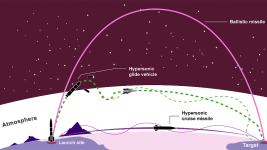
Again this where you show your lack of understanding on what a HGV is. A HGV can change its course and can skip the upper atmosphere following a psuedo random trajectory and avoid radar zones before striking its opponent all while at speeds of Mach 14+. That means it’s rate of success is MAGNITUDES higher than a Emad, right now I would say 90%+

1714429602188.png

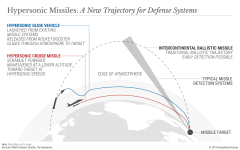
Detection time is also much shorter than an BM (due to speed and flight path)

1714429680976.png

Thus by the time a radar based system locates a HGV or HCM, they likely have less than <90 seconds to impact. And even if it got its best ABMs to lock on to the HGV it’s future path would only be an estimated guess with such limited reaction time chances a interceptor is successful drops to less than <10% maybe even <5%.

Thus a system like Arrow-3 is not designed for such engagements or inter-atmosphere engagements, the hope is Arrow-4 will be able to be more kinetically flexible. But even in such a scenario the ABM would have to fire MULTIPLE interceptors each costing 60-100M+ with the hope that one of them can intercept the HGV successfully on its future (uncertain path).
 
well its a bit strange because it has the same first stage as Fattah-1 so it does seem to leave the atmosphere

but the RV is like a cruise missile and can (only) manoeuvre inside the atmosphere

but I don't see why Fattah couldn't be converted to anti-ship missiles

Fattah is an HGV, an HCM is a cruise missile using a hypersonic scramjet engine to achieve extreme speeds while flying a much lower altitude path. They fly slower (Mach 6-8) than their HGV counterparts but that’s also because of they are lower in atmosphere and have more friction acting up on the object and unlike HGV do not “skip and glide”.

Iran is years away (maybe decades) from having that capability. Iran’s CM tech is subsonic in nature.

HCM are much harder to build than HGVs.
 
Any missile that doesn’t follow a pre-set trajectory.
not that simple and nobody claims that. pseudo random manoeuvring is likely already in place with Kheibar Shekan but then it comes down to kinematics of interceptor vs missile
Irrational copium.
no it's facts

I tried to tell you guys this during Yemen war, but you didn’t want to hear it.

Houthi’s fired 300+ BMs at Saudi Arabia and UAE. A nation right next door (low reaction time) and with much more territory and less advanced shield than Israel. And yet vast majority of BMs were intercepted.
UAE is not next door to Yemen and Riyadh is same distance from Yemen as Israel is from Iran

Again this where you show your lack of understanding on what a HGV is. A HGV can change its course and can skip the upper atmosphere following a psuedo random trajectory and avoid radar zones before striking its opponent all while at speeds of Mach 14+. That means it’s rate of success is MAGNITUDES higher than a Emad, right now I would say 80-90%+

Detection time is also much shorter than an BM (due to speed and flight path)

Thus by the time a radar based system locates a HGV or HCM, they likely have less than <90 seconds to impact. And even if it got its best ABMs to lock on to the HGV it’s future path would only be an estimated guess with such limited reaction time chances a interceptor is successful drops to less than <10% maybe even <5%.

Thus a system like Arrow-3 is not designed for such engagements or inter-atmosphere engagements, the hope is Arrow-4 will be able to be more kinetically flexible. But even in such a scenario the ABM would have to fire MULTIPLE interceptors each costing 60-100M+ with the hope that one of them can intercept the HGV successfully on its future (uncertain path).
how do you avoid 'radar zones' when your target is an entity as small as Israel with multiple overlapping ABM systems that cover the entire territory? space based radars will detect and track it from launch, so the idea it can avoid detection until the last 90 seconds is fantasy

and I don't think Fattah impacts at mach 14 or close to it, that's just the max velocity during the flight. impact velocity is much slower hence it can be defeated by a kinematically superior interceptor

if Fattah-2 has 80-90% chance of evading ABMs then we don't need to worry about anything because we can just send a few Fattah-2s to each Israeli ABM radar and launchers then follow up with large waves of Shahab class MRBMs
 
if Fattah-2 has 80-90% chance of evading ABMs then we don't need to worry about anything because we can just send a few Fattah-2s to each Israeli ABM radar and launchers then follow up with large waves of Shahab class MRBMs

This sounds very interesting, one of the lessons Iran extracted from military retaliation in Israel was the position of Israeli ABM systems. How is that possible? some experts are saying that.

I think Fattah class missiles has not contenders and can strike anything, and it seems they are not the latest and more advanced missiles Iran already has.

Iran must showcase also Iranian supersonic cruisse missiles, because another lesson Iran has is subsonic cruise missiles nowdays are useless against advanced armies.
 
not that simple and nobody claims that. pseudo random manoeuvring is likely already in place with Kheibar Shekan but then it comes down to kinematics of interceptor vs missile

Kheibar Shekan follows an endo atmospheric depressed trajectory using the natural limitation of earth’s curvature to “hide the RV”, hence why it’s [official] range is also depressed. Kehibar Shekan does not do psuedo random trajectory other than a glide path, it simply lacks energy to do that inside the atmosphere. A pull up maneuver just before impact is probably the most it can do. It’s key ability is glide and lower trajectory to stay hidden as long as it can and which forces endo interceptors to be used vs exo.

no it's facts


UAE is not next door to Yemen and Riyadh is same distance from Yemen as Israel is from Iran

UAE is closer and Riyadh is closer to Yemen then Israel is.

Again you avoid acknowledging the that both of those nations had less advanced ABMs than Israel and relied entirely on patriot and still intercepted the vast majority of Shahab-3 derivatives fired at them.

Even now Yemen during shipping wars has struggled with targeting ships reliably with BMs and that’s with Beshad providing up to date targeting.

how do you avoid 'radar zones' when your target is an entity as small as Israel with multiple overlapping ABM systems that cover the entire territory?

You avoid the radar zones that in between Iran and Israel not the ones in israel. Saudi Arabia, Jordan, Egypt everyone was sharing radar data with US
space based radars will detect and track it from launch,

That’s not how it works, you been watching too much Hollywood movies. I literally posted graphics from credible sources.

You confuse satellites with infrared detection capabilities that detect the hot booster start of a missile as it exits the TEL.

Shortly after reaching upper stages of atmosphere the HGV separates and begins its psuedo random path and no there is no “space based radar” that can track a Mach 14 object as it ripples thru the upper atmosphere. There’s hundreds of thousands of debris in space, any space radar would be “pinging” so many objects it would be indicated with noise. I think you are confusing the capacities of ISR.

There are early attempts to build a future infrared satellite constellation that will attempt to look for the plasma plume of the HGV, but this assumes that HGVs stay very very expensive (ie 50-100M+ a missile). If Iran can bring the cost down to $5M or less and be able to use multiple HGVs the economics favors Iran drastically as it’s unlikely that US/Israel will be able to create an interceptor cheaper than $75M.

and I don't think Fattah impacts at mach 14 or close to it, that's just the max velocity during the flight.

No one here said Mach 14th is terminal velocity, it’s actually the most important is in-flight that reduces reaction time. Currently it’s 8-10 mins using Iran’s current missiles. Assuming that max speed of those is mach 8-10, even a 30% reduction in travel time is highly significant factor plus instead of at a max apogee with a booster attached you are in the upper atmosphere just a wedge warhead again reducing radar observance. Add into the fact that HGVs have lower RCS due to lower drag surfaces (especially wedge) and lower flight path and you have a much harder target to locate even as TV drops to below Mach 7.

impact velocity is much slower hence it can be defeated by a kinematically superior interceptor

Oh look you solved the problem. I guess Russia/China/Iran/North Korea/America/UK all going for Hypersonics are naive and should have just consulted you.

Any interceptor will be a glorified BM. Kinetics go to the challenger as it’s merely a low drag wedge shaped warhead plummeting downward using gravity to its advantage and any ABM is a fuel loaded rocket going against gravity.

Here is arrow 3 (notice the limited launchers)
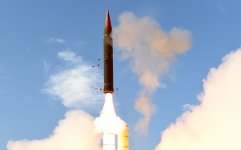
1714447135561.jpeg

Arrow-3 is already likely at a major kinteic disadvantage against Fattah-2 just like S-500 is against the same class missile. Arrow-4 remains to be seen what interceptor they select, but it’s high doubtful it will be cheap. You have some interceptors in the $100M range.

To be nimble inside the atmosphere requires some clever engineering to be able to pull high G’s forces necessary to play cat and mouse.

if Fattah-2 has 80-90% chance of evading ABMs then we don't need to worry about anything because we can just send a few Fattah-2s to each Israeli ABM radar and launchers then follow up with large waves of Shahab class MRBMs

The main question becomes how much does Fattah-2 cost and how many can iran produce under sanctions. Everyone here assumes it’s cheap, but that’s unlikely especially once you get to true wedge HGVs which I assume would be closer to North Korea’s
1714446539484.png

Most HGVs field by China and Russia and US are going to be very expensive. But they will tasked with carrying a nuclear payload so the cost off-set the mighty importance (break thru the shield and deliver a nuclear hit to your opponent at a success % rate that forces your opponent to avoid war)

But in Iran’s case it’s HGVs will be conventional and much like a conventional ICBM, the issue will cost and practicality of a conventional warhead. If Fattah-2 or future Fattah-3 costs Iran $10M a missile (not unheard of) and Qiam costs Iran $100-200K a missile then that’s a big gap and I’m not sure what Iran’s leadership will do.

To be able to reliably target the main radars of THAAD and arrow-3/4, iran will need much better ISR in the future to be able to locate these radars prior and during conflict. This is an area that Russia itself is currently lacking compared to NATO. So it’s not very easy. But here Israel’s limited size works against it, as Iran can locate potential installations much faster than Russia in a much bigger Ukraine.
 
Last edited:
To view this content we will need your consent to set third party cookies.
For more detailed information, see our cookies page.
 
but the Israeli ABM shield is the most advanced and dense in the world and only has to cover a tiny entity with 10 mins+ warning time from launches in Iran (if Iran doesn't make the launch obvious in advance). so I don't think any of us were under the impression Iran could fire 1 of any magical ABM evading missile and get through every time. that's just not going to happen. and saturation is precisely Iran's strategy.

let's assume the worst: Iran did fire c. 100 MRBMs and only c. 9 got through (9% success rate, or 18% if we discount those that apparently failed to launch). Israel used c. 25% of its entire Arrow interceptor stockpile to intercept c. 40 mostly SCUD based MRBMs. is that a good trade off? is that sustainable? 3-4 more of those waves and suddenly Israel's interception capability is severely depleted and every missile will have a better chance of meeting Mohsen's criteria of likelihood of impacting!
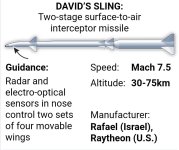
The issue with Israeli ABM defence is that there's a very very significant gap in capabilities between available systems, namely between Iron Dome and David's Sling.

Iron Dome is a (somewhat) sustainable system with cheap interceptors, but in turn, has extremely limited capabilities due to rudimentary seeker head and limited flight performance, which means it is really a terminal intercept, point defence system designed to hit slow and low targets with head-on intercept. David's Sling is a proper area air defence system with fast terminal speed, which enables side intercept thus enabling true area AD analogous with PAC.

The key weakness in this setup is that there's a clear gap between this two-tiered AD setup (at least for the time being), especially with David's Sling having a per-unit cost of allegedly 1 million USD and, more importantly, a very low production rate. Keep in mind that by Israeli definition, a successful intercept is when they identify threats, decide to intercept, launch 2 missiles, and destroy the target, which pushes the cost of intercept even higher.

A lot of the newer Iranian & Friends' missiles are very clearly exploiting this weakness, having a terminal speed just barely above Mach 2-3, making it difficult for Iron Dome to intercept, but far too expensive to intercept with David's Sling.
 
The issue with Israeli ABM defence is that there's a very very significant gap in capabilities between available systems, namely between Iron Dome and David's Sling.

Iron Dome is a (somewhat) sustainable system with cheap interceptors, but in turn, has extremely limited capabilities due to rudimentary seeker head and limited flight performance, which means it is really a terminal intercept, point defence system designed to hit slow and low targets with head-on intercept. David's Sling is a proper area air defence system with fast terminal speed, which enables side intercept thus enabling true area AD analogous with PAC.

The key weakness in this setup is that there's a clear gap between this two-tiered AD setup (at least for the time being), especially with David's Sling having a per-unit cost of allegedly 1 million USD and, more importantly, a very low production rate. Keep in mind that by Israeli definition, a successful intercept is when they identify threats, decide to intercept, launch 2 missiles, and destroy the target, which pushes the cost of intercept even higher.

A lot of the newer Iranian & Friends' missiles are very clearly exploiting this weakness, having a terminal speed just barely above Mach 2-3, making it difficult for Iron Dome to intercept, but far too expensive to intercept with David's Sling.
This guy is a typical Youtube liar that claims to have data about something everyone wonders about and follow a typical CENTCOM agenda of "It sUcKs", on every subject there is this son of bastard on Youtube claiming to be an insider but "cannot post the proof", so unless he proves to people what he says, he is this typical Youtube pseudo-researcher liar
 
To view this content we will need your consent to set third party cookies.
For more detailed information, see our cookies page.


To view this content we will need your consent to set third party cookies.
For more detailed information, see our cookies page.
 
The issue with Israeli ABM defence is that there's a very very significant gap in capabilities between available systems, namely between Iron Dome and David's Sling.

Not true.

Iron Dome is a (somewhat) sustainable system with cheap interceptors, but in turn, has extremely limited capabilities due to rudimentary seeker head and limited flight performance, which means it is really a terminal intercept, point defence system designed to hit slow and low targets with head-on intercept.

Yes and it’s pretty successful given the workload it’s under. No system is perfect, but iron dome is a successful weapon system all things considered. The alternative (nothing) would certainty be worse.

David's Sling is a proper area air defence system with fast terminal speed, which enables side intercept thus enabling true area AD analogous with PAC.

David’s Sling is meant to replace PAC-2 not operate in conjunction with it.

To view this content we will need your consent to set third party cookies.
For more detailed information, see our cookies page.


The key weakness in this setup is that there's a clear gap between this two-tiered AD setup (at least for the time being),

There is no gap. Not sure what you are referring to.

Iron Dome > Iron Beam (laser) > David’s sling > Arrow 2/3 (traditional BMs) > THAAD/Arrow-4 (next gen BMs)

That is one of the most capable air defense IADS in the world. Most militaries don’t come close to that.


especially with David's Sling having a per-unit cost of allegedly 1 million USD

Very reasonable interceptor cost (if true). Patriot interceptor cost is $3M. So you a talking 1/3 cost and better endo maneuverability vs bulky TVC based systems.


and, more importantly, a very low production rate.

Do you work in the factories?

Keep in mind that by Israeli definition, a successful intercept is when they identify threats, decide to intercept, launch 2 missiles, and destroy the target, which pushes the cost of intercept even higher.

That is not a Israeli thing. Russian systems also use a two missile protocol as does Patriot.

A lot of the newer Iranian & Friends' missiles are very clearly exploiting this weakness,

No they are not. Iranian strategy from 2008-2020 was a saturation strategy. They are now slowly moving to an evasion strategy by using glide vehicles, HGV, and MaRVs (Fattah-1).

having a terminal speed just barely above Mach 2-3,

What?

making it difficult for Iron Dome to intercept,

Well Iron Dome is for rockets, drones, and artillery not Mach 3+ missiles (more like Mach 6+ but whatever).

but far too expensive to intercept with David's Sling.

Lol what? $1M per interceptor is too expensive? Someone call Ukraine and tell them to stop blowing 10 interceptors ($30M) every interception attempt or Saudi Arabia for emptying hundreds of patriot interceptors during their war on Yemen.

1714496637403.jpeg

To view this content we will need your consent to set third party cookies.
For more detailed information, see our cookies page.
 
Excellent shots of the almas being used in lofted trajectory strikes against targets under cover by hezbollah.
This really does show you its advantage over the conventional line of sight types like the kornet.
To view this content we will need your consent to set third party cookies.
For more detailed information, see our cookies page.
 

Users who are viewing this thread

Back
Top