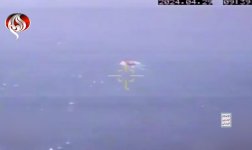
not that simple and nobody claims that. pseudo random manoeuvring is likely already in place with Kheibar Shekan but then it comes down to kinematics of interceptor vs missile
Kheibar Shekan follows an endo atmospheric depressed trajectory using the natural limitation of earth’s curvature to “hide the RV”, hence why it’s [official] range is also depressed. Kehibar Shekan does not do psuedo random trajectory other than a glide path, it simply lacks energy to do that inside the atmosphere. A pull up maneuver just before impact is probably the most it can do. It’s key ability is glide and lower trajectory to stay hidden as long as it can and which forces endo interceptors to be used vs exo.
no it's facts
UAE is not next door to Yemen and Riyadh is same distance from Yemen as Israel is from Iran
UAE is closer and Riyadh is closer to Yemen then Israel is.
Again you avoid acknowledging the that both of those nations had less advanced ABMs than Israel and relied entirely on patriot and still intercepted the vast majority of Shahab-3 derivatives fired at them.
Even now Yemen during shipping wars has struggled with targeting ships reliably with BMs and that’s with Beshad providing up to date targeting.
how do you avoid 'radar zones' when your target is an entity as small as Israel with multiple overlapping ABM systems that cover the entire territory?
You avoid the radar zones that in between Iran and Israel not the ones in israel. Saudi Arabia, Jordan, Egypt everyone was sharing radar data with US
space based radars will detect and track it from launch,
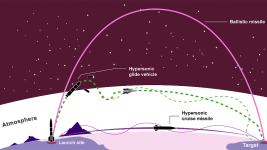
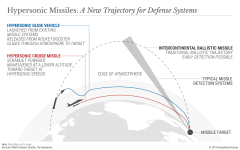
That’s not how it works, you been watching too much Hollywood movies. I literally posted graphics from credible sources.
You confuse satellites with infrared detection capabilities that detect the hot booster start of a missile as it exits the TEL.
Shortly after reaching upper stages of atmosphere the HGV separates and begins its psuedo random path and no there is no “space based radar” that can track a Mach 14 object as it ripples thru the upper atmosphere. There’s hundreds of thousands of debris in space, any space radar would be “pinging” so many objects it would be indicated with noise. I think you are confusing the capacities of ISR.
There are early attempts to build a future infrared satellite
constellation that will attempt to look for the plasma plume of the HGV, but this assumes that HGVs stay very very expensive (ie 50-100M+ a missile). If Iran can bring the cost down to $5M or less and be able to use multiple HGVs the economics favors Iran drastically as it’s unlikely that US/Israel will be able to create an interceptor cheaper than $75M.
and I don't think Fattah impacts at mach 14 or close to it, that's just the max velocity during the flight.
No one here said Mach 14th is terminal velocity, it’s actually the most important is in-flight that reduces reaction time. Currently it’s 8-10 mins using Iran’s current missiles. Assuming that max speed of those is mach 8-10, even a 30% reduction in travel time is highly significant factor plus instead of at a max apogee with a booster attached you are in the upper atmosphere just a wedge warhead again reducing radar observance. Add into the fact that HGVs have lower RCS due to lower drag surfaces (especially wedge) and lower flight path and you have a much harder target to locate even as TV drops to below Mach 7.
impact velocity is much slower hence it can be defeated by a kinematically superior interceptor
Oh look you solved the problem. I guess Russia/China/Iran/North Korea/America/UK all going for Hypersonics are naive and should have just consulted you.
Any interceptor will be a glorified BM. Kinetics go to the challenger as it’s merely a low drag wedge shaped warhead plummeting downward using gravity to its advantage and any ABM is a fuel loaded rocket going against gravity.
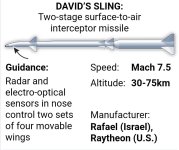
Here is arrow 3 (notice the limited launchers)
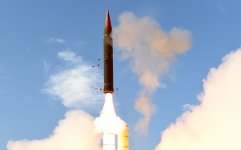
Arrow-3 is already likely at a major kinteic disadvantage against Fattah-2 just like S-500 is against the same class missile. Arrow-4 remains to be seen what interceptor they select, but it’s high doubtful it will be cheap. You have some interceptors in the $100M range.
To be nimble inside the atmosphere requires some clever engineering to be able to pull high G’s forces necessary to play cat and mouse.
if Fattah-2 has 80-90% chance of evading ABMs then we don't need to worry about anything because we can just send a few Fattah-2s to each Israeli ABM radar and launchers then follow up with large waves of Shahab class MRBMs
The main question becomes how much does Fattah-2 cost and how many can iran produce under sanctions. Everyone here assumes it’s cheap, but that’s unlikely especially once you get to true wedge HGVs which I assume would be closer to North Korea’s
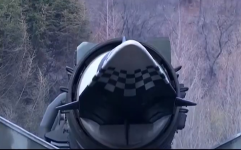
Most HGVs field by China and Russia and US are going to be very expensive. But they will tasked with carrying a nuclear payload so the cost off-set the mighty importance (break thru the shield and deliver a nuclear hit to your opponent at a success % rate that forces your opponent to avoid war)
But in Iran’s case it’s HGVs will be conventional and much like a conventional ICBM, the issue will cost and practicality of a conventional warhead. If Fattah-2 or future Fattah-3 costs Iran $10M a missile (not unheard of) and Qiam costs Iran $100-200K a missile then that’s a big gap and I’m not sure what Iran’s leadership will do.
To be able to reliably target the main radars of THAAD and arrow-3/4, iran will need much better ISR in the future to be able to locate these radars prior and during conflict. This is an area that Russia itself is currently lacking compared to NATO. So it’s not very easy. But here Israel’s limited size works against it, as Iran can locate potential installations much faster than Russia in a much bigger Ukraine.