India - China History and Relations

Recently, there has been much discussion in China about the protection of agricultural land.

When I looked up the data, I found a very interesting question.
1. Total population: India 1,429,200,000 (1); China 1,409,670,000 (2).
2. Cultivated land area: India 1,765,260 (1); China 1,476,925 (3).
3. Grain production: India 314 million tonnes (3); China 682 million tonnes (1).
Figures in parentheses are world rankings. There may be some discrepancies in the figures; they are not the focus of the discussion.

Focus of discussion:
China is the world's leading food importer. in the first half of 2024, China's total food imports reached 84.18 million tonnes, while its total food exports during the same period were only 1 million tonnes.
I could not find the latest data on India's total food imports and exports. Overall, India is a food exporter and its total food exports are greater than its total food imports.
The total population of China and India is roughly the same, but there is a huge difference in per capita food consumption.

As ordinary Chinese, we don't have a lot of food wastage in our daily lives and we eat ordinary food.

I am curious to know how India manages to feed a much larger population with a small amount of food.
 
Recently, there has been much discussion in China about the protection of agricultural land.

When I looked up the data, I found a very interesting question.
1. Total population: India 1,429,200,000 (1); China 1,409,670,000 (2).
2. Cultivated land area: India 1,765,260 (1); China 1,476,925 (3).
3. Grain production: India 314 million tonnes (3); China 682 million tonnes (1).
Figures in parentheses are world rankings. There may be some discrepancies in the figures; they are not the focus of the discussion.

Focus of discussion:
China is the world's leading food importer. in the first half of 2024, China's total food imports reached 84.18 million tonnes, while its total food exports during the same period were only 1 million tonnes.
I could not find the latest data on India's total food imports and exports. Overall, India is a food exporter and its total food exports are greater than its total food imports.
The total population of China and India is roughly the same, but there is a huge difference in per capita food consumption.

As ordinary Chinese, we don't have a lot of food wastage in our daily lives and we eat ordinary food.

I am curious to know how India manages to feed a much larger population with a small amount of food.

China has like 10x or so higher meat consumption than India. Meat takes a lot of extra grain to feed....so China has lot larger grain consumption totals.
 
China has like 10x or so higher meat consumption than India. Meat takes a lot of extra grain to feed....so China has lot larger grain consumption totals.
The Chinese do like to eat meat. China imports large quantities of soybeans from the United States and Brazil. The dregs of these soybeans left behind after the oil is extracted are used to feed meat pigs. Eventually, these meat hogs become food for the Chinese.
My family of three, on average, consumes about 250g of pork per day.

Meanwhile, the Chinese consume a huge amount of alcohol. Both baijiu and huangjiu, which are favored by the Chinese, require the use of large quantities of grain to brew.
I drink about 200g of baijiu every day.

So, what is the average Indian's consumption of meat and wine a like? It shouldn't be a 10x difference.
 
The Chinese do like to eat meat. China imports large quantities of soybeans from the United States and Brazil. The dregs of these soybeans left behind after the oil is extracted are used to feed meat pigs. Eventually, these meat hogs become food for the Chinese.
My family of three, on average, consumes about 250g of pork per day.

Meanwhile, the Chinese consume a huge amount of alcohol. Both baijiu and huangjiu, which are favored by the Chinese, require the use of large quantities of grain to brew.
I drink about 200g of baijiu every day.

So, what is the average Indian's consumption of meat and wine a like? It shouldn't be a 10x difference.
China also exports meat and liquor, both of which require food grains.
 
China has like 10x or so higher meat consumption than India. Meat takes a lot of extra grain to feed....so China has lot larger grain consumption totals.
Indian pork is of much better quality than Chinese pork, yet India has not fully capitalized on this resource. Pork consumption and exports should be encouraged in India, as it is a valuable source of protein.
 
In general Chinese see india as a china wanna bee....

but Chinese think of indians as

> full of crap (literally)
> much lower on productivity scale
> poor quality production (just look at china india trade gap)
> horrible infrastructure
> absurd customs
> dirty and disorganized
Chinese social media does have some of what you're talking about, but it's not my opinion or the opinion of all Chinese people. China is currently in the age of self media and certain people can do a lot of crazy things for web traffic.

I prefer to see some realities and the logic and reasons for some phenomena. I know it is very difficult to get the truth in the current environment of China-India relations, but I am still trying my best.
 
The Chinese do like to eat meat. China imports large quantities of soybeans from the United States and Brazil. The dregs of these soybeans left behind after the oil is extracted are used to feed meat pigs. Eventually, these meat hogs become food for the Chinese.
My family of three, on average, consumes about 250g of pork per day.

Meanwhile, the Chinese consume a huge amount of alcohol. Both baijiu and huangjiu, which are favored by the Chinese, require the use of large quantities of grain to brew.
I drink about 200g of baijiu every day.

So, what is the average Indian's consumption of meat and wine a like? It shouldn't be a 10x difference.
Pork in India is not as popular as it is in China, and it's unclear why the Indian government is not focusing on the mass production, consumption, and export of pork. Indian pork is of excellent quality, and the breeds of pigs found in India have a uniquely distinct taste.
If you ever visit India, be sure to try the local pork—you’ll become a fan of its unique taste.
 
Indian pork is of much better quality than Chinese pork, yet India has not fully capitalized on this resource. Pork consumption and exports should be encouraged in India, as it is a valuable source of protein.
In the face of China's huge population base, only industrially farmed meat hogs can satisfy Chinese demand. It is not enough for us to rely solely on meat pigs raised in farmers' homes to supply pork.
In China's farmers' markets, pork is categorized into feed pork and grain pork, and there is a big difference in their prices. The public chooses for themselves what kind of pork to buy.

China's meat imports are mainly beef. I have not heard of pork imports.
If the quality of pork in India is really very good, try going the high end food import route. The prerequisite is that India's pork must be very good. You can refer to Thai rice in China, they have been dominating the Chinese high-end rice market.

Bonus Fun Fact: In recent years. China's largest beef importer is Huawei. Yes, you read that right, the same Huawei company that makes cell phones.
 
Last edited:
In the face of China's huge population base, only industrially farmed meat hogs can satisfy Chinese demand. It is not enough for us to rely solely on meat pigs raised in farmers' homes to supply pork.
In China's farmers' markets, pork is categorized into feed pork and grain pork, and there is a big difference in their prices. The public chooses for themselves what kind of pork to buy.

China's meat imports are mainly beef. I have not heard of pork imports.
If the quality of pork in India is really very good, try going the high end food import route. The prerequisite is that India's pork must be very good. You can refer to Thai rice in China, they have been dominating the Chinese high-end rice market.

Bonus Fun Fact: In recent years. China's largest beef importer is Huawei. Yes, you read that right, the same Huawei company that makes cell phones.
Cow beef cannot be permitted in India due to the country’s Hindu majority, as Hindu philosophy regards the cow as a mother figure because it provides milk. However, India has the potential to capitalize on pork. I’m a big fan of Indian pork, but it’s not yet available in packaged form in the international market.
 
Cow beef cannot be permitted in India due to the country’s Hindu majority, as Hindu philosophy regards the cow as a mother figure because it provides milk. However, India has the potential to capitalize on pork. I’m a big fan of Indian pork, but it’s not yet available in packaged form in the international market.
Indian pork can try to be exported to China, but on two conditions:
1. political relations. At least China needs to agree to import Indian pork. China's Ministry of Commerce has publicly available rules regarding food imports.
2, The Indian pork industry has to be strong enough in the face of competition from China, which has a huge pork industry of its own. Pork Quality, Corporate Strength, Marketing Plan .............
Please refer to Thai rice in China. I don't think Indian pork companies can survive competition in China's fiercely competitive pork market. But it can be tried on a small scale.
 
All human actions must ultimately be within the bounds of human psychology and sociology. Human interactions are complex(*); state-to-state interactions infinitely more so. There was a brief discussion earlier in this thread about Thucydides Trap and possible exceptions.

Only time will tell.

* As an aside, my favorite theory of human evolution asserts that the taming of fire was the single most important event in human evolution. Aside from the defensive, offensive, and nutritional benefits that fire brought, the campfire spurred the formation of complex societal structures which, in turn, took the art of politics to a new high. Humans had to anticipate, plan and counter-plan around what other humans might do, and this was far more complicated than planning a simple hunt against animals. (Even animals have rudimentary societies and can plan a pack hunt so that by itself doesn't require big brains.) It is politics, therefore, which gave an evolutionary impetus for the development of larger brains. Anyway, sorry for the off-topic.
Love the campfires and the entailing discussions .... psychedelic ones are the best ..... (good thread , ignore my post if it's a hinderence )
 
Nice discussion going on here that I missed . ..I will go through all of it and threw in my few cents if I could collect some .
 
Pork in India is not as popular as it is in China, and it's unclear why the Indian government is not focusing on the mass production, consumption, and export of pork. Indian pork is of excellent quality, and the breeds of pigs found in India have a uniquely distinct taste.
If you ever visit India, be sure to try the local pork—you’ll become a fan of its unique taste.
The sorpotel is quite good, nice and salty, perfect little quick snack but its made of the worst bits, baloney.. just spiced good.

In Manipur etc they make pork curry which is to be had with rotis.. super delish.

Coorg do the best version in all my tastings of desi pork.. pandi curry, that shit is to die for.

Beef ki bhi lots of dishes here regionally, like the errachi fry (stir fry) from Kerala, north east do their own versions too.

I like Goat/lamb the best of the desi meat offerings but.. nothing beats a good burra !

image

🤤
 
The sorpotel is quite good, nice and salty, perfect little quick snack but its made of the worst bits, baloney.. just spiced good.

In Manipur etc they make pork curry which is to be had with rotis.. super delish.

Coorg do the best version in all my tastings of desi pork.. pandi curry, that shit is to die for.

Beef ki bhi lots of dishes here regionally, like the errachi fry (stir fry) from Kerala, north east do their own versions too.

I like Goat/lamb the best of the desi meat offerings but.. nothing beats a good burra !

image

🤤
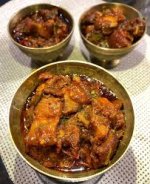
I don’t eat any kind of beef, but I really miss Indian pork, especially the version made with extra garlic. It’s very popular in Bihar, Nepal, Bengal, and the Northeast. The wild black pigs found in India have a flavor that is quite different from the industrial pork available anywhere else in the world.
1727430219775.jpeg1727430219775.jpeg
 
I don’t eat any kind of beef, but I really miss Indian pork, especially the version made with extra garlic. It’s very popular in Bihar, Nepal, Bengal, and the Northeast. The wild black pigs found in India have a flavor that is quite different from the industrial pork available anywhere else in the world.
China has very strict wildlife protection laws. Wild boars are legally protected animals and illegal hunting is prohibited. These wild animals are also not allowed to be driven or killed if they infringe on farmland or houses. It is up to the government to pay for the damages.

Recently, there is a place in China that is flooded with wild boars. The local government invites people to hunt and kill on a limited basis, however, the use of guns or drugs is prohibited. The hunted wild boars are handed over to the government for disposal, and the government pays for the hunts.

Chinese people prefer to eat wild animals, and the current wild boar meat is all artificially bred wild boar. If India can provide large quantities of high quality wild boar meat, this will be a very good market. However, due to completely different eating habits, these wild boars will be difficult to sell if they are processed and then sold to China. Therefore, direct supply of wild boar meat is the best option.
 

Users who are viewing this thread

Back
Top