Bangladesh Socio-Political Crisis 2024 and onwards

Of course they knew there was an expiry date on their asset. Unfortunate for them their asset didn't know it. And it is because of that arrogance of Sheikh Hasina, she accelerated her downfall rapidly.

As for Indian government - even though Hasina is gone, they have the system in place, i.e. the ultra secular Islamophobic left (the Shahbagis) and the Hindutva flag bearers. There is a wonderful harmony between these two groups in Bangladesh. And from these group they will bring in their replacement for their asset Hasina.

We are already seeing reputation repair and sabotaging of reforms in motion simultaneously in Bangladesh. On one hand you have the mainstream media with the likes of Prothom Alo and Daily Star. And on the other hand you have social media where rumours are being generated non-stop. And also the dual agents within the CG itself.

The objective is to create chaos, divide people and then introduce BAL 2.0 with fresh faces, who nonetheless will serve the same role as that of Hasina.

That would explain why the Indians knew something was afoot and had known the plan since at least 2020 but did nothing or could do nothing to save Hasina as she would not face reality very much like Sheikh Mujib who did not believe that the people would turn against him ...
 
That would explain why the Indians knew something was afoot and had known the plan since at least 2020 but did nothing or could do nothing to save Hasina as she would not face reality very much like Sheikh Mujib who did not believe that the people would turn against him ...

The family suffers from delusion. Just watch Joy's videos and Hasina's phone calls. They are having hard time accepting reality.
 
😄 😄 😄 Funny man.

This man was instrumental on the diplomatic ground in giving Awami League complete control of the country during the 2007-2009 period.

I believe the agitation would have stopped after the Supreme Court judgment, which reduced the quota to only 7 per cent. More than 300 people died during those agitations. The protesters returned with a nine-point demand. They wanted the resignation of ministers, the police commissioner, and so on. Now, why they did that is a mystery. And my view is that there were other influences at work there — mostly foreign and some internal. Since Hasina obviously did not agree to sack her ministers they went on a rampage again. And this time, I think, it was a very well-oiled machine backing them.

Bullshit.

She’s been here before, stayed from 1975 to ’81, when her whole family was murdered as part of a political plot. She’s back again. Does she have a future as a political leader of the Awami League (AL)? I would say we cannot dismiss the possibility that the AL reorganises, they are not a party that will disappear. They will participate in the next elections. Would Hasina then go back? She’ll have to face cases and inquiries, and they might put her in jail. It’s what was done to Khaleda Zia, and revenge politics is very much possible. But will the AL produce a new leader? These are all possibilities. Whether Hasina will continue to stay here, is her choice. I don’t think the government of India is going to push her out.

Well, she killed 1,500-2,000 people. I know the innocent until proven guilty thingy, but she's guilty. That pain and memory won't go away easily in our minds. And that will weigh in on the AL heavily.

You know what? This makes me want to vote to get the AL banned even more. Bangladesh is not somebody's else's personal property.
 
Last edited:
How rickshaw puller Noor tried to save Nafiz

Golam Nafiz, who was unconscious after being hit by the bullet, is hanging from the rickshaw's legs. Flag tied on one side of the head. Dull legs droop. This scene made thousands of people cry.

Ignoring the bloodshed and threats of the police, the brave rickshaw puller Noor Mohammad first tried to take Nafiz to a hospital near Farmgate.

On today's Star Connects Noor narrates the story to The Daily Star.

Video in the link: https://www.thedailystar.net/star-m...rickshaw-puller-noor-tried-save-nafiz-3725441
 
To view this content we will need your consent to set third party cookies.
For more detailed information, see our cookies page.
 
😄 😄 😄 Funny man.

This man was instrumental on the diplomatic ground in giving Awami League complete control of the country during the 2007-2009 period.


Bullshit.


Well, she killed 1,500-2,000 people. I know the innocent until proven guilty thingy, but she's guilty. That pain and memory won't go away easily in our minds. And that will weigh in on the AL heavily.

You know what? This makes me want to vote to get the AL banned even more. Bangladesh is not somebody's else's personal property.
There are people when rubbed the wrong way, take it very seriously. I believe the July killings put the trajectory in critical mass mode. There was no turning back. At that point the movement needed no external help.
The point is AL is a criminal entity, it is not a political party. It hasn't been for the last 15 years.
 
There are people when rubbed the wrong way, take it very seriously. I believe the July killings put the trajectory in critical mass mode. There was no turning back. At that point the movement needed no external help.
The point is AL is a criminal entity, it is not a political party. It hasn't been for the last 15 years.

The AL never quite got out of their underground practices in the lead up to 1971. It had always been a criminal-like enterprise refusing to adopt practices to become a legitimate political party as any party should be.
 
Former Indian High Commissioner to Bangladesh Pinak Ranjan Chakravarty on the ties between the two countries and the interim government in Bangladesh. The session was moderated by Shubhajit Roy, Diplomatic Affairs Editor

Written by Shubhajit Roy
New Delhi | October 12, 2024

View attachment 71706

This Explained Live event was held on August 30. Since then, the interim government has announced a nine-member commission to review and evaluate the country’s Constitution and recommend necessary reforms. Muhammad Yunus, the Chief Adviser to the government, expressed discomfort at Sheikh Hasina making statements about Bangladesh from India, where she has been since she fled the country amid protests. However, Yunus recently said Dhaka-Delhi relations should be “very close” despite the regime change, saying it would be in the interest of both countries. On the economic front, inflation remains high in Bangladesh.

On what the Sheikh Hasina government meant for Bangladesh​

It certainly meant that Bangladesh became one of the fastest-growing economies in Asia. It also had a stable relationship with India. Indian investments were made in Bangladesh, and we developed energy connectivity, railway and transport links. The two economies were increasingly getting integrated to benefit both, and trade grew to almost $18 billion (pre-Covid figures). Bangladeshis also became the largest set of foreign visitors to India.

On the negative side, there were allegations of elections not being free and fair. The other major party, the Bangladesh Nationalist Party (BNP), also boycotted the polls. Then the Jamaat-e-Islami was banned as a political organisation and a party.

Hasina also banned the Jamaat’s student wing, the Islamic Chhatra Shibir. Plus, she instituted the International War Crimes Tribunal, for the Jamaat leaders who were pro-Pakistan in 1971. Those leaders were convicted and hanged; that created bad blood. Then the BNP’s leader Khaleda Zia was convicted of corruption. Such domestic developments gave the feeling that Sheikh Hasina was becoming increasingly authoritarian. India had no role to play in those things; they were entirely domestic.

On India’s relationship with the Bangladesh govt under Hasina​

India’s problems with the previous BNP-Jamaat government were over security issues and their dalliance with Pakistan’s Inter-services Intelligence (ISI). The BNP has always been a little right-wing and pro-Pakistan. Jamaat, of course, has always been very pro-Pakistan, although they now claim that they are different. The BNP, too, claims they have changed.

But when Sheikh Hasina came to power in 2009, she said they would not allow their soil to be used against Indian security interests. This was something she lived up to. The United Liberation Front of Asom (ULFA) Assam insurgency leaders were handed over to India. She ensured the insurgents’ camps were uprooted and handed over. So on that score, Hasina fulfilled one of our major concerns, of security.

She also realised that on the economic side, it would be best to cooperate fully with India. I remember how Hasina first told me that she needed electricity from India. That is how the project began for connecting the grids. Today, we provide almost 1,200 megawatts. We also planned the Numaligarh refinery pipeline to northern Bangladesh, to provide diesel and petroleum products, which helps our economy by powering boats and other riverine cargo that goes everywhere, as it is a country of rivers.

On the dissatisfaction with the economy, especially among the youth​

I think people welcomed the economic growth until the Ukraine war broke out and the energy and food prices went sky high. Further, Bangladesh’s growth was probably not equitable. The jobs created were insufficient and a younger generation was entering the economy. That’s why the anti-quota agitation came in since quotas blocked employment in the government. Plus, with the elections, the new voters felt that they were not getting a choice. That also added to the rising dissatisfaction.

The quota system started in 1972 after the 1971 War of Liberation. The government then decided to give some preference to those who fought for Bangladesh’s freedom and fixed a quota for them in public jobs. Over the years, once that generation passed on, they demanded that the quota be continued and given to their children, and later to their grandchildren.

The dissent stemmed from the fact that if you include the other quotas for minorities, women, etc., it came to almost 56 per cent. In 2012, an anti-quota movement first began. In 2018, Sheikh Hasina decided to remove the quotas and issued a government order cancelling them, which was challenged by those benefitting from the provision. The High Court then stayed the order and that’s when the agitation began again.

On how the anti-quota agitation grew​

I believe the agitation would have stopped after the Supreme Court judgment, which reduced the quota to only 7 per cent. More than 300 people died during those agitations. The protesters returned with a nine-point demand. They wanted the resignation of ministers, the police commissioner, and so on. Now, why they did that is a mystery. And my view is that there were other influences at work there — mostly foreign and some internal. Since Hasina obviously did not agree to sack her ministers they went on a rampage again. And this time, I think, it was a very well-oiled machine backing them.

Why did it turn so political, with the march to Dhaka and demands for the PM’s resignation? That is also a question. I would say that ultimately it was the army that unseated her by saying that, no, we can’t protect you. We will not fire on these protesters.

On whether India saw this coming​

Did we know about the things happening in Bangladesh? Of course, we knew. But the question is whether Sheikh Hasina anticipated her downfall. My sense is that she didn’t, maybe if you stay for 15 years in power, then you feel that everything is okay.

On the interim government led by Muhammad Yunus​

It comprises different kinds of people. There is a leader of the far-right group Hefazat-e-Islam Bangladesh. Then there are BNP sympathisers. And then, of course, Professor Yunus is there. He’s a big, internationally-known figure. I would say he’s very anti-Hasina and she has slammed several legal cases against him, for things such as embezzlement. My worry is, will they (different sections) be able to work together? All of them could pull the government in different directions. There are two student leaders in the advisory council and apparently, there are two student appointees in every ministry to oversee what it does. Of course, some indicators are there. For example, Prof Yunus has said we must revive the South Asian Association for Regional Cooperation (SAARC). He has also reportedly said that he would want Bangladesh to join The Association of Southeast Asian Nations (ASEAN). But ultimately, reality will bite. Things are still all over the place. Hindus were also attacked, unfortunately, they are seen as Awami League supporters. In 2001, when the BNP-Jamaat government came to power, the same thing happened.

On Sheikh Hasina’s presence in India​

She’s been here before, stayed from 1975 to ’81, when her whole family was murdered as part of a political plot. She’s back again. Does she have a future as a political leader of the Awami League (AL)? I would say we cannot dismiss the possibility that the AL reorganises, they are not a party that will disappear. They will participate in the next elections. Would Hasina then go back? She’ll have to face cases and inquiries, and they might put her in jail. It’s what was done to Khaleda Zia, and revenge politics is very much possible. But will the AL produce a new leader? These are all possibilities. Whether Hasina will continue to stay here, is her choice. I don’t think the government of India is going to push her out.

I clearly remember this gentleman along with Bina Sikri, sujeta Singh and other Indian dignitaries went above and beyond their profession profile to support Haisna's rehabilitation in Bd politics. They acted as they were Awami's activists..

They also played crucial role behind the unjust killing of nationalist Jamat and BNP leaders in the name of "71 war crime"

Indian politicians put a permanent scar between Bd-India relationship which will not recover any time soon.

I got nothing against good people of Indian but I despise their policy makers due to their one sided support for Awami League, and economic and cultural aggression towards Bd.
 
The current government came to power with promises of systemic reform and state reorganization. However, the alarming rise of mob justice across Bangladesh suggests a shift from reform to revenge. Since the police returned to duty on August 11, 21 people have been beaten to death in 38 days, with only eight arrests. This highlights the failure of law enforcement to curb mob violence

By Monira Nazmi Jahan Oct 14, 2024

1_8.jpg

On August 5, Bangladesh underwent a significant political upheaval as the government was overthrown in a revolution. On the same day, former Prime Minister Sheikh Hasina resigned and left the country. Protesters' demands led to the establishment of an interim government, with Dr. Muhammad Yunus serving as Chief Advisor. The public, filled with anticipation for a new era, widely hoped that this new administration would eradicate vandalism, discrimination, looting, corruption, and violence while restoring the rule of law. However, a disturbing wave of mob justice has shaken the country instead of bringing stability, leaving the public deeply disillusioned.

Does mob justice establish justice or the rule of law in society? The answer is no; it does the opposite. When mob justice becomes the norm, the stability and integrity of the entire country are jeopardised. Such lawlessness threatens to plunge the nation into civil unrest, pushing it closer to the brink of a failed state.

The rule of law is a cornerstone of governance, establishing state legitimacy through accountability, transparency, and protecting citizens' human rights. Without implementation, these rights would remain mere rhetoric. However, the rise of mob justice, where individuals bypass legal processes to exact swift punishment on suspected offenders, directly threatens this principle.

Mob justice not alien to Bangladesh

Undoubtedly, mob justice in Bangladesh is a significant threat to the rule of law and human rights as it violates the fundamental rights to life, liberty, and security that the Constitution of 1972 and international conventions guarantee. Although Article 31 of the Constitution 1972 guarantees the right to legal protection, and Article 35 guarantees the right to a fair trial, pervasive mob violence persists unabated. This directly opposes Bangladesh's obligations under the Universal Declaration of Human Rights 1948 and the International Covenant on Civil and Political Rights 1966, guaranteeing the right to a fair trial and the presumption of innocence. Mob justice violates national laws, too, such as the Penal Code 1860, Code of Criminal Procedure 1898, Special Powers Act 1974, Metropolitan Ordinances, and Cyber Security Act 2023.

Is mob justice an alien concept in Bangladesh? The answer is no. In the past, alleged thieves and robbers were subjected to violent mob beatings. But this time, there have been incidents of forcibly making teachers of educational institutions, university vice-chancellors, and heads or officials of various institutions resign, driving them away through beatings, attacks on defendants in court premises, vandalism of places of worship of people with opposing views, destruction of mausoleums, and even killings by beating and stabbing on university campuses. The alarming trend has brought the term "mob justice" into sharp focus. An enraged mob desecrated and destroyed a grave in a particularly shocking incident. Such acts raise serious concerns about the state of social order and the extent of lawlessness in the country. As these incidents continue to unfold, they highlight a growing crisis in which not even the sanctity of the dead is respected, posing urgent questions about the state of collective morality and justice in Bangladesh.

Mob justice can be understood through Tylerian procedural justice theory and liberal democratic theory. Tylerian theory suggests that people resort to mob justice when they experience procedural injustice, as fair treatment by authorities fosters respect and compliance. Liberal democratic theory posits that citizens follow laws when the government is accountable and upholds legal principles, which lends legitimacy to the legal system. When this trust is absent, people may bypass the judicial system, perceiving it as unfair or inconsistent, and take justice into their own hands.

Conflicting messages from government

Following the recent revolution, Bangladesh established an interim government that appears to align with the aspirations of the revolutionaries. Yet, a troubling rise in mob justice overshadows the transition. Dr. Muhammad Yunus, the head of the interim government, has urged citizens to refrain from taking the law into their own hands. This surge in vigilantism raises critical questions: Why are people losing faith in the current criminal justice system despite having their preferred government in power? What drives them to bypass legal channels and assert control? Do they feel entitled to disregard the law, or is this a sign of deeper dissatisfaction, signalling a desire to challenge the government's authority and test its resilience in these early days?

The Attorney General of Bangladesh recently announced, "From July 36 (August 5) to today (September 21), no one in Bangladesh has been a victim of extrajudicial killing. The primary credit goes to our esteemed professor, Dr. Asif Nazrul, under whose leadership this has been achieved." This statement appeared to celebrate a significant milestone for the interim government. However, just days earlier, on September 19, Dr Asif Nazrul, the Law Adviser, condemned recent incidents of mob violence (killing) at two prominent universities, Dhaka University and Jahangirnagar University, warning that such acts would not be tolerated and that the government would take a firm stance against them.

These seemingly conflicting messages may raise questions: Does the government’s rejection of extrajudicial killings extend to mob justice? Will these kinds of discrepancies allow the offenders to take the law into their own hands? If responsible officials fail to take decisive action against offenders, the problem persists.

The current government came to power with promises of systemic reform and state reorganization. However, the alarming rise of mob justice across Bangladesh suggests a shift from reform to revenge. Since the police returned to duty on August 11, 21 people have been beaten to death in 38 days, with only eight arrests. This highlights the failure of law enforcement to curb mob violence. If the government continues with warnings but no concrete action, the situation could spiral into civil unrest. As trust in state protection erodes, people may take justice into their own hands, risking a cycle of violence that could lead to civil war. The government must act decisively to prevent further destabilization.

Risk of descent to mob rule

This culture of lawlessness has infiltrated every sector, with people taking matters into their own hands whenever dissatisfied while the government remains passive. Even court premises, once seen as the safest place for justice, have been violated, as defendants are attacked under police watch. These incidents erode public trust in the judiciary and threaten the collapse of the legal system.

Despite a clear understanding of the growing threat of mob justice, the authorities appear reluctant to take decisive action, confining their response to issuing threats. This hesitation raises crucial questions: What prevents the government from taking strong measures to curb mob violence? Why, despite full awareness, do they avoid addressing these issues head-on? Does sympathy toward certain groups or factions drive this inaction?

These concerns demand urgent attention. If the army’s deployment with magisterial powers fails to control mob justice, Bangladesh risks descending into chaos and mob rule. The government cannot ignore this reality. Failure to act will overshadow any progress made and without decisive action the country’s immense potential could be lost, leading to its collapse into a failed state.
 
No alternatives to holding free and fair elections. They better hold it sooner than later. Only the nationalist and patriotic political leaders have the mandate and public support to instill true and lasting reforms....
 
1000026633.png


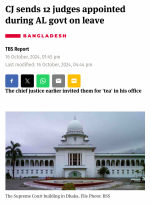
A very good move, which was forced by revolutionaries after they surrounded the High court in protest.
 
View attachment 72870


A very good move, which was forced by revolutionaries after they surrounded the High court in protest.

little late but good. Awami lovers must be removed from all organ of government bodies.
 
Ousted Awami Mayor arrested.

We need to see Awami goons get convicted and severely punished. Make it an exemplary punishment so that no one dares to do what Awami did with Bd people and Bd as a country.

To view this content we will need your consent to set third party cookies.
For more detailed information, see our cookies page.
 
Concerning news From journalist Zulkarnain Saer Sami

I posted the Bangla version of this and I’m putting it out in English as these are matters of grave concern and can do all the sacrifices made to unseat the most evil tyrant this land has seen. This has come from my most reliable sources within the armed forces.

1. The army’s role as an institution in the July Revolution is somewhat romanticised. While it is true that the middle- to low-ranking officers and the generals were on the side of the public, senior army officers loyal to the Awami League were working against the masses. However, the reason the army did not fire at the protestors on the 5th of August is more of an obligatory nature: on the 4th of August, Donald Lu, the US assistant secretary of state for South and Central Asia, called Md Tofazzel Hossain Miah, Sheikh Hasina’s principal secretary, and warned that if the army opened fire, Bangladesh would be struck off UN peacekeeping, the lucrative and coveted assignment for the armed forces. After that phone call, from 2:30 am to 7 am, Salman F Rahman, a close confidante of Hasina tried to reach out to Donald Lu but didn’t succeed. At the morning chiefs of armed forces and other forces convinced Hasina to pack it all in and leave for safety in India.

2. The AL-loyalist group within the army still wields quite the power and they are conspiring to rehabilitate the party and Hasina and dictate proceedings of the interim government. For instance, this group, which comprises major generals and brigadier generals from the 34th and 35th BMA Long Course, have barred army personnel from arresting AL men. The major generals in this group includes AKM Nazmul Hasan, Kabir Ahmed, Mohammad Jahangir Alam, Mahbubur Rashid, Aminul Haque, Selim Azad, Sheikh Saroar and six Major General from the 27th BMA Long Course except Abu Mohammad Sarwar Farid, the current director general of NSI. That is why the AL-loyalist Major General Muhammad Moin Khan remains in his position as the general officer commanding the 9th Infantry Division and area commander of Savar Cantonment despite myriads of allegations against him. That is why the AL loyalists who enabled the grave violations of human rights during Hasina’s reign still remain safe within the army.

3. From the 27th BMA Long Course is Major General Ferdous Hasan Salim, who is the leader of the pack. He is the military secretary to Muhammad Yunus and is stationed at the Chief Adviser’s Office. He is privy to all discussions, which are looped into Hasina and Tarique Ahmed Siddiqui in Delhi. Major General Ferdous is very close to Hasina — he calls her phupu, which is the term for one’s paternal aunt — and she even attended his passing out ceremony on the 20th of December 1992, her only time attending such events as the leader of the opposition. Surprisingly he was the military secretary to the past two army chiefs which is unprecedented, he was deeply involved in all the corruption and nefarious activities by them. As Yunus’s military adviser, he is working to instil AL loyalists in the armed forces, police, and civil and foreign services. In some cases, Major General Ferdous overruled the recommendations of the force chiefs, as was seen in the appointment of AL-loyalist Mohammad Jahangir Alam as the DGFI DG. The army chief had recommended Brigadier General Mustafiz from the 27th BMA Long Course for the post but Major General Ferdous managed to change and installed the preferred choice of Tarique Ahmed Siddiqui, Hasina’s most trusted aide. Here, it must be said that Major General Jahangir during his three years at the NSI did all sorts of dirty work for Hasina and planned the logistics of the bogus election in January.

4. This pack’s main aim is to get President Mohammed Shahabuddin Chuppu to declare an emergency in November by creating a seriously unstable situation in the country.

5. To prevent this pack from prevailing, the controversial senior army officers must be immediately removed from important posts like Major Generals Ferdous, Jahangir, Moin, Muhammad Ashraful Islam, and Salim Azad. The AL-loyalists like Major Generals Amin, Mahbubur Rashid, Kabir Ahmed (commandment of the school of infantry and tactics at Sylhet Cantonment), Muhammad Khaled Al Mamun (GOC of 11th Infantry Division and area commander of Bogra Cantonment) and Sheikh Mohammad Sarwar Hossain must be immediately sent into retirement. Army personnel involved with enforced disappearances and extrajudicial killings must be identified and expelled — there were at least 40-50 of them.


This is very concerning. Army top brass needs a massive overhaul.
 

Users who are viewing this thread

Pakistan Defence Latest

Back
Top