BRICS Summit 2024: News & Updates

Modi meets Xi as India, China ties recover from 2020 military clash

By Krishn Kaushik and Ethan Wang
October 23, 20243:19 PM GMT+3Updated 11 min ago


Participants of the BRICS Summit attend a concert in Kazan

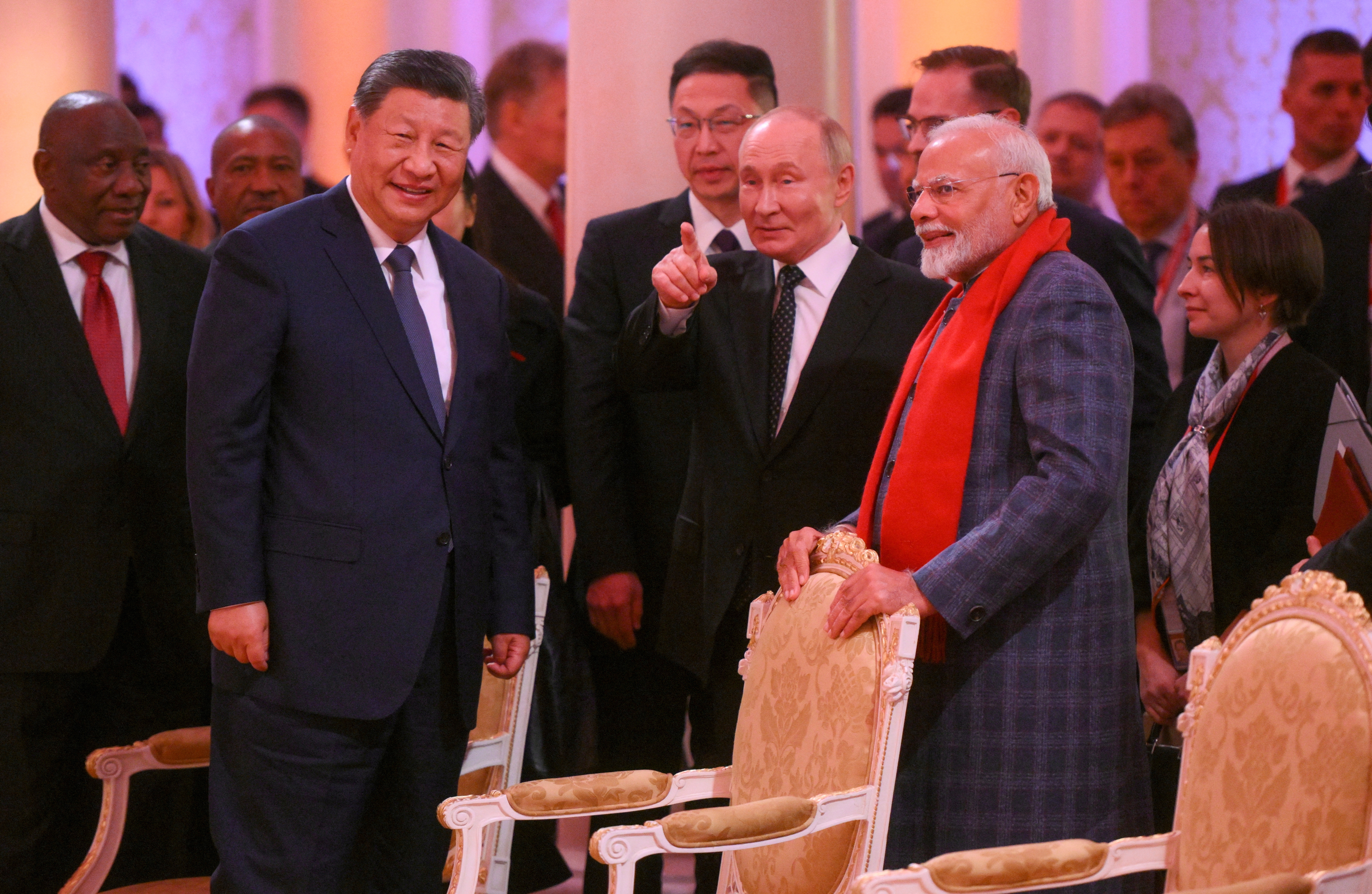
Chinese President Xi Jinping, Russian President Vladimir Putin and Indian Prime Minister Narendra Modi attend a concert before an informal dinner on the sidelines of the BRICS Summit in Kazan, Russia October 22, 2024. Alexander Kryazhev/BRICS-RUSSIA2024.RU Host Photo Agency via REUTERS

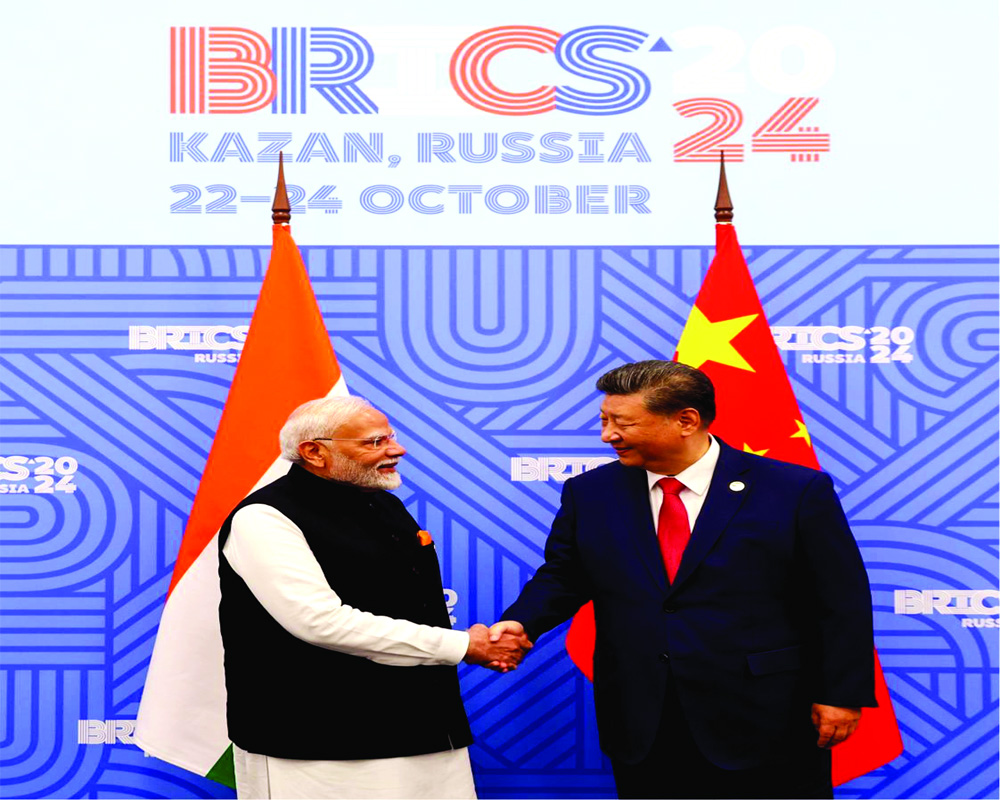
NEW DELHI/BEIJING, Oct 23 (Reuters) - Indian Prime Minister Narendra Modi and Chinese President Xi Jinping held their first formal talks in five years on Wednesday, signalling that ties between the Asian giants damaged by a deadly military clash in 2020 had begun to recover.

The two leaders met on the sidelines of the BRICS summit in the Russian city of Kazan, the Indian government and Chinese state media said, two days after New Delhi announced that it had reached a deal with Beijing to resolve the four-year military stand-off on their disputed Himalayan frontier.

Relations between the world's two most populous nations - both nuclear powers - have been strained since a clash between their troops on the largely undemarcated frontier in the western Himalayas of Ladakh left 20 Indian and four Chinese soldiers dead in 2020.

The neighbours increased their military presence along the icy frontier since, adding tens of thousands of troops and weapons over the last four years.

Modi and Xi had not held formal bilateral talks since although they both participated in multilateral events. Their last summit talks were held in Oct. 2019 in the southern Indian town of Mamallapuram.

The two spoke briefly on the sidelines of the G20 summit in Bali in Nov. 2022 and exchanged courtesies. They spoke again on the sidelines of the BRICS summit in Johannesburg in Aug. 2023 but ended up releasing different versions of the conversation, indicating the two sides didn't see eye to eye.

Xi skipped the G20 summit hosted by New Delhi the following month, a decision seen as another setback to their relations.

Diplomatic efforts gained momentum in recent months after foreign ministers of the two countries met in July and agreed to step up talks to ease the border tensions.
As India had made improving the wider political and damaged business ties contingent upon finding a solution to the border stand-off, Wednesday's talks between the two leaders is expected to result in potentially more Chinese investment into India.

New Delhi had increased the scrutiny of investments coming from China, blocked direct flights between the two countries and had practically barred issuing any visas to Chinese nationals since the Ladakh clashes.

Neither New Delhi nor Beijing - which confirmed the border pact on Tuesday - has shared details of how the stand-off will be resolved under the deal agreed to this week.
An Indian military source told Reuters that the pact will allow both sides to patrol contested points on the frontier according to an agreed schedule to prevent confrontations.

The Reuters Daily Briefing newsletter provides all the news you need to start your day. Sign up here.

Reporting by Krishn Kaushik in New Delhi and Ethan Wang in Beijing; Editing by YP Rajesh
 
Does Putin regret now for dragging India in all kinds of organizations such as SCO, BRICS to balance China? India is ruining them.
India wasn’t brought into BRICS by Russia; India is one of the founding members of BRICS. In fact, the term BRICS was coined by an Indian.
 
India wasn’t brought into BRICS by Russia; India is one of the founding members of BRICS. In fact, the term BRICS was coined by an Indian.
I know what you mean. But China is the only golden brick in the BRICS. Others are just bricks. China must have discussed with Russia about what kind of organization it will be before decided to establish it.
 

India and China grab eyeballs at BRICS

Thursday, 24 October 2024 | PTI | Kazan
1
2
3
4
5

India and China grab eyeballs at BRICS


In their first structured bilateral talks in nearly five years, Prime Minister Narendra Modi and Chinese President Xi Jinping on Wednesday agreed that India and China can have a “peaceful and stable” relationship by displaying maturity and mutual respect, and endorsed the pact on the resolution of the dragging eastern Ladakh border row.

In the meeting, Modi underscored the importance of properly handling differences and disputes and not allowing them to disturb peace and tranquillity. In a post on ‘X’, Modi said, “India-China relations are important for the people of our countries, and for regional and global peace and stability.”

“Mutual trust, mutual respect and mutual sensitivity will guide bilateral relations,” he said. Foreign Secretary Vikram Misri said at a media briefing that the two leaders noted that the special representatives on the India-China boundary question have a critical role to play in the resolution of the issue and for the maintenance of peace and tranquillity in border areas.

Modi and Xi instructed the special representatives to meet at an early date and continue their efforts, he said.

“We hope to schedule the next meeting of Special Representatives at an appropriate date,” he said. The foreign secretary said Modi and Xi reviewed the state of bilateral relations from a strategic and long-term perspective and they were of the view that stable ties between the two countries will have a positive impact on regional and global peace and prosperity.

Both Modi and Xi stressed that with maturity and wisdom, and by showing mutual respect, India and China can have a peaceful and stable relationship, Misri said. He said restoration of peace and tranquillity in border areas will create space for returning towards the path of normalisation of ties.

Officials will now take the next steps to discuss enhancing strategic communication and stabilising bilateral relations by utilising official dialogue mechanisms, he said. “Welcoming the recent agreement for complete disengagement and resolution of issues that arose in 2020 in the India-China border areas, Prime Minister Modi underscored the importance of properly handling differences and disputes and not allowing them to disturb peace and tranquillity,” the Ministry of External Affairs (MEA) said in a statement.

It said the two leaders affirmed that stable, predictable, and amicable bilateral relations between India and China, as two neighbours and the two largest nations on earth, will have a positive impact on regional and global peace and prosperity. “It will also contribute to a multi-polar Asia and a multi-polar world,” the MEA said.

“The leaders underlined the need to progress bilateral relations from a strategic and long-term perspective, enhance strategic communication and explore cooperation to address developmental challenges,” it said.
 
BRICS nations agree to boost trade, financial settlement in local currencies

BRICS nations have decided to boost trade using local currencies and explore new finance infrastructures. They agreed to study the feasibility of an independent cross-border settlement system and establish a BRICS reinsurance company. The New Development will also be developed further. They emphasized financial cooperation and inclusion in financial transactions.
PTI
Updated On Oct 24, 2024 at 11:35 AM IST

Kazan: BRICS nations on Wednesday agreed to strengthen trade and financial settlement in local currencies, study feasibility of an independent cross-border settlement and depositary infrastructure, and a BRICS reinsurance company. The leaders also agreed to jointly develop the New Development Bank into a new type of multilateral development bank (MDB) in the 21st century and supported further expansion of the BRICS-led bank's membership.

In the declaration issued after the 16th BRICS Summit here, the leaders reiterated their commitment to enhancing financial cooperation within BRICS.

"We recognise the widespread benefits of faster, low cost, more efficient, transparent, safe and inclusive cross-border payment instruments built upon the principle of minimizing trade barriers and non-discriminatory access.

"We welcome the use of local currencies in financial transactions between BRICS countries and their trading partners," it said.

Prime Minister Narendra Modi is here to attend the BRICS Summit.

The BRICS leaders encouraged strengthening of correspondent banking networks within BRICS and enabling settlements in local currencies in line with BRICS Cross-Border Payments Initiative (BCBPI), which is voluntary and non-binding.

BRICS, consisting of Brazil, Russia, India, China and South Africa, has now expanded with five additional members - Egypt, Ethiopia, Iran, Saudi Arabia, and the UAE.

The nations also acknowledged the importance of exploring the feasibility of connecting BRICS countries' financial markets infrastructure.

"We agree to discuss and study the feasibility of establishment of an independent cross-border settlement and depositary infrastructure, BRICS Clear, an initiative to complement the existing financial market infrastructure, as well as BRICS independent reinsurance capacity, including BRICS (Re) Insurance Company, with participation on a
voluntary basis," it added.

In his address at the 16th BRICS Summit, Modi renewed his call for dialogue and diplomacy as being the only way forward to resolve conflicts, in an unambiguous message to press for the resolution of the Russia-Ukraine war through peaceful negotiations.

Published On Oct 24, 2024 at 11:35 AM IST
 
I know what you mean. But China is the only golden brick in the BRICS. Others are just bricks. China must have discussed with Russia about what kind of organization it will be before decided to establish it.
Then China can just fukc off from the platform and create a separate huddle with its lackeys.
 
BRICS leaders adopt Kazan Declaration— Key Points
The 43-page final communiqué addressed a range of topics including geopolitics, artificial intelligence, and the preservation of endangered species. Here are the key outcomes
By Anushka Sharma

The 16th BRICS Summit concluded on Wednesday, October 23, with the adoption of the Kazan Declaration, a comprehensive document outlining key areas of cooperation and the bloc's unified stance on global issues.

The summit held in Kazan, Russia, saw productive discussions on strengthening multilateralism, countering terrorism, promoting economic growth, and addressing the concerns of the Global South.

Leaders of more than 20 nations, including Chinese President Xi Jinping, Indian Prime Minister Narendra Modi, UAE President Sheikh Mohammed bin Zayed Al Nahyan, and Iranian President Masoud Pezeshkian, participated in the summit.

The 43-page final communiqué addressed a range of topics, including geopolitics, artificial intelligence, and the preservation of endangered species.

Under the theme "Strengthening Multilateralism for Just Global Development and Security", the Kazan Declaration emphasised the importance of BRICS solidarity and strategic partnerships. The leaders pledged their commitment to fostering peace, ensuring a fairer international order, and promoting sustainable development.

"We, the Leaders of BRICS countries, met in Kazan, Russian Federation, from 22 to 24 October 2024 for the XVI BRICS Summit held under the theme: 'Strengthening Multilateralism for Just Global Development and Security,'" the leaders said.

"We reaffirm our commitment to the BRICS spirit of mutual respect and understanding, sovereign equality, solidarity, democracy, openness, inclusiveness, collaboration, and consensus," the leaders stated.

"As we build upon 16 years of BRICS Summits, we further commit ourselves to strengthening cooperation in the expanded BRICS under the three pillars of political and security, economic and financial, cultural and people-to-people cooperation and to enhancing our strategic partnership for the benefit of our people through the promotion of peace, a more representative, fairer international order, a reinvigorated and reformed multilateral system, sustainable development and inclusive growth."

Key Outcomes of the Kazan Declaration
Geopolitical Concerns

The summit addressed pressing international conflicts, with the declaration emphasising the need for peaceful resolution through diplomacy.

Ukraine conflict: the leaders reaffirmed the importance of adhering to the principles of the United Nations Charter and welcomed mediation efforts. "We note with appreciation relevant proposals of mediation and good offices, aimed at a peaceful resolution of the conflict through dialogue and diplomacy."

Palestine: Expressing concern over the worsening situation in Palestine, the declaration stated, "We reiterate our grave concern at the deterioration of the situation and humanitarian crisis in the Occupied Palestinian Territory, in particular the unprecedented escalation of violence in the Gaza Strip and West Bank."

Middle East Crisis: They also voiced grave concern over the escalating humanitarian crisis in the Middle East. "We express alarm over the situation in Southern Lebanon. We condemn the loss of civilian lives and the immense damage to civilian infrastructure resulting from attacks by Israel in residential areas in Lebanon and call for immediate cessation of military acts."

Global Governance and Multilateralism
G20 Role:
The summit underscored the importance of the G20 in global decision-making. "We recognise the importance of the continued and productive functioning of the G20, based on consensus with a focus on result-oriented outcomes".

Financial Architecture Reform: The BRICS nations reiterated their pledge to improve global governance by advocating for a more agile, responsive, and representative multilateral system. This includes reforms to the international financial architecture and promoting inclusive growth.

"We reiterate the importance of further enhancing BRICS solidarity and cooperation based on our mutual interests and key priorities and further strengthening our strategic partnership, "the leaders added. "We underscore the need to reform the current international financial architecture to meet the global financial challenges."

Financial Innovation: The leaders encouraged new financial practices. "We welcome the BRICS Interbank Cooperation Mechanism (ICM) focus on facilitating and expanding innovative financial practices."

International Monetary Fund: The declaration supported maintaining a strong IMF. "We reaffirm our commitment to maintaining a strong and effective Global Financial Safety Net with a quota-based and adequately resourced IMF at its centre."

Economic Cooperation and Local Currencies
Cross-Border Payments:
A key highlight of the summit was the agreement to strengthen trade and financial settlements in local currencies. The declaration welcomed the use of local currencies in BRICS financial transactions and supported the exploration of an independent cross-border settlement infrastructure.

"We recognise the widespread benefits of faster, low-cost, more efficient, transparent, safe, and inclusive cross-border payment instruments built upon the principle of minimising trade barriers and non-discriminatory access," the document stated.

BRICS Clear depository: Looking ahead, the BRICS nations agreed to explore initiatives that could further integrate their economies, such as establishing a BRICS Grain Exchange and studying the feasibility of a BRICS Cross-Border Payment System and BRICS (Re)Insurance Company.

BRICS Grain Exchange: The establishment of a BRICS-based grain exchange was welcomed. "We welcome the initiative of the Russian side to establish a grain (commodities) trading platform within BRICS."

BRICS Plus Partnership: With growing interest from nations in the Global South, the leaders endorsed the creation of a BRICS Partner Country category, welcoming new member countries, including Egypt, Ethiopia, Iran, Saudi Arabia, and the UAE.

Pandemic Preparedness and Environmental Conservation
Health Initiatives:
The summit emphasised the importance of strengthening health systems through collaboration. "We support the initiatives of the BRICS R&D Vaccine Center, further development of the BRICS Integrated Early Warning System for preventing mass infectious diseases risks and the operations of the BRICS TB Research Network."

The leaders also recognised the threat of antimicrobial resistance (AMR): "We welcome the outcomes of the 79th United Nations General Assembly (UNGA) High-Level Meeting on AMR... and note the timeliness of holding the first BRICS Conference on AMR in May 2024."

Big Cats: India’s initiative to create an International Big Cats Alliance received recognition, as BRICS countries pledged to collaborate on preserving endangered species. "We encourage BRICS countries to work together to make further contributions to the conservation of big cats," the declaration noted.

As BRICS continues to expand its partnerships with the Global South, the bloc aims to strengthen its influence in global governance and provide a platform for emerging markets and developing countries to work together.

The leaders expressed optimism about the future of BRICS cooperation, emphasising that ongoing collaboration will be key to addressing global challenges and fostering a more just and equitable world order.

Read the full Kazan Declaration here.
 
If China leaves, BRICS will be meaningless. If India leaves, BRICS will be more meaningful

I suggest you take you self fellatio trollings to elsewhere..
 
it will be slow progress but an alternative to American IOUS is on its way and with it America will lose its exorbitant privilege and once thats lost US will go bankrupt split up and Zios will be chased out of Palestine
 
But, why Modi is only attending the first 2 days out of 3 days full summit, again a snub to Putin and BRICS +, just to please the US and G7 ?
 
Then China can just fukc off from the platform and create a separate huddle with its lackeys.
Lol, does any member other than India like to take your Indian's position want to kick China out of BRICS + ? It might well be that India the members want to boot out, you are a pro-G7 odd man out country in the group.
 

Users who are viewing this thread

Pakistan Defence Latest

Latest Posts

Back
Top