China’s military robot-wolf follows voice commands in real time
On
Nov 10, 2024
At China’s recent Zhuhai Air Show, a new robotic quadruped known as the Q-UGV Wolf stole the spotlight, demonstrating its capability to respond to real-time voice commands. A video of the demonstration shows the
“wolf robot” executing simple commands such as
“stand,” “sit,” and
“move” in response to vocal prompts.
While labeled a
“robot wolf” by its designers, this platform presents itself as a powerful tactical tool likely aimed at military or security applications, where its design and capabilities stand to offer significant operational value.
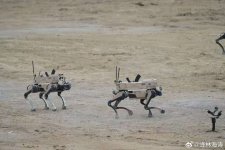
The robot’s four-legged design is an immediate indicator of its intended tactical flexibility. This configuration grants stability and mobility on uneven surfaces where wheeled or tracked vehicles struggle. Its sand-colored body points toward camouflage in desert or semi-arid environments, implying a mission profile suited to open, rugged terrain.
Video screenshots
Equipped with sensors and cameras, it appears designed for versatile, all-terrain operations where it might need to traverse varied landscapes, from rocky paths to inclined surfaces. These features make it an adaptable solution for reconnaissance and patrol missions in challenging environments, maintaining surveillance over a broad area, or following complex paths autonomously.
A closer look reveals an array of sensors mounted on the front of the robot, potentially including infrared and night-vision capabilities. These tools would allow it to operate effectively in low-visibility or nocturnal conditions, providing a real-time visual feed to remote operators.
Antennas on the upper body hint at sophisticated, long-range wireless communication abilities. Such features likely support GPS integration and a remote control link, allowing it to either follow commands from a control center or perform tasks independently.
Video screenshot
The robot’s modular framework can accommodate additional equipment, like lightweight weaponry or tactical sensors, making it capable of multiple mission types. This flexibility suggests it could be outfitted for tasks ranging from reconnaissance and perimeter defense to tactical support for human teams.
By allowing for payload customization, the robot could be tasked with anything from logistical support to carrying small cargo or even providing reconnaissance in complex environments such as buildings or underground passages.
For missions requiring discrete and continuous observation, the robot’s array of cameras and sensors makes it particularly valuable. It can be deployed in hazardous or hard-to-reach areas, supplying live thermal or visual data back to command units.
Such a feature is indispensable in tactical and special operations, where intelligence about surroundings is critical to mission success. Its quiet operational profile and compact build mean it could navigate tight spaces and provide tactical teams with real-time reconnaissance without alerting adversaries to its presence.
The demonstration at Zhuhai also showcased a coordinated maneuver where a team, or
“pack,” of four Q-UGV Wolves deployed together. Two of these units were equipped with visible weapon mounts, while the others remained unarmed. The video displays the pack navigating various obstacles, including stairs, offering a glimpse into potential multi-robot deployments.
This capability for coordinated movement suggests these robots could support broader tactical strategies, such as area sweeps, secure patrols, or complex environmental monitoring in zones with minimal human presence.