100 days of Yunus govt in Bangladesh—nepotism, chaos, U-turns
Muhammad Yunus doesn’t have a magic bullet, but rising unemployment, spiralling prices, and a lack of an electoral roadmap are eroding the legitimacy of Bangladesh’s interim government.
Ahmede Hussain
17 November, 2024
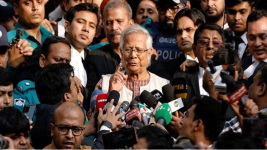
On 10 November, Muhammad Yunus, the chief of Bangladesh’s interim government, expanded his cabinet by inducting four new advisers. This move has triggered widespread anger on the Dhaka University campus. Several leaders of the Anti-discrimination Student Movement, which spearheaded the anti-Sheikh Hasina mass uprising, joined a protest demanding the removal of newly appointed cultural affairs adviser, film director Mostofa Sarwar Farooki, and others accused of being ‘autocratic allies’.
Meanwhile, social media was flooded with Farooki’s past photos and Facebook posts, where he glorified an array of people—
from Sheikh Mujibur Rahman to former police chief Benazir Ahmed, who, according to
The Daily Star, forced poor
Hindus to sell their lands to him. Farooki even defended a
rigged mayoral election.
Now, the filmmaker has made a U-turn and is portraying
himself as a victim of Sheikh Hasina’s despotic rule. However, Facebook is flooded with images of him smiling alongside Sheikh Hasina, often accompanied by his wife Nusrat Imroz Tisha—who played Hasina’s mother in Mujib’s biopic. After becoming an adviser, Farooki even claimed that he has played a pioneering role in “ousting (India’s) West Bengal’s Kolkata-centric hegemony of Bangla from Bangladesh”.
Another newly inducted adviser to come in the line of fire is Sheikh Bashir Uddin, who
faces a murder case in which the deposed Prime Minister Sheikh Hasina is also listed as an accused. In his defense, Bashir said he was unaware of being an
accused in the case, filed over the killing of a young man during the July uprising.
Bashir Uddin, allegedly a Jamaat nominee, is the brother of former Awami League MP
Sheikh Afil Uddin. Bashir claims they parted ways 25 years ago in 1999 when the family property and business were divided. Yet, his appointment as the head of the Ministry of Textiles and Jute—despite
owning jute mills—is strange. Even though he says he has left his obligations behind, it is surprising that the government failed to find someone without such conflict of interest for this portfolio.
This failure is evident in other appointments as well. Take senior journalist Golam Mortoza, now
Press Minister at the Bangladesh Embassy in Washington. Mortoza, formerly an editor of the Bengali section of an English newspaper, has never written anything of significance in English. It’s inexplicable why he has been bestowed with the responsibility of representing Bangladesh to the United States, especially under Donald Trump’s hawkish administration and spy chief Tulsi Gabbard, who openly spoke against
oppression of Hindus in Bangladesh.
Several other appointments smack of favouritism to friends or relatives. Nurjahan Begum,
a banker who held the fort of Yunus’s Grameen Bank after he left the institution in 2011, is now Bangladesh’s Health and Family Adviser. She
faced protests during a visit to a hospital treating those injured in the July uprising. Protesters blocked Begum’s car, criticising the lack of proper treatment, forcing her and British High Commissioner Sarah Cooke to hurriedly leave the scene in another vehicle.
Bangladesh Sangbad Sangstha, a government-owned news outlet led by another beneficiary of
the ‘jobs for the boys’, didn’t cover the protest. Instead, it showed Begum
showering motherly affection on an injured boy. It was like the bad old days of Hasina’s rule.
Not that a banker cannot run the health ministry, but like a lot of appointments, Yunus’s administration seems to have bypassed more qualified professionals in favour of loyalists. Advisers like Sharmeen Murshid, Faruk-e-Azam, Supradip Chakma, and Dr Bidhan Ranjan Roy—Yunus’s wife’s doctor—haven’t done any significant work.
It is indeed ironic that the best-run ministries in the 84-year-old Chief Adviser’s interim government are led by two 26-year-old student leaders,
Nahid Islam and
Asif Mahmud. They were not chosen by anyone—but are products of the very movement that brought Muhammad Yunus to power.
Muhammad Yunus doesn’t have a magic bullet, but rising unemployment, spiralling prices, and a lack of an electoral roadmap are eroding the legitimacy of Bangladesh’s interim government.

theprint.in