Bangladesh Socio-Political Crisis 2024 and onwards

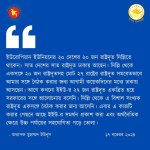
FB_IMG_1731864851482.jpg
.
20 ambassadors from 20 EU countries reside in Delhi. Seven ambassadors of seven countries are in Dhaka. A total of 27 ambassadors, including 20 ambassadors from Delhi, are collectively coming to Dhaka in the next few days to meet with me. Never before have 27 ambassadors of the EU come together to negotiate with the government. A large number of ambassadors from Delhi did not come to meet together. This time, the reason for doing this is to express the support of the EU and to build a high level of cooperation in the economic field.
.
Now this is what we call "Hedom" (power) of Prof MD Yunus.
 
Last edited by a moderator:
View attachment 81622
.
20 ambassadors from 20 EU countries reside in Delhi. Seven ambassadors of seven countries are in Dhaka. A total of 27 ambassadors, including 20 ambassadors from Delhi, are collectively coming to Dhaka in the next few days to meet with me. Never before have 27 ambassadors of the EU come together to negotiate with the government. A large number of ambassadors from Delhi did not come to meet together. This time, the reason for doing this is to express the support of the EU and to build a high level of cooperation in the economic field.
.
Now this is what we call "Hedom" (power) of Prof MD Yunus.

@SoulSpokesman @UKBengali

Any Bangladeshi who wants a visa for those countries need to travel to Delhi. For that they need an Indian visa first.

The route to those countries is literally through India lol

They aren’t coming to support him - they are coming to remind him of the reality!
 
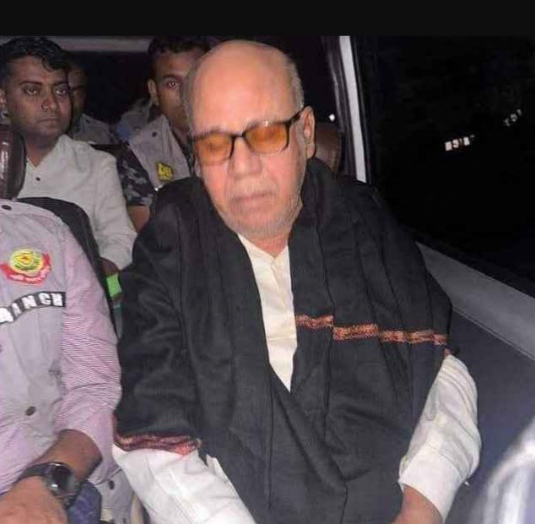
Another Awami Harami Taklu Kamrul arrested.


DB arrests AL leader Kamrul Islam​


image-224570-1731954213.jpg


DHAKA, Nov 18, 2024 (BSS)- Detective Branch (DB) of Police arrested Awami League (AL) presidium member and former minister Advocate Kamrul Islam.

Media and Public Relations Wing of DMP said Kamrul Islam has been arrested from city’s Uttara area tonight.

 
100 days of Yunus govt in Bangladesh—nepotism, chaos, U-turns

Muhammad Yunus doesn’t have a magic bullet, but rising unemployment, spiralling prices, and a lack of an electoral roadmap are eroding the legitimacy of Bangladesh’s interim government.

Ahmede Hussain
17 November, 2024
100-days-of-Yunus-govt-in-Bangladesh—nepotism-chaos-U-turns-11-19-2024_07_42_AM.png

On 10 November, Muhammad Yunus, the chief of Bangladesh’s interim government, expanded his cabinet by inducting four new advisers. This move has triggered widespread anger on the Dhaka University campus. Several leaders of the Anti-discrimination Student Movement, which spearheaded the anti-Sheikh Hasina mass uprising, joined a protest demanding the removal of newly appointed cultural affairs adviser, film director Mostofa Sarwar Farooki, and others accused of being ‘autocratic allies’.

Meanwhile, social media was flooded with Farooki’s past photos and Facebook posts, where he glorified an array of people—from Sheikh Mujibur Rahman to former police chief Benazir Ahmed, who, according to The Daily Star, forced poor Hindus to sell their lands to him. Farooki even defended a rigged mayoral election.

Now, the filmmaker has made a U-turn and is portraying himself as a victim of Sheikh Hasina’s despotic rule. However, Facebook is flooded with images of him smiling alongside Sheikh Hasina, often accompanied by his wife Nusrat Imroz Tisha—who played Hasina’s mother in Mujib’s biopic. After becoming an adviser, Farooki even claimed that he has played a pioneering role in “ousting (India’s) West Bengal’s Kolkata-centric hegemony of Bangla from Bangladesh”.
Another newly inducted adviser to come in the line of fire is Sheikh Bashir Uddin, who faces a murder case in which the deposed Prime Minister Sheikh Hasina is also listed as an accused. In his defense, Bashir said he was unaware of being an accused in the case, filed over the killing of a young man during the July uprising.

Bashir Uddin, allegedly a Jamaat nominee, is the brother of former Awami League MP Sheikh Afil Uddin. Bashir claims they parted ways 25 years ago in 1999 when the family property and business were divided. Yet, his appointment as the head of the Ministry of Textiles and Jute—despite owning jute mills—is strange. Even though he says he has left his obligations behind, it is surprising that the government failed to find someone without such conflict of interest for this portfolio.

This failure is evident in other appointments as well. Take senior journalist Golam Mortoza, now Press Minister at the Bangladesh Embassy in Washington. Mortoza, formerly an editor of the Bengali section of an English newspaper, has never written anything of significance in English. It’s inexplicable why he has been bestowed with the responsibility of representing Bangladesh to the United States, especially under Donald Trump’s hawkish administration and spy chief Tulsi Gabbard, who openly spoke against oppression of Hindus in Bangladesh.


Several other appointments smack of favouritism to friends or relatives. Nurjahan Begum, a banker who held the fort of Yunus’s Grameen Bank after he left the institution in 2011, is now Bangladesh’s Health and Family Adviser. She faced protests during a visit to a hospital treating those injured in the July uprising. Protesters blocked Begum’s car, criticising the lack of proper treatment, forcing her and British High Commissioner Sarah Cooke to hurriedly leave the scene in another vehicle.

Bangladesh Sangbad Sangstha, a government-owned news outlet led by another beneficiary of the ‘jobs for the boys’, didn’t cover the protest. Instead, it showed Begum showering motherly affection on an injured boy. It was like the bad old days of Hasina’s rule.

Not that a banker cannot run the health ministry, but like a lot of appointments, Yunus’s administration seems to have bypassed more qualified professionals in favour of loyalists. Advisers like Sharmeen Murshid, Faruk-e-Azam, Supradip Chakma, and Dr Bidhan Ranjan Roy—Yunus’s wife’s doctor—haven’t done any significant work.

It is indeed ironic that the best-run ministries in the 84-year-old Chief Adviser’s interim government are led by two 26-year-old student leaders, Nahid Islam and Asif Mahmud. They were not chosen by anyone—but are products of the very movement that brought Muhammad Yunus to power.


Bangladesh ex-police chief faces crimes against humanity charges

AFP
November 20, 2024

Police personnel escort detainees Chowdhury Abdullah Al-Mamun (C), a former police inspector general and Ziaul Ahsan (back 2R), a former military general and former director general of the National Telecommunication Monitoring Centre (NTMC), to Bangladesh’s International Crimes Tribunal (ICT) court in Dhaka on November 20, 2024. — Munir Uz Zaman/AFP


Police personnel escort detainees Chowdhury Abdullah Al-Mamun (C), a former police inspector general and Ziaul Ahsan (back 2R), a former military general and former director general of the National Telecommunication Monitoring Centre (NTMC), to Bangladesh’s International Crimes Tribunal (ICT) court in Dhaka on November 20, 2024. — Munir Uz Zaman/AFP
https://whatsapp.com/channel/0029VaMc238IiRov8okfYy3n
Bangladesh’s former police chief appeared in court on Wednesday, accused of overseeing a deadly crackdown in a failed bid to suppress the August revolution that toppled the regime of Sheikh Hasina.

Former police inspector general Chowdhury Abdullah Al-Mamun was flanked by serving officers as he was led into court, where prosecutors alleged he was responsible for overseeing massacres, genocide, and crimes against humanity.

Eight defendants appeared in court in Dhaka, including Ziaul Ahsan, a former commander of the feared Rapid Action Battalion paramilitary force.

Chief prosecutor Mohammad Tajul Islam, from Bangladesh’s International Crimes Tribunal, said the eight men had committed crimes “that even devils dare not do”.

Islam said the former police chief was the “commander of all atrocities carried out against the student protesters”, he told reporters outside court after the hearing.

Dozens of Hasina’s allies have been taken into custody since her regime collapsed, accused of involvement in a police crackdown that killed more than 700 people during the unrest that led to her ouster.

Islam presented a detailed list of crimes allegedly committed by Ahsan that included extrajudicial killings, the dismembering of bodies, and the surveillance of government critics.
 
To view this content we will need your consent to set third party cookies.
For more detailed information, see our cookies page.


This type of blatant media demonstration of hate is insane. A portion of Indian society, current Indian stablishment are our ideological, religious and cultural enemies. (In their very own views.)
 
To view this content we will need your consent to set third party cookies.
For more detailed information, see our cookies page.


This type of blatant media demonstration of hate is insane. A portion of Indian society, current Indian stablishment are our ideological, religious and cultural enemies. (In their very own views.)


“stablishment”? is that a word? Not sure what you are alluding to here.

Yes! BJP is vile and Trump will give them free reign!
 
“stablishment”? is that a word? Not sure what you are alluding to here.

Yes! BJP is vile and Trump will give them free reign!

Ever heard of typos?

I just saw in another post you wrote "none the less". Should we mock your English now?

Focus on discussion topic instead of picking fights with other members over trivial issues.
 
Last edited by a moderator:
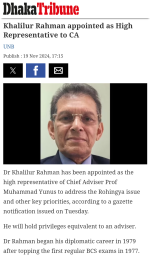
1000027623.png
That same year, he earned a first-class MA in Economics from Dhaka University and briefly worked at American Express International Bank before joining the Foreign Service.

He furthered his education at the Fletcher School of Law and Diplomacy, Tufts University, and the Kennedy School of Government, Harvard University, earning an MA in Law and Diplomacy and a PhD in Economics.

His diplomatic tenure includes roles in Bangladesh’s Ministry of Foreign Affairs, the Permanent Mission to the UN, and as private secretary to the foreign minister.

He was a spokesperson for Least Developed Countries (LDCs) at the UN Economic and Financial Committee.

In 1991, Dr Rahman joined the UN Secretariat as a special adviser at UNCTAD in Geneva.

Over 25 years, he held senior positions in New York and Geneva, including head of Economic, Social, and Development Affairs at the Executive Office of the UN secretary-general, chief of the LDCs Programme, and chair of the UN Interagency Group on Non-Tariff Barriers to Trade.

He contributed significantly to flagship UN reports and played a key role in drafting the Programme of Action for the 2001 Brussels LDCs Conference, introducing duty- and quota-free access for LDC exports.

In 2001, he briefly served as private secretary to Justice Latifur Rahman, chief adviser of the caretaker government.


A founding member of East West University in Dhaka, Dr Rahman continues to serve on its Board of Trustees.

 
Last edited:

Users who are viewing this thread

Pakistan Defence Latest

Back
Top