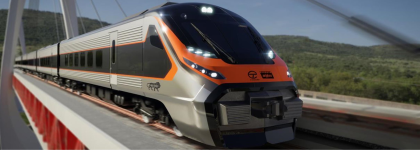
Bengaluru To Manufacture India's First High-Speed Train, Designed For 280 Kmph For The Mumbai-Ahmedabad Corridor

They should do it for Bangalore - chennai & Bangalore - hyderabad routes.
Imagine reaching chennai in 1 hour and hyderbad in 2 !
They will. These are costly projects which has to be indegenised to build at scale. Indian railways will study in details about the Japanese project, then indigenise it on other routes.

Next projects in Line: Chennai to Bangalore, Bangalore to Hyderabad, Hyderabad to Mumbai via Pune, Ahmedabad to Delhi via Jaipur.
 
They should do it for Bangalore - chennai & Bangalore - hyderabad routes.
Imagine reaching chennai in 1 hour and hyderbad in 2 !

ICF couldn't convince MoR to run first T-18 between Chennai & Bangalore and you are hoping bullet to run there.

They will. These are costly projects which has to be indegenised to build at scale. Indian railways will study in details about the Japanese project, then indigenise it on other routes.

Next projects in Line: Chennai to Bangalore, Bangalore to Hyderabad, Hyderabad to Mumbai via Pune, Ahmedabad to Delhi via Jaipur.

pvt bus maffia will not allow run bullet between Chennai - Bangalore
 
well Modi ji trying to bring out best trains but abdul putting stone slabs , gas cylinders or even using hammer to break class of vande bharat express standing on a station ... why modi is doing this ...????

View attachment 66220

We need to do complete evacuation of encroachment on Railways property and fencing. Then only wish Semi HSR on normal tracks. Till then lets build some dedicated HSR corridors with Japanese help and run Shinkansen and our donestic HSR on it.
 

Mumbai-Ahmedabad bullet train: India unlikely to import 'Shinkansen' from Japan following failed price negotiations and revised price norms​

India Blooms News Service | @indiablooms | 23 Nov 2024, 04:01 pm

New Delhi/IBNS: India is unlikely to import Japan’s Shinkansen, or bullet train, for the Mumbai-Ahmedabad High-Speed Rail (MAHSR) corridor, seven years after the project's launch, Moneycontrol reported.

Instead, the country has embraced a Make-in-India strategy, awarding the train manufacturing contract in September to the BEML Ltd-Medha Servo Drives joint venture, which produces Vande Bharat trains, according to the report.

"Negotiations with the Japanese government to procure Shinkansen trains are ongoing, but discussions have slowed considerably over the past six months," an official familiar with the matter told Moneycontrol.
The two governments have yet to reach an agreement on pricing and timelines for conducting test runs, the report added.

Efforts to resolve these issues included a visit to Japan by Railway Minister Ashwini Vaishnaw and other officials in September.

However, the talks ended without a resolution.

"Importing Shinkansen trains is a costly proposition," a second official explained. "Moreover, their lifetime maintenance would require Japanese expertise, further driving up the overall project cost."
Despite these hurdles, Japan International Cooperation Agency (JICA) remains committed to funding Rs 59,396 crore for the project, according to Moneycontrol.

The terms of the loan are being renegotiated to avoid further delays in the joint venture's completion.

Originally launched in 2017, the project was slated for completion by December 2023.


Mumbai-Ahmedabad bullet train: India unlikely to import 'Shinkansen' from Japan following failed price negotiations and revised price norms​

India Blooms News Service | @indiablooms | 23 Nov 2024, 04:01 pm

New Delhi/IBNS: India is unlikely to import Japan’s Shinkansen, or bullet train, for the Mumbai-Ahmedabad High-Speed Rail (MAHSR) corridor, seven years after the project's launch, Moneycontrol reported.

Instead, the country has embraced a Make-in-India strategy, awarding the train manufacturing contract in September to the BEML Ltd-Medha Servo Drives joint venture, which produces Vande Bharat trains, according to the report.


The two governments have yet to reach an agreement on pricing and timelines for conducting test runs, the report added.

Efforts to resolve these issues included a visit to Japan by Railway Minister Ashwini Vaishnaw and other officials in September.

However, the talks ended without a resolution.


Despite these hurdles, Japan International Cooperation Agency (JICA) remains committed to funding Rs 59,396 crore for the project, according to Moneycontrol.

The terms of the loan are being renegotiated to avoid further delays in the joint venture's completion.


its a rational decision considering cost of maintenance
 
I would never touch this train. Once this train crashes (which is inevitable), no one will dare build these idiotic trains. FFS, we can't even run trains that do 100 or 120 km/h average, nevermind the constant accidents!

Imagine this thing derailing or suffering from "malfunction" ( a word that works even for murder in India).
It does not matter if a train is moving at 100 or 120 KM or 280 KM/h. If it crashes you will die. You should avoid any Indian trains and may be walk from Delhi to Bombay. That will never crash.
 

BEML bags Rs 866 crore contract to build India’s first bullet train – Read more about the high-speed rail projects here​


Mumbai-Ahmedabad-bullet-train-4_20241016080342.png

The trainsets, which will have a test speed of 280 km/h, will be the first indigenously designed and manufactured high-speed trains in India. The project is part of India’s ambitious high-speed rail corridor between Mumbai and Ahmedabad, which spans 508 km.​

State-run BEML Ltd has been awarded a significant contract for the design, manufacturing, and commissioning of two high-speed trainsets by the Integral Coach Factory (ICF), marking a major milestone in India’s high-speed rail journey.

Each trainset will consist of eight cars, with the price per car set at Rs 27.86 crore, resulting in a total contract value of Rs 866.87 crore. This contract includes the design cost, one-time development expenses, non-recurring charges, and a one-time investment in jigs, fixtures, tooling, and testing facilities. These facilities will be used for future high-speed rail projects in India, providing critical infrastructure for the country’s growing rail network.

The trainsets, which will have a test speed of 280 km/h, will be the first indigenously designed and manufactured high-speed trains in India. The project is part of India’s ambitious high-speed rail corridor between Mumbai and Ahmedabad, which spans 508 km. Initially, Japanese E5 series Shinkansen trains were planned for this corridor, but due to the high costs quoted by Japanese firms, the Indian government decided to opt for domestic manufacturing.
 
India plans local supply chains for bullet trains
1732949126829.png

Titagarh-BHEL consortium design for Vande Bharat Sleeper

India is preparing to indigenise manufacture of bullet trains and signalling system compliant with such high-speed rolling stock, senior government officials told ET. These new trains will run on future standard gauge bullet train corridors. Officials also said progress of key infrastructure projects such as the bullet train are going to gain pace in Maharashtra after recent election results.

“Work on the bullet train corridor in Maharashtra picked up pace after the National Democratic Alliance (NDA) government took charge. Entire land acquisition is complete and over 320-kilometres of the physical infrastructure work is ready,” the official said.

Commenting on future bullet train corridors, he said experience from developing the Mumbai-Ahmedabad High Speed Rail (MAHSR) corridor will come handy. “India is now capable to single-handedly take up this project in more corridors. We should have our own trains in future corridors as well," he said.

These indigenous high-speed trains are expected be built upon the existing Vande Bharat platform. In addition to this, the signalling for these corridors will lead to development of Kavach 5.0 – the most advanced form of automatic train protection systems.

“India wants to become fully capable of making bullet trains that can touch speeds of up to 280 kilometres per hour (kmph) and average at 250 kmph operational speed," a second official said.

On development of India’s own bullet trains and how this will be achieved, the second official said, “There will be incremental improvement in Bogies (suspension systems). But power train and body will require significant development. They will take around three years to be ready.”

Responding to a query on whether the Indian-made trains will mean a cold shoulder to Shinkansen suppliers, the second official said, “We do not want to stop Japanese collaboration. Negotiation is ongoing
regarding the supply deal for these modern trains that will run on the MAHSR corridor.”

The Bhartiya Janta Party (BJP) manifesto had announced initiating feasibility studies for Bullet Train Corridors in North, South and East India.

Civil works for the MAHSR corridor are over 50% complete. Meanwhile, the Railway Board has tasked Integral Coach Factory (ICF) to manufacture a bullet train that can top speeds of 280 kmph. The railway production unit roped in BEML to make these trains for Rs 866.87 crore.

According to BEML these trains will be priced at Rs 27.86 crore per coach. The total contract value includes design cost, one-time development cost, non-recurring charges, onetime cost towards Jigs, fixtures, tooling and testing facilities.
 

Costs have soared and completion has been pushed back to 2031 as India and Japan disagree over signalling and the cost of rolling stock. Srinand Jha reports.

March 14, 2025

THE latest revised cost of building India’s first high-speed line, running for 508km from Mumbai to Ahmedabad, is understood to have risen to Rs 2 trillion ($US 24.3bn) and the timeline for completion extended to 2031.

The original cost estimate for the project was Rs 960bn and the target completion date fixed for 2024. The cost was revised upwards to Rs 1.08 trillion following the decision to build the new line on viaduct due to poor ground conditions on sections of the route, including near Bharuch and Baroda in Gujarat state.

The National High Speed Rail Corporation (NHSRCL) that is delivering the project recently informed the Railway Board that costs have increased due to a range of factors, including slow progress during the Covid-19 pandemic and the fluctuating exchange rate between the Rupee and the Yen.

Internal estimates prepared by Indian Railways (IR) suggest that delays have caused losses to escalate by 5% compared with the project cost. On this basis, building the high-speed line is likely to produce a loss of Rs 100bn a year.

NHSRCL’s official position is that the cost of the project and the timeline for delivering it cannot be determined at this point. In a report published on March 10 by the Indian Parliament’s Standing Committee on Railways, IR officials are quoted as saying: “Timelines and costs can only be ascertained after finalisation of all contract packages, completion of all associated work timelines related to civil structures, track, electric power supply, signalling and telecommunications, and the supply of rolling stock.”

Civil works on the project have progressed rapidly, with overall physical progress standing at 48.55% in January for expenditure of Rs 711.16bn. The main cause of delay at present is the failure to decide on two key issues: the type of rolling stock and the signalling system to be deployed on the new line.

Rolling stock in question​

On the understanding that Japanese technology will be used, 80% of the project cost is being funded by a 50-year loan from the Japan International Cooperation Agency (Jica), bearing interest at 0.1% and with a 20-year moratorium on repayment. Of the remainder, 50% will be provided by the Indian government and 50% by the states of Maharashtra and Gujarat.

At a recent meeting of the inter-ministerial group overseeing the project, the Japanese delegation is understood to have informed its Indian counterparts that it would not be possible to deliver Shinkansen high-speed trains before 2030, as India has yet to order them. A total of 400 cars are needed to operate as eight and 16-car trains.

India has been attempting to persuade Japan to reduce its price of Rs 200bn for the new trains, but so far without success. Within the Ministry of Railways, it is felt in some quarters that high-speed trains could be procured from European manufacturers at approximately half the cost. However, this could prove problematic for India, as integrating European rolling stock with Japanese signalling technology is unlikely to provide the best solution.

The Indian government would also need to pay upfront for new trains from Alstom or Siemens, whereas the Japanese trains will be funded by the soft loan from Jica, repayable in 50 years. In addition to training for high-speed operations, Indian engineers are already preparing to work on domestic production of Shinkansen components in the long term, while the agreement between India and Japan specifies that at least 50% of components will be procured from Japanese companies.

In what appears as an attempt by India to pressure Japan to reduce the price of the new high-speed fleet, IR subsidiary Integral Coach Factory (ICF) awarded a Rs 8.7bn contract in October to the state-owned Bharat Earth Movers (BEML) to supply two trains with a maximum speed of 280km/h.

Depending on the success of the two prototypes, these domestically-designed trains will be deployed on India’s first high-speed line. BEML will partner with Medha Servo Drives, which developed the traction system of IR’s Vande Bharat EMU, and is reported to have appointed EC Engineering of Poland as engineering design consultant. It is expected that other electrical systems and onboard signalling equipment will be supplied by Siemens.

The BEML trains could serve as a stop-gap in order to conduct trials on the 50km Surat - Bilimoria section, or potentially operate over the entire 508km high-speed line at an average speed of around 180km/h. However, BEML is understood to have informed IR that it will not be possible for deliveries to start before 2028, meaning that passenger services on the Mumbai - Ahmedabad high-speed line are unlikely to begin before 2029, even at a lower speed.

Signalling debate​

Japan and India have also been unable to reach agreement on the signalling system for the new line. Japan has insisted on the leaky feeder or radiating cable technology used on Shinkansen lines, while the Indian government has been contemplating the use of ETCS Level 2.

The latter, developed in Europe, is now in operation in India on the Regional Rapid Transit System (RRTS) commuter line in Delhi, and the contract awarded to BEML includes provision to install ETCS Level 2 on the new 280km/h trains.

Japan and India may have reached an impasse for the time being, but the silver lining is that neither of the two countries can walk away from the deal. It is therefore possible and likely that a middle way will be found to resolve these contentious issues.
 

E10 bullet train to debut in India and Japan simultaneously in 2030​

India and Japan are set to introduce the latest iteration of the Shinkansen, the Alfa-X, also known as the E10, simultaneously in 2029-30. Originally set to receive the Shinkansen E5, India’s transition to the more advanced E10 signifies a significant leap forward in high-speed rail technology.

This strategic development, as per a report in The Hindustan Times, highlights the deep collaboration between India and Japan in the ambitious bullet train project, which aims to connect Ahmedabad and Mumbai, revolutionising rail travel between the two cities.

The Shinkansen (colloquial for bullet train) E5, with a top speed of 320 kmph, was India’s earlier plan for its high-speed rail system. However, the introduction of the Shinkansen E10 has been agreed upon, offering a much-improved version with a top speed of 400 kmph. The E5 series is a Japanese Shinkansen high-speed train operated by East Japan Railway Company on Tohoku Shinkansen services since March 5, 2011.

Japan’s willingness to launch the E10 model simultaneously in its homeland and in India signifies a historic move in high-speed rail innovation. India is expected to get two E10 bullet train models -- an unprecedented step highlighting a deeper collaboration between India and Japan in integrating cutting-edge railway technology.

India’s indigenously developed high-speed trains

In addition to receiving the Shinkansen E10, India is also progressing with its indigenous high-speed trains. Two semi high-speed trains are being developed by India’s Integral Coach Factory (ICF) in collaboration with BEML Ltd. The contract for manufacturing these trains is valued at Rs 867 crore and is expected to be completed by the end of 2026. These trains are designed to operate at a top speed of 280 kmph, with a reliable cruising speed around 249 kmph. This development aligns with India’s goal of fostering self-reliance in high-speed rail manufacturing.

The infrastructure for the Mumbai-Ahmedabad corridor, including a 21-km long undersea tunnel and various viaducts, is also moving rapidly under the supervision of India’s Railway Ministry. With the full-scale launch scheduled for 2028-30, these indigenous trains will be vital in complementing the E10 Shinkansen in providing efficient and sustainable high-speed rail services.

India-Japan financial collaboration

The Mumbai-Ahmedabad High-Speed Rail Corridor is a joint venture between the Centre, Gujarat, and Maharashtra, with significant funding provided through a 50-year loan from the Japan International Cooperation Agency. The loan, amounting to approximately 80 per cent of the project cost, comes at an annual interest rate of 0.1 per cent, making it financially feasible for India’s rapid development of high-speed rail infrastructure.

This project not only focuses on speed but also on adapting the technology to Indian conditions, ensuring enhanced luggage capacity and durability against extreme temperatures and dust. India’s collaboration with Japan also involves modifying the Shinkansen trains to better suit local needs – like more luggage space, better dust management, and others.

Mumbai-Ahmedabad bullet train project: Challenges and milestones

Despite a delayed timeline from the initial 2022 launch date, the Mumbai-Ahmedabad bullet train project has gained momentum in recent months. All civil contracts have been awarded, and significant progress has been made in acquiring land and completing critical engineering works. By 2028-30, India is set to have its first high-speed rail corridor, revolutionising travel between Mumbai and Ahmedabad in just two hours and seven minutes.

Meanwhile, India is developing advanced signalling systems and ensuring the continuous upgrade of infrastructure to handle speeds exceeding 250 kmph, aligning with its vision of the National Rail Plan 2030.
 
Apparently the new "plan" or grift is to ....... introduce in 2027 a trainset built in India which can do 250 KMPH on average and top speed of 280 KMPH.

While in 2031 to introduce E10 from Japan with top speed of 400 KMPH....

Since its India we are talking about, I think ultimately they will put Train 18 EMU on this track with top speed of 160 KMPH and average of 120 KMPH and will call it a day.
 
Homemade 280 kmph train.... Amazing...

Indeed!!!

This is a great achievement for India!

290 kmph is just 60 kmph away from the world fastest HSR.

I think it can be achieved very soon too.
 

Users who are viewing this thread

Back
Top