Indian Americans - USA and Western politics

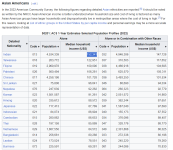
If 'Government firms' and 'government jobs' are filled by First Grade people, why is Indian government not functioning as well as Japan or Singapore? You showed a table that has Indian-Americans doing better than Korean-Americans and Vietnamese-Americans for example. But I think Korean and Vietnamese government workers are functioning better than Indian government workers.

sir, I would say that Indian government is functioning well :)

we find different infrastructure - industrial projects in India which are well being operated by Indian government sectors.
here, we heard Chinese engineers helping Pakistani projects, have you ever heard the same for India-Russia? Indian different projects are supported by Indian government firms and their engineers....

one example, now India is listed among Newly Industrialised Countries, its something better than Japan or Singapore, i think. I would say, only China exceeds India in NICs ☕

.
 
Last edited:
India is rising and Im running few threads in this regard also....

India is now listed with Newly Industrialised Countries as below. growth of India is home demand based, less related to foreign buyers/export, so we hope it would be maintained on long run :coffee:


So anything comparable to western levels? Anything at all?

Therefore my original point is that flexing what Indian origin do in other nations... but then barely in India?

Chinese have shown what can be done, they go back to China
 
If 'Government firms' and 'government jobs' are filled by First Grade people, why is Indian government not functioning as well as Japan or Singapore? You showed a table that has Indian-Americans doing better than Korean-Americans and Vietnamese-Americans for example. But I think Korean and Vietnamese government workers are functioning better than Indian government workers.

This isn't the flex you think it is

It shows a western system gives Indians economic opportunity that they benefit from

It raises the question why it cannot be created within India by Indians, especially given the old civilization narrative

It also brings into question why the Chinese in decades have created a comparable economic system and that Chinese do go back to China

Ofcourse you will want the analysis to not go that far

here is the details of Indian Middle Class of Asian standard. (y)
how you see growing Middle class of India of Asian standard which is estimated at 31% at present?
.

=>
The middle class is the fastest-growing major segment of the Indian population in both percentage and absolute terms, rising at 6.3 percent per year between 1995 and 2021. It now represents 31 percent of the population and is expected to be 38 percent by 2031 and 60 percent in 2047. More than one billion Indians will make up the middle-class when India will turn 100. These are the figures from PRICE ICE 3600 surveys based on primary data.

How the middle class will play the hero in India's rise as world power

.
=>
also, we have list of Billionaires of India as below:- :coffee:
How Japanese or other Asian countries would be compared to Indians in this field?
.

=>
India’s ultra-high-net-worth individuals (UHNWI) with net worth over $30 million is estimated to rise by 58.4% in the next five years to 19,119 individuals in 2027 from 12,069 in 2022. India’s billionaire population is expected to move up to 195 individuals in 2027 from 161 individuals in 2022, showed a Knight Frank India report.

.
 
So anything comparable to western levels? Anything at all?

Therefore my original point is that flexing what Indian origin do in other nations... but then barely in India?

Chinese have shown what can be done, they go back to China
Everything about India is interesting.

This is the country they worship rats and elephants and where the world’s software engineers are produced. Mighty skyscrapers sit next to crowded slums. A food exporting nation while nutrition rates are worse than sub-Saharan Africa.

Parts of India are desolate and disconnected from the world ( Nicobar Islands) while the country is one of the premier space powers of the world sending satellites and robots to distant corners of space.

India is a country of contrasts and contradictions.

sir, how you see a report by Forbes as below: ☕
.

=>
When statistical adjustments are used to convert the backward digit span results to full-scale IQ scores, Indian Americans place at about 112 on a bell-shaped IQ distribution, with white Americans at 100. 112 is the 79th percentile of the white distribution. For more context, consider that Ashkenazi Jews are a famously intelligent ethnic group, and their mean IQ is somewhere around 110.

There is nothing inevitable about immigration. Who immigrates each year is a policy decision, free to be modified at any time by Congress. Constructing new legislation is always difficult, but I propose a simple starting point for immigration selection: Anyone who can spell guerdon is in! (y)

Jason Richwine is a National Research Initiative fellow at the American Enterprise Institute in Washington.

Indian Americans: The New Model Minority (forbes.com)
 
we have a news about South Asians as below :coffee:

To view this content we will need your consent to set third party cookies.
For more detailed information, see our cookies page.
 
a news we have as below ☕
.

=>

Top One Percent: Are Hindus the New Jews in America​

Hindu Americans have surpassed Jewish Americans in education and rival them in household incomes. How did immigrants from India, one of the world's poorest countries, join the ranks of the richest people in the United States? How did such a small minority of just 1% become so disproportionately represented in the highest income occupations ranging from top corporate executives and technology entrepreneurs to doctors, lawyers and investment bankers? Indian-American Professor Devesh Kapur, co-author of The Other One Percent: Indians in America, explains it in terms of educational achievement. He says that an Indian-American is at least 9 times more educated than an individual in India. He attributes it to what he calls a process of "triple selection". :coffee:

Hindu American Household Income:
A 2016 Pew study reported that more than a third of Hindus (36%) and four-in-ten Jews (44%) live in households with incomes of at least $100,000. More recently, the US Census data shows that the median household income of Indian-Americans, vast majority of whom are Hindus, has reached $127,000, the highest among all ethnic groups in America.
Median income of Pakistani-American households is $87.51K, below $97.3K for Asian-Americans but significantly higher than $65.71K for overall population. Median income for Indian-American households $126.7K, the highest in the nation.


[td]


[td]​


Hindu Americans Education: :coffee:

Indian-Americans, vast majority of whom are Hindu, have the highest educational achievement among the religions in America. More than three-quarters (76%) of them have at least a bachelors's degree. This high achieving population of Indian-American includes very few of India’s most marginalized groups such as Adivasis, Dalits, and Muslims.


By comparison, sixty percent of Pakistani-Americans have at least a bachelor's degree, the second highest percentage among Asian-Americans. The average for Asian-Americans with at least a bachelor's degree is 56%.

American Hindus are the most highly educated with 96% of them having college degrees, according to Pew Research. 75% of Jews and 54% of American Muslims have college degrees versus the US national average of 39% for all Americans. American Christians trail all other groups with just 36% of them having college degrees. 96% of Hindus and 80% of Muslims in the U.S. are either immigrants or the children of immigrants.


Jews are the second-best educated in America with 59% of them having college degrees. Then come Buddhists (47%), Muslims (39%) and Christians (25%).
Triple Selection:
Devesh Kapur, a professor of political science at the University of Pennsylvania and co-author of The Other One Percent: Indians in America (Oxford University Press, 2017), explains the phenomenon of high-achieving Indian-Americans as follows: “What we learned in researching this book is that Indians in America did not resemble any other population anywhere; not the Indian population in India, nor the native population in the United States, nor any other immigrant group from any other nation.”

Kapur talks about what he calls “a triple selection” process that gave Indian-Americans a boost over typically poor and uneducated immigrants who come to the United States from other countries. The first two selections took place in India. As explained in the book: “The social system created a small pool of persons to receive higher education, who were urban, educated, and from high/dominant castes.” India’s examination system then selected individuals for specialized training in technical fields that also happened to be in demand in the United States. Kapur estimated that the India-American population is nine times more educated than individuals in the home country.


Summary:

Hindu Americans rival Jewish Americans in educational achievement and household incomes. Hindus in America have joined the ranks of the richest people in the United States. They account for just 1% of the US population but they are disproportionately represented in the highest income occupations ranging from top corporate executives and technology entrepreneurs to doctors, lawyers and investment bankers. Indian-American Professor Devesh Kapur, co-author of The Other One Percent: Indians in America, explains it in terms of their educational achievement. He says that an Indian-American is at least 9 times more educated than an individual in India. He attributes it to what he calls a process of "triple selection". ☕


https://www.riazhaq.com/2021/06/top-one-percent-are-hindus-new-jews-in.html
 
Last edited:
a news we have as below ☕
.

=>

Top One Percent: Are Hindus the New Jews in America​

Hindu Americans have surpassed Jewish Americans in education and rival them in household incomes. How did immigrants from India, one of the world's poorest countries, join the ranks of the richest people in the United States? How did such a small minority of just 1% become so disproportionately represented in the highest income occupations ranging from top corporate executives and technology entrepreneurs to doctors, lawyers and investment bankers? Indian-American Professor Devesh Kapur, co-author of The Other One Percent: Indians in America, explains it in terms of educational achievement. He says that an Indian-American is at least 9 times more educated than an individual in India. He attributes it to what he calls a process of "triple selection". :coffee:

Hindu American Household Income:
A 2016 Pew study reported that more than a third of Hindus (36%) and four-in-ten Jews (44%) live in households with incomes of at least $100,000. More recently, the US Census data shows that the median household income of Indian-Americans, vast majority of whom are Hindus, has reached $127,000, the highest among all ethnic groups in America.
Median income of Pakistani-American households is $87.51K, below $97.3K for Asian-Americans but significantly higher than $65.71K for overall population. Median income for Indian-American households $126.7K, the highest in the nation.


[td]


[td]​


Hindu Americans Education: :coffee:

Indian-Americans, vast majority of whom are Hindu, have the highest educational achievement among the religions in America. More than three-quarters (76%) of them have at least a bachelors's degree. This high achieving population of Indian-American includes very few of India’s most marginalized groups such as Adivasis, Dalits, and Muslims.


By comparison, sixty percent of Pakistani-Americans have at least a bachelor's degree, the second highest percentage among Asian-Americans. The average for Asian-Americans with at least a bachelor's degree is 56%.

American Hindus are the most highly educated with 96% of them having college degrees, according to Pew Research. 75% of Jews and 54% of American Muslims have college degrees versus the US national average of 39% for all Americans. American Christians trail all other groups with just 36% of them having college degrees. 96% of Hindus and 80% of Muslims in the U.S. are either immigrants or the children of immigrants.


Jews are the second-best educated in America with 59% of them having college degrees. Then come Buddhists (47%), Muslims (39%) and Christians (25%).
Triple Selection:
Devesh Kapur, a professor of political science at the University of Pennsylvania and co-author of The Other One Percent: Indians in America (Oxford University Press, 2017), explains the phenomenon of high-achieving Indian-Americans as follows: “What we learned in researching this book is that Indians in America did not resemble any other population anywhere; not the Indian population in India, nor the native population in the United States, nor any other immigrant group from any other nation.”

Kapur talks about what he calls “a triple selection” process that gave Indian-Americans a boost over typically poor and uneducated immigrants who come to the United States from other countries. The first two selections took place in India. As explained in the book: “The social system created a small pool of persons to receive higher education, who were urban, educated, and from high/dominant castes.” India’s examination system then selected individuals for specialized training in technical fields that also happened to be in demand in the United States. Kapur estimated that the India-American population is nine times more educated than individuals in the home country.


Summary:

Hindu Americans rival Jewish Americans in educational achievement and household incomes. Hindus in America have joined the ranks of the richest people in the United States. They account for just 1% of the US population but they are disproportionately represented in the highest income occupations ranging from top corporate executives and technology entrepreneurs to doctors, lawyers and investment bankers. Indian-American Professor Devesh Kapur, co-author of The Other One Percent: Indians in America, explains it in terms of their educational achievement. He says that an Indian-American is at least 9 times more educated than an individual in India. He attributes it to what he calls a process of "triple selection". ☕


https://www.riazhaq.com/2021/06/top-one-percent-are-hindus-new-jews-in.html
I don't know what your thesis is. Indian-Americans are extremely successful. But that has little to nothing to do with Indian government. Only thing great about Indian government is the quality of education is high enough that Indian-Americans are successful. What is not good is the inability of Indian government to utilize the talent of these people like East Asian countries have done (like Japan, South Korea, Taiwan, Singapore, China).
 
I don't know what your thesis is. Indian-Americans are extremely successful. But that has little to nothing to do with Indian government. Only thing great about Indian government is the quality of education is high enough that Indian-Americans are successful. What is not good is the inability of Indian government to utilize the talent of these people like East Asian countries have done (like Japan, South Korea, Taiwan, Singapore, China).

how would you see the post#168, about growing Middle Class of India :coffee:

India is now Listed among the Newly Industrialised Countries, like East Asian countries. we are catching up :)

=> https://corporatefinanceinstitute.com/resources/economics/newly-industrialized-country-nic/
 
Last edited:
Very good news. But a long way to go still. India currently has a lower per capita GDP than Bolivia.

with reference of post#168, as above, India is supposed to have more than 31% population as Middle class.....

the GDP calculation for Developing countries has many issues. there are many 'undocumented' parts of GDP, the ratio of GDP we dont document for developing countries....

a more close to GDP on PPP per capita is given as below . here GDP of India is measured above $16.0tn, which has yet to include many segments of 'undocumented' parts of GDP, as in case of a developing country ☕

 
Last edited:

Indian Americans​

Indian Americans are people with ancestry from India who are citizens or permanent residents of the United States or migrants of other types. The terms Asian Indian and East Indian are used to avoid confusion with Native Americans in the United States, who are also referred to as "Indians" or "American Indians". With a population of more than 5.1 million, Indian Americans make up approximately 1.47% of the U.S. population :coffee:

Education​

According to Pew Research in 2015, of Indian Americans aged 25 and older, 72% had obtained a bachelor's degree and 40% had obtained a postgraduate degree, whereas of all Americans, 19% had obtained a bachelor's degree and 11% had obtained a postgraduate degree. ☕

Income​

The median household income for Indian immigrants in 2019 was much higher than that of the overall foreign- and native-born populations. Indians overall have much higher incomes than the total foreign and native-born populations.

In a 2019 survey, it was found that households headed by an Indian immigrant had a median income of $132,000, compared to $64,000 and $66,000 for all immigrant and U.S.-born households, respectively. Indian immigrants were also much less likely to be in poverty (5%) than immigrants overall (14%) or the U.S. born (12%).

According to 2023 US Census data, the median Indian American household income is now $157,005. ☕

75.1% of Indian Americans worked in Management, business, science, and arts occupations, this is compared to only 43.2% for the total population. ☕


1733530108148.png
also, here we see Indians at population 4.5mil+ are now more than Chinese at 4.2mil+ in USA :coffee:
 
Last edited:

Very good news. But a long way to go still. India currently has a lower per capita GDP than Bolivia.

Would you stop intentionally misleading people. Maybe voted in some local districts with a high asian population but not nationwide.

Some schools also vote in "Deer Shooting Day", "Rodeo Day","Potato Harvest Day", and other "holidays" that pertains to them.


how you people see post#176. I heard common Americans pay less than 1/3rd Tax as compared to Indian Americans :coffee:

here, as on Wikipedia, Average household Income of American citizens are nearly $59,995 . as compared to Indians at $150,000+.......
.
 
how you people see post#176. I heard common Americans pay less than 1/3rd Tax as compared to Indian Americans :coffee:

here, as on Wikipedia, Average household Income of American citizens are nearly $59,995 . as compared to Indians at $150,000+.......

Obviously "Indian Immigrants" are related to tech fields like software and medical...many through the H1B program. I'm in financial software and there are many H1B workers and we are all paid in the $200,000+ range so seeing a figure of $150,000 is not surprising. Actually it has only been in the last 10 years that Indian workers have been paid well. Previously they all worked through agencies which took a big cut of their pay.
 
Obviously "Indian Immigrants" are related to tech fields like software and medical...many through the H1B program. I'm in financial software and there are many H1B workers and we are all paid in the $200,000+ range so seeing a figure of $150,000 is not surprising. Actually it has only been in the last 10 years that Indian workers have been paid well. Previously they all worked through agencies which took a big cut of their pay.

sir, here is an article of Forbes, published nearing recession, by Feb 24, 2009, as below.
here we find Indian origin were having highest income than common Americans by 10years before also. ......
it details as below :coffee:
☕

=> key points:

Despite constituting less than 1% of the U.S. population, Indian-Americans are 3% of the nation's engineers, 7% of its IT workers and 8% of its physicians and surgeons.

Indian Americans are in fact a new "model minority." This term dates back to the 1960s, when East Asians--Americans of Chinese, Japanese and Korean descent--were noted for their advanced educations and high earnings. :coffee:

In 2007, the median income of households headed by an Indian American was approximately $83,000, compared with $61,000 for East Asians and $55,000 for whites.

Indian Americans are also less likely to be poor or in prison, compared with whites. ☕

The success of Indian Americans is also often ascribed to the culture they bring with them, which places strong--some would even say obsessive--emphasis on academic achievement.

When statistical adjustments are used to convert the backward digit span results to full-scale IQ scores, Indian Americans place at about 112 on a bell-shaped IQ distribution, with white Americans at 100. 112 is the 79th percentile of the white distribution. For more context, consider that Ashkenazi Jews are a famously intelligent ethnic group, and their mean IQ is somewhere around 110.

In sharp contrast to Indian Americans, most U.S. immigrants, especially Mexican, are much less wealthy and educated than U.S. natives, even after many years in the country.

A new immigration policy that prioritizes skills over family reunification could bring more successful immigrants to the U.S. By emphasizing education, work experience and IQ in our immigration policy, immigrant groups from other national backgrounds could join the list of model minorities. ☕

Constructing new legislation is always difficult, but I propose a simple starting point for immigration selection: Anyone who can spell guerdon is in! (y)

 
sir, here is an article of Forbes, published nearing recession, by Feb 24, 2009, as below.
here we find Indian origin were having highest income than common Americans by 10years before also. ......
it details as below :coffee:
☕

=> key points:

Despite constituting less than 1% of the U.S. population, Indian-Americans are 3% of the nation's engineers, 7% of its IT workers and 8% of its physicians and surgeons.

Indian Americans are in fact a new "model minority." This term dates back to the 1960s, when East Asians--Americans of Chinese, Japanese and Korean descent--were noted for their advanced educations and high earnings. :coffee:

In 2007, the median income of households headed by an Indian American was approximately $83,000, compared with $61,000 for East Asians and $55,000 for whites.

Indian Americans are also less likely to be poor or in prison, compared with whites. ☕

The success of Indian Americans is also often ascribed to the culture they bring with them, which places strong--some would even say obsessive--emphasis on academic achievement.

When statistical adjustments are used to convert the backward digit span results to full-scale IQ scores, Indian Americans place at about 112 on a bell-shaped IQ distribution, with white Americans at 100. 112 is the 79th percentile of the white distribution. For more context, consider that Ashkenazi Jews are a famously intelligent ethnic group, and their mean IQ is somewhere around 110.

In sharp contrast to Indian Americans, most U.S. immigrants, especially Mexican, are much less wealthy and educated than U.S. natives, even after many years in the country.

A new immigration policy that prioritizes skills over family reunification could bring more successful immigrants to the U.S. By emphasizing education, work experience and IQ in our immigration policy, immigrant groups from other national backgrounds could join the list of model minorities. ☕

Constructing new legislation is always difficult, but I propose a simple starting point for immigration selection: Anyone who can spell guerdon is in! (y)


Buddy, I don't know how to say this to you

Most INDIANS ARE IDIOTS

if any country in the world had a open door immigration policy towards India, they would make their country into a Indian slum with street shitting and communal violence and the rest of it

This is more to do with the selective immigration process

If you carefully select the most educated or competent of a country with over 1.4 billion people and bring many of them over on specific educational or work visa with waiting jobs then the outcome is not a result of that countries people but more because you only selected a tiny competent and educated, motivated minority and left the rest of the 1.4 billion street shitters at home
 

Users who are viewing this thread

Pakistan Defence Latest

Country Watch Latest

Back
Top