Bangladesh Economy


For Bangladesh, it is no longer the question of whether the economy is destined for a hard landing or a glide to a flat state; rather the question now is how deep the descent will be.

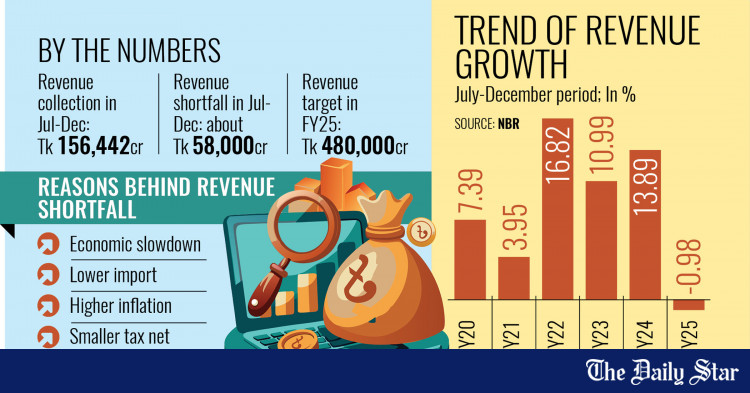
Roughly speaking, the collection turned negative in the first half of the current fiscal year (FY) 2024-25, which is a first since at least the pandemic era -- when markets shuttered, manufacturing units came to a grinding halt, supply chains collapsed, and life and livelihood endured unprecedented shockwaves.

But those days were long over.

Yet, in the July-December period of FY25, taxmen collected Tk 156,442 crore -- 0.98 percent down year-on-year, according to National Board of Revenue (NBR) data.

This negative growth in revenue collection itself is not the disease, according to economists and businesspeople. Rather, it is a symptom of a slowing economy and growing cracks on the macro frontier.

In FY25, major macro indicators like the growth of the gross domestic product (GDP) tumbled, high inflation continued its rampage without showing signs of stopping anytime soon, the exchange rate remained volatile, and development spending hit a four-year low.

All these fairly indicate a single message: the economy is slowing down, it is hurting and will continue to do so due to a lot of factors, including revenue mobilisation, according to economists.

They said NBR's struggle to mobilise revenue and meet targets is nothing new, but these newly emerged economic cracks have added to the collection inefficiency.

In the last 13 years, the revenue board has been consistent in failing to meet its collection targets.

Despite a 6.66 percent collection growth in December, the revenue administration's collection still fell short of its target by Tk 58,000 crore or 25 percent in the first half of FY25, with its end goal set at Tk 480,000 crore for the year.

Taxmen and policy analysts point the finger at the political and
economic shakeup stemming from the ouster of the Awami League government following a mass uprising on August 5 last year.

"The lower revenue growth is closely linked to the current economic slowdown, which also expedites the NBR's inefficiencies," said MA Razzaque, research director of the Policy Research Institute (PRI) of Bangladesh, a local think tank.

Prolonged inefficiencies, reduced imports, higher exemptions and inflationary pressure also contributed to the overall shortfall, the economist added.

The World Bank slashed its forecast for Bangladesh's economic growth by 1.7 percentage points to 4 percent for FY25 due to "significant uncertainties following recent political turmoil" and
"data unavailability".

But Razzaque said the country's actual GDP growth this year could be lower than the World Bank projection.

The country's US dollar stocks have been depleting fast since 2022, prompting the authorities to tighten the belt and restrict imports.

As per the BPM-6 method by the International Monetary Fund (IMF), Bangladesh forex reserves now hover around $20 billion, according to the latest Bangladesh Bank data.
Furthermore, the country's total imports decreased from $90 billion in 2021 to $70 billion in 2023.

"So, the NBR is not going to get enough tariffs from imports," Razzaque added.

Besides, inflationary pressure is also hurting revenue growth as people have been slashing their consumption for a couple of years.

Echoing similar views, Anwar-ul Alam Chowdhury (Parvez), president of the Bangladesh Chamber of Industries (BCI), said lower imports contributed to lower revenue collection.

"The reduction of the overall import volume has contributed to the lower revenue growth and lack of business expansion," he said.

Besides, sluggish implementation of the development budget, officially known as the annual development programme (ADP), is another reason for the lacklustre revenue collection.

The NBR is not getting value-added tax (VAT) and supplementary duties (SDs) from construction works, according to the business leader.

"The projects automatically generate revenue for the NBR," he said.

The implementation of the Annual Development Programme (ADP) in the first six months of fiscal year 2024-25 was down 19 percent year-on-year.

Development spending in the July-December period amounted to Tk 50,002 crore, according to the Implementation Monitoring and Evaluation Division (IMED) under the planning ministry.

"There is an interrelation between the reduction of development spending and lower manufacturing growth," said Parvez.

For example, he said, if there is an ongoing project, there would be demand for construction items and services.

When government spending slows, it badly hits production, including cement, rod and brick manufacturing, causing lower revenue collection, explained Parvez, also a former president of the Bangladesh Garment Manufacturers and Exporters Association.

He also criticised NBR for failing to expand the tax net.

"We don't see any major progress in expanding the tax net. Rather, the NBR is burdening existing taxpayers," he said.

Seeking anonymity, an NBR official acknowledged that the negative collection growth occurred due to the economic slowdown.

"We are facing hurdles in collecting revenue amid the government's lower public spending, higher inflation and slow private sector credit growth," the official said.

Prof Selim Raihan, executive director of the South Asian Network on Economic Modeling (Sanem), suggested exploring more diversified sectors for revenue generation, properly implementing the wealth tax, and expanding the tax net.

"The NBR should not take any ad-hoc decisions for tax hikes without consultation stakeholders," he said, referring to the revenue board's recent withdrawal of hiked VAT and SD on nine goods and services.

"It should be well researched and meticulously planned," he said.

Regards

The fall in revenue collection is interesting - if it continues we can conclude one or both of the following:

1. Economic activity is significantly down.

2. Corruption is up.

There has to be some explanation from Younus!
 
Takeaway from the above two posts

#1 Prof Yunus says that growth under SHW was fake but doesnt say why. If BD's reported GDP is fake, then it is his govts obligation to tell us what is the real GDP. Shouldn't be very difficult for the Central Bank and BBS.

#2 BD's economy has slowed down after SHW left- he must deliver on current performance and not blame his predecessor.

Regards

@BananaRepublic @UKBengali @Afif

This is why I demand Younus to put up or shut up!

He needs to stop behaving like a political Pygmy!
 
This is why I demand Younus to put up or shut up!

He needs to stop behaving like a political Pygmy!


He is losing credibility.

His own published export figures of 50 billion US dollars a year for calendar 2024 prove this to be untrue.

At most growth was maybe 0.5-1% a year lower on average than claimed by Hasina/AL over the last 15 years.

Shows how weak the man is that he needs to say stupid things like his when even his own economic review concluded that BD economic data was broadly correct with some discrepancies in the last 2-3 years.
 
Except for few exceptionally retarded sycophants, no one thinks facist bloodthirsty Hassina was a better option for Bangladesh than Doctor Yunus.

And it's so awesome that we got rid of BAL so spectacularly that bunch of loosers can't do much except whine here and there and throw bunch of empty veiled threats from time to time.
 
Last edited by a moderator:
@UKBengali @BananaRepublic

Younus and his ragtag govt face a dilemma. They have to come out with their own GDP estimate sooner rather than later.

#1 If they show that the GDP is close to the previous estimates, they lose their credibility. Their theory of large-scale corruption and manipulation of numbers falls like a pack of cards.
#2 If they show that the GDP is much lower, the credibility of BD and its economy takes a beating. Their debt ratios shoot up and their ability to attract investment goes down. Which means their own govt will struggle to attract the investment needed to show real growth (whatever that number is).

Personally, I have no skin in this game. But I would like to see BD actual numbers for sure.

Regards
 
@UKBengali @BananaRepublic

Younus and his ragtag govt face a dilemma. They have to come out with their own GDP estimate sooner rather than later.

#1 If they show that the GDP is close to the previous estimates, they lose their credibility. Their theory of large-scale corruption and manipulation of numbers falls like a pack of cards.
#2 If they show that the GDP is much lower, the credibility of BD and its economy takes a beating. Their debt ratios shoot up and their ability to attract investment goes down. Which means their own govt will struggle to attract the investment needed to show real growth (whatever that number is).

Personally, I have no skin in this game. But I would like to see BD actual numbers for sure.

Regards


BD GDP is broadly correct but to save face, Yunus may change down by 5-10% at most.

Anyway updating base year may in fact then make BD GDP even larger as it is currently 2016. Lots of new economic activities are not fully captured due to base year being 9 years back.
 
@UKBengali

It would be very embarassing for the IG to conclude that the BD GDP is even bigger than what SHW had said it was.

Regards


Younis is weak and so needs to pander to the anti-Hasina elements that have the power over him now.

Imagine he said Hasina did not fiddle the figures!
 
Except for few exceptionally retarded Chagols, no one thinks facist bloodthirsty Hassina was a better option for Bangladesh than Doctor Yunus.

And it's so awesome that we got rid of BAL so spectacularly that bunch of loosers can't do much except whine here and there and throw bunch of empty veiled threats from time to time.

@Musings and @Joe Shearer

Please look at the use of the word “Chagols” - it’s not the first time this poster has personalised insults.
 
@UKBengali @BananaRepublic

Younus and his ragtag govt face a dilemma. They have to come out with their own GDP estimate sooner rather than later.

#1 If they show that the GDP is close to the previous estimates, they lose their credibility. Their theory of large-scale corruption and manipulation of numbers falls like a pack of cards.
#2 If they show that the GDP is much lower, the credibility of BD and its economy takes a beating. Their debt ratios shoot up and their ability to attract investment goes down. Which means their own govt will struggle to attract the investment needed to show real growth (whatever that number is).

Personally, I have no skin in this game. But I would like to see BD actual numbers for sure.

Regards

A wise person would keep their mouth shut unless the main lenders showed concerns and objections.

People ask what’s the point of crowing about GDP?

The answer is it’s an indication of economic activity.

Why is this important?

The answer is, it is effectively a collateral for borrowing. Just like a bank will look at your assets and earnings before approving your mortgage - lenders to nation states look at GDP.

GDP dictates whether you can borrow. Once you have borrowed - it’s liquidity/reserve that dictates whether you can make the payments.

Some people assert lenders don’t give a toss about GDP - in which case you should have no issue revising the GDP down to satisfy your political ego.

@Joe Shearer and @UKBengali - it’s put up or shut up time.
 
Last edited:
@Musings and @Joe Shearer

Please look at the use of the word “Chagols” - it’s not the first time this poster has personalised insults.

Ah, did I specifically mention you or something? I just expressed my observation. You are bringing it on yourself on your own.
 
And it's so awesome that we got rid of BAL so spectacularly that bunch of loosers can't do much except whine here and there and throw bunch of empty veiled threats from time to time.
If the economy does not recover, they will be able to do a lot more than whine.
 
A wise person would keep their mouth shut unless the main lenders showed concerns and objections.

People ask what’s the point of crowing about GDP?

The answer is it’s an indication of economic activity.

Why is this important?

The answer is, it is effectively a collateral for borrowing. Just like a bank will look at your assets and earnings before approving your mortgage - lenders to nation states look at GDP.

GDP dictates whether you can borrow. Once you have borrowed - it’s liquidity/reserve that dictates whether you can make the payments.

Some people assert lenders don’t give a toss about GDP - in which case you should have no issue revising the GDP down to satisfy your political ego.

@Joe Shearer and @UKBengali - it’s put up or shut up time.


Yes GDP is important but exports and reserves are even more important.

In essence, ability to repay is the no. 1 criteria.

BD has healthy exports and remittances and so should be able to get loans to complete the infrastructure buildup over next 5-10 years that Hasina started back in 2009.
 

Users who are viewing this thread

Country Watch Latest

Latest Posts

Back
Top