LeGenD
THINK TANK: CONSULTANT

Where is the evidence of such Canadian victories that broke the German spirit and their backs in WW1? Canadian forces provided breakthrough in the Battle of Vimy Ridge in 1917 but this achievement did not change the status quo in the region as overarching the Nivelle Offensive FLOPPED. The Battle of Passchendaele provided limited gains in 1917 that were lost without firing a shot in the face of the German Spring Offensive in 1918. The US-led military operations such as the Battle of St. Mihiel followed by the Meuse-Argonne Offensive in 1918 proved decisive in turning the tide of the war in the end.Did not learn my WW1 and WW2 history from the broken American school system.
Canadian victories in WW1 broke the German spirit as well as their backs. The victories came right exactly when the WW1 entered its final phase. The USA's arrival did nothing major.
The Meuse-Argonne Offensive in September 1918 was part of a large Allied effort to attack the Germans along the entire front to force them out of France and back into Germany. The plan sought to take advantage of the arrival of the American Expeditionary Force under General Pershing. After four years of fighting, European soldiers were exhausted, but the arrival of the U.S. Forces gave the Allies fresh troops and numerical superiority.
The 600,000 man strong U.S. 1st Army planned to attack northward with nine divisions in the line and five in reserve, supported by 2,700 pieces of artillery, 189 tanks, and 821 aircraft, along a fifteen to twenty mile wide corridor bounded by the impassable Meuse River on the east and the dense Argonne Forest and the Aire River on the west.
The Germans had occupied the area for years and had developed an elaborate defensive system of four fortified lines with a dense network of wire entanglements, machine-gun positions, and concrete fighting posts. In between these trench lines, the Germans had a series of strong points in the woods and knolls. With five divisions on the line and another seven in reserve, French General Philippe Petain believed that the German defenses were so strong that the Americans would do well if they managed to reach one of their first objectives, the town of Montfaucon, located a few miles behind enemy lines, before winter.
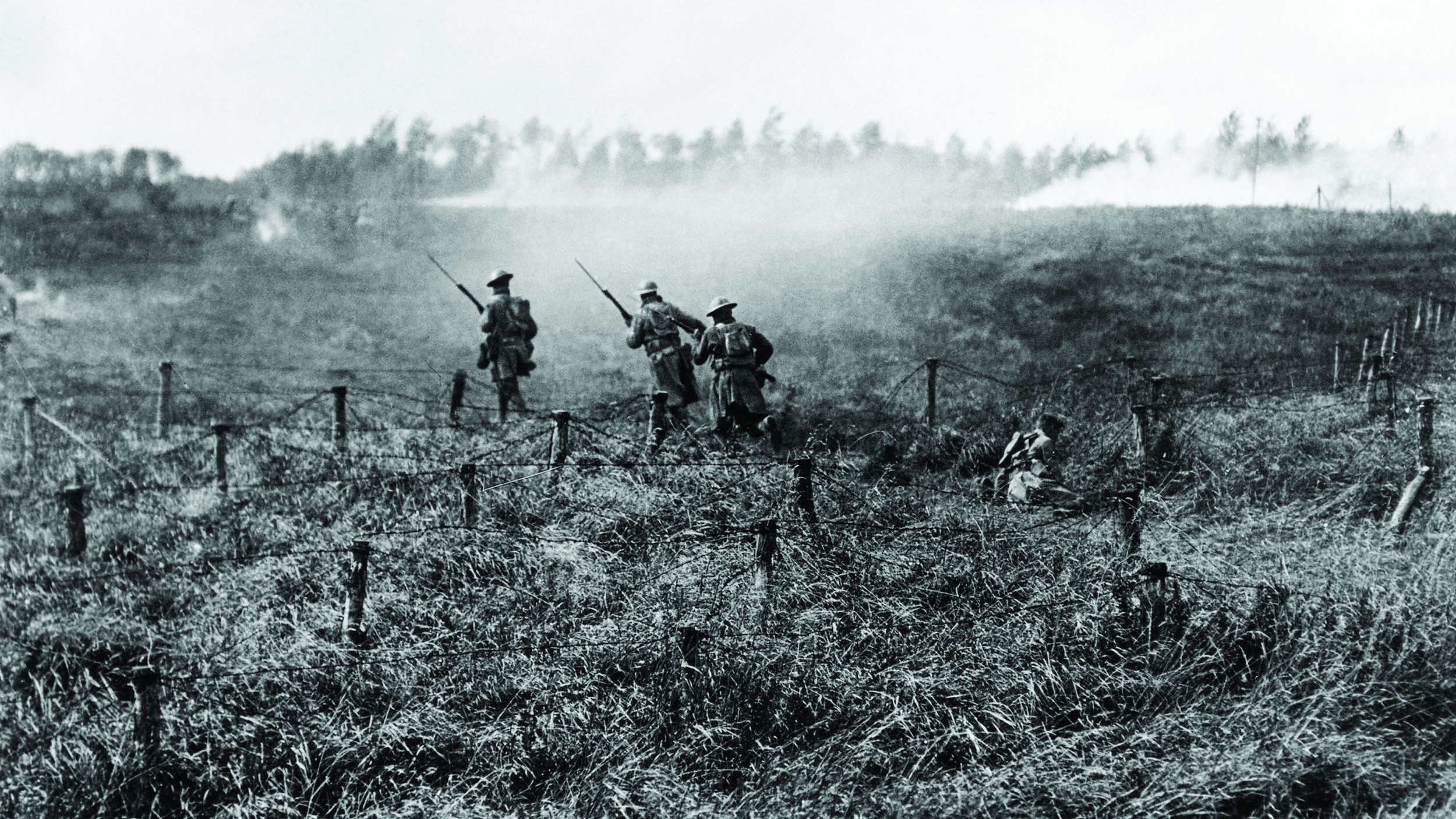
At 5:30 A.M. on September 26, 1918, after a three-hour artillery bombardment, Pershing launched his attack. Despite heavy fog, rugged terrain, and the network of barbed wire, American Soldiers quickly overran the Germans’ forward positions. For the rest of September, the 1st Army plodded forward. Heavy rains turned the terrain to mud, which bogged down tanks and artillery and slowed resupply efforts. The Germans used the delay to bring in reinforcements, and German artillery rained down fire from the heights of the Meuse and the Argonne Forest. The advance became a continuous series of bloody, hard-fought engagements.
Of the nine U.S. divisions in the initial assault, only three had significant combat experience. The 79th Division had only been in France for seven weeks. Heavy fog, rain, and the broken terrain sorely tested the inexperienced troops. Many divisions suffered from a lack of coordination, and the infantry and artillery often failed to work together effectively.
Despite these problems, the 1st Army advanced eight miles into the German lines by the end of September, fighting through some of the strongest positions on the Western Front and capturing 9,000 prisoners and large amounts of supplies and equipment.
As the battle progressed, Pershing began to reorganize the 1st Army, rotating three battle-hardened divisions into the line to relieve some of the less experienced units. The Germans also strengthened their position, adding six new divisions, bringing their total to eleven.
To prepare for the second phase of the offensive, Liggett ordered a series of limited attacks to keep the pressure on the Germans while his battle-weary men reequipped and recuperated. By the end of October, the 1st Army was ready for the next general attack.
On November 1, Liggett’s 1st Army attacked north, toward the Meuse River. Over the next several days, the 1st Army advanced as fast as it could move artillery and supplies forward. At one point, the advance was so rapid that it ran off the AEF headquarters’ maps. By November 4, the Americans had achieved their objective.
Liggett’s careful preparation of the 1st Army paid off. Infantry and artillery coordination was superb. Instead of stopping to deal with fortified positions, regular troops pushed through and around them while special assault troops remained behind to deal with them. Under Liggett’s tutelage, the American units had finally developed into a well-trained, well-organized fighting force.
One week later the Armistice was signed, and World War I was over. The fighting ended at the eleventh hour of the eleventh day of the eleventh month—November 11, 1918. When it ended, the Meuse-Argonne Campaign was the greatest battle that the U.S. Army had ever fought. Almost 1.25 million American troops had participated during the course of the 47-day campaign. American casualties were high—over 117,000—but the results were impressive. The 1st Army had driven forty-three German divisions back about thirty miles over some of the most difficult terrain and most heavily fortified positions on the Western Front, while inflicting over 120,000 casualties. While credit for victory belongs to all the Allied nations, there is little doubt that the success of the American forces during this offensive was a major factor in Germany’s surrender. - Link
The Meuse-Argonne Offensive broke the German spirit and their backs in WW1.
Canadian troops fought well with courage and I don't question this reality but Canada wasn't a military juggernaut that could defeat a power like Germany back in those days when German nationalism was at its peak.
China had no Navy or Air Force to challenge the Japanese in WW2. The Japanese forces overran numerous Chinese lands and reached Burma in 1942. The Japanese forces were at their strongest in the Pacific with a well-developed Navy and Air Force that were collectively used to spearhead operations across the Pacific. The USN destroyed a major Japanese force in the Battle of Midway in 1942.As far as the WW2 in the Pacific was concerned, China had been fighting against Imperial Japan since 1936. The USA came into WW2 way too late just like in the WW1.
Had there been no China fighting and putting up a fierce fight against Imperial Japan, the Japanese would have crippled and completely annihilated the USA.
Imperial Japan had a plan to destroy the USA's urban populations by using chemical/bilological weapons but the Japanese high command decided against it because they thought it would be too inhumane.
Now compare that with the racists running the USA at that time. The moment they had a weapon of mass destruction they used it on civillians in Japan.
Every war the USA fought that they barely came out of alive, the ended up glamourising it as a stunning victory.
The Battle of Midway occurred when the U.S. Navy intercepted a Japanese invasion fleet heading for Midway Island, achieving an overwhelming victory and resulting in the turning point of the war in the Pacific. Hard at work since early 1942, Commander Joseph Rochefort and his team at Station HYPO were able to analyze and partially break down the Japanese code for the attack. At this point, the Japanese were on the defensive and never recovered from the loss of four aircraft carriers and numerous pilots. - Link
The US was also fighting on several fronts and its operations proved decisive in turning the tide of the war. Your logic is not sound.
Then Imperial Japan started the war with the US by attacking Pearl Harbor in 1941, thousands of Americans lost their lives in this incident alone. The Japanese forces were well-trained and brutal and many American troops lost their lives in clashes with them across the Pacific. American leaders were frustrated and decided to use all manner of tools at their disposal to ensure Japanese surrender. American Air Power bombed Tokyo back to the stone age on 09-03-1945. Hiroshima and Nagasaki were destroyed later - both were cities of considerable military importance to the Japanese.Now compare that with the racists running the USA at that time. The moment they had a weapon of mass destruction they used it on civillians in Japan.
Every war the USA fought that they barely came out of alive, the ended up glamourising it as a stunning victory.
WW2 was by far the most brutal war in human history. The gloves were off for this one.
The Japanese also used biological weapons in China in WW2.
The Japanese also had a nuclear weapons research program in WW2.
The US shifted to Theory of Limited War for the lesser wars in post-WW2 times. The Pacific War Model is an option not considered in a long time. However, Trump threatened to wipe out North Korea in 2017 and Vance might be mentally preparing American citizens for the possibility that the US can be brutal in its conduct of war to have a decisive outcome like in WW2 [if there is a need to fight one]. The US is the only country in the world to have visually demonstrated the capability to intercept ICBM class targets and they are working to expand this capacity.
Last edited: