TF-X / KAAN / Hürjet Turkish Fighter & Trainer Aircrafts News & Discussions

Many things but for example spin testing. Do you really want to lose a prototype to spin testing? Another use is testing features like AutoGCAS, terrain-following, etc. Furthermore, the first prototype wasn't really meant for flight testing - it was pushed into flights through modifications. So it is not meant to and will not fly regularly.

But spin testing can be done in a wind tunnel as well. In fact a more controlled set of tests can be done in a wind tunnel than in a scaled "toy" out in the open.

What speeds is this thing going to fly at? Is that representative in any way of the stall speeds of the real fighter? AutoGCAS can be tested on a real prototype when those are flying already. It's a function of the FCS, which I doubt they've designed specifically for this scaled toy.
 
But spin testing can be done in a wind tunnel as well. In fact a more controlled set of tests can be done in a wind tunnel than in a scaled "toy" out in the open.
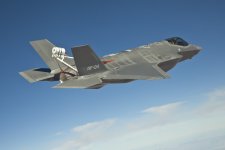
A. No. Please read my posts - I've explained in a lot of detail, why wind tunnels only provide limited data on spin testing. And that too requires special wind tunnels. If wind tunnels were all you needed why are aircraft as modern as F-35 doing spin testing:
1742370259313.jpeg
That's a spin chute for recovery from spin when control system fails. Spin testing is done to develop procedures for escaping spin.
B. It is not a toy. But if you insist on calling it a useless toy, I can't convince you otherwise.
What speeds is this thing going to fly at? Is that representative in any way of the stall speeds of the real fighter? AutoGCAS can be tested on a real prototype when those are flying already. It's a function of the FCS, which I doubt they've designed specifically for this scaled toy.
Again, please skim through the pdf I shared on scaled flight testing. I'm sorry but I can't possibly give a lecture on aircraft scaled flight testing on a forum. I cannot believe I have to convince you of the utility of this when we see scaled flight testing for all sorts of programs.

Also, you really don't know who you are talking to on a forum, which goes both ways of course - you could be the world expert on scaled flight testing. But lecturing me about AutoGCAS is amazingly ironic. @Quwa lol.
 
But spin testing can be done in a wind tunnel as well. In fact a more controlled set of tests can be done in a wind tunnel than in a scaled "toy" out in the open.

What speeds is this thing going to fly at? Is that representative in any way of the stall speeds of the real fighter? AutoGCAS can be tested on a real prototype when those are flying already. It's a function of the FCS, which I doubt they've designed specifically for this scaled toy.
Why design flying prototypes?

Why not just limit testing to a wind tunnel and then churn out a finalised design?

You might be onto something here...
 
What speeds is this thing going to fly at? Is that representative in any way of the stall speeds of the real fighter? AutoGCAS can be tested on a real prototype when those are flying already. It's a function of the FCS, which I doubt they've designed specifically for this scaled toy.
except, as JamD and many others have said, the TFX 'prototype' was rushed into production and was not intended to fly.

You also don't do testing with your only prototype aircraft. If you lose it, you will be in for a bad time. Its probably very likely you cannot even use the first prototype for the tests and data needed. If you spin it and lose it, you've got a real problem on your hands...
 
But spin testing can be done in a wind tunnel as well. In fact a more controlled set of tests can be done in a wind tunnel than in a scaled "toy" out in the open.

What speeds is this thing going to fly at? Is that representative in any way of the stall speeds of the real fighter? AutoGCAS can be tested on a real prototype when those are flying already. It's a function of the FCS, which I doubt they've designed specifically for this scaled toy.
When it comes to some specialized knowledge that we don't understand at all, we can choose to ignore it, or, we try to ask DeepSeek for answers.
Competing with professionals is tantamount to self-defeating!

Here are the answers from DeepSeek:

**Fighter Jet Scaled RC Models: Key Testing Objectives**
Scaled remote-controlled (RC) models of fighter jets play a critical role in aircraft development, enabling cost-effective validation of designs, aerodynamic optimization, and risk reduction before full-scale prototypes are built. Below are their primary testing focuses:

---

### **1. Aerodynamic Validation**
- **Lift & Drag Analysis**:
Tests measure lift-to-drag ratios at varying angles of attack and speeds to validate wing shapes, canard/delta wing configurations, and other aerodynamic features.
- **Stability & Control**:
Evaluates static/dynamic stability in pitch, roll, and yaw, as well as the initial feasibility of flight control logic.
- **Stall & Spin Behavior**:
Simulates stall-induced phenomena (e.g., wing drop, asymmetric spins) to assess recovery strategies or aerodynamic tweaks (e.g., vortex generators).

---

### **2. Flight Control System Testing**
- **Control Law Verification**:
Validates fly-by-wire algorithms, including anti-stall/spin logic, response times, and redundancy mechanisms.
- **Control Surface Effectiveness**:
Tests the impact of canards, flaps, thrust vectoring nozzles, and other surfaces on maneuverability.
- **Autonomous Systems**:
Demonstrates AI-driven capabilities like autonomous navigation, swarm coordination, or target tracking (e.g., loyal wingman concepts).

---

### **3. Stealth Performance Evaluation**
- **Radar Cross-Section (RCS) Testing**:
Validates stealth geometry (e.g., faceted surfaces, S-shaped intakes, angled tails) using scaled radar measurements.
- **Infrared Signature Reduction**:
Assesses designs for engine exhaust cooling or heat-shielding to minimize IR visibility.

---

### **4. Special Configurations & Mission Testing**
- **External Stores Integration**:
Analyzes aerodynamic interference from weapons/fuel tanks and ensures safe separation during release.
- **Adaptive Airframe Designs**:
Tests mechanical reliability of variable-sweep wings, folding mechanisms (carrier-based jets), or modular payloads.
- **VTOL/STOL Systems**:
Validates thrust management for lift fans (e.g., F-35B-inspired models) or tiltrotor configurations.

---

### **5. Risk Mitigation & Cost Efficiency**
- **Rapid Design Iteration**:
Allows quick modifications (e.g., adjusting wing sweep, fuselage shape) to compare multiple configurations.
- **Preventing Full-Scale Failures**:
Identifies issues like flutter, aerodynamic coupling, or control instability before committing to expensive prototypes.
- **Training & Demonstration**:
Provides pilots and engineers with intuitive visualizations of complex maneuvers or failure scenarios.

---

### **6. Notable Examples**
- **NASA X-36**: A 28% scale tailless RC model tested agility and control laws for future stealth UAVs.
- **Russian Okhotnik UAV**: Scaled models validated the flying-wing design’s aerodynamics and autonomous systems.
- **Chinese "Sharp Sword" UAV**: Stealth characteristics and flight controls were refined using RC models.

---

### **Limitations**
1. **Reynolds Number Discrepancies**: Smaller models operate at lower Reynolds numbers, affecting airflow accuracy (requires wind tunnel correlation).
2. **Structural Simplifications**: Materials and flexural properties may not replicate real-world stress responses.
3. **Power System Scaling Challenges**: Miniaturized engines or batteries often fail to mimic full-scale thrust/endurance.

---

### **Conclusion**
Scaled RC models are indispensable for **low-risk, high-speed innovation** in fighter jet development. While physical scaling introduces limitations, they remain vital for early-stage validation of aerodynamics, stealth, and control systems—bridging the gap between digital simulations and full-scale flight testing.
 
To view this content we will need your consent to set third party cookies.
For more detailed information, see our cookies page.

Please don't post random ai generated youtube videos with generic language that provides nothing.
 
Scaled-technology demonstrator for Ka'an took to the skies for the first time. It is named Iqbal after Allama Iqbal.
@Quwa
To view this content we will need your consent to set third party cookies.
For more detailed information, see our cookies page.

Keep in mind, this isn't a heavily modified RC plane.

It seems to just be an extremely miniaturied prototype version of the Kaan, just for testing purposes. So basically a microengine, with landing gear, and a few sensors involved. Nothing substantial, but not a toy.

I personally don't think it's gonna be anything more than a tech demo, but who knows?

@Deino @Quwa
 
Keep in mind, this isn't a heavily modified RC plane.

It seems to just be an extremely miniaturied prototype version of the Kaan, just for testing purposes. So basically a microengine, with landing gear, and a few sensors involved. Nothing substantial, but not a toy.

I personally don't think it's gonna be anything more than a tech demo, but who knows?

@Deino @Quwa
this is a great way to minimise the purpose of such equipment
 
Keep in mind, this isn't a heavily modified RC plane.

It seems to just be an extremely miniaturied prototype version of the Kaan, just for testing purposes. So basically a microengine, with landing gear, and a few sensors involved. Nothing substantial, but not a toy.

I personally don't think it's gonna be anything more than a tech demo, but who knows?

@Deino @Quwa
I will only speak to my domain, which is GNC. However, everything I say probably applies to every other field too.

Contrary to what the first flight of the P0* Kaan might suggest, the Kaan program is really early in its development. There are SO MANY things that are to go into the flight software. Obviously, most of it is deeply classified but I can list things that we generally expect to be there like terrain following, AutoGCAS, collision avoidance, etc. Furthermore, the FLCS needs to be tested in static conditions to verify windtunnel models. Then the FLCS needs to be tested in dynamic conditions where windtunnel models don't exist most of the time. I wish I could tell you exactly the status of Kaan but I cannot. If I could, and you believed me, all of this debate on the need for scaled-testing would go away.

A LOT of this testing can be done on scale models. This is a science that has been worked on by the USA for decades. This is a standard practice too. There is so much data that these scale-models can generate for the Kaan program at the absolute fraction of the cost of the actual flying prototype. Just imagine the time and money that is utilized in flying a full-size jet versus a small RC jet. 1000s of times smaller cost and 100s of times faster.

Regarding the testing of things like terrain following, AutoGCAS, collision avoidance:
A. We have to test the algorithms themselves, not just how they interact with the FLCS. So they are flown on things that don't even look like Kaan. This vastly speeds up algorithm development because you don't have to wait to flights of the prototype and have something better than simulations to rely on - the challenges of implementing algorithms on simulation and on actual flight hardware are wholly different.
B. Once a lot of the FLCS testing is done, it is quite reasonable to assume that Iqbal's FLCS + Iqbal behaves almost exactly like Kaan's FLCS + Kaan. We go through a lot of work to ensure this. Then these algorithms are flight tested on Iqbal.
 
Keep in mind, this isn't a heavily modified RC plane.

It seems to just be an extremely miniaturied prototype version of the Kaan, just for testing purposes. So basically a microengine, with landing gear, and a few sensors involved. Nothing substantial, but not a toy.

I personally don't think it's gonna be anything more than a tech demo, but who knows?

@Deino @Quwa
It's a solid project for the TA Pakistan team to build expertise and capacity for more serious KAAN and other work. TA is basically trying to nurture an adept R&D capacity in Pakistan's private sector (albeit directly), which could, potentially, shift how things work in Pakistan over the long-run.

However, IMO, the near-term play re TA Pakistan is to entice PAF, PA, PN, etc., decision-makers. TA Pak can be a conduit for offsets, which the Turks could leverage to compete even more effectively on up front pricing while still making money (via the long run) through after-sale services/support, like MRO.
 
A. No. Please read my posts - I've explained in a lot of detail, why wind tunnels only provide limited data on spin testing. And that too requires special wind tunnels. If wind tunnels were all you needed why are aircraft as modern as F-35 doing spin testing:
View attachment 108931
That's a spin chute for recovery from spin when control system fails. Spin testing is done to develop procedures for escaping spin.
B. It is not a toy. But if you insist on calling it a useless toy, I can't convince you otherwise.

Again, please skim through the pdf I shared on scaled flight testing. I'm sorry but I can't possibly give a lecture on aircraft scaled flight testing on a forum. I cannot believe I have to convince you of the utility of this when we see scaled flight testing for all sorts of programs.

Also, you really don't know who you are talking to on a forum, which goes both ways of course - you could be the world expert on scaled flight testing. But lecturing me about AutoGCAS is amazingly ironic. @Quwa lol.

I never said that spin testing is entirely done in wind tunnels. It is also a mandatory part of the FCS qualification, to allow for departure free flying in modern FBW equipped fighters.

But those tests at high angles of attack and slow speeds are done on fully representative flying prototypes, like the F-35 with the spin chute in the back that you posted. F-35 may have needed that to figure out what is the max AoA beyond which it would stall, and with post stall behaviour not being clear, a spin chute is a safety net.

I've seen it done for the F/A-18 E/F Super Hornet, where once it was clear that it stalled at a given AoA and speed, the FCS was tweaked to ensure that the fighter automatically recovered by applying stick down and rudder in reverse. The pilot needed to let go of controls, literally just hold the "towel racks" and trust the FBW to pull it out of a spin, in a way making the fighter almost departure resistant.

It is a difficult thing to qualify the spin behaviour of a plane, with lots of factors being involved, but I personally don't see it as being a very accurate way to do it with such a small model that may not be flying at the truly representative speeds.
 
I never said that spin testing is entirely done in wind tunnels. It is also a mandatory part of the FCS qualification, to allow for departure free flying in modern FBW equipped fighters.

But those tests at high angles of attack and slow speeds are done on fully representative flying prototypes, like the F-35 with the spin chute in the back that you posted. F-35 may have needed that to figure out what is the max AoA beyond which it would stall, and with post stall behaviour not being clear, a spin chute is a safety net.

I've seen it done for the F/A-18 E/F Super Hornet, where once it was clear that it stalled at a given AoA and speed, the FCS was tweaked to ensure that the fighter automatically recovered by applying stick down and rudder in reverse. The pilot needed to let go of controls, literally just hold the "towel racks" and trust the FBW to pull it out of a spin, in a way making the fighter almost departure resistant.

It is a difficult thing to qualify the spin behaviour of a plane, with lots of factors being involved, but I personally don't see it as being a very accurate way to do it with such a small model that may not be flying at the truly representative speeds.
Of course, you are 100% correct and everyone else on the planet is wrong.

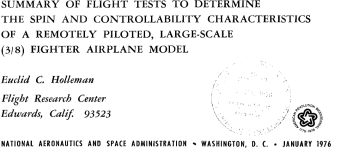
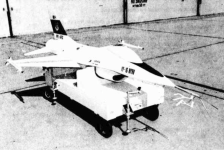
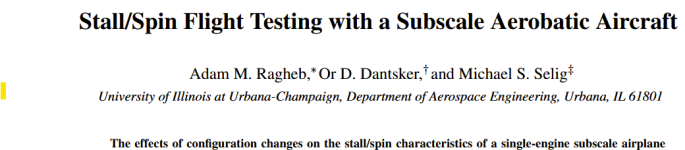
To respond to your nonsense in case somebody else sees it. Here's a few documents detailing how various agencies did spin testing on R/C models - finding this took 3 seconds on google. So very clearly you just want to win the argument and care nothing about the truth.
1742482721016.png


1742483488745.png


1742483591031.png


You very OBVIOUSLY know very little about scaled-flight testing and keep harping on about representative speeds. My brother, the speeds are scaled through scaling laws and Iqbal is designed to achieve those speeds. Even if you were totally ignorant you could've skimmed through the pdf I shared but very clearly your ego won't let you be wrong.

Also, you have grabbed on to spin testing and totally ignored everything else that I listed as missions for Iqbal. Spin testing was just ONE POSSIBLE missions out of TEN I listed. This is more evidence that you are here for a pissing contest. I'm sorry it is obvious to me that you are arguing to win and not to learn. Welcome to my ignore list.

Good day.
 
@JamD

Dear Your posts are really helpful, thank you! I just had a little suggestion. To enhance accessibility for those less familiar with technical terminology, would you consider providing the full form of acronyms alongside their abbreviated versions? Sometimes you use acronyms that are new to folks like me and not always sure what they mean. This would be incredibly helpful for those of us who are still learning, and it would ensure everyone can fully grasp the valuable information you share.
 
Of course, you are 100% correct and everyone else on the planet is wrong.

To respond to your nonsense in case somebody else sees it. Here's a few documents detailing how various agencies did spin testing on R/C models - finding this took 3 seconds on google. So very clearly you just want to win the argument and care nothing about the truth.
View attachment 109069


View attachment 109071


View attachment 109072


You very OBVIOUSLY know very little about scaled-flight testing and keep harping on about representative speeds. My brother, the speeds are scaled through scaling laws and Iqbal is designed to achieve those speeds. Even if you were totally ignorant you could've skimmed through the pdf I shared but very clearly your ego won't let you be wrong.

Also, you have grabbed on to spin testing and totally ignored everything else that I listed as missions for Iqbal. Spin testing was just ONE POSSIBLE missions out of TEN I listed. This is more evidence that you are here for a pissing contest. I'm sorry it is obvious to me that you are arguing to win and not to learn. Welcome to my ignore list.

Good day.

my bad. I hadn't seen the PDF. The one that you've attached here is really interesting. Happy to learn something new.
 
@JamD

Dear Your posts are really helpful, thank you! I just had a little suggestion. To enhance accessibility for those less familiar with technical terminology, would you consider providing the full form of acronyms alongside their abbreviated versions? Sometimes you use acronyms that are new to folks like me and not always sure what they mean. This would be incredibly helpful for those of us who are still learning, and it would ensure everyone can fully grasp the valuable information you share.
Good point. You are right. I will try to be more careful.

For my last few posts in this thread
FLCS: Flight Control System
RC: Radio Control
AutoGCAS: Automatic Ground Collision Avoidance System
GNC: Guidance, Navigation, Control
TA: Turkish Aerospace (they dropped the Industries)
ONERA: Office National d’Études et de Recherches Aéronautiques (National Office for Aeronautical Studies and Research)
 

Users who are viewing this thread

Pakistan Defence Latest

Country Watch Latest

Back
Top