Second quarter GDP growth reaches 1.73%
Major crops in agriculture and industrial sectors witness contractions and remain negative
By Mehtab Haider
March 27, 2025
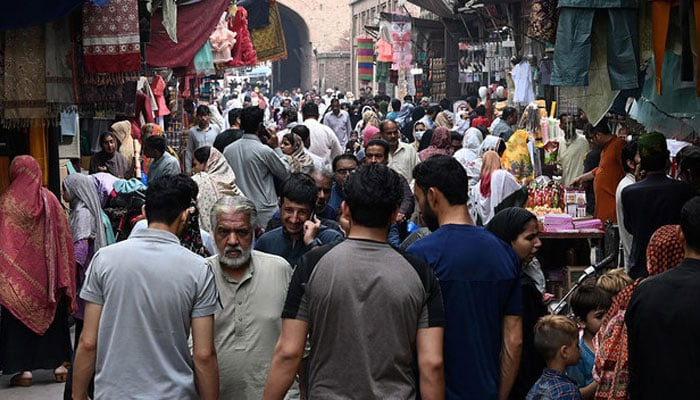
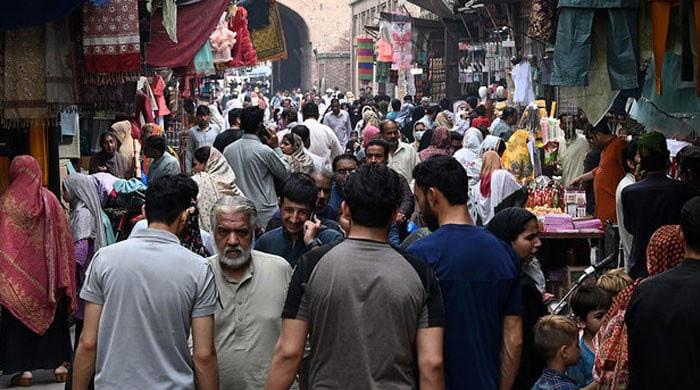
In this picture taken on April 16, 2023, people throng a market area during shopping in Lahore. — AFP
ISLAMABAD: Pakistan’s GDP growth rate bounced back in the second quarter, reaching 1.73pc on the back of impressive growth in the services and livestock sectors.
However, major crops in the agriculture and industrial sectors witnessed contractions and remained negative. In the services sector, the government’s expenditures and financial services helped to jump the growth up to 1.73 percent but it lagged behind the annual GDP growth rate target of 3.6 percent for the current fiscal year. The growth in government services went up to 9 percent.
This can be attributed to growth without creating jobs as it shows an increased spending spree on government services while the numbers of livestock such as horses and donkeys increased. The livestock sector growth was usually estimated at around 4 percent but in the second quarter, it went up to 6.4 percent. To fulfil the IMF conditions, the government has worked out a provisional GDP growth rate of 1.73 percent for the second quarter (Oct-Dec) period but still lagged behind the annually envisaged target of 3.6 percent for 2024-25.
A meeting of the National Accounts Committee (NAC) of the Pakistan Bureau of Statistics (PBS) was held on Wednesday under the chairmanship of secretary Planning and approved provisional growth for Q2 and updated growth for Q1 FY2024-25. Despite the contraction in the industry (-0.18pc), the economy posted a growth of 1.73pc during FY2024-25Q2 due to positive growth in agriculture (1.10pc) and services (2.57pc). Due to upward revisions in services from 1.43pc to 2.21pc and improvement in the industrial sector from -1.03pc to -0.66pc, the overall updated growth during FY2024-25 Q1 stands at 1.34pc as compared to 0.92pc approved in the previous NAC meeting.
The committee approved the updated growth rate of GDP during Q1 and the provisional growth rate during Q2 FY2024-25. The committee approved the updated growth of GDP during FY2024-25Q1 at 1.34pc as compared to 0.92pc estimated previously. Agriculture has shown a growth of 1.10pc in Q2 as compared to the same period of last year. Important crops have shown a negative growth of -7.65pc in Q2 because of a decline in the production of cotton, rice and maize. Cotton has shown a growth of -30.7pc by posting production of 7.084 million bales this year against 10.22 million bales last year.
Rice has declined by -1.4pc with 9.72 million tons of production as compared to 9.86 million tons last year. Similarly, maize witnessed negative growth of -15.4pc with production of 8.24 million tons as compared to 9.74 million tons last year. Sugarcane also witnessed a decline in production of -2.3pc in revised estimates with a production of 85.62 million tons as compared to 87.64 million tons last year. Wheat, which had no impact in Q1, has shown a decline of -6.8pc in area as compared to last year. The high base of 2023-24 has also resulted in a decline in the growth of important crops.
Other crops have shown a positive growth of 0.73pc because of an increase in the area of potatoes by 14.2pc. Cotton ginning and miscellaneous components had a high positive growth because of healthy cotton production in 2023-24 but have now witnessed negative growth because of low production of cotton crop in 2024-25. Livestock has shown a growth of 6.51pc mainly because of low base i-e 2.96pc in Q2 of last year and partly due to a decline in intermediate consumption in the shape of dry fodder (-6.7pc) and green fodder (-1.68pc). Forestry has declined because of a decline in estimated production in KP, while fishing has retained its normal growth.
Industry in Q2, like Q1, has shown a negative growth of (-0.18pc) as compared to Q2 last year. Negative growth of (-3.29pc) has been witnessed in the mining and quarrying industry because of a decrease in the production of gas (-6.16pc), oil (-11.4pc), coal (-6.34pc), etc. Large scale manufacturing, which is based on Quantum Index of Manufacturing (QIM) for the quarter (October-December), has witnessed a negative growth of -2.86pc. The decline is attributed to negative growth in sugar (-12.63pc), cement (-1.82pc), iron & steel (-17.86pc), etc. Small-scale slaughtering has witnessed a fixed growth. The electricity, gas and water supply industry has shown a positive growth of 7.71pc because of an increase in the output of the gas industry as well as a decline in deflator. These industries are estimated directly from the data provided by the sources which has variations when compiled quarterly.
The construction industry declined by -7.14pc in Q2 due to a decrease in production of cement (-1.82pc) and iron & steel (-17.86pc).
The services industry has shown a growth of 2.43pc in Q2 of 2024-25. The wholesale and retail trade has witnessed a negative growth of -1.13pc because of a decline in output LSM (-1.5pc) and imports (-3.5pc). The transport and storage industry has increased by 1.15pc because of the increase in the output of road transport, air transport and water transport. The decline in inflation is now resulting in an improvement in growth for sectors compiled on current prices and then deflated to constant prices. Information and communication is one of those industries which has shown significant growth of 8.45pc because of an increase in the output of mobile companies, a decline in inflation as well a low base.
Similarly, the Finance & Insurance industry has shown growth of 10.21pc because of a significant decline in deflator, interest rate and Kibor. Public administration and social security, which is commonly termed as General Government, has posted a growth of 9.10pc because of a decline in deflator (CPI General increased by 6.26pc as compared to 28.95pc the same quarter last year) and an increase in the annual benchmarks.
Public sector education has also witnessed an improvement because of a decline in CPI education (6.72pc as compared to 12.57pc the same quarter last year) resulting in an increase of 4.80pc in 2024-25 from a high base of 9.10pc in 2023-24.
Similarly, the Human Health and Social Work industry has increased by 6.60pc because of a decline in deflator (14.60pc as compared to 21.44pc the same quarter last year). Other private services have been estimated at 3.14pc based on indicators received from the sources.
ISLAMABAD: Pakistan’s GDP growth rate bounced back in the second quarter, reaching 1.73pc on the back of impressive growth in the services and livestock sectors.However, major crops in the...

www.thenews.com.pk