Iran - Israel/US War: Israel-US declare war on Iran, Iran responds

I've read the replies here and it seems you @PersianGulf are the only sensible one here. Petty scruples like "Islamic virtue" have no place in the iron laws of realpolitik or the jungle of human interaction.

Khamenei shot Iran in the foot with his fatwa, with his missile limitations, and with his idiotic approach of valuing martyrdom over the desire for our people to live and prosper. The Jews fight to live, to prosper. And they win, and drink the blood of their enemies and marry. Our men fight to die, and seek bliss in the afterlife, in the process losing battle after battle and showing weakness. We need to adopt a mindset of ruthless survival, or we will lose this dear nation our forefathers have shed blood for. We need to value Iranian lives, Iranian birth rates, Iranian youth, Iranian ideals, Iranian land and not piss it up for some nomads who were slaughtered in the desert a thousand years ago.
We're a massive country with hundreds of underground weapon bases

Google AMAD project, Iranian military nuclear program between 1990's and 2000's


  • Home
  • Countries
  • Iran
  • Reports
  • The Fourth Nuclear-Weapons-Related Testing Site Located: Another Parchin Site, More Undeclared Nuclear Material Possible

Reports

The Fourth Nuclear-Weapons-Related Testing Site Located: Another Parchin Site, More Undeclared Nuclear Material Possible

by David Albright and Sarah Burkhard [1]

September 7, 2022

Executive Summary

Background

  • The Amad Plan was the code name for Iran’s crash nuclear weapons program in the 1990s and early 2000s, documented in the Iranian Nuclear Archive secured by Israel in 2018 and summarized in Iran’s Perilous Pursuit of Nuclear Weapons by David Albright, Sarah Burkhard and the Good ISIS team. The extent to which Iran continued parts of the nuclear weapons program after the Amad Plan ended in 2003 is still not fully known.
  • Iran has consistently violated its obligations under the Nuclear Non-Proliferation Treaty (NPT) to cooperate with the International Atomic Energy Agency (IAEA) and fully account for its past and present nuclear activities.
  • The IAEA has publicly discussed four locations where it found evidence of undeclared nuclear material, and it has declared one of these sites a clear nuclear safeguards violation under the NPT. The resolution of the undeclared materials, equipment, and activities at the other three locations awaits truthful answers from Iran.
Findings

  • The present report is a technical analysis of Golab Dareh, a test site identified in the Nuclear Archive. This is one of a number of sites associated with explosive testing of nuclear weapons components and the development of associated, high-speed diagnostic equipment. We did not know the exact location of Golab Dareh until recently when we obtained the site’s coordinates from officials knowledgeable about the Nuclear Archive.
  • Based on the available information, we conclude that tests using uranium may have taken place at Golab Dareh, another indication that the number of sites involving undeclared nuclear material may be larger than just the four discussed publicly by the IAEA.
Recommendations

  • It is critical for the IAEA to continue its investigation of Iran’s violation of nuclear safeguards under the NPT. Absent a marked shift in Iran’s actions, the IAEA Board of Governors should condemn Iran’s non-cooperation and refer the issue to the UN Security Council.
  • The United States and Europe should refuse Iran’s demands to end the ongoing IAEA investigation as a condition for a revived nuclear deal under the JCPOA (Joint Comprehensive Plan of Action) framework. The West should instead pressure Iran to cooperate with the IAEA by strengthening sanctions, including so-called snapback sanctions allowed for in case of Iranian non-compliance with the JCPOA.

Golab Dareh Explosive Test Site

The Parchin complex near Tehran contains another Amad Plan site, Golab Dareh, bringing the total there to three. The newly located site is one of four known sites associated with explosive testing of nuclear weapons components and the development of associated, high-speed diagnostic equipment. We have previously discussed Golab Dareh in our reports and book _Iran’s Perilous Pursuit of Nuclear Weapons,_<a href="https://isis-online.org/isis-report...ar-weapons-related-testing-site-located/8#fn2">2</a> but we did not know its location until recently, when we obtained the site’s coordinates from officials knowledgeable about the Iran Nuclear Archive. Based on the available information, this site may have conducted tests using uranium, another indication that the number of sites involving undeclared nuclear material may be larger than just the four cases discussed publicly by the International Atomic Energy Agency.<a href="https://isis-online.org/isis-report...ar-weapons-related-testing-site-located/8#fn3">3</a>

Purpose

Golab Dareh was one of four identified Amad sites involved in nuclear weapons-related research and development experimentation. Figure 1 shows its location at the Parchin complex, along with the location of the other two nuclear weapons-related sites at Parchin: one is another explosives testing location that included two internal test cell facilities (Taleghan 1 and 2), and the other is the Shahid Boroujerdi underground site that was slated to make weapon-grade uranium cores of nuclear weapons. Figure 2 provides a close-up of the Golab Dareh site as it appeared in March 2004. The site features a large bunker protected by an earthen berm, another smaller bunker, and a rectangular building flanked by a blast deflection wall and berm. The two bunkers and the building are positioned in a triangle. Figure 3 contains a ground image of the main bunker at the site from the Nuclear Archive.

Golab_Daleh_Figure_1.jpg


Figure 1. The Parchin military complex hosted three known Amad Plan sites. One, Golab Dareh; two, Taleghan 1 and 2, featuring high explosive test chambers; and three, the Shahid Boroujerdi tunnel complex, slated to make weapon-grade uranium cores of nuclear weapons.

Golab_Daleh_Figure_2.jpg


Figure 2. The Golab Dareh site in March 2004 featured a large bunker and a building suitable for nuclear-weapons related testing and developing high-speed diagnostic equipment.

Golab_Daleh_Figure_3.jpg


Figure 3. A ground photo from the Nuclear Archive shows the entrance area of the main bunker.

The Amad Plan conducted at least 41 tests at this site between September 2002 and April 2003. Figure 4 is from a translated table from the Amad Plan, found in the Nuclear Archives, tabulating the number of tests at the four main nuclear weapons-related testing locations over this seven-month period. The other three test locations are Taleghan 1 and 2 at Parchin, featuring two high-explosive test chambers; the Sanjarian site with two more chambers, called Upper and Lower Nour-Abad;<a href="https://isis-online.org/isis-report...ar-weapons-related-testing-site-located/8#fn4">4</a> and the Marivan outdoor testing site.<a href="https://isis-online.org/isis-report...ar-weapons-related-testing-site-located/8#fn5">5</a> (Three tests were conducted under project name Pour Midani, which is excluded here because the tests were related to explosive yield measurements vital for testing underground a finished nuclear explosive device.<a href="https://isis-online.org/isis-report...ar-weapons-related-testing-site-located/8#fn6">6</a>) The table lists a total of 189 tests at these four sites over that seven-month period, of which about 20 percent were conducted at Golab Dareh. This fraction should not be seen as indicating the relative importance of the testing campaigns at Golab Dareh compared to the other sites, but it does show that Golab Dareh was an active Amad Plan testing site.

As we reported earlier, according to senior Israeli officials knowledgeable about the Nuclear Archive, this site was involved in equation-of-state experiments, including metal flyer plate and velocity experiments. It was also involved in testing photodiodes. A few examples of photodiode tests are mentioned in the Institute study on Sanjarian. A photodiode converts a light signal to a current, thus, these tests may be related to developing fast diagnostic capabilities where light from an explosion is detected in a photodiode and subsequently recorded.
 
Last edited:
Flyer plate experiments involve slamming together materials at tremendous velocities, using gases or propellants, generating high temperatures and pressures, permitting measurements of the hydrodynamic behavior of materials upon impact. High-speed diagnostic equipment monitors the impact. Such equation-of-state experiments would be necessary in the design of an implosion-type nuclear weapon, the Amad Plan’s choice, where the experiments would be generating high temperature and pressure data important to refining nuclear weapons codes. In a nuclear weapons program like Iran’s, with a weapon design based on weapon-grade uranium, such experiments would have involved natural uranium metal.

Based on archive information, Iran had a “1 Mbar gun” which is likely the device used to conduct the equation-of-state experiments at Golab Dareh. Preliminary experiments with the gun, likely involving associated diagnostic equipment, were conducted at Sanjarian. Figure 5 is an archive photo showing the gun that may have been used to propel the flyer plate, suggesting the experiments used propulsion methods rather than gases. The firing system involved propellant and a firing mechanism using the properties of a flat distributor (the channels in the distributor have been obscured digitally in the photo). This initiation method was pioneered by the ex-Soviet nuclear weapons expert Vyacheslav Danilenko. A larger, hemispherical variant was used for initiating the high explosives in the nuclear weapons.
Golab_Daleh_Figure_4.jpg


Figure 4. Translation of a Nuclear Archive table documenting the number of tests across the Amad Plan’s nuclear weapons development testing sites over a seven-months period from March 2002 to April 2003.

Golab_Daleh_Figure_5.jpg


Figure 5. A gun system, with propellant, used to fire flyer plate. Image from Nuclear Archive.

Details of the Site

The Golab Dareh site is small and surrounded by other military facilities in the southern part of the Parchin complex. It is not located in or near the Tehran district carrying the same name. It does not appear to have its own security perimeter and it does not appear to have been destroyed or dismantled, at least not to an extent visible in available satellite imagery, as of August 2022. The coordinates for the site are 35.49548N , 51.74423E.

The site consists of one main bunker with an L-shaped earthen berm, and a second, smaller bunker. Based on its adjacency to the other structures, a rectangular flat-roofed building appears to be part of the site. It features a probable vent on the roof, and a blast deflection wall that is backed by an earthen berm on the east end of the facility. Given the layout of this facility, it is likely that the building was designed for some form of hydrodynamics testing, likely involving the gun device described above.

The triangular arrangement between the secondary bunker, the main bunker and the building indicates that the smaller bunker could have served as a control bunker. Further, a semicircular object is visible near the smaller bunker, which could be for storage.

The ground image of the main bunker from the Nuclear Archive, when compared with another ground image found on suSPNDed.org, provides enough indicators to assess that they are likely the same bunker (see Figure 6), and that the main bunker is about twice the height of an average person, or roughly 3.5 meters tall. Both images show stacks of sandbags around the bunker entrance. The second, probable ground image not only shows the sandbags, but, in addition, holes in the bunker lining, assessed as probable explosive testing ejecta divots.

The precise location of the equation-of-state experiments is difficult to determine. Two sites are possible–the main bunker faced with a berm or the slightly longer nearby building with a blast deflection wall and berm at its east end. Either location could be capable of conducting such tests, where impact debris must be contained, but a building can provide a more controlled laboratory environment.

The site underwent substantial changes between the first available Google Earth image, dated July 2002, and the next available from March 2004. Between the two dates, the building and the blast protection wall were added. Further visible changes occurred around 2009, when an earthen berm was added perpendicular to the main bunker. Additional minor changes were also noted between 2011 - 2012.

Golab_Daleh_Figure_6.jpg


Figure 6. Probable ground photo of the Golab Dareh main bunker. Source: suSPNDed.org.
 
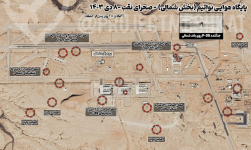
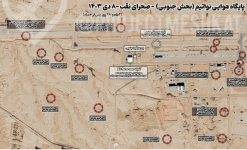
Analysis of Operation True Promise II (new satellite imagery - see next post):

Summary:

  • 36 impacts recorded at Nevatim base.
  • 10-14 impacts recorded in Tel Nof. Still no high resolution satellite imagery was released for Tel Nof.
  • 3-4 impacts near Tel Aviv (1 hit the side of a road, 1 hit 500m from Mossad HQ, 1 supposedly hit a school).
  • 1-2 in Gaza (Netzarim axis from video footage).
  • we have visual evidence of at least 50-55 impacts / 180 missiles = c. 30% penetration rate for TP2 (compared to c. 10% for the ballistic missiles used in TP1).
  • however, almost half of these missiles wildly missed the target. only a small number impacted something accurately (a building, a runway). only 3 buildings were seriously damaged/destroyed (2 in Nevatim and 1 in Tel Nof).
  • Higher missile penetration rate in TP2 (30%) vs TP1 (10%) likely due to combination of Iran using newer missiles and Israel choosing to prioritise protection of population centres over air bases.
Nevatim Air Base - 36 impacts:
  • 20 impacts in the north part of the base (where F-35 jets are housed), and 16 impacts in the south part of the base. of these 36 impacts, 13-14 were very far off target (35-40%), the other missiles had an average accuracy of 70-80m. (This makes sense: CEP measures the probability that a missile will impact within x m CEP of the target 50% of the time.)
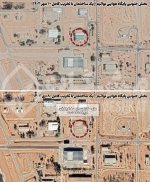
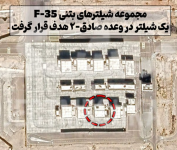
  • of the remaining 'reasonably accurate' 22 impacts, 16/22 hit runways or access roads (or very close to them). only 4 directly hit a building, 2 of these causing severe damage (non-concrete AWACS shelter in south and a large building in the north), 1 causing limited damage and 1 causing very limited damage (to a concrete F-35 shelter).
  • the impacts on the runways were ineffective, causing relatively small impact craters <10m and repaired within a few hours.
  • South of base (16 impacts): 7 of these were very far off target, 7 hit runways or access roads, 1 hit the AWACS hangar (non-concrete) and caused severe damage to 2 hangars (famous image), 1 hit a building but caused limited damage. Observation towers and Wing of Zion shelter were not hit at all, unfortunately. Cluster munitions may have been more effective here as the impact radius of the impacted warheads was < 10 metres. Strong missed opportunity to damage IAF's capabilities.
  • North of base (20 impacts): 6 of these were very far off target, 9 hit runways or access roads or close to them, 3 missiles impacted close to F-35 and AWACS shelters but missed (by 10-100m), 1 direct hit on F-35 concrete shelter (very limited damage), and 1 direct hit on a large building, which was totally destroyed.

Conclusions
  • IRGC overwhelmed Israeli air defences, forcing Israel to prioritise defence of population centres over military targets
  • IRGC intended to inflict major damage at Israeli air bases in TP2, but the missiles were unable to achieve these goals due to insufficient accuracy and low destructive capability against hardened shelters.
  • IRGC threats to destroy enemy air bases are currently not credible due to need for <10m CEP precision at 1500km range, a very difficult capability that the IRGC-ASF does not yet seem to possess with its MRBM (with 70-80m CEP)
  • Cluster munitions may have fared better for large dispersed targets.
  • Heavier warheads with more efficient explosives and improvements in RV guidance systems are required. Improvements in target selection and methods could result in greater success (e.g., destroying observation centres and important shelters).
  • Better targets for Iran's MRBM arsenal (with a 70-80m CEP) require less dispersion or concentrated attack on a smaller number of targets.
 
Last edited:
Satellite imagery of Nevatim air base from TP2:

 
To view this content we will need your consent to set third party cookies.
For more detailed information, see our cookies page.


this account alleges most of the missiles used were the newer Kheibar-Shekan 2 and the attack destroyed Iranian deterrence due to the terrible accuracy of these missiles despite years of channeling funds into the missile program
 
To view this content we will need your consent to set third party cookies.
For more detailed information, see our cookies page.


this account alleges most of the missiles used were the newer Kheibar-Shekan 2 and the attack destroyed Iranian deterrence due to the terrible accuracy of these missiles despite years of channeling funds into the missile program

There is a reason most countries use ballistic missiles as a nuclear weapons delivery platform where accuracy is less of a concern. An argument can be made for SRBMs and MRBMs but ICBMs are essentially pointless without nuclear warheads.
 
There is a reason most countries use ballistic missiles as a nuclear weapons delivery platform where accuracy is less of a concern. An argument can be made for SRBMs and MRBMs but ICBMs are essentially pointless without nuclear warheads.
Some countries - such as China - use ballistic missiles for anti-ship functions, so accuracy is not really an obstacle that can limit the effectiveness of a BM. Even though there is no proof of the BM's operability yet, a BM can still be a deadly weapon regardless of the inaccuracy. For example, a swarm of BMs converging on the same target could be a very interesting tactic. If Iran really has thousands of BMs as is speculated, it could do good damage to selected targets. According to previous posts, the variety and dispersion of targets limited the effectiveness of TP II.
 
Some countries - such as China - use ballistic missiles for anti-ship functions, so accuracy is not really an obstacle that can limit the effectiveness of a BM. Even though there is no proof of the BM's operability yet, a BM can still be a deadly weapon regardless of the inaccuracy. For example, a swarm of BMs converging on the same target could be a very interesting tactic. If Iran really has thousands of BMs as is speculated, it could do good damage to selected targets. According to previous posts, the variety and dispersion of targets limited the effectiveness of TP II.
Wrecking an aircraft carrier's deck knocks it out of operation and that damage can't be quickly repaired out of port. Cratering a airfield runway takes an afternoon to repair. Iran has to balance accuracy with speed and survivability. To ensure penetration, a missile needs to be very fast or perform evasive maneuvers, reducing accuracy, but without it you're going to get intercepted. Iran doesn't have satellites to help guide them and is mostly relying on inertial navigation systems for accuracy. With a nuclear warhead, you drop it in the general vicinity of the target as fast as you can and that is enough. With these conventional warheads you need accuracy to be useful. Throw in long ranges into the mix you are again limiting how much accuracy you can get out of inertial navigation. Most militaries that can use strike jets for these types of operations.
 
To view this content we will need your consent to set third party cookies.
For more detailed information, see our cookies page.


this account alleges most of the missiles used were the newer Kheibar-Shekan 2 and the attack destroyed Iranian deterrence due to the terrible accuracy of these missiles despite years of channeling funds into the missile program


This is correct. It proved the world that Iran's missiles are inaccurate and that Iran does not have the ability to deter or inflict damage. Any assumption of "this was just a warning" is copium. Iran has quantity (not 100K as some idiots believe, but maybe 3-5K) but the quality is worse than North Korea. With proxies shown to be paper tigers (except Hamas and Houthis), Iran has lost any and all credibility and it's shown its hand, now Israel and the US know what they can do, which is why they are on the warpath.
 
Wrecking an aircraft carrier's deck knocks it out of operation and that damage can't be quickly repaired out of port. Cratering a airfield runway takes an afternoon to repair. Iran has to balance accuracy with speed and survivability. To ensure penetration, a missile needs to be very fast or perform evasive maneuvers, reducing accuracy, but without it you're going to get intercepted. Iran doesn't have satellites to help guide them and is mostly relying on inertial navigation systems for accuracy. With a nuclear warhead, you drop it in the general vicinity of the target as fast as you can and that is enough. With these conventional warheads you need accuracy to be useful. Throw in long ranges into the mix you are again limiting how much accuracy you can get out of inertial navigation. Most militaries that can use strike jets for these types of operations.
But that's why I said that one way to compensate for this inaccuracy disadvantage is to simply change your attack strategy and attack one target at a time in an eventual True Promise III. Even with the BM's inaccuracy, the strategy of converging all missiles launched to the same target is a solution that should really be addressed/discussed.
 
This is correct. It proved the world that Iran's missiles are inaccurate and that Iran does not have the ability to deter or inflict damage. Any assumption of "this was just a warning" is copium. Iran has quantity (not 100K as some idiots believe, but maybe 3-5K) but the quality is worse than North Korea. With proxies shown to be paper tigers (except Hamas and Houthis), Iran has lost any and all credibility and it's shown its hand, now Israel and the US know what they can do, which is why they are on the warpath.

So because Iran didn't kill any babies it cannot inflict damage. Gotcha
 

Users who are viewing this thread

Country Watch Latest

Back
Top