"Chinese goods are sold out", Americans are frantically stockpiling
Daily Economic News
2025-04-06 06:05:39 From Beijing
According to CCTV News, based on the executive order on the so-called "reciprocal tariffs" signed by Trump on the 2nd of this month, the United States is scheduled to impose a 10% "minimum base tariff" on all trading partners starting on the 5th. Higher "reciprocal tariffs" will be imposed on certain trading partners, and these measures will take effect on the 9th.
U.S. economists and business leaders have warned that additional tariffs will push up prices and ultimately be passed on to consumers. Some U.S. consumers have already started stockpiling amid concerns about soaring prices.
Another video shows that Chinese products were sold out in American supermarkets.
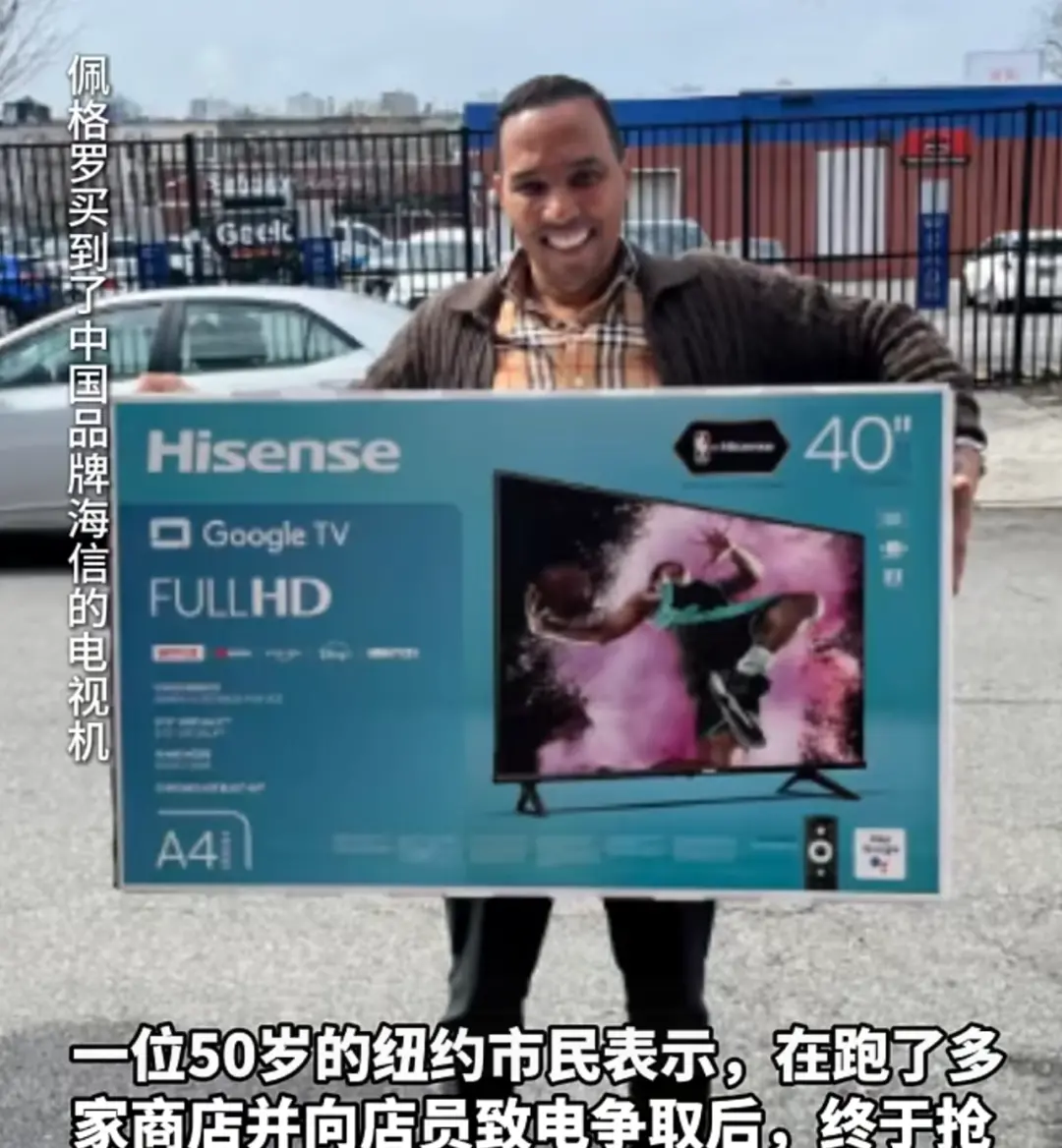
According to China Daily, with tariffs imminent, Americans have begun frantically stockpiling and snapping up Chinese-brand televisions.
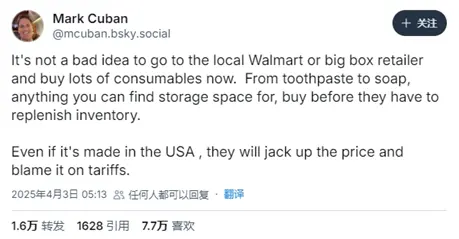
American billionaire reminds people to stock up:
From toothpaste to soap
For American consumers, high tariffs could mean higher prices for everything from cars and appliances to gasoline and groceries.
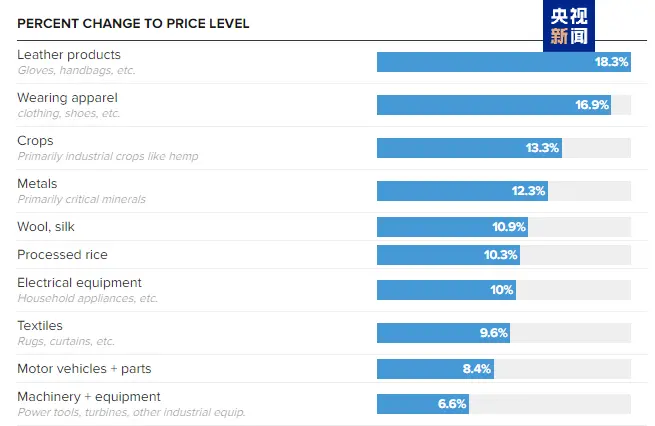
Forecast data released by the Yale University Budget Lab
According to the Yale University Budget Lab, prices of leather products, clothing, crops, metals, wool and other categories will increase by more than 10%.
In response, some Americans have begun to get nervous and are busy "adding things to their shopping carts."
On the afternoon of April 2, Mark Cuban, a well-known American investor and billionaire, wrote on social media that it is time to start stockpiling. "From toothpaste to soap, anything you can find a place to store should be bought early, preferably before stores restock," Cuban said. Cuban said even American-made goods may increase in price, "and they'll blame it on tariffs."
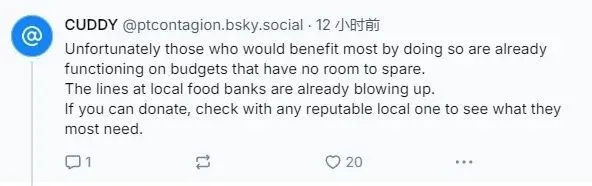
American netizens said that the local queues for food were already full.
At supermarkets and electronics retailers, some consumers appeared to have taken Cuban's advice, pushing loaded shopping carts through parking lots in an attempt to stock up before prices rise.
Chinese-made TVs sold out
According to Cankao Xiaoxi, some US media have noticed that due to concerns about a sharp rise in prices, many people have started to rush to buy, and the popular goods being snapped up include Chinese-made televisions!
According to the Wall Street Journal website, 50-year-old Pegro from New York City took immediate action after hearing the news about the tariffs. From the evening of the 2nd to the morning of the 3rd, Peguero estimates that he spent about $3,000 on electronics, car parts, gardening equipment and other household items.
Interestingly, Pegro almost failed to buy the Chinese-made TV set he wanted. He went to two offline electronics stores in New York, but found out when he arrived that this type of TV was out of stock! He then quickly called another store and was told there was only one left.
"I called the clerk and pleaded: Please leave it to me," he said.
Video screenshots
Similar scenes of panic buying have occurred frequently across the United States. Americans have been busy "adding items to their carts," says the Wall Street Journal. The newspaper also stated that "Americans were already nervous" long before Trump announced large-scale tariff measures!
Americans' nervousness is understandable. After all, rising prices are only one aspect of the impact of tariffs, while the volatility in the U.S. stock market is even more "bloody." Just on the 4th, as the tariff war exacerbated panic, the New York stock market in the United States and European stock markets plummeted for the second consecutive day. The three major U.S. stock indices all fell by more than 5%, and the three major European stock indices all fell. According to US media reports, some American college students have been paying attention to the stock market, worried about the economic situation they will face when they graduate.
As we all know, launching a tariff war wantonly will harm others and not benefit oneself. Trump's tariff policy will cause multiple damages to the US and world economies, from pushing up prices to triggering retaliation, to supply chain disruptions, economic slowdowns and job losses. The long-term consequences will be very severe. And the American people have obviously suffered from this!
Automotive industry insiders:
Costs will be passed on to U.S. consumers
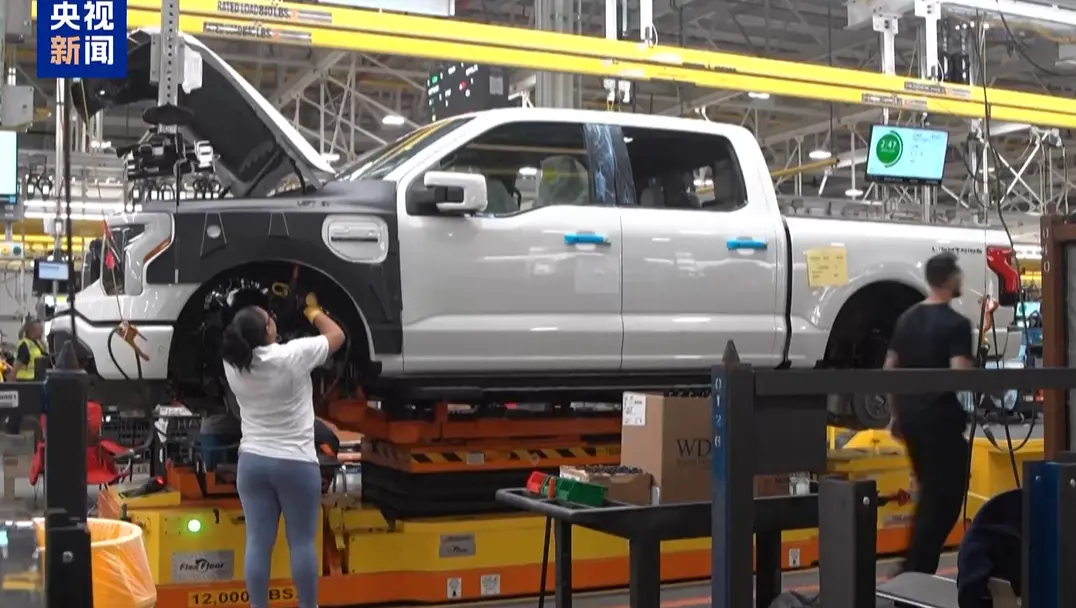
The US policy of imposing a 25% tariff on imported cars will officially take effect on the 3rd of this month. Many industry experts believe that the automobile industry has long become an industry that relies on the global supply chain. High tariffs cannot achieve the goal of "one country monopolizing the industry". It will only make more Americans unable to afford cars, the US automobile industry loses competitiveness, and the US economy faces a greater risk of stalling.
Industry insiders believe that American automakers are unable to bear the cost pressure brought by the 25% import tariff. According to JPMorgan Chase's estimates, after the auto tariffs take effect, General Motors will pay up to $13 billion in import tariffs each year, while Ford Motor will have to pay about $4.5 billion in import tariffs.
Some industry insiders believe that under the impact of tariffs, the US auto industry may slide towards high prices and low quality. A Bank of America analysis report believes that auto tariffs could cause U.S. auto sales to drop by 3 million units, equivalent to nearly one-fifth of last year's total sales.
The average loss per household per year
$3,800 in purchasing power
According to CCTV News, Trump hopes to put pressure on other countries by imposing "reciprocal tariffs", which may make American consumers pay a particularly high price.
Currently, U.S. consumer confidence continues to decline, and "reciprocal tariffs" will further increase spending on household goods, erode household purchasing power, aggravate household finances, and increase the burden on American families.
The Yale University Budget Lab estimates that after the United States implements "reciprocal tariffs", if other countries take retaliatory measures, low-, middle-, and high-income American families will lose an average of $1,300, $2,100, and $5,400 respectively.
According to an analysis by the Yale University Budget Lab, the tariff policies announced by the new U.S. administration may lead to a 2.3% increase in the overall U.S. inflation rate this year, including a 2.8% increase in food prices and an 8.4% increase in car prices, equivalent to a loss of $3,800 per year for every average American household.
According to estimates by the US think tank Tax Foundation, without considering countermeasures from other countries and regions, the US "reciprocal tariff" policy will lead to the following situations this year:
Federal tax revenue increased by $258.4 billion, or 0.85% of GDP.
The average after-tax income of individuals in the United States decreased by 1.9%.
The average American household will face an additional $1,900 in tax burden each year.
"Reciprocal tariffs" spark global condemnation
American-style "big gamble" may bring bad consequences
America's rule-breaking actions hurt others and itself. A commentary in the New York Times believes that the Trump administration is making a "big gamble" and believes that the United States can solve almost all problems with the "stick" of tariffs. This strategy of mixing mercantilism with bullying poses great risks to the U.S. economy. Affected by this, following the sharp drop the previous day, the three major stock indexes in New York plunged again after opening on the 4th. How do you view this situation? What other impacts will there be in the future?
“Reciprocal tariffs” could lead to retaliatory tariffs from trading partners
Lu Jiefeng, Associate Professor at the University of International Business and Economics: At present, the panic among investors in the US market is continuing to spread and intensify, which can be understood from the following three levels. In the short term, the market is worried that the so-called "reciprocal tariffs" implemented by the United States will trigger retaliatory tariffs from its trading partners, leading to an escalation of the trade war. This expectation prompted investors to sell risky assets such as stocks out of risk aversion.
U.S. companies will face higher import costs and export barriers
Lu Jiefeng, Associate Professor at the University of International Business and Economics: In the medium term, the market's expectations for corporate earnings have been lowered. Investors are worried that companies will face the dual dilemma of rising import costs and blocked exports. In the manufacturing and technology industries, many American companies rely on trading partners to supply parts; in the agriculture and automobile industries, they may be directly hit by retaliatory tariffs from trading partners. In addition, the profit margins of the US retail industry will be greatly compressed due to rising commodity costs.
Reciprocal tariffs will bring economic stagflation risks to the United States
Lu Jiefeng, associate professor at the University of International Business and Economics: In the long run, investors are worried about the slowdown in overall economic growth. Trump’s so-called “reciprocal tariffs” are actually trade protectionism at work, which will lead to reduced supply chain efficiency, higher costs and higher consumer prices, and may eventually trigger the risk of economic stagflation. It can be said that what the market fears or panics about is not the tariffs themselves, but the chain reactions they cause on economic development in the short, medium and long term. Judging from the current market reaction, Trump intends to punish US trading partners through "reciprocal tariffs", but the US itself will actually be the one being punished.
On April 4th local time, Federal Reserve Chairman Powell said that US President Trump’s tariff policy may lead to rising unemployment and may lead to rising inflation and slower economic growth.
Analysts from several U.S. financial institutions pointed out that the imposition of tariffs may cause the U.S. economy to fall into recession.
According to US media reports, JPMorgan Chase economist Michael Feroli said on the 4th that JPMorgan Chase expects the US real GDP for the whole year to shrink "under the heavy pressure of the US government's new tariff policy" and the US economy may fall into recession. JPMorgan Chase has lowered its full-year forecast for U.S. real GDP growth to a 0.3% contraction from its previous forecast of 1.3%.
Mark Zandi, chief economist at Moody's Analytics, said on social media on the 3rd that if the United States continues to fully implement its tariff policy, even if the U.S. economy does not fall into a depression, it will suffer a severe recession.
Citigroup released an investment strategy report on the 3rd, saying that if the impact of the US tariffs cannot be eliminated through negotiations, the US GDP growth in 2025 may be "wiped out."
不少业内专家认为,汽车业早已成为依赖全球供应链的产业,高关税无法实现产业“一国独享”的目的,只会让更多美国人买不起车、美国汽车业失去竞争力、美国经济面临更大失速风险。

finance-ifeng-com.translate.goog