China hits back at Canada with fresh agriculture tariffs

China’s economy had already problems with slow growth, property fraud (Evergrande), declining consumption, declining population and ghost cities with empty appartments.

Trump’s tarrifs made everything more worse for China.

But Chinese are intelligent people. They can overcome this.
 
China’s economy had already problems with slow growth, property fraud (Evergrande), declining consumption, declining population and ghost cities with empty appartments.

Trump’s tarrifs made everything more worse for China.

But Chinese are intelligent people. They can overcome this.
Yes problems, but many are exaggerated by the West, like ghost cities, slow growth at 5.00% GDP rate ? And US GDP growth rate is expected to go to like -2.0% or worse in the first quarter of 2025.
 
Last edited:
China’s economy had already problems with slow growth, property fraud (Evergrande), declining consumption, declining population and ghost cities with empty appartments.
Trump’s tarrifs made everything more worse for China.
You can see a lot of fake news about China in the Western English media.

China is doing well today.
Most Chinese people don't pay attention to the tariff war started by Trump!
Chinese people like me only regard these as entertainment news. ------ A "clown" is constantly bringing us joy.
 
China’s economy had already problems with slow growth, property fraud (Evergrande), declining consumption, declining population and ghost cities with empty appartments.

Trump’s tarrifs made everything more worse for China.

But Chinese are intelligent people. They can overcome this.
What big problem? like unprecedented 1 trillion dollars trade surplus in the human history last year? like BYD became the biggest EV maker and China the biggest car exporter in the world last year? Like Huawei reclaimed top spot last year? or Deepseek or chip breakthroughs last year?

微信图片_20250406193710.png
 

China’s tariffs as a Mike Tyson knockout punch to America

If China pulls off the tariff-consumption retaliatory combo, it could be a fatal blow to US relevance in the global economy
By HAN FEIZIAPRIL 6, 2025

Mike Tyson’s most dangerous combo was a right hook to his opponent’s left kidney followed by a snap uppercut to the chin. Correctly executed, the right hook to the body momentarily stuns the opponent causing him to double over, exposing the chin to the uppercut follow-up.

China just went big, implementing a 34% across-the-board tariff on imports from the US, export restrictions on a range of rare earth minerals and sanctions on 11 American companies. Mike Tyson has just delivered a right hook to the body.

China also went first. A parade of economies, Vietnam most publicly, has been making calls to the White House to negotiate away crippling tariffs. The pusillanimous strategy would have been to wait and see.

If China’s strategy were to salvage as much trade as possible, a wait-and-see strategy would be appropriate. The whole world would be jockeying for advantage as everyone takes cues from everyone else and winds up with similarly lousy deals, namely large reductions in tariffs and/or commitments to purchase sizeable quantities of American goods.

By going out big with a retaliatory tariff, China signaled that it is not trying to meet President Donald Trump halfway. Mike Tyson wants to brawl and is going for a knockout.

Only China (maybe the EU, but come on, who’re we kidding?) can go big. If China had waited, many smaller economies would have capitulated, forcing China to either match or twist in the wind – retaliation at that point would be pointless and self-isolating.

By going out first and going out strong, China just improved everyone’s negotiating position. Now, smaller economies (and the EU, e.g. Airbus) know China will not undercut them in negotiations. Going out early provides cover for other economies to drive a harder bargain, magnifying the impact of China’s retaliatory body blow.

Previously, Han Feizi lamented the tragic political economy that prevented America from reindustrializing, writing:

Reversing globalization would involve a massive derating of US asset prices as sales to foreign buyers are artificially restricted. Effects on GDP could theoretically be contained, but the wealthy would have to become poorer in hopes of bringing low-income folks back into the middle class as investment bankers become process engineers and Uber drivers become factory workers.

For a political economy that couldn’t figure out a mechanism to pay them off as globalization created immense riches, how likely is it that the immensely rich will stomach becoming significantly poorer?
Evidently, Han Feizi underestimated President Trump’s stomach for chaos. On many levels, we should all applaud Trump. He has blown a hole right through America’s tragic political economy and threw rich people under the bus – something no president, Democrat nor Republican, has had the cajones to do.

Unfortunately, these tariffs are a confused muck-up and will leave the US a much reduced economic power. It is unclear what the Trump administration is trying to accomplish. Is he trying to raise revenue, reindustrialize America or strong-arm trade partners?

The entire rollout, from the Mickey Mouse tariff formula to slapping tariffs on penguin-inhabited islands, was an embarrassment. We will not belabor what a dumpster fire this ill-conceived expression of Trump’s 1980s “Japan is eating our lunch” mind rot this all is and instead focus on what China and the rest of the world can do in response.

The US ran a US$1.2 trillion trade deficit in 2024 on $4.1 trillion in imports. Han Feizi is of the belief that there is no such thing as unbalanced trade – by definition. That’s why it is called “trade” and not “robbery” or “theft.”

The world sold more goods to the US than it purchased. The world didn’t supply these excess goods out of the kindness of their hearts. Nor did they get bamboozled into accepting worthless paper from the printing presses of the US Federal Reserve.

The world made up the difference by accepting American assets in lieu of goods. Paper currency and US government debt are just claims on American assets. And foreigners have been claiming American assets. About 40% of the market cap of US stocks is now held by foreigners – up from less than 5% in 1965.

The greatest event in economic history was the opening of the North American continent for capitalist exploitation. The US has always traded assets for labor, whether through settler colonialism, pioneers, slavery, immigration or trade.

The political economy of America’s asset and labor allocation has made trade “deficits” all but unavoidable. What should have been avoided was concentrating the spoils of this assets-for-goods business model in so few hands.

Trump has just implemented import tariffs which rends asunder this assets-for-goods business model. Unfortunately, America is short $1.2 trillion per annum of goods production and conjuring up much capacity domestically is highly unlikely in the short term.

The rest of the world, however, is presented with a different but altogether more favorable conundrum. Goods, formerly exchanged for American assets, will now have to be exchanged for other goods, the productive capacity of which already exists.

China, to nobody’s surprise, is a major manufacturer of bass boats. The non-American market for bass boats is essentially zero. It should be far less costly to convert bass boat production to other products (scooters, jet skis, flying cars, who knows?) than to build the capacity from scratch in the US — the factories, engineers, machinists and technicians already exist in China.

Reshaping the market so that existing productive capacity finds buyers should be a lesser hurdle than creating this capacity where none exist. This is the “increase domestic consumption” strategy.

The more ambitious strategy would be to create a new set of assets to replace American ones. The new asset class of the world’s ultimate fantasy is surely Global South infrastructure. This is the holy grail of rational economic development and the theoretical basis for President Xi Jinping’s Belt and Road Initiative.

Well before Trump’s tariff temper tantrum, Chinese policymakers have long understood that capital flowing from less-developed Asia to fund consumption in more developed America — the Lucas Paradox — was highly problematic.

The BRI project was devised to correct this unnatural development model for the Global South, where capital from a richer China flows to less developed economies to fund infrastructure construction. In this case, our bass boat factory can be retooled to make excavators or cement mixers to build power plants in Nairobi or Ashgabat.

There are, of course, obstacles to this model on top of retooling bass boat factories. To date, the BRI project has shelled out $1.2 trillion, with a significant slowdown in recent years.

The Covid recession has damaged China’s BRI portfolio, forcing outstanding loans to be restructured, often extending tenures or taking haircuts which, given China’s surging exports and growing economic integration with the Global South, may be justified.

For the BRI to significantly offset a diminished US market, the Global South will need to demonstrate more consistent creditworthiness.

These two strategies – increase domestic consumption and reaccelerate BRI – can be the uppercut follow-up. China has been loath to fund direct consumption stimulus beyond modest car and appliance rebate programs.

The government has leaned heavily on investment, the benefits of which flow to consumers as better infrastructure, lower prices and more innovative products.

Over the long term (10-40 years), this investment strategy has increased China’s household consumption more than any other economy – all 194 of them and twice as fast as second place South Korea.

This time, however, China may just need to lean into stimulating domestic consumption. China (and Hong Kong) exported $477 billion of goods to the US in 2024 with another $100-200 billion in transshipments through third countries like Vietnam and Mexico with the goods skewed towards consumer products. Stimulating another round of investment will soak up steel and cement capacity but not electronics, furniture and appliances.

Announcing a consumption stimulus takes the heat off of global markets, which have been bracing for a flood of Chinese goods redirected to their shores, preventing tariffs from cascading across the world.

Not only would it backstop the deflation induced by the Trump tariffs but exacerbate American inflation, putting the Federal Reserve in a stagflation bind.

But can China make up for lost American demand? Does China have the financial firepower? While not the path favored by the Chinese Communist Party’s conservative style, the fact that the government has not been profligate suggests that there is ample financial firepower.

Various agencies have pegged China’s debt-to-GDP ratio at a high 300% – above that of the US which, in recent years, has been inflated down to 275%.

This is far off the mark. Like in many other calculations, consensus Western economists are using the wrong denominator. China has been reporting GDP on a completely different basis for decades (see here) and as such, its debt-to-GDP ratio is closer to 150% or even lower.

Simplistically, there are 500 million Chinese consuming at developed world levels – these are the people who make China the world’s largest market for cars and luxury goods.

And 900 million who are consuming at Southeast Asian levels – these are the people who will be moving into developed world consumption patterns in the next 20 years. So yes, there are plenty of people who can pick up the slack.

If China successfully pulls off the one-two Mike Tyson combo, it could be a knockout blow to the relevance of America in the global economy. China would have created a global trading system that not only does it lead but also leaves the US isolated.

If China plays its cards correctly, the Trump tariffs could go down in history as a far greater debacle than Brexit. Donald Trump has committed an unforced error and presented China with an opportunity that will not be seen in centuries.

While the modern Communist Party has generally been a conservative steward of national interests, it has been known to take wild swings. Zhu Rongji laid off 30 million SOE employees in the late 1990s. Hu Jintao unleashed an epic investment stimulus after the 2008-9 Global Financial Crisis.

Mike Tyson just delivered the first punch with the matching 34% tariff. Will he follow up with the massive consumption stimulus uppercut?


Let Donald Trump unleash his tariff blitz, China has already trade-war-proofed its economy​

By David Fickling, Bloomberg
Last Updated: Apr 06, 2025, 08:31:00 AM IST

Synopsis
China has imposed a 34% import tax on US goods in response to Trump's tariffs, highlighting its readiness for a prolonged trade war. Unlike the US, which heavily relies on Chinese imports, China has a diversified market and low domestic inflation. This gives China an upper hand, as the US consumers bear the brunt of American tariffs.

A common maxim of trade wars is that the best retaliation is not to retaliate at all.

Such conflicts, after all, are counterproductive in the first place. Raising levies on imports simply increases costs for domestic consumers, more than offsetting the benefits that local producers may enjoy from the higher prices they receive from the shift in spending. The best solution is just to stand aloof from this contest of economic self-harm, however much you’re provoked.

That’s the case with most economies — but China, which has announced a 34% import tax against all US goods in response to President Donald Trump’s tariff blitz earlier last Wednesday, may be a rare exception. That’s because the world’s biggest manufacturer has spent decades building an economy that’s already largely war-proofed against blowback from its own trade practices.

814x-1.jpg


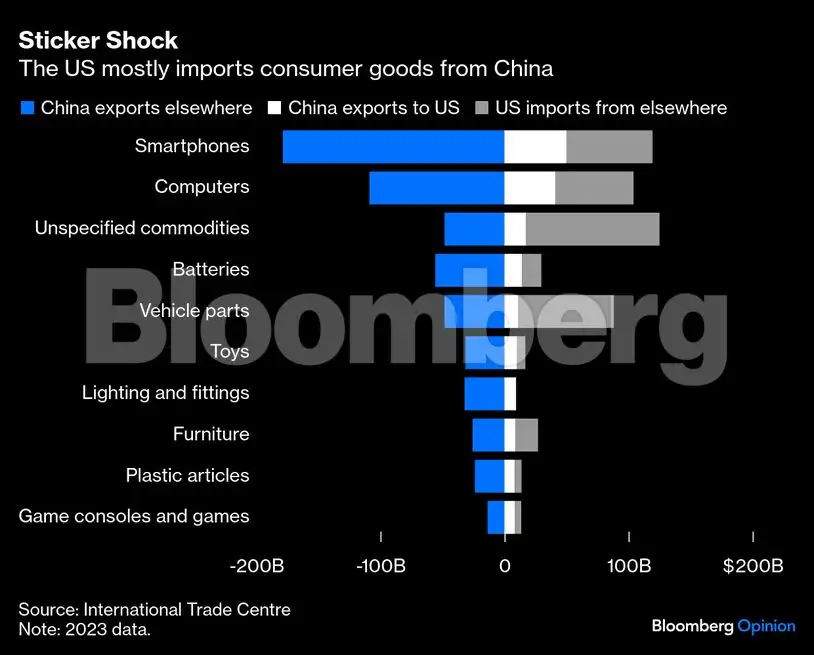
Consider the main items the nations trade with each other. The major products that the US imports from China are mostly things you’ll find in a Walmart Inc., at a shopping mall, or on Amazon.com Inc.: smartphones, computers, games consoles, furniture, toys and clothing. Slap a 54% tariff on these items, as Trump has done, and American consumers are going to notice pretty soon.

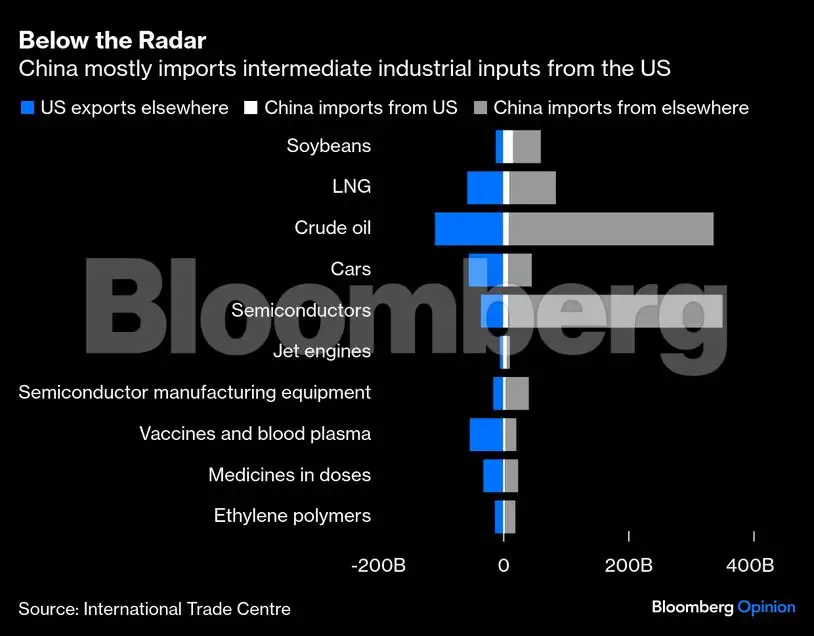
The flow in the opposite direction couldn’t be more different. Most of China’s major imports from the US are intermediate goods for its manufacturing industry, which would be almost impossible for an ordinary consumer to get their hands on, such as LNG and crude oil, silicon chips and chip-making machines, aircraft jets and plastics. The only real exception is cars — and, given the parlous competitive position of the US auto industry in China, wiping out the remnants of Buick, Chevrolet and Ford’s mainland markets might almost be a mercy killing.

814x-1-1.jpg


An important thing to note in the charts above is the relative size of the white, gray and blue bars. China tends to have quite a dominant role in US merchandise imports, making it hard for American consumers to switch to alternative suppliers. The US, by contrast, is a relatively minor supplier to China in almost every major product category except jet engines and, to a limited extent, soy. China, meanwhile, has broad and diverse markets for its exports if the US market ends up closed off, as demonstrated by the relatively large blue bars in the first chart.

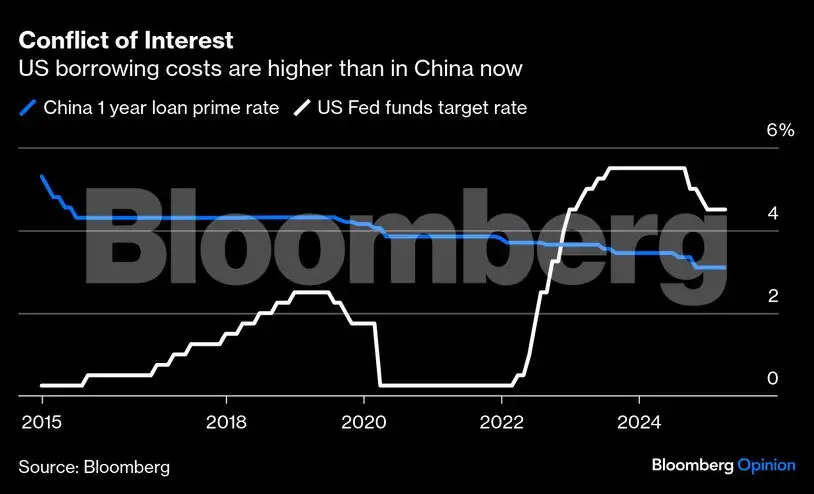
This is an important consideration when you start thinking about each country’s ability to sustain a prolonged trade war. Trump’s tariffs fall mainly on ordinary American citizens and voters who’ve already suffered four years of above-target inflation and are seeing interest rates around their highest levels in nearly two decades.

814x-1-2.jpg


The tariffs imposed by China will hurt quite a different group — businesses who are into their third year of producer price deflation, with the benchmark loan prime interest rate at its lowest level on record. Even consumer prices are falling right now.

That means that China already has a decent amount of slack to accommodate the supply-side shock from tariffs, whereas the US economy is already busting at the seams.

Even if Chinese businesses start to feel economic pain as the tariffs squeeze their margins, they’re less likely to complain. Alibaba Group Holding Ltd. founder Jack Ma disappeared from public life for nearly five years after a speech in 2020 criticizing international financial regulations, which local officials appear to have interpreted as a veiled attack on their handling of Alibaba’s payments platform Ant Group Co.

For President Xi Jinping, Trump’s self-inflicted wound is an opportunity. China can present itself as a better representative of the rules-based international order than a US that did so much to establish that system, and a friendlier trade and investment partner for the 85% of the global economy that’s not within America’s borders. That would put dreams of supplanting the US as the world’s hegemonic power well within reach.

814x-1-3.jpg


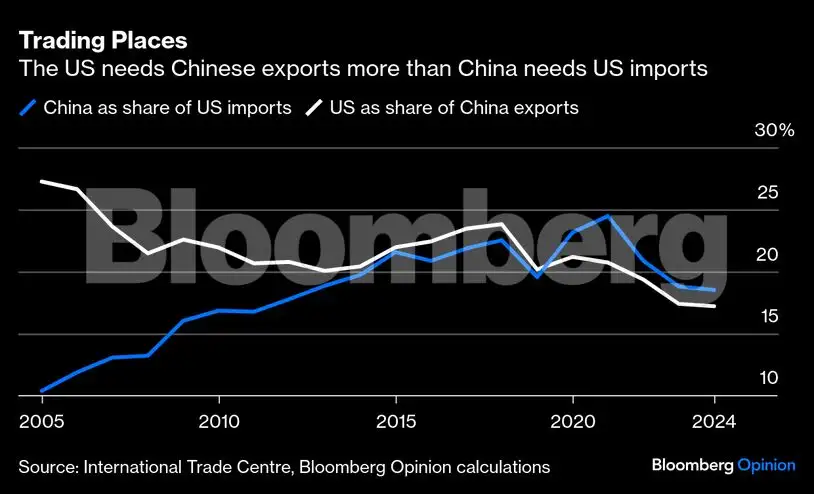
Both countries have been decoupling from each other since the start of Trump’s first trade war in 2018, but China has done so more effectively. As a share of its exports, the US has slipped 6.6 percentage points to 17.2%, whereas China as a share of US imports is down only 4 percentage points, to 18.5%. Xi, moreover, is using this moment to build ties with other trading nations, while the Trump administration is punishing its allies with tariffs barely less savage than those it’s imposing on Beijing.

If you want to avoid a future where China cements its rise with tighter links to other countries and crucial roles in blocs such as the Regional Comprehensive Economic Partnership, which includes most of east Asia’s other large economies, then the US tariff plan is the worst possible outcome. China’s economy has problems right now, but international commerce isn’t one of them. If the world is settling in for a long trade war, Trump’s most formidable rival has already fortified itself.
 
To view this content we will need your consent to set third party cookies.
For more detailed information, see our cookies page.
 
Yes! Can't wait for the US to collapse based on Trump's own stupid policies! It will be reaping what he sows! 😆
 
Haha, Americans as shown the opinions of the article are actually expecting the world not to do anything in response to their gov's madness. Ask what EU and Canada their allies will do first, not lest their foe China.
 
What big problem? like unprecedented 1 trillion dollars trade surplus in the human history last year? like BYD became the biggest EV maker and China the biggest car exporter in the world last year? Like Huawei reclaimed top spot last year? or Deepseek or chip breakthroughs last year?

View attachment 111387

Well i explained it many times, but you are neglecting it and responding with pictures and articles about China’s export records.
 

"Chinese goods are sold out", Americans are frantically stockpiling

Daily Economic News
2025-04-06 06:05:39 From Beijing


According to CCTV News, based on the executive order on the so-called "reciprocal tariffs" signed by Trump on the 2nd of this month, the United States is scheduled to impose a 10% "minimum base tariff" on all trading partners starting on the 5th. Higher "reciprocal tariffs" will be imposed on certain trading partners, and these measures will take effect on the 9th.

U.S. economists and business leaders have warned that additional tariffs will push up prices and ultimately be passed on to consumers. Some U.S. consumers have already started stockpiling amid concerns about soaring prices.

Another video shows that Chinese products were sold out in American supermarkets.

According to China Daily, with tariffs imminent, Americans have begun frantically stockpiling and snapping up Chinese-brand televisions.

American billionaire reminds people to stock up:

From toothpaste to soap


For American consumers, high tariffs could mean higher prices for everything from cars and appliances to gasoline and groceries.

CFF20LXzkOymqbsUSZfVeWEhuovHianP7Gejdzycs3TjOOMnecmxOXXZp3k8ljtuDEss3jxMHVaGOxaytIPGMHw.png


Forecast data released by the Yale University Budget Lab

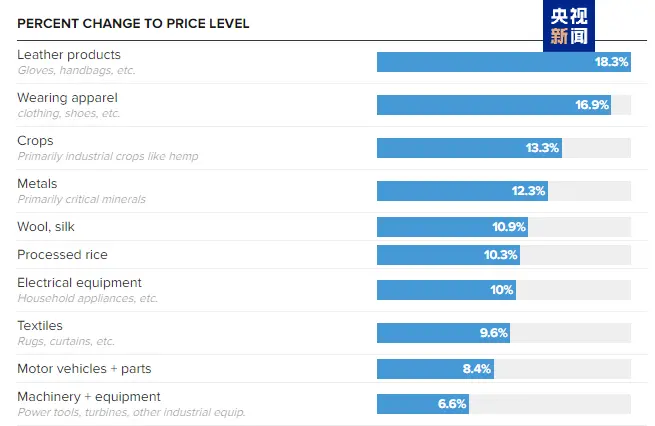
According to the Yale University Budget Lab, prices of leather products, clothing, crops, metals, wool and other categories will increase by more than 10%.

In response, some Americans have begun to get nervous and are busy "adding things to their shopping carts."

CFF20LXzkOymqbsUSZfVeWEhuovHianP7Tsf617TLoy4EIUpSFFFWdLiaibDMdaRjmFbWoORwrj4zrXf8WM7kCSyg.png


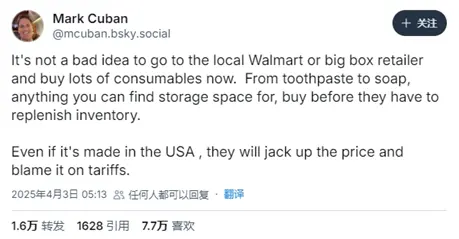
On the afternoon of April 2, Mark Cuban, a well-known American investor and billionaire, wrote on social media that it is time to start stockpiling. "From toothpaste to soap, anything you can find a place to store should be bought early, preferably before stores restock," Cuban said. Cuban said even American-made goods may increase in price, "and they'll blame it on tariffs."

CFF20LXzkOymqbsUSZfVeWEhuovHianP7YWVyCcwvw1hnQyLuzyKADZZTGSfPbv94IJLxXERXu8iceLhBuQyZVRw.jpg


American netizens said that the local queues for food were already full.

At supermarkets and electronics retailers, some consumers appeared to have taken Cuban's advice, pushing loaded shopping carts through parking lots in an attempt to stock up before prices rise.

Chinese-made TVs sold out

According to Cankao Xiaoxi, some US media have noticed that due to concerns about a sharp rise in prices, many people have started to rush to buy, and the popular goods being snapped up include Chinese-made televisions!

According to the Wall Street Journal website, 50-year-old Pegro from New York City took immediate action after hearing the news about the tariffs. From the evening of the 2nd to the morning of the 3rd, Peguero estimates that he spent about $3,000 on electronics, car parts, gardening equipment and other household items.

Interestingly, Pegro almost failed to buy the Chinese-made TV set he wanted. He went to two offline electronics stores in New York, but found out when he arrived that this type of TV was out of stock! He then quickly called another store and was told there was only one left.

"I called the clerk and pleaded: Please leave it to me," he said.

CFF20LXzkOymqbsUSZfVeWEhuovHianP7ST6sc8URhBzUm6EVUb3iaox4pGh2BsgQpFowwVQ0MgptSyCWmy9ccvQ.png


Video screenshots

Similar scenes of panic buying have occurred frequently across the United States. Americans have been busy "adding items to their carts," says the Wall Street Journal. The newspaper also stated that "Americans were already nervous" long before Trump announced large-scale tariff measures!

Americans' nervousness is understandable. After all, rising prices are only one aspect of the impact of tariffs, while the volatility in the U.S. stock market is even more "bloody." Just on the 4th, as the tariff war exacerbated panic, the New York stock market in the United States and European stock markets plummeted for the second consecutive day. The three major U.S. stock indices all fell by more than 5%, and the three major European stock indices all fell. According to US media reports, some American college students have been paying attention to the stock market, worried about the economic situation they will face when they graduate.

As we all know, launching a tariff war wantonly will harm others and not benefit oneself. Trump's tariff policy will cause multiple damages to the US and world economies, from pushing up prices to triggering retaliation, to supply chain disruptions, economic slowdowns and job losses. The long-term consequences will be very severe. And the American people have obviously suffered from this!

Automotive industry insiders:

Costs will be passed on to U.S. consumers


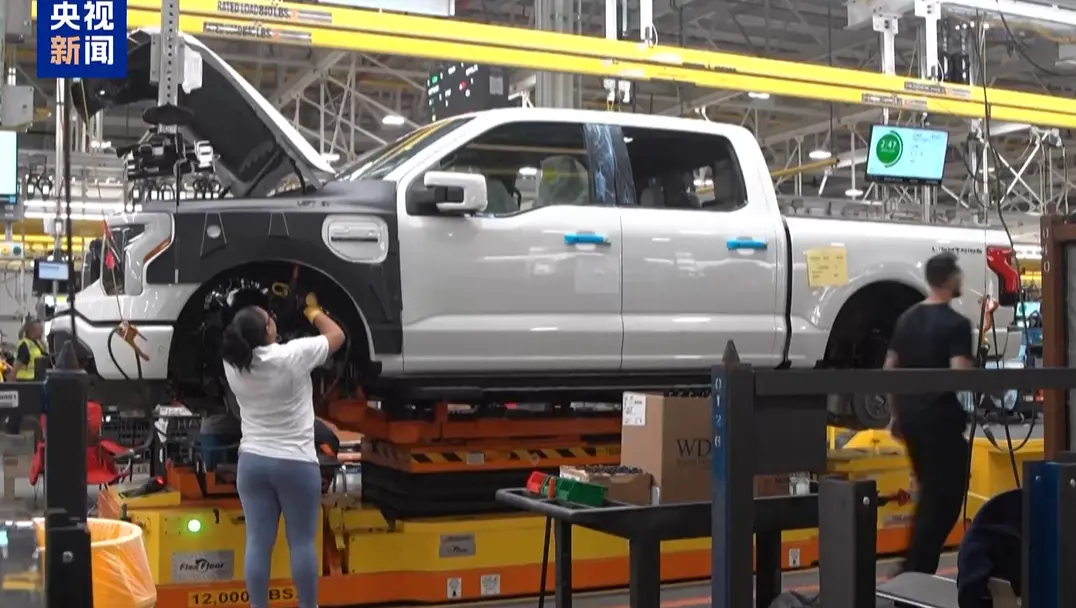
The US policy of imposing a 25% tariff on imported cars will officially take effect on the 3rd of this month. Many industry experts believe that the automobile industry has long become an industry that relies on the global supply chain. High tariffs cannot achieve the goal of "one country monopolizing the industry". It will only make more Americans unable to afford cars, the US automobile industry loses competitiveness, and the US economy faces a greater risk of stalling.

CFF20LXzkOymqbsUSZfVeWEhuovHianP7kckgxWwWnBQvMkBmsDEqbthzjibryYbUfpZlSTqXeU8WtrBIZf6Rl1Q.png


Industry insiders believe that American automakers are unable to bear the cost pressure brought by the 25% import tariff. According to JPMorgan Chase's estimates, after the auto tariffs take effect, General Motors will pay up to $13 billion in import tariffs each year, while Ford Motor will have to pay about $4.5 billion in import tariffs.

Some industry insiders believe that under the impact of tariffs, the US auto industry may slide towards high prices and low quality. A Bank of America analysis report believes that auto tariffs could cause U.S. auto sales to drop by 3 million units, equivalent to nearly one-fifth of last year's total sales.

The average loss per household per year

$3,800 in purchasing power


According to CCTV News, Trump hopes to put pressure on other countries by imposing "reciprocal tariffs", which may make American consumers pay a particularly high price.

Currently, U.S. consumer confidence continues to decline, and "reciprocal tariffs" will further increase spending on household goods, erode household purchasing power, aggravate household finances, and increase the burden on American families.


The Yale University Budget Lab estimates that after the United States implements "reciprocal tariffs", if other countries take retaliatory measures, low-, middle-, and high-income American families will lose an average of $1,300, $2,100, and $5,400 respectively.

According to an analysis by the Yale University Budget Lab, the tariff policies announced by the new U.S. administration may lead to a 2.3% increase in the overall U.S. inflation rate this year, including a 2.8% increase in food prices and an 8.4% increase in car prices, equivalent to a loss of $3,800 per year for every average American household.

According to estimates by the US think tank Tax Foundation, without considering countermeasures from other countries and regions, the US "reciprocal tariff" policy will lead to the following situations this year:

Federal tax revenue increased by $258.4 billion, or 0.85% of GDP.

The average after-tax income of individuals in the United States decreased by 1.9%.

The average American household will face an additional $1,900 in tax burden each year.

"Reciprocal tariffs" spark global condemnation

American-style "big gamble" may bring bad consequences


America's rule-breaking actions hurt others and itself. A commentary in the New York Times believes that the Trump administration is making a "big gamble" and believes that the United States can solve almost all problems with the "stick" of tariffs. This strategy of mixing mercantilism with bullying poses great risks to the U.S. economy. Affected by this, following the sharp drop the previous day, the three major stock indexes in New York plunged again after opening on the 4th. How do you view this situation? What other impacts will there be in the future?

“Reciprocal tariffs” could lead to retaliatory tariffs from trading partners

Lu Jiefeng, Associate Professor at the University of International Business and Economics: At present, the panic among investors in the US market is continuing to spread and intensify, which can be understood from the following three levels. In the short term, the market is worried that the so-called "reciprocal tariffs" implemented by the United States will trigger retaliatory tariffs from its trading partners, leading to an escalation of the trade war. This expectation prompted investors to sell risky assets such as stocks out of risk aversion.


U.S. companies will face higher import costs and export barriers

Lu Jiefeng, Associate Professor at the University of International Business and Economics: In the medium term, the market's expectations for corporate earnings have been lowered. Investors are worried that companies will face the dual dilemma of rising import costs and blocked exports. In the manufacturing and technology industries, many American companies rely on trading partners to supply parts; in the agriculture and automobile industries, they may be directly hit by retaliatory tariffs from trading partners. In addition, the profit margins of the US retail industry will be greatly compressed due to rising commodity costs.

CFF20LXzkOymqbsUSZfVeWEhuovHianP7x5wVsHjMuohvIZ0sNV7psqSr0tt72ib1jcoPCtrULC4HiblhvXX04uYA.png


Reciprocal tariffs will bring economic stagflation risks to the United States

Lu Jiefeng, associate professor at the University of International Business and Economics: In the long run, investors are worried about the slowdown in overall economic growth. Trump’s so-called “reciprocal tariffs” are actually trade protectionism at work, which will lead to reduced supply chain efficiency, higher costs and higher consumer prices, and may eventually trigger the risk of economic stagflation. It can be said that what the market fears or panics about is not the tariffs themselves, but the chain reactions they cause on economic development in the short, medium and long term. Judging from the current market reaction, Trump intends to punish US trading partners through "reciprocal tariffs", but the US itself will actually be the one being punished.

On April 4th local time, Federal Reserve Chairman Powell said that US President Trump’s tariff policy may lead to rising unemployment and may lead to rising inflation and slower economic growth.

Analysts from several U.S. financial institutions pointed out that the imposition of tariffs may cause the U.S. economy to fall into recession.

According to US media reports, JPMorgan Chase economist Michael Feroli said on the 4th that JPMorgan Chase expects the US real GDP for the whole year to shrink "under the heavy pressure of the US government's new tariff policy" and the US economy may fall into recession. JPMorgan Chase has lowered its full-year forecast for U.S. real GDP growth to a 0.3% contraction from its previous forecast of 1.3%.

Mark Zandi, chief economist at Moody's Analytics, said on social media on the 3rd that if the United States continues to fully implement its tariff policy, even if the U.S. economy does not fall into a depression, it will suffer a severe recession.

Citigroup released an investment strategy report on the 3rd, saying that if the impact of the US tariffs cannot be eliminated through negotiations, the US GDP growth in 2025 may be "wiped out."


Well i explained it many times, but you are neglecting it and responding with pictures and articles about China’s export records.
Where? how can I don't feel it in China and you can feel it in Turkey?
 
Just read my posts and stop trolling and posting big pictures and headlines when someone doesnt agree with you. Get over it.
You are such a troll, so which troll post do you want me to read? can you post it again? I don't only post pictures, they are screenshots of news reports with detailed information.
 

Asia-Pacific markets extended their sell-off Monday as fears over a global trade war sparked by U.S. President Donald Trump’s tariffs fueled a risk-off mood.

Hong Kong markets led losses in the region, with the Hang Seng Index declining 8.95%. Meanwhile, mainland China’s CSI 300 fell 5.41%.

Over in Japan, the benchmark Nikkei 225 lost 5.92% to hit an 18-month low while the broader Topix index plummeted 5.94%. Earlier in the day, trading in Japanese futures was suspended due the market hitting circuit breakers.

In South Korea, the Kospi index pared some losses and was last down 4.11%, while the small-cap Kosdaq declined 3.41%.

Australia’s
S&P/ASX 200 also pared some losses to 3.78%. The benchmark slid into correction territory with an 11% decline since its last high in February, in its previous session.

U.S. futures dropped as investors’ hopes of the Trump administration having successful negotiations with countries to lower the rates were dashed.

Meanwhile, U.S. oil prices dropped below $60 a barrel on Sunday stateside. Futures tied to U.S. West Texas intermediate crude fell more than 3% to $59.74, their lowest since April 2021.

Trump’s top economic officials dismissed any fears of inflation and recession, declaring that tariffs would persist whatever markets may do.

Stocks in the U.S. sold off sharply last Friday, after China retaliated with fresh tariffs on U.S. goods, sparking fears of a global trade war that could lead to a recession in the world’s largest economy.

The Dow Jones Industrial Average dropped 2,231.07 points, or 5.5%, to 38,314.86 on Friday, the biggest decline since June 2020 during the Covid-19 pandemic.

The S&P 500 nosedived 5.97% to 5,074.08, its biggest decline since March 2020.

Meanwhile, the Nasdaq Composite, which captures many tech companies that sell to China and manufacture there as well, dropped 5.8%, to 15,587.79. This takes the index down by 22% from its December record, representing a bear market in Wall Street terminology.
 

Users who are viewing this thread

Country Watch Latest

Back
Top