Pakistan Exports / Imports - Updates

Pakistan exports goods worth $2.38 billion to China in FY25​

By Tahir Ali | Gwadar Pro
Jul 13, 2025

ISLAMABAD, Jul 14 (Gwadar Pro) - Pakistan exported goods worth $2.38 billion ($2,375 million) to China during the fiscal year 2024–25, according to the Trade Development Authority of Pakistan (TDAP), reflecting continued strong trade volumes between the two countries.

In June FY 2024–25 alone, exports to China reached $152 million, showing a slight increase of 1% compared to $150 million in the same month last year.

Pakistan’s total exports for FY 2024–25 (July–June) were recorded at $32.11 billion ($32,106 million), reflecting a 4.67% year-on-year growth. During the same period, total imports stood at $58.38 billion ($58,380 million), resulting in a trade deficit of $26.27 billion ($26,274 million). China accounted for 7.4% of Pakistan’s total exports.

Pakistan’s main exports to China include textiles and garments, knitwear, cotton yarn and fabric, minerals, rice, sesame seeds, chilies, pink salt, and seafood. Most of these are raw or semi-processed goods, though value-added products are gradually gaining traction.

The growth in exports is partly attributed to the second phase of the China-Pakistan Free Trade Agreement (CPFTA-II), which came into effect on January 1, 2020. By reducing tariffs and enhancing market access, CPFTA-II has opened new opportunities for Pakistani exporters in the Chinese market.
 

Exports up by 4.67pc to $32.10b in FY2024-25​

The Nation
Jul 6, 2025

ISLAMABAD: The exports from the country increased by 4.67 percent during the fiscal year 2024- 25 as compared to previous year, Pakistan Bureau of Statistics (PBS) reported on Wednesday. Exports during July-June (2024-25) were recorded at $32.106 billion against $30.675 billion during July-June (2023-24), according to latest PBS data. On the other hand, imports into the country also went up by 6.57 percent by growing from $54.779 billion last year to $58.380 billion during the fiscal year 2024-25.

Based on the figures, the trade deficit during the period under review was recorded at $26.274 billion against the deficit of $24.104 billion last year, showing an increase of 9 percent.

Meanwhile, on year-on-year basis, the exports in June 2025 decreased by 0.59 percent to $2.543 billion from $2.558 billion in June 2024.

On the other hand, the imports also declined by 1.97 percent by falling from $4.964 billion last year to $4.866 billion in FY2024-25, according to PBS data.

On a month-on-month basis, the exports from the country came down by 4.79 percent when compared to the exports of $2.671 billion during May 2025. The imports witnessed a decrease of 7.08 percent when compared to the imports of $5.237 billion in May 2025, PBS reported.

AGRICULTURAL, OTHER CHEMICALS IMPORTS GREW BY 3.35PC IN 11 MONTHS

Agriculture and other chemicals group imports into the country during the 11 months of the financial year ending on June 30, 2025, increased by 3.45 percent as compared to the imports of the corresponding period of the last year.

During the period from July-May 2024- 25, agricultural and other chemicals worth $8.108 billion were imported as compared to the imports of $7.873 billion of the same period of the last year.

Over 1.850 million metric tons of plastic materials valued at $2.278 billion were imported as compared to the imports of 1.702 million tons worth of $2.080 billion of the same period of the last year, according to the data of the Pakistan Bureau of Statistics.

However, during the period under review, the imports of fertilizers into the country decreased by 13.68 percent as 929,714 metric tons of fertilizers worth of $576.025 million were imported as compared to the imports of 1.320 million metric tons valued at $667.436 million of the same period of the last year.

Meanwhile, the imports of insecticides went down by 22.05 per cent during the period under review as 30,288 metric tons of the above-mentioned commodity valued at $142.112 million were imported as compared to the imports of 34,875 metric tons worth of $182.314 million of the same period of the last year.
 
Meat exports in Pakistan reached $511 million in FY 2023-24, a 20% year-on-year (YoY) growth. The country ranks among the top 10 global beef/veal producers, gaining access to China and Malaysia. Meanwhile, Middle Eastern and Gulf markets offer untapped opportunities for halal meat.

In comparison to leading beef industries, Pakistan’s average carcass weight for beef animals is 125kg compared to the United States (370kg), Australia (290Kg), New Zealand (160kg) and Brazil (250kg).

It is due to the lack of specified beef breeds and limited adoption of feedlot fattening technology in the meat production system. It can be optimised to gain 180kg through efficiency in production and adopting the best globally practicing technologies i.e. calf milk replacer in calves weaning, backgrounding and feedlot fattening.

The 30% underweight slaughtering of beef calves is a significantly economic loss of the national resource base and may necessitates consideration for a policy decision on minimum slaughtering weight for beef animals in meat industry.
 

Accelerating Pakistan’s livestock exports in global halal markets


Dr Mohsin Kiani
July 16, 2025

Pakistan’s economic trajectory shall be defined strategically to enhance productivity, technological upgrading, and global market integration. The country’s export sector stands at a crossroads grappling with structural challenges and untapped opportunities. Structural barriers leads to export stagnation, including a combination of policy distortions, market inefficiencies, and administrative bottlenecks.

Addressing these challenges is essential for unlocking growth and improving export competitiveness. To avail the opportunities, the country must prioritise advancements in productive capacity, efficiency, and technological capabilities to drive higher output and global competitiveness.

Pakistan’s livestock sector remains a dynamic and resilient sector of the country’s economy contributing 63.6% to agriculture’s value addition and 14.97% to the country’s gross domestic product (GDP) at constant market prices in the fiscal year 2024-25.
 

Pakistan’s IT exports surge to all-time high of $3.8 billion in FY25


Gohar Ali Khan

Pakistan’s IT exports continued their strong growth trajectory, reaching a record high of $3.8 billion in the financial year 2024-25, driven by innovation and quality service delivery.

According to the State Bank of Pakistan (SBP), exports of IT and IT-enabled services rose to $3.8 billion in FY25, up from $3.2 billion in the previous year—reflecting a year-on-year growth of 18%.

The IT sector remained the third-largest source of foreign exchange for Pakistan, following the textile and rice sectors. It also accounted for the largest share—45%—of the country’s total services exports by the end of FY25.

Senior Vice Chairman of the Pakistan Software Houses Association (P@SHA), Muhammad Umair Nizam, said IT exports have shown consistent growth over the past several years, significantly contributing to the national economy, particularly in helping stabilize the current account, which recorded a surplus this fiscal year.

He noted that Pakistan’s IT sector could have earned even more foreign exchange if favorable policies had been introduced in a timely manner and if unpredictable national and global challenges had not emerged.

He added that the IT industry, in collaboration with its representative body P@SHA and key government organizations—including the Ministry of IT and Telecommunication, Pakistan Software Export Board (PSEB), and the Special Investment Facilitation Council (SIFC)—is actively working to promote the domestic IT sector and boost exports.

“Once the government resolves outstanding challenges, IT companies will be better positioned to attract increased foreign exchange through exports,” Nizam said.

In the last fiscal year, the government allowed IT companies to retain 50% of their foreign currency earnings in special forex bank accounts. It also introduced cash rewards for top exporters and addressed tax reporting issues.

Mehwish Salman Ali, a member of P@SHA’s AI Committee, said that export values can rise further through the adoption of cutting-edge technologies, offering advanced solutions to international markets to secure higher profit margins.

She emphasized that Pakistani companies should accelerate innovation and cater to emerging demands, particularly in areas such as Artificial Intelligence, Machine Learning, and Cybersecurity. She also highlighted the importance of capacity building among IT professionals and fostering joint ventures with foreign companies in various regions.

The government, along with IT companies, has made investments in promoting Pakistan’s IT sector, showcasing its solutions and services in the Gulf, Europe, and ASEAN countries.

Khushnood Aftab, Convener of the IT Committee at the Federation of Pakistan Chambers of Commerce and Industry (FPCCI), stressed that the government should diversify not only export markets but also the range of IT products.

He noted that while Pakistan currently exports IT hardware in limited volumes, innovation in technology could boost exports of hardware such as computers, laptops, and various devices. This would not only bring in foreign exchange but also foster technology transfer in the country.

Aftab, who is also Chairman of Viper Group, said Pakistan could enhance its global reputation by promoting ‘Made-in-Pakistan’ IT hardware products.

The government has set an ambitious target of $5 billion in IT exports for FY26, and $10 billion by FY29, under its Uraan Pakistan vision.
 

IT exports hit record at $4.6b​


Minister links 26% growth to unified strategy; industry complains about dearth of support

ZAFAR BHUTTA
July 19, 2025


Pakistan's information technology, IT-enabled services (ITeS) and freelancers' exports hit an all-time high of $4.6 billion in fiscal year 2024-25, higher by 26.4% from the previous year, but stakeholders still complained about the lack of government support.

The total exports included $3.8 billion in services' exports and $779 million in earnings from freelancing and remote work, up 90%.

The Ministry of IT and Telecom stressed that the government focused on action across five core areas that contributed to the massive growth. These areas comprised positioning Pakistan globally, investing in talent and infrastructure, protecting and supporting through policy, ensuring stable high-speed internet and digitalisation, especially digitising the economy and cashless initiatives.

IT and Telecom Minister Shaza Fatima Khawaja said that Pakistan was well on its way to achieve $15 billion in IT exports by 2030. She credited the achievement of $4.6 billion in IT exports to a unified national strategy, led by the government and supported by the Special Investment Facilitation Council (SIFC) and allied institutions.

Speaking to the media, the minister said, "This success is the result of close coordination between the civilian and military leadership, along with contributions from the Pakistan Telecommunication Authority, Ministry of Finance, Planning Commission, Universal Service Fund (USF), Ignite and Pakistan Software Export Board (PSEB)."

She highlighted the government's focus on developing human capital, with over 350,000 youth trained through joint programmes with PSEB, Ignite, National Vocational and Technical Training Commission (NAVTTC), Higher Education Commission (HEC) and global tech leaders like Google, Huawei and Microsoft.

Shaza Fatima said that the IT ministry had launched 43 new co-working spaces and 23 Special Technology Zones last year, taking the total number of tech parks to 44. These facilities now house over 18,000 professionals engaged in freelancing, remote work and tech startups.

She also announced government-backed incentives to expand those spaces into tier-2 and tier-3 cities through interest-free loans. "We're rapidly emerging as a regional digital and data hub," she stated.
 

IT exports – record high

BR Research
July 28, 2025

Pakistan’s IT and ICT exports touched a historic high in FY25, clocking in at $3.8 billion. That’s an 18 percent jump over last year, though shy of the government’s $4 billion target and slower than the 24 percent growth seen in FY24.

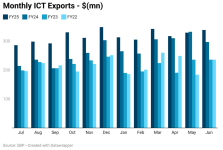
June alone brought in $338 million, up 14 percent year-on-year and 3 percent month-on-month, taking monthly exports above the 12-month average of $314 million. Net IT exports (after imports) also reached $306 million for the month, up 20 percent year-on-year.

1753733205221.png

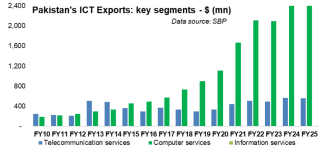
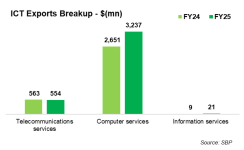
The story remains anchored in computer services, which pulled in $3.24 billion, up from $2.65 billion last year, while telecom exports stalled at $554 million. Information services, though small, more than doubled to $21 million, hinting at a slow but growing diversification within the export basket.

Yet, even with the record-breaking performance, the missed target underscores persistent structural bottlenecks. Pakistan’s IT sector still grapples with talent shortages, rising wage pressures, and patchy connectivity, while global tech spending slowed as firms cut back on budgets.

1753733233027.png

Tax and payment reforms have also lagged, limiting exporters’ ability to fully ride global demand. The slower growth rate in FY25 compared to FY24 can also be attributed to a base effect since FY24 had already seen an unusually high jump of 24 percent year-on year.

Policy support has, however, cushioned the sector. The State Bank allowed exporters to retain 50 percent of their foreign earnings (up from 35 percent) and even invest abroad, encouraging them to repatriate a larger share of profits.

1753733259247.png

Pakistani IT firms have also been busy expanding their global footprint, tapping into the GCC market, and highlighting at international events like London Tech Week 2025 and the Pak-US Tech Investment Conference.

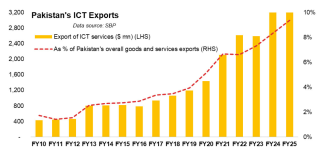
A decade ago, IT exports accounted for barely 2–3 percent of Pakistan’s goods and services exports; today, they are close to 10 percent.

1753733301384.png

The government’s ambition is to hit $10 billion by FY29 under the “Uraan Pakistan” plan, which implies an annual growth rate of 27 percent. Whether that materializes will depend on how fast Pakistan can fix infrastructure gaps, build a skilled talent pipeline, and simplify its regulatory framework.
 

Exports rise to $31.75b despite global headwinds​


Textiles, non-traditional sectors drive growth; minister issues steps to sustain momentum

Our Correspondent
August 02, 2025

tribune


ISLAMABAD: Federal Minister for Commerce Jam Kamal Khan chaired a high-level meeting of the Trade Review Committee on Friday to assess Pakistan’s trade performance for FY2024–25.

The meeting brought together senior officials from the ministry to evaluate sector-wise progress and set forward strategies amid global trade challenges, according to an official statement.

Despite facing global headwinds, including tariff tensions, slowing major markets, intensifying price competition, and geopolitical uncertainty, Pakistan’s exports rose to $31.75 billion, up from $30.76 billion in FY2023–24. This growth was driven by strong performance in value-added and emerging sectors.

The textile and apparel sector led the gains, with knitted garments up 15%, woven garments rising 16%, and home textiles increasing by 9%. Growth was also seen in non-traditional exports as tobacco and cigarettes jumped 135%, plastic products rose 17%, and cement exports increased 25%. Pharmaceuticals and ICT-related services also showed steady growth. The commerce minister praised the resilience of these sectors, especially the gains in non-traditional exports, calling them vital to long-term trade sustainability. On the import side, capital goods rose by 24%, signalling renewed industrial activity and improving consumer confidence.

To sustain and build on this momentum, Kamal Khan issued several strategic directives. These include country-specific export plans with a focus on non-traditional and emerging markets, and the creation of a Trade Alert System to respond in real-time to global disruptions such as SPS/TBT concerns and trade remedy measures.

The commerce ministry will also revitalise Sectoral Export Councils to ensure effective consultation with the private sector and evidence-based policymaking. Adoption of artificial intelligence and data analytics will guide smarter trade intelligence and global marketing. A national strategy for services exports will also be developed, with focus on ICT, freelancing, and the creative economy.

Speaking at the meeting’s conclusion, Kamal Khan said Pakistan’s export performance reflects the resilience and adaptability of its trade ecosystem.
 

Exports rise to $31.75b despite global headwinds​


Textiles, non-traditional sectors drive growth; minister issues steps to sustain momentum

Our Correspondent
August 02, 2025

tribune


ISLAMABAD: Federal Minister for Commerce Jam Kamal Khan chaired a high-level meeting of the Trade Review Committee on Friday to assess Pakistan’s trade performance for FY2024–25.

The meeting brought together senior officials from the ministry to evaluate sector-wise progress and set forward strategies amid global trade challenges, according to an official statement.

Despite facing global headwinds, including tariff tensions, slowing major markets, intensifying price competition, and geopolitical uncertainty, Pakistan’s exports rose to $31.75 billion, up from $30.76 billion in FY2023–24. This growth was driven by strong performance in value-added and emerging sectors.

Our exports target 1 is $ 50 billion. Target 2: in next 5 years is $100 billion. All foreign relations need to get out of traditional "brotherly" and "friendly" narratives and include a "trade with us" push! Everyone loves to trade, even with friendly and brotherly relations.

At $100 billion annual exports and $ 25 in IT / AI / Crypto revenue, we'll start to move towards becoming a much more modernized nation with a trillion dollar GDP in next 6-8 years.
 

Services exports rise 9.2pc to $8.39bn in FY25


Mubarak Zeb Khan
August 10, 2025

ISLAMABAD: Pakistan’s exports of services grew by 9.23 per cent to $8.39 billion in FY25, up from $7.68bn in the previous year, mainly on the back of stronger performance in telecommunication, computer, and information services, according to data released by the Pakistan Bureau of Statistics (PBS) on Thursday.

The growth, though modest, reflects a continued recovery and expansion in the services sector, which has posted consistent increases since February 2024, despite a brief dip of 6.5pc in August.

In rupee terms, services exports rose by 7.86pc to Rs2.345tr in FY25 from Rs2.174tr in FY24, indicating a steady uptrend despite currency fluctuations.

Monthly figures for June show that services exports surged by 12.91pc year-on-year, reaching $726.68m compared to $643.59m in June 2024.
 
IT, transport drive modest growth; trade deficit narrows by 15.8pc

State Bank of Pakistan data reveals that exports of telecommunication, computer, and information services — the largest component of services exports — increased by 18.18pc to $3.809bn in FY25 from $3.223bn in the preceding year. Other business services also showed a positive trend, rising by 7.35pc to $1.665bn from $1.551bn.

Transport services exports jumped by 27.86pc to $982m, compared to $768m last year, supported by growing demand in logistics and cargo movement. However, travel services declined by 4.88pc to $721m in FY25, down from $758m in FY24.

The growth in FY25 follows two years of subdued expansion in services exports — 2.77pc in FY24 and 2.78pc in FY23. In FY23, services exports stood at $7.30bn, compared to $7.10bn in FY22.

The government has set an ambitious target of boosting IT exports to $15bn over the next five years, positioning the digital economy as a key driver of future growth.

On the import side, services imports edged up by 2.01pc to $11.02bn in FY25 from $10.79bn in the previous year. However, in June, services imports dropped sharply by 24.01pc to $851.56m compared to $1.122bn in the same month of last year.

The main contributors to the increase in imports were transport and travel services. Transport payments remained substantial, though slightly lower at $4.645bn in FY25 compared to $4.677bn in FY24 — a marginal decline of 0.68pc. Meanwhile, travel services imports rose by 6.17pc to $2.406bn from $2.266bn, reflecting increased outbound travel and tourism.

In FY24, services imports had grown by 17.14pc to $10.119bn from $8.638bn a year earlier, largely due to post-pandemic normalisation of travel and logistics. Despite the rise in imports, Pakistan’s services trade deficit narrowed significantly by 15.84pc to $2.618bn in FY25, compared to $3.11bn in the previous year.

The narrowing trend continued in June, with the deficit falling by 73.9pc year-on-year to $124.89m, down from $478.41m in the same month last year.
 

US tariff on Indian rice opens market for Pakistan

Anwar Iqbal Published August 12, 2025

Indian exporters have warned that the cost of additional US tariffs risked making businesses ‘not viable’ after 50pc levies imposed on imports from India.—AFP


WASHINGTON: The 50 per cent tariff imposed by the Trump administration on Indian goods, including basmati rice, has reshaped trade flows in the United States, providing Pakistan an opportunity to expand its share in the American aromatic rice market.

Pakistan’s basmati rice exports have witnessed steady growth in recent years. According to the Rice Exporters Association of Pakistan (REAP), the country exported approximately 772,725 tonnes of basmati rice in FY24, generating $876.9m — up from 595,120 tonnes worth $650.4m in the previous fiscal year. The average export price per tonne also increased from $1,092.93 to $1,134.86.

Data from Volza’s Global Trade platform shows that between November 2023 and October 2024, the United States accounted for 24pc of Pakistan’s total basmati exports through 1,519 shipments. Italy and the United Kingdom followed with shares of 14pc (908 shipments) and 11pc (716 shipments), respectively.

Together, these three markets consumed nearly 49pc of Pakistan’s basmati rice exports. Pakistan currently exports basmati rice to over 110 countries, with other key destinations including Australia, Saudi Arabia, the UAE, Canada, the Netherlands, and Germany.

Basmati exports rose 35pc in FY24 to 772,725 tonnes, earning $876.9m

According to the US Department of Agriculture (USDA), rice imports in the US have grown steadily over the past three decades — from 7pc of the domestic market in 1993/94 to over 25pc by 2022/23. Over 60pc of these imports consist of aromatic varieties from Asia, mainly jasmine from Thailand and basmati from India and Pakistan.

While the US produces some aromatic rice domestically, these differ in quality and aroma from their Asian counterparts. The USDA projects continued growth in demand for aromatic rice imports in the coming years.

The tariff dispute emerged from US punitive measures targeting India’s trade and energy ties with Russia, resulting in broad tariffs on several Indian exports, including basmati rice, pharmaceuticals, and electronics. Although some sectors later received exemptions, basmati rice remained subject to the full 50pc tariff. In contrast, Pakistani basmati rice continues to face a lower tariff of 19pc, giving it a distinct pricing advantage in the US market.

Indian media reports suggest that the tariff hike could reduce India’s basmati exports to the US by 50-80pc, with prices climbing to nearly $1,800 per metric tonne. Pakistani basmati, by comparison, remains priced at around $1,450 per metric tonne, making it more competitive for US importers and retailers.

Retailers across the US are already reporting increased interest in Pakistani basmati rice. Khan Mohammed, a salesman at Super Halal grocery in Springfield, Virginia, noted: “Pakistani rice is already popular.

Published in Dawn, August 12th, 2025
 

Pakistan’s IT exports grow $354mln in July


Tahir Amin
August 19, 2025

The country’s information technology and IT-enabled services (ITeS) exports remittances comprising computer services and call centre services registered around 24 percent growth in the first month (July) of current fiscal year 2025-26 as it remained $354 million compared to $286 million during the same period of last fiscal year.

According to official data IT exports remittances increased by around 5 per cent on month-on-month basis in July 2025 and stood at $354 million when compared to $339 million in June 2025.

Pakistan’s IT and IT-enabled services (ITeS) exports have seen significant growth, with a nearly 18% increase in FY 2024-25, reaching $3.810 billion. This growth is part of a larger trend, with the IT sector declared one of the fastest-growing segments of the national economy.

The government had set a target of $4.2 billion in IT exports for 2025, but missed it by around $400 million. The government has set the target of $5 billion from IT exports for the current fiscal year.

The IT ministry has identified several constraints including inconsistency in policies, taxation issues and banking hurdles which are hampering the country’s information technology sector’s export potential of around $15 billion.

Pakistan’s IT industry has huge potential. Many experts believe it can bring in more dollars for the country. It can also create jobs for the youth. To reach the $5 billion goal, the government and private sector will need to work together.

Better training, faster internet, and support for startups can help. If the momentum continues, Pakistan’s IT sector can become one of the top earners for the economy in the coming years, experts added.
 

Users who are viewing this thread

Country Watch Latest

Back
Top