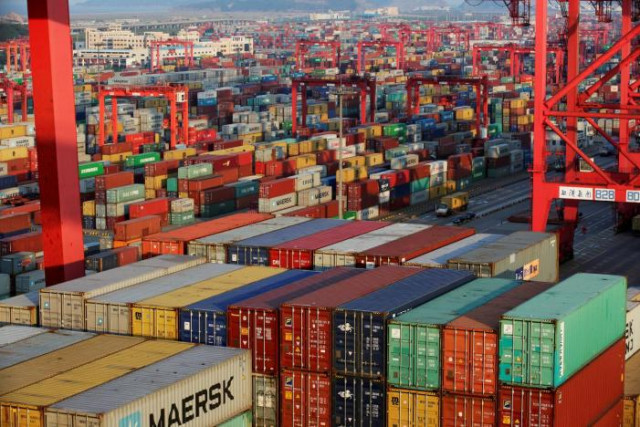
Pakistan Exports / Imports - Updates

Textile exports surge by 32pc in July


Mubarak Zeb Khan
August 23, 2025

ISLAMABAD: Pakistan’s textile and clothing exports saw a strong start to the current fiscal year, rising by 32 per cent in July.

This surge, driven by increased demand from North America, follows the imposition of higher tariffs on competitors in the sector. Export proceeds for the month reached $1.68 billion, compared to $1.27bn in July 2024, according to data from the Pakistan Bureau of Statistics (PBS).

The sector has shown a positive growth trend in recent months, with June recording a year-on-year increase of 7.59pc. This recovery comes after consecutive declines in April and May, when exports posted negative growth. Pakistan’s textile and clothing exports grew by 7.39pc in FY25, totalling $17.887bn, up from $16.655bn the previous year.

Despite a $25bn installed capacity, the sector has faced stagnation over the past two years due to structural issues, according to industry players. Exporters continue to press for the early release of pending refunds and rebates, which have been delayed for months.


PBS data shows that in July FY26, exports of readymade garments rose by 35.47pc in value and 36.90pc in quantity, while knitwear saw a 43.50pc increase in value and a 51.06pc rise in quantity. Bedwear exports also grew by 38.29pc in value and 40.43pc in quantity. However, cotton cloth exports saw modest growth, rising by just 1.19pc in value and 5.56pc in quantity. Yarn exports showed a marginal increase of 0.57pc.

Exports of made-up articles, excluding towels, surged by 45.38pc, while towel exports rose by 33.93pc in value and 32.85pc in quantity. However, exports of tents, canvas, and tarpaulin fell by 37.64pc. Notably, no raw cotton was exported in July FY26.

Imports of synthetic fibre increased by 30.63pc, and imports of synthetic and artificial silk yarn grew by 37.43pc. Textile machinery imports surged by 115.42pc during the same period. However, raw cotton imports declined by 4.13pc, and second-hand clothing imports grew.

In the broader export sector, total exports in July increased by 16.42pc, reaching $2.68bn, up from $2.31bn a year ago.
 

Pakistan gets US nod to extend seafood exports for 4 years, set to ‘bolster position in global market’

Umaid Ali
August 30, 2025

Pakistan has received authorisation to extend the export of seafood products to the United States for another four years, Minister for Maritime Affairs Muhammad Junaid Anwar Chaudhry announced on Saturday.

Pakistan’s seafood exports rose to $465 million in FY25, reflecting a 13.4 per cent increase in value and an 8pc growth in quantity compared to last year, according to data released by the Pakistan Bureau of Statistics (PBS) in July.

According to a press release by the maritime ministry, the US National Oceanic and Atmospheric Administration (NOAA) classified all Pakistani fisheries listed on its List of Foreign Fisheries as “comparable” under the Marine Mammal Protection Act (MMPA).

“This classification confirms that Pakistan’s fisheries meet US standards for protecting marine mammals from incidental mortality and serious injury during fishing operations,” Chaudhry was quoted as saying.

The MMPA required fisheries to “minimise marine mammal bycatch, adopt conservation practices, and sustainably operate measures” for supporting healthier marine ecosystems, the press release read.

“The decision reflects international recognition of the quality of Pakistan’s seafood and will provide long-term stability to the sector,” the minister said.

“The extension is expected to bolster our position in the global seafood market, securing access to one of the world’s largest seafood importers,” he added.

The maritime ministry further said that the current seafood earnings were about $2 per kilogramme in the global market, noting that “with this international endorsement of compliance, the price is projected to rise, potentially opening new markets in Europe and the Gulf.”

It stated that Pakistan exported 242,484 metric tons of seafood products worth $489.2 million at an average of $2 per kilogramme. “The same export volume next year could generate nearly $600 million.”

Chaudhry called the successful submission of a comprehensive compliance dossier to NOAA “a critical milestone”. “This acceptance validates Pakistan’s ongoing efforts to regulate its commercial fisheries, uphold sustainable fishing practices, and align with international environmental standards,” he added.

The minister highlighted that the approval was “vital” to protect multi-million-dollar seafood exports to the US market and enhance the country’s reputation for responsible and sustainable fisheries management. Chaudhry also emphasised “strengthening protective measures for marine mammal populations” to ensure the long-term health of marine biodiversity.

Earlier this month, the Ministry of Commerce noted that Pakistan’s exporters were poised to gain a significant competitive advantage in the US market after the government successfully negotiated a reduction in reciprocal tariffs — from 29pc to 19pc — the lowest rate in the region.

Commerce Minister Jam Kamal had said the revised tariff structure presents a timely opportunity to boost exports and appreciated the coordinated efforts of the government’s economic team, along with private sector support, in achieving this milestone.
 

Pakistan’s imports from Iran climb 70pc in July on month-on-month basis​

By Staff Reporter | The Nation
Aug 31, 2025

Pakistan’s imports from Iran showed a tremendous growth of 70 percent during the first month (July) of the ongoing fiscal year 2025-26 on a month-on-month basis.

However, on year-on-year basis, Pakistan’s imports from Iran enhanced by 12 percent during July 2025 as compared to the same period of the previous fiscal year, official source told The Nation here Sunday.

Pakistani imports from Iran increased by 70 percent on a monthly basis in July of the FY2025-26 as compared to the month of June 2025 of the previous fiscal year, the source said.

Pakistan’s imports from Iran were $66 million in June 2025, which have jumped to $112 million during July 2025, it said. Pakistan’s imports from Iran increased by 12 percent on year-over-year basis in July 2025 as compared to July 2024. In July 2024, Pakistan imported goods worth $100 million from Iran, government sources said.

Pakistan’s imports from Iran increased by 18 per cent in the fiscal year 2024-25, sources said. In FY2024-25, Pakistani imports from Iran increased to $1.222 billion, from $1.037 billion during the FY 2023-24.

Notably, Pakistani exports to Iran are negligible, mainly due to embargos imposed by the United States on Tehran. In the five fiscal years, from FY2019-20 to FY2023-24, Pakistan’s total exports to Iran were merely $130,000.

Pakistani exports to Iran in the fiscal year 2023-24 were $20,000, while exports reached $100,000 in the fiscal year 2022-23. In the FY2020-21 and FY2021-22, Pakistan’s exports to Iran were zero, while in the FY2019-20, the exports were only $10,000.

When asked about negligible Pakistan’s export to Iran, the source said that the lack of banking channels due to US sanctions has been a major reason for the low exports to Tehran.

Pakistan’s imports from Iran in the FY2024-25 were $1.222 billion, $1.037 billion in the FY2023-24, and $880 million in the FY 2022-23. Similarly, the volume of imports from Iran in FY2021-22 was $773.8 million, $518.6 million in the FY2020-21, while in the FY2019-20, imports were $440 million.
 

Services exports rise 18.3pc in July


Mubarak Zeb Khan
September 5, 2025

ISLAMABAD: Pakistan’s exports of services rose by 18.27 per cent year-on-year in July — the first month of FY26 — mainly on the back of a strong performance in telecommunication, computer, and information services, official data showed on Thursday.

According to figures released by the Pakistan Bureau of Statistics, services exports increased to $745.52 million in July, up from $630.38m in the corresponding month of the previous fiscal year. On a month-on-month basis, exports rose by 4.47pc.

In rupee terms, services exports grew 20.74pc to Rs211.89bn in July compared to Rs175.49bn in the same month last year, indicating continued strength in foreign currency inflows from the sector.

The data highlights that the double-digit growth was primarily driven by a 23.77pc surge in telecommunication, computer, and information services, which reached $354m in July compared to $286m in the same period last year, according to the State Bank of Pakistan.

IT-related services lead a 23.8pc rise in telecom, computer, and information exports

Other business services also posted robust growth, rising 17.96pc to $151m from $128m a year earlier. Transport services exports increased by 21.54pc to $79m from $65m.

However, the export of travel services declined sharply by 20.33pc, falling to $47m from $59m in the same month of FY25, reflecting subdued demand or reduced outbound activity in the travel segment.

Despite the overall rise in services exports, imports of services marginally declined by 0.61pc to $871.44m in July compared to $876.83m in the corresponding month last year. On a monthly basis, however, imports rose by 3.41pc.

The slight decline in imports was largely due to reduced spending on transport and business-related services. Transport services imports dropped 2.97pc to $391m in July FY26 from $403m a year earlier. In contrast, travel services imports rose 16pc to $210m from $181m in the same period.

As a result of rising exports and easing imports, Pakistan’s trade deficit in services narrowed significantly by 48.91pc in July FY26, falling to $125.92m from $246.45m in the same month last year.

In FY25, the country’s services exports grew 9.23pc to $8.39bn, compared to $7.68bn in FY24. The momentum has largely been fuelled by consistent growth in IT-related exports since February 2024, though the sector did witness a 6.5pc dip in August 2024.

Analysts believe the performance of the services sector — especially IT and digital services — will remain a key driver of foreign exchange earnings in the current fiscal year, particularly amid volatility in goods exports.
 

Pakistan exports 900 tons of condensed buffalo milk to China​


By Yasir Habib Khan | Gwadar Pro
Sep 21, 2025

ISLAMABAD - In collaboration with Chinese company Royal Cell Biotechnology (Pakistan), Royal JW holding and Royal JW foods, 900 tons of condensed buffalo milk have been exported to China last week.

Dr. Nassar of JW food told Gwadar Pro, “We plan to further export around 1500 tons of condensed buffalo milk to China next month and it is highly likely that more to be followed in coming months,” he added.

Condensed milk is a thickened, partially dehydrated milk where the fat content is no less than 7.5%. The dry matter of the substance is no less than 25%. In this form, the milk is stored and transported more easily. Condensed milk may contain sugar or be unsweetened. This dairy product is colored from light yellow to caramel. It has a thick, creamy consistency. The taste is gentle and enjoyable. The scent is delicate, barely noticeable. Condensed milk is a product widely used in the confectionery industry. Chefs often infuse it in creams, cakes and other sweet temptations.

Royal Cell Biotechnology (Pakistan) Dr. Qaisar Shahzad said that all condensed Buffalo milk exported to China is unsweetened. “The composition of condensed milk contains notable amounts of carbohydrates, fats and proteins. It is a source of calcium, iron, phosphorus, potassium and sodium. You will also find vitamin A, vitamin B1, vitamin B2, vitamin B3, vitamin B6, vitamin C, vitamin D and vitamin E,” he said.

In China, thick and creamy consistency of condensed Buffalo milk allow for its use in all sorts of culinary ways. It is a preferred product in many creams, puddings, ice creams, mousses, cakes, cheesecakes, rolls and more.

Condensed milk is recommended for vegetarians especially, since it has the ability to compensate for the absence of meat in their diet. The global condensed milk market size was valued at $9.9 billion in 2021, and is projected to reach $15.2 billion by 2031.
 
To view this content we will need your consent to set third party cookies.
For more detailed information, see our cookies page.
 

Government approves resumption of donkey hide exports


Tahir Sherani
October 2, 2025

1759440844919.png

The federal government on Thursday authorised the export of donkey hides as part of an amendment to the Ministry of Commerce’s Export Policy Order, according to a notification available with Dawn.com.

In 2015, the Economic Coordination Council (ECC) banned the export of donkey hides in the country in view of the sale of donkey meat under the guise of beef and mutton in different cities.

According to the commerce ministry notification, the export of donkey hides shall be allowed only to those “firms [and] companies manufacturing in designated, approved [or] registered donkey slaughterhouses located in [the] Gwadar Free Zone only”.

The notification also stated that the ban on exporting donkey hides would be “omitted” from the Export Policy Order.

Last July, the Senate Standing Committee on Commerce was informed that protocols to export donkey skins and meat to China had been finalised, along with the export of onions, potatoes and chillies.

However, in August this year, a consultative workshop on the role of working equines in supporting livelihoods and addressing emerging threats to donkeys, horses and mules found that of the 55.5 million donkeys in the world, 6 million are killed annually across the globe.

Besides recognising the role of working equines in sustaining the livelihoods of poor and marginalised communities, the workshop also aimed to raise awareness of the ongoing welfare challenges and the emerging threat of the donkey skin trade in Pakistan.
 

Trade deficit surges 33% to $9.4b in Q1​


Exports fall, imports rise in double digits as govt's economic plans fail to deliver required push

Shahbaz Rana
October 03, 2025

pakistan s trade deficit photo file


Pakistan’s trade deficit. PHOTO: FILE

ISLAMABAD:
In a deadly combination for Pakistan's external sector stability, exports sank while imports grew in double digits during the first quarter of the current fiscal year, causing the trade deficit to balloon by one-third to $9.4 billion.

The international trade bulletin released by the Pakistan Bureau of Statistics (PBS) on Thursday suggested that neither Planning Minister Ahsan Iqbal's Uraan Pakistan programme nor the United Kingdom's (UK) economist Stefan Dercon's economic plan has so far been effective in boosting exports.

According to PBS, the gap between imports and exports reached $9.4 billion during the July-September period. The deficit was $2.3 billion, or 33%, higher than the same period of the last fiscal year.

The $2.3 billion additional deficit in just three months also exceeds the $2 billion loan tranche of the International Monetary Fund (IMF) that the government expects to receive after meeting 50 harsh conditions.
 
Imports during the first three months reached $17 billion, up $2 billion, or 13.5%, compared to the same period last year. Imports were also more than double the total value of exports during this period.

The PBS stated that exports, meanwhile, fell to just $7.6 billion in three months, down 3.8% year-on-year. In absolute terms, exports were $303 million less than the same period last year.


Pakistan's external sector stability now largely hinges on smooth and higher inflows of foreign remittances, as exports continue to lag despite multiple initiatives announced by successive governments over a period of time. Neither the Planning Commission's Uraan Pakistan programme nor Dercon's Economic Growth Plan has helped boost exports. In the midst of falling exports and rising imports, the government has opened the economy to greater foreign competition, adding pressure to the import bill.

The first-quarter results could also undermine the government's latest projection of a $500 million current account deficit for the fiscal year, based on higher remittances. This projection, shared with the IMF this week, is based on the assumption that exports will remain above $34 billion and imports near $65 billion.

However, if current trends are not reversed, exports could fall below $31 billion while imports may surpass $68 billion, enough to torpedo fragile external sector stability.
 
Exporters argue that exchange rate rigidity is eroding competitiveness, while market analysts suspect exporters may again be holding part of their proceeds abroad. The rupee has been gradually appreciating after authorities, once again, intervened to stem its slide. The rupee-dollar parity now hovers around Rs281.

Under the IMF programme, the government has committed to cutting import taxes by 52% over a period of five years, with the first phase implemented in July.

However, trade liberalisation is not yet supported by an increase in exports, putting the external sector under pressure. Tight import controls until June had eased pressure on Pakistan's foreign exchange reserves, but unless exports recover in the coming months, the government may have to reconsider its liberalisation policy.

On a year-on-year basis, PBS data shows, exports amounted to just $2.5 billion in September, down $332 million, or 11.7%, from the same month last year. This was the second consecutive month of falling exports which could come as a big matter of concern for policymakers.

In contrast, imports grew 14% to $5.84 billion in September. This was the third consecutive month imports stayed above the $5 billion controlled threshold. In absolute terms, imports increased $718 million in a single month.

As a result, the trade deficit widened 46% to $3.3 billion last month, an increase of $1 billion. In absolute terms, there was a billion dollar increase in the trade deficit.

PBS data further showed that on a month-on-month basis, the trade deficit jumped 16.3%.
 
The Collectorate of Customs Appraisement (West) and the Collectorate of Customs Enforcement, Karachi, in a joint operation, successfully foiled an attempt to illegally import banned Indian-origin textile machinery in Karachi.

The action was initiated after the new Risk Management System (RMS 2.0), currently on a test run by the Federal Board of Revenue (FBR) at the Karachi Port, generated an alert for misdeclaration of the goods’ origin, the FBR said in a press release.

As per details, customs formations intercepted and examined a container at the Karachi International Container Terminal (KICT).


The goods were imported by a Karachi-based textile manufacturer under the declaration that they were a “Textile Twisting machine” of Chinese origin imported from Jebel Ali, Dubai.

Customs collectors’ roles and authority revised

Upon physical inspection, the consignment, which contained a new Textile Twisting Machine with 576 spindles and accessories in Semi-Knocked Down (SKD) condition, was found to be of Indian origin.

Customs noted that the manufacturer’s plates and specification markings had been deliberately removed or scratched in an attempt to hide the actual country of origin.

The assessed value of the seized goods is US $85,107.

FBR introduces Pakistan’s first AI-powered customs clearance system

A formal case of mis-declaration of origin has been registered, and legal proceedings have been initiated.

The Collectorate stated that this detection “manifests the alertness of Customs collectorates against attempts of import of Indian origin goods routed from transshipment ports and testifies the efficacy of the upgraded RMS being developed by the FBR.”
 
The Collectorate of Customs Appraisement (West) and the Collectorate of Customs Enforcement, Karachi, in a joint operation, successfully foiled an attempt to illegally import banned Indian-origin textile machinery in Karachi.

The action was initiated after the new Risk Management System (RMS 2.0), currently on a test run by the Federal Board of Revenue (FBR) at the Karachi Port, generated an alert for misdeclaration of the goods’ origin, the FBR said in a press release.

As per details, customs formations intercepted and examined a container at the Karachi International Container Terminal (KICT).


The goods were imported by a Karachi-based textile manufacturer under the declaration that they were a “Textile Twisting machine” of Chinese origin imported from Jebel Ali, Dubai.

Customs collectors’ roles and authority revised

Upon physical inspection, the consignment, which contained a new Textile Twisting Machine with 576 spindles and accessories in Semi-Knocked Down (SKD) condition, was found to be of Indian origin.

Customs noted that the manufacturer’s plates and specification markings had been deliberately removed or scratched in an attempt to hide the actual country of origin.

The assessed value of the seized goods is US $85,107.

FBR introduces Pakistan’s first AI-powered customs clearance system

A formal case of mis-declaration of origin has been registered, and legal proceedings have been initiated.

The Collectorate stated that this detection “manifests the alertness of Customs collectorates against attempts of import of Indian origin goods routed from transshipment ports and testifies the efficacy of the upgraded RMS being developed by the FBR.”
Dubai is the usual conduit for proscribed trade between India and Pakistan, but the real question to ask is why the importer was going through all that trouble to import Indian machinery when Chinese ones could be imported for cheaper through proper channels. It doesn't make any sense. The only logical explanation is that it is some bespoke equipment used for desi-style apparel that is made only in India. Unless Pakistan can produce such machinery locally, the only alternative, other than shutting down, for the importer would be to shift their production to some third country like Bangladesh where import of such machinery is not banned and then ship the finished goods to Pakistan and other markets.
 
India economic warfare against Pakistan continues.
How is this India's economic warfare against Pakistan?

It's a lone Pakistani manufacturer who choose to rout an Indian product via Dubai. There is no state level involvement here just contractual business between two parties.

The seizing aspect is your state policy, the manufacturer has likely paid for the good so he'll have to take the loss.
 
There is agreat rivalry between US and China ......between Russia and the West .......Still they continue to trade directly or indirectly, through 3rd party / country.

Such trade / machinery shouldn't be stopped at all. Economy is already in wild downturn and nothing the government does, is propping up the Economy.

Those who could generate trade and business activities, shouldn't be stopped / prohibited from doing business, in the greater good of the country.

Pakistan's Economy is USD 400 billion maybe ?

But

USD 85 000 is nothing but a miniscule amount for the USD 3 Trillion Indian Economy.

No wonder, exporters are moving abroad for business.

Did Pakistan not get spare parts for their F - 16, through 3rd party / country, very long time ago, from a company / country, with whom we don't recognise or trade with?
 
Last edited:

Users who are viewing this thread

Back
Top