US pushes Vietnam to decouple from Chinese tech, sources say

Viet

VIP Member
Joined
Jun 18, 2012
Messages
39,008
Reaction score
23,895
Reputation
944.5
Country of Origin
Country of Residence
1750073610651.png
HANOI (Reuters) -The United States is pushing Vietnam in tariff talks to reduce the use of Chinese tech in devices that are assembled in the country before being exported to America, three people briefed on the matter said.

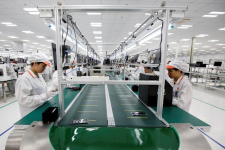
Vietnam is home to large manufacturing operations of tech firms such as Apple and Samsung, which often rely on components made in China. Meta and Google also have contractors in Vietnam that produce goods such as virtual reality headsets and smartphones.

The Southeast Asian nation has been organising meetings with local businesses to boost the supply of Vietnamese parts, with firms showing willingness to cooperate but also warning they would need time and technology to do so, according to one person with knowledge of the discussions.

The Trump administration has threatened Vietnam with crippling tariffs of 46% which could significantly limit access for Vietnam-made goods to their main market and upend the Communist-run country's export-oriented growth model.

Vietnam has been asked "to reduce its dependency on Chinese high-tech," said one person familiar with the discussions. "That is part of the restructuring of supply chains and would in turn reduce U.S. dependency on Chinese components," the person added.

The ultimate objective is to speed up U.S. decoupling from Chinese high-tech while increasing Vietnam's industrial capacity, a second person said, citing virtual reality devices as an example of Vietnam-assembled products that are too dependent on Chinese technology.

All sources declined to be identified as the discussions were confidential. Reuters was not able to learn if the U.S. has proposed numerical targets such as caps on Chinese content for "Made in Vietnam" goods or different tariff rates based on the amount of Chinese content.

Apple, Samsung, Meta and Google did not reply to Reuters requests for comment.

As the U.S.-imposed deadline of July 8 nears before the tariffs take effect, the timing and scope of a possible deal remain unclear.

All sources stressed that while the U.S. has made broader requests for Vietnam to reduce its reliance on China, tackling the issue of Chinese high-tech content in exports was a key priority.

Last year, China exported around $44 billion of tech such as electronics components, computers and phones to Vietnam, about 30% of its total exports to the country. Vietnam shipped $33 billion of tech goods to the United States or 28% of the U.S.-bound exports. Both flows are on the rise this year, according to Vietnam's customs data.

Vietnam's trade ministry did not reply to Reuters requests for comment. Separate sources have previously said that U.S. demands were seen as "tough" and "difficult" by Vietnamese negotiators.

The U.S. also wants Vietnam to crack down on the practice of shipping Chinese goods to America with misleading "Made in Vietnam" labels that draw lower duties - which Vietnam is also trying to heed.

The ministry said on Sunday that a third round of talks last week in Washington ended with progress, but critical issues remain unresolved.

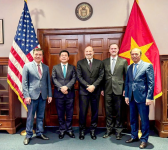
Vietnam's ruling Communist Party chief To Lam intends to meet U.S. President Donald Trump in the United States, possibly in late June, officials with knowledge of the matter said. No date has been announced for the trip.

The White House and Vietnam's foreign ministry did not respond to requests for comment on the possible visit.

NOT TOO FAST

Local firms attending meetings organised by the trade ministry in recent weeks expressed a general willingness to adapt, but many warned that instant changes "would destroy business", according to one of the sources.

Vietnam has been slowly developing an industrial ecosystem with local suppliers but it has a long way to go before it can match China's advanced supply chains and cheaper pricing, industry executives say.

"Vietnam is about 15–20 years behind China in somewhat fully replicating its supply chain scale and sophistication, but it's catching up fast, especially in key sectors like textiles and electronics," said Carlo Chiandone, a Vietnam-based supply chain expert.

Abrupt changes to existing practices may hurt Vietnam's delicate relationship with China, which is both a major investor in its Southeast Asian neighbour and a source of security concerns.
 
1750073921291.png
1750074008807.png

such demand by the MAGA is totally unrealistic. how’s going to work without China supply chain?
Not now. maybe in 10-15 years. hopefully To Lam can convince Trump.
 
View attachment 128470
View attachment 128471

such demand by the MAGA is totally unrealistic. how’s going to work without China supply chain?
Not now. maybe in 10-15 years. hopefully To Lam can convince Trump.
Man, diversify your exports, 30% of your GDP is too much. US, esp Trump and company, is not a reliable and trustable trade partner, and to the world too.
 
Trump is thinking too simply.

Vietnam's manufacturing industry is already deeply integrated into China's industrial system, in which Vietnam is responsible for some of the production segments, such as parts for electronic products like cell phones, tablets, and other electronic products, parts for household appliances, textiles and footwear, parts for industrial machinery and power tools, automotive parts, primary processing of wood products, and so on.

Trump wants to separate Vietnam from the Chinese industrial system, so is Trump capable of providing another system to Vietnam? Or does Trump think Vietnam is capable of creating a complete industrial system on its own?
 
Trump is thinking too simply.

Vietnam's manufacturing industry is already deeply integrated into China's industrial system, in which Vietnam is responsible for some of the production segments, such as parts for electronic products like cell phones, tablets, and other electronic products, parts for household appliances, textiles and footwear, parts for industrial machinery and power tools, automotive parts, primary processing of wood products, and so on.

Trump wants to separate Vietnam from the Chinese industrial system, so is Trump capable of providing another system to Vietnam? Or does Trump think Vietnam is capable of creating a complete industrial system on its own?
easy to understand. Trump wants Vietnam to reorganise the supply chain, more import from US. he looks at Vietnam import. $162 billion from China last year 2024, this year 2025 probably $200 billion.
the MAGA endgame is isolating, weakening China.
that’s unrealistic. Vietnam gov will never agree.
 
easy to understand. Trump wants Vietnam to reorganise the supply chain, more import from US.
he looks at Vietnam import. $162 billion from China last year 2024, this year 2025 probably $200 billion.
the MAGA endgame is isolating, weakening China.
that’s unrealistic. Vietnam gov will never agree.
Trump never expected Vietnam to get out of China's supply chain and knew the Vietnamese government would not agree. It's not even likely that he would allow Vietnam as a supply chain replacement. Vietnam, or for that matter all Southeast Asian countries, have developed nationally in favor of China and against the United States. The richer Southeast Asia gets, the bigger China's market gets. Trump's first choice for supply chain is Central and South America and second choice is India. As for Southeast Asia, that's prey for US hedge funds. Now Trump's outrageous demands on Vietnam are extreme pressure with the ultimate goal of Vietnam buying US debt. Not short-term US debt, but long-term US debt that they haven't sold.
 
The United States just wants Southeast Asian countries to fight with China. The supply chain of the United States will not be in Southeast Asia, and the United States will not rest assured.
 
The United States just wants Southeast Asian countries to fight with China. The supply chain of the United States will not be in Southeast Asia, and the United States will not rest assured.
China has been operating in ASEAN for many years and maintains mutual trust with most countries. ASEAN is also one of the biggest beneficiaries of China's economic development. No ASEAN country will listen to Trump except for that dumb ass Philippines. Trump is well aware of this, he just wants a reason to apply pressure and the ultimate goal is still to sell US debt.
 
China has been operating in ASEAN for many years and maintains mutual trust with most countries. ASEAN is also one of the biggest beneficiaries of China's economic development. No ASEAN country will listen to Trump except for that dumb ass Philippines. Trump is well aware of this, he just wants a reason to apply pressure and the ultimate goal is still to sell US debt.
The United States is now developing agents everywhere, and he himself is making a strategic retreat. Push the agent to the front desk. India, Philippines, Japan, Korea. The recent actions of these countries are quite frequent, except that South Korea has just changed its president and has not yet taken any action.
India has just stuck its head out to be beaten by Pakistan, and now it is back in South Asia licking its wounds and waiting for them to heal.Who is the next country?
China is now very upset, if China does not make a move, they will quarrel like flies all the time, and if China teaches them a lesson, they are afraid of beating each other to death without control.
Australia has been very honest recently. Maybe our cruiser went around their country before.
 
These are the standard terms President Trump's administration will insist on for all trade deals. If reshoring to America is not possible, at least friend-shoring should happen. The US and many other countries don't want to face the kind of blackmail China is employing on rare earth exports again.
 
These are the standard terms President Trump's administration will insist on for all trade deals. If reshoring to America is not possible, at least friend-shoring should happen. The US and many other countries don't want to face the kind of blackmail China is employing on rare earth exports again.
from what I see the MAGA purses “american only” policy. not friend shoring, not near shoring. in the case of Vietnam Trump wants manufacturing from China back to the US, not Canada, not Mexico.
but that obsession with manufacturing is unrealistic if not too delusional.
the US don’t have such large cheap labor pool.
last but not least, in economics you make more money with service, aka designing the shoes, not with making the shoes.
 
from what I see the MAGA purses “american only” policy. not friend shoring, not near shoring. in the case of Vietnam Trump wants manufacturing from China back to the US, not Canada, not Mexico.
but that obsession with manufacturing is unrealistic if not too delusional.
the US don’t have such large cheap labor pool.
last but not least, in economics you make more money with service, aka designing the shoes, not with making the shoes.
Hardcore MAGA are mostly economically illiterate, but many of their goals are shared by the conservative billionaires and the US establishment- who all want to have less dependence on China for the supply chain in critical sectors .

Producing every thing is America is the holy grail, but practically it is simply not possible. However, it is preferable for the supply chain dependence to be on friendly countries like Phillipines and Thailand than on China or those in her orbit.

The deal with the UK has provisions to reduce dependence on China and those being negotiated with the likes of India and Vietnam will have similar provisons. It would be for these countries to make a choice.

Complete decoupling in the short-term is impossible, but the long term goal is to insulate US supply chains from Chinese dependence as much as possible.
 
Playing with fire can cause severe economic damage, which can lead to a physical confrontation between the two powers.

The correct approach would be to avoid being the grass underneath the feet of the two elephants.
 
If Vietnam chooses to stand in the American camp, it will be the front line of the United States. If it stands in the Chinese camp, it will be the Chinese border guard. With the growing contradictions between the great powers, the idea of neutrality is not feasible, which will make both sides suspicious.Iran is a very obvious example, he wants to play the strategic balance, both sides talk about conditions, the result is only himself.
 
If Vietnam chooses to stand in the American camp, it will be the front line of the United States. If it stands in the Chinese camp, it will be the Chinese border guard. With the growing contradictions between the great powers, the idea of neutrality is not feasible, which will make both sides suspicious.

It is best to be in the Chinese camp, as Vietnam has deeper roots and cultural proximity than the United States.
 

Users who are viewing this thread

Pakistan Defence Latest

Country Watch Latest

Latest Posts

Back
Top