Pharmaceutical and Hospital facilities updates

1750801676339.png


1750801804822.png

Novacare Hospital is set to open in Islamabad's DHA by 2026

Our Correspondent
June 25, 2025

hospital partnership photo app

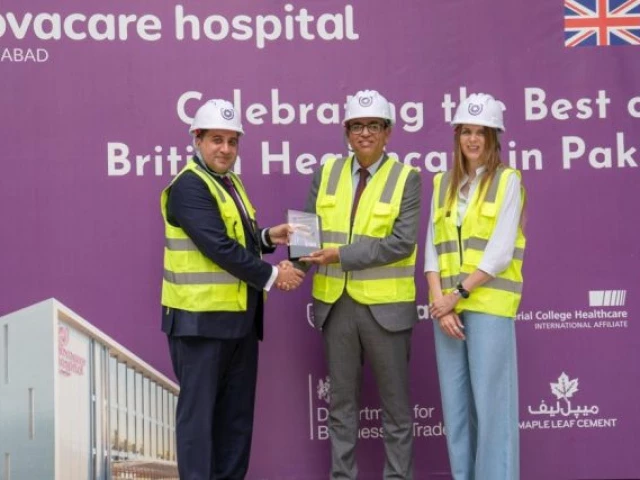
Hospital partnership. Photo APP

ISLAMABAD: London's Imperial College Healthcare NHS Trust has signed its first official partnership with a Pakistani hospital, Novacare Hospital, to share clinical best practices and foster healthcare staff development.
 
1750801676339.png


1750801804822.png

Novacare Hospital is set to open in Islamabad's DHA by 2026

Our Correspondent
June 25, 2025

hospital partnership photo app

Hospital partnership. Photo APP

ISLAMABAD: London's Imperial College Healthcare NHS Trust has signed its first official partnership with a Pakistani hospital, Novacare Hospital, to share clinical best practices and foster healthcare staff development.

Is this Novacare the same company that operates Dvago Chain Pharmacy in Pakistan?
 
Is this Novacare the same company that operates Dvago Chain Pharmacy in Pakistan?
I think, it is separate company.

Novo Nordisk Pharma (Private) Limited​

113, Shahrah-e-Iran,
Clifton, Karachi, Pakistan
Phone: +92 21 35360920

..........
 
I think, it is separate company.

Novo Nordisk Pharma (Private) Limited​

113, Shahrah-e-Iran,
Clifton, Karachi, Pakistan
Phone: +92 21 35360920

..........

I doubt it will be Novo Nordisk Pharma as it is a Multinational pharma company (not Pakistani) mainly dealing with diabetes products.


Haleon invests $12m in Panadol​


New facility in Jamshoro to boost output to 8b tablets; CEO stresses need for long-term economic policy

Usman Hanif
July 24, 2025

tribune


KARACHI: Haleon Pakistan has announced a fresh investment of $12 million to expand its manufacturing capacity, focusing on scaling up Panadol production. The move aims to meet growing domestic demand and ensure consistent availability of the widely used pain relief medicine.

Speaking at Haleon's head office, CEO and General Manager Qawi Naseer said the company's 2022 demerger from GSK enabled it to focus exclusively on consumer healthcare. This shift has given the company greater autonomy to invest locally, innovate brands, and support community initiatives.

Over the past three years, Haleon has made significant progress, including local production of Centrum, now available in both domestic and export markets. Naseer said the new $12 million investment is part of a broader plan to enhance production capabilities, subject to regulatory approvals.
 
Pakistan’s pharmaceutical industry is pumping more than $500 million into modernizing factories in a bid to meet international standards and capture markets stretching from the Persian Gulf to Europe.


The sector, which generated $457 million in exports in FY24 after recording its fastest growth in two decades with a 34 percent year-on-year surge, is now positioning itself for a much larger global footprint. Officials estimate medicine exports could climb to $5 billion annually within the next eight years if companies secure global certifications and policy support.

Pharmaceutical exports already account for over 1 percent of GDP and save Pakistan about $2 billion a year through import substitution, according to the United Business Group of the FPCCI. Yet, with per capita drug spending among the lowest in the region, domestic sales still dominate the industry, which was valued at around $3.29 billion last year.


“India and Bangladesh are benchmarks for what we can achieve in exports,” said Javed Ghulam Mohammad, CEO of Martin Dow Group, one of the country’s largest drugmakers and a key member of the Pakistan Pharmaceutical Manufacturers Association.

Martin Dow itself is investing $30 million to secure Good Manufacturing Practice certification, targeting a tenfold increase in export share—from 5 percent today to half its revenue within five to eight years. The firm, which posted annual sales of more than $200 million, already produces Roche Holding AG drugs locally, cutting import costs by 50 percent.

The broader industry’s main buyers include Afghanistan, the Philippines, Sri Lanka, Uzbekistan and Iraq, while Kenya, Vietnam, Myanmar and Thailand are seen as growth frontiers. Business Recorder projects Pakistani medicine exports to reach $1.5 billion by 2030.


For now, companies are aiming first at less strictly regulated regions such as Cambodia, Myanmar and East Africa. Once Martin Dow completes its Karachi facility upgrades by 2027, it plans to expand into Europe and the Middle East, where compliance standards are more demanding.

Despite the export push, challenges loom. High energy prices, currency devaluation and past government drug price caps have squeezed margins, leaving some firms financially vulnerable. Even so, with more than 650 manufacturers serving a population of 250 million, industry leaders say the sector’s global ambitions are stronger than ever.
 
This makes sense. Pakistan manufacturers a lot of medicines , many of high quality and yet it exports very little. Most of the generic medicines in American pharmacies are imported from India, Pakistan has missed huge opportunities in pharma exports.
 
This makes sense. Pakistan manufacturers a lot of medicines , many of high quality and yet it exports very little. Most of the generic medicines in American pharmacies are imported from India, Pakistan has missed huge opportunities in pharma exports.

Pakistan should fully exploit new world obsession with diversification and not putting all eggs in 1 basket.
 
KARACHI: At least 8 pharmaceutical companies from Pakistan have won prestigious international recognition for producing quality medicine of global standards, including WHO prequalification, PIC/S recognition, and MHRA (Medicines and Healthcare products Regulatory Agency) accreditation in recent times.

This has opened doors for them to expand the country’s exports to the regulated high-end world markets including the United States (US), Europe and the Gulf Cooperation Council (GCC) countries - a step towards achieving the $30 billion export target by the industry in five years.

“Another 10 to 15 companies are expected to receive such global certifications over the next one to two years,” Pakistan Pharmaceutical Manufa cturers Association (PPMA) chairman Tauqeer Ul Haq said while speaking at the 8th Pakistan Pharma Summit and 4th Pharma Export Summit and Awards 2025 (PESA 2025) this week in Islamabad.


A former chairman of the association, Haroon Qasim estimated that top 100 companies – out of a total of around 800 firms in the country – could easily go for the international certifications.

He said his company PharmEvo received an outstanding response from international visitors at the Arab Health exhibition held recently at the Dubai World Trade Centre after it had received WHO prequalification.

“A big number of delegates visited our stall in the wake of the prequalification this time. We are now exporting into 30-35 countries at present compared to around 2-3 countries before the prequalification,” he said.

Another former chairman Kaiser Waheed said people asked them why Pakistani firms had not exported to Europe and the US and why there had not been a single firm certified by the US Food and Drug Administration (FDA) like India.

“I don’t know why. This is perhaps because we don’t have such global institutions in the country and expect the pharma industry to come up to global standards,” he said.

However, some eight Pakistan-based pharma companies or groups have achieved WHO and MHRA qualifications. “You may call it the first step to the moon.”

To overcome the shortcomings in the industry, PPMA organised a workshop to train and upgrade industry people and graduate them to WHO (World Health Organization) prequalification, PIC/S (Pharmaceutical Inspection Co-operation Scheme) recognition and MHRA accreditation.

Waheed informed this while speaking at an official Post-Event Workshop of the 8th PPMA Pharma Summit on Friday in Karachi titled ‘Pathways to Regulated Markets: A Practical Guide for Pakistani Pharma Manufacturers’

Copyright Business Recorder, 2025
 
KARACHI: At least 8 pharmaceutical companies from Pakistan have won prestigious international recognition for producing quality medicine of global standards, including WHO prequalification, PIC/S recognition, and MHRA (Medicines and Healthcare products Regulatory Agency) accreditation in recent times.

This has opened doors for them to expand the country’s exports to the regulated high-end world markets including the United States (US), Europe and the Gulf Cooperation Council (GCC) countries - a step towards achieving the $30 billion export target by the industry in five years.

“Another 10 to 15 companies are expected to receive such global certifications over the next one to two years,” Pakistan Pharmaceutical Manufa cturers Association (PPMA) chairman Tauqeer Ul Haq said while speaking at the 8th Pakistan Pharma Summit and 4th Pharma Export Summit and Awards 2025 (PESA 2025) this week in Islamabad.


A former chairman of the association, Haroon Qasim estimated that top 100 companies – out of a total of around 800 firms in the country – could easily go for the international certifications.

He said his company PharmEvo received an outstanding response from international visitors at the Arab Health exhibition held recently at the Dubai World Trade Centre after it had received WHO prequalification.

“A big number of delegates visited our stall in the wake of the prequalification this time. We are now exporting into 30-35 countries at present compared to around 2-3 countries before the prequalification,” he said.

Another former chairman Kaiser Waheed said people asked them why Pakistani firms had not exported to Europe and the US and why there had not been a single firm certified by the US Food and Drug Administration (FDA) like India.

“I don’t know why. This is perhaps because we don’t have such global institutions in the country and expect the pharma industry to come up to global standards,” he said.

However, some eight Pakistan-based pharma companies or groups have achieved WHO and MHRA qualifications. “You may call it the first step to the moon.”

To overcome the shortcomings in the industry, PPMA organised a workshop to train and upgrade industry people and graduate them to WHO (World Health Organization) prequalification, PIC/S (Pharmaceutical Inspection Co-operation Scheme) recognition and MHRA accreditation.

Waheed informed this while speaking at an official Post-Event Workshop of the 8th PPMA Pharma Summit on Friday in Karachi titled ‘Pathways to Regulated Markets: A Practical Guide for Pakistani Pharma Manufacturers’

Copyright Business Recorder, 2025
$30 Billion Export goal is brave
 
KARACHI: At least 8 pharmaceutical companies from Pakistan have won prestigious international recognition for producing quality medicine of global standards, including WHO prequalification, PIC/S recognition, and MHRA (Medicines and Healthcare products Regulatory Agency) accreditation in recent times.

This has opened doors for them to expand the country’s exports to the regulated high-end world markets including the United States (US), Europe and the Gulf Cooperation Council (GCC) countries - a step towards achieving the $30 billion export target by the industry in five years.

“Another 10 to 15 companies are expected to receive such global certifications over the next one to two years,” Pakistan Pharmaceutical Manufa cturers Association (PPMA) chairman Tauqeer Ul Haq said while speaking at the 8th Pakistan Pharma Summit and 4th Pharma Export Summit and Awards 2025 (PESA 2025) this week in Islamabad.


A former chairman of the association, Haroon Qasim estimated that top 100 companies – out of a total of around 800 firms in the country – could easily go for the international certifications.

He said his company PharmEvo received an outstanding response from international visitors at the Arab Health exhibition held recently at the Dubai World Trade Centre after it had received WHO prequalification.

“A big number of delegates visited our stall in the wake of the prequalification this time. We are now exporting into 30-35 countries at present compared to around 2-3 countries before the prequalification,” he said.

Another former chairman Kaiser Waheed said people asked them why Pakistani firms had not exported to Europe and the US and why there had not been a single firm certified by the US Food and Drug Administration (FDA) like India.

“I don’t know why. This is perhaps because we don’t have such global institutions in the country and expect the pharma industry to come up to global standards,” he said.

However, some eight Pakistan-based pharma companies or groups have achieved WHO and MHRA qualifications. “You may call it the first step to the moon.”

To overcome the shortcomings in the industry, PPMA organised a workshop to train and upgrade industry people and graduate them to WHO (World Health Organization) prequalification, PIC/S (Pharmaceutical Inspection Co-operation Scheme) recognition and MHRA accreditation.

Waheed informed this while speaking at an official Post-Event Workshop of the 8th PPMA Pharma Summit on Friday in Karachi titled ‘Pathways to Regulated Markets: A Practical Guide for Pakistani Pharma Manufacturers’

Copyright Business Recorder, 2025

Perfect! American and Canadian markets are wide open for us to exports medicine since they are kicking India out. Trump wants other nations in for the market that's still left with Indian companies. So we must include Pharma on our trade agenda with the US.
 
Trump is about to put 100% tariffs on pharma export companies from next month :D
 

Users who are viewing this thread

Pakistan Defence Latest

Country Watch Latest

Back
Top