Pakistanis are increasingly ditching the national grid in favour of solar power, prompting a boom in rooftop panels.
AFP
July 16, 2025
The quiet energy revolution has spread from wealthy neighbourhoods to middle- and lower-income households as customers look to escape soaring electricity bills and prolonged power cuts.
Down a cramped alley in Karachi, residents fighting the sweltering summer heat gather in Fareeda Saleem’s modest home for something they had never experienced before —uninterrupted power.
“Solar makes life easier, but it’s a hard choice for people like us,” she says of the installation cost.
Saleem was cut from the grid last year for refusing to pay her bills in protest over enduring 18-hour power cuts.
A widow and mother of two disabled children, she sold her jewellery — a prized possession for women in Pakistan — and borrowed money from relatives to buy two solar panels, a solar inverter and a battery to store energy, for Rs180,000 ($630).
As temperatures pass 40 degrees Celsius, children duck under Saleem’s door and gather around the breeze of her fan.
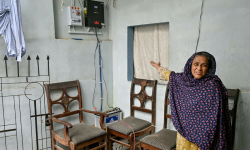
Fareeda Saleem, a local resident, shows a newly installed inverter at her home in Karachi, on June 24, 2025. — AFP
Mounted on poles above homes, solar panels have become a common sight across the country of 240 million people, with the installation cost typically recovered within two to five years.
Making up less than two per cent of the energy mix in 2020, solar power reached 10.3pc in 2024, according to the global energy think tank Ember.
But in a remarkable acceleration, it more than doubled to 24pc in the first five months of 2025, becoming the largest source of energy production for the first time.
It has edged past gas, coal and nuclear electricity sources, as well as hydropower, which has seen hundreds of millions of dollars of investment over the past decades.
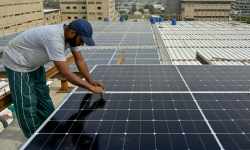
Technicians install solar panels on the rooftop of a factory in Karachi, on July 2, 2025. — AFP
As a result, Pakistan has unexpectedly surged towards its target of renewable energy, making up 60pc of its energy mix by 2030.
Dave Jones, chief analyst at Ember, told
AFP that Pakistan was “a leader in rooftop solar”.
Soaring fuel costs globally, coupled with demands from the International Monetary Fund (IMF) to slash government subsidies, led successive administrations to repeatedly hike electricity costs.
Prices have fluctuated since 2022 but peaked at a 155pc increase, and power bills sometimes outweigh the cost of rent.
“The great solar rush is not the result of any government’s policy push,” Muhammad Basit Ghauri, an energy transition expert at Renewables First, told
AFP.
“Residents have taken the decision out of clear frustration over our classical power system, which is essentially based on a lot of inefficiencies.”
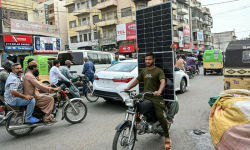
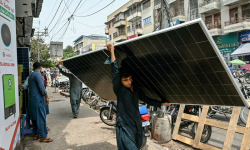
A local resident transports a solar panel on his motorcycle in Karachi, on June 23, 2025. — AFP
Pakistan sources most of its solar equipment from neighbouring China, where prices have dropped sharply, largely driven by overproduction and tech advancements.
But the fall in national grid consumers has crept up on an unprepared government burdened by $8 billion of power sector debt, analysts say.


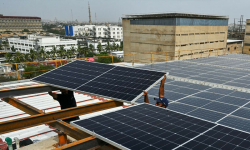


 Kohinoor Textile Mills Goes Green with 7.2MW Solar Power Shift!
 Goals: Cost savings + reduced reliance on imported fuel
 Stock reaction: Shares surge 10% to Rs81.15
 Industrial Solar Wave:


