Pakistan Solar Power: News & Updates

Pakistan’s PET bottle maker to install 2MW solar system


BR Web Desk
June 23, 2025

Ecopack Limited has taken a significant step towards sustainable energy consumption, announcing plans to install a 2 megawatt (MW) solar system.

The listed company, engaged in the manufacturing and sale of Polyethylene Terephthalate (PET) bottles and preforms for the market of beverages and other liquid packaging industry, disclosed the development in its notice to the Pakistan Stock Exchange (PSX) on Monday.

“The Board has approved the CAPEX for acquisition of land measuring 3.63 acres and the installation of a 2.03 MW solar power generation facility,” read the notice.

Ecopack Limited is a limited liability Company incorporated in Pakistan under the repealed Companies Ordinance, 1984.

Despite being a low-income country plagued by economic and social issues, a green revolution is taking place in Pakistan, and the South Asian country has quietly emerged as one of the world’s largest markets for the growing solar industry.
 
According to the Global Electricity Review 2025 by Ember, an energy think tank in the UK, Pakistan imported 17 gigawatts (GW) of solar panels in 2024, joining the ranks of leading solar nations.

This rising trend has left decision-makers grappling with its implications for the national grid and energy sector, as electricity consumption remains stagnant.

In response, the federal government, in its budget for the financial year 2025-26, on Tuesday revealed its intention to impose an 18% sales tax on imported solar panels.

The proposed tax would help the local industry grow, Finance Minister Muhammad Aurangzeb said in his budget speech in the National Assembly.

However, the government, after consultation with the stakeholders, decided to lower GST to 10%.

The development comes amid a solar boom in the country, with net-metering capacity in Pakistan jumping to 2,813 megawatts (MW) as of March 31, 2025, according to the Pakistan Economic Survey 2024-25.
 

Pakistan’s cement sector joins solar wave as Gharibwal doubles down on renewable


BR Web Desk
June 16, 2025

Gharibwal Cement Limited has taken a significant step towards sustainable energy consumption with the successful commissioning of an additional 12.5 megawatt (MW) solar power system at its plant site.

The listed company, engaged in the production and sale of cement, disclosed the development in its notice to the Pakistan Stock Exchange (PSX) on Monday.

“We are pleased to inform the PSX and other stakeholders that Gharibwal Cement Limited has successfully completed the installation and commissioning of an additional 12.5 MW solar power system at its plant site,” read the notice.

The cement maker shared that this new capacity has been integrated with the company’s existing 12MW solar infrastructure, thereby enhancing the total installed solar generation capacity to 24.5MW.

“The additional 12.5MW solar power system has commenced commercial operations from June 16, 2025, and is now contributing to the company’s captive energy requirements.

“This strategic investment aligns with the company’s sustainability objectives and long-term energy cost optimization strategy by enhancing reliance on renewable energy resources, reducing dependence on fossil fuels, and contributing to environmental conservation,” it added.
 

Tax on imported solar panels: what does it mean for Pakistan’s renewable energy future?


Govt insists tax decision balances fiscal needs while maintaining support for clean energy

Gohar Ali Khan
July 4, 2025

The recent move in the federal budget 2025-26 to impose a 10% tax on imported solar panels marks a critical turning point in the country’s renewable energy journey, while impacting consumers and dealers, according to economic nationalists and clean energy advocates.

It could also ramp up investments in local solar panel manufacturing.

After an initial proposal of an 18% tax was rolled back after the industry’s reaction-cum-pushback, the newly-approved 10% levy is due to push up panel prices by 8%–10% starting from July 1, directly impacting consumers and dealers.


The government insists this decision balances fiscal needs while maintaining support for clean energy.

However, Pakistan has witnessed a historic solar boom, while becoming the world’s largest importer of solar panels in 2024.

Ali Majid - LONGi Green Energy Technology Co Ltd General Manager Central Asia and Middle East and North Africa - said Pakistan’s solarisation momentum faces challenges with the 10% tax on imported panels.

Speaking to Business Recorder, he said he believes a long-term drive for clean energy, along with local initiatives to boost domestic solar manufacturing and optimize supply chains, can help mitigate cost impacts.

LONGi said it is committed to working with stakeholders, offering efficient, cost-competitive products and solutions, to support Pakistan in sustaining its solar growth trajectory despite these short-term hurdles.

Majid said for households and industries, the tax-driven price hike will add to energy cost burdens. But LONGi aims to ease the impact.

According to Majid, “We’ll leverage our global scale, research and development (R&D) strength, and local presence to provide high-efficiency, reliable solar products at optimized costs.”

“By promoting distributed generation and energy-saving solutions, we help reduce long-term energy expenses, supporting both sectors to navigate inflationary pressures and still embrace solar benefits.”

‘Solar continues to be the smarter long-term choice’

Meanwhile Livoltek’s Pakistan Director Sales, Max Ma, said the 10% tax will slightly scale up solar system costs, but grid electricity remains significantly more expensive and unreliable.
 
‘Demand for solar remains resilient’

Business Recorder also spoke to analyst Usman Suhail said the 10% levy on imported solar panels is likely to increase retail prices, creating immediate cost pressure on both residential and commercial buyers.

This price hike may temporarily slow down new solar installations, especially in the lower-income and small business segments that were driving the recent boom.

However, demand for solar remains resilient due to ongoing grid instability and rising electricity tariffs.

“Rather than a mass shift back to grid electricity, we may see a slowdown in new installations, not a reversal. On the upside, this move could incentivize serious investment in local solar panel manufacturing, which has long struggled to gain traction due to cheaper imports. But establishing competitive local supply will require policy support, quality assurance, and technology transfer,” he said.

In the short term, price sensitivity could reduce sales volume, but the long-term market fundamentals still favor solar—if supported by consistent policy and incentives for local production.
 

Pakistan’s quiet solar rush puts pressure on national grid


Pakistanis are increasingly ditching the national grid in favour of solar power, prompting a boom in rooftop panels.

AFP
July 16, 2025

The quiet energy revolution has spread from wealthy neighbourhoods to middle- and lower-income households as customers look to escape soaring electricity bills and prolonged power cuts.

Down a cramped alley in Karachi, residents fighting the sweltering summer heat gather in Fareeda Saleem’s modest home for something they had never experienced before —uninterrupted power.

“Solar makes life easier, but it’s a hard choice for people like us,” she says of the installation cost.

Saleem was cut from the grid last year for refusing to pay her bills in protest over enduring 18-hour power cuts.

A widow and mother of two disabled children, she sold her jewellery — a prized possession for women in Pakistan — and borrowed money from relatives to buy two solar panels, a solar inverter and a battery to store energy, for Rs180,000 ($630).

As temperatures pass 40 degrees Celsius, children duck under Saleem’s door and gather around the breeze of her fan.
1752674156505.png

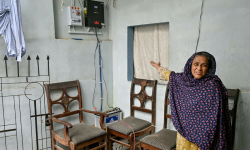
Fareeda Saleem, a local resident, shows a newly installed inverter at her home in Karachi, on June 24, 2025. — AFP

Mounted on poles above homes, solar panels have become a common sight across the country of 240 million people, with the installation cost typically recovered within two to five years.

Making up less than two per cent of the energy mix in 2020, solar power reached 10.3pc in 2024, according to the global energy think tank Ember.

But in a remarkable acceleration, it more than doubled to 24pc in the first five months of 2025, becoming the largest source of energy production for the first time.

It has edged past gas, coal and nuclear electricity sources, as well as hydropower, which has seen hundreds of millions of dollars of investment over the past decades.
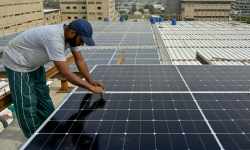
1752674050541.png

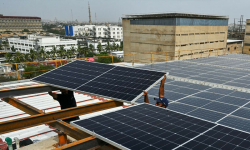
Technicians install solar panels on the rooftop of a factory in Karachi, on July 2, 2025. — AFP

As a result, Pakistan has unexpectedly surged towards its target of renewable energy, making up 60pc of its energy mix by 2030.

Dave Jones, chief analyst at Ember, told AFP that Pakistan was “a leader in rooftop solar”.

Soaring fuel costs globally, coupled with demands from the International Monetary Fund (IMF) to slash government subsidies, led successive administrations to repeatedly hike electricity costs.

Prices have fluctuated since 2022 but peaked at a 155pc increase, and power bills sometimes outweigh the cost of rent.

“The great solar rush is not the result of any government’s policy push,” Muhammad Basit Ghauri, an energy transition expert at Renewables First, told AFP.

“Residents have taken the decision out of clear frustration over our classical power system, which is essentially based on a lot of inefficiencies.”
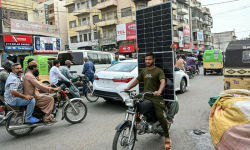
1752674108434.png

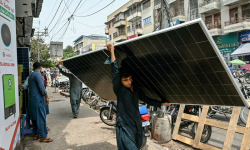
A local resident transports a solar panel on his motorcycle in Karachi, on June 23, 2025. — AFP

Pakistan sources most of its solar equipment from neighbouring China, where prices have dropped sharply, largely driven by overproduction and tech advancements.

But the fall in national grid consumers has crept up on an unprepared government burdened by $8 billion of power sector debt, analysts say.
 
1752674260405.png

Pakistan depends heavily on costly gas importswhich it sells at a loss to national energy providers. It is also tied into lengthy contracts with independent power producers, including some owned by China, for which it pays a fixed amount regardless of actual demand.

A government report in March said the solar power increase has created a “disproportionate financial burden on grid consumers, contributing to higher electricity tariffs and undermining the sustainability of the energy sector”.

Electricity sales dropped 2.8pc year-on-year in June, marking a second consecutive year of decline.

1752674418424.png

A labourer carries a solar panel along a road in Pakistan’s port city of Karachi, on June 23, 2025. — AFP

Last month, the government imposed a new 10pc tax on all imported solar, while the energy ministry has proposed slashing the rate at which it buys excess solar energy from consumers.

“The household solar boom was a response to a crisis, not the cause of it,” said analyst Jones, warning of “substantial problems for the grid”, including a surge during evenings when solar users who cannot store energy return to traditional power.

The national grid is losing paying customers like businessman Arsalan Arif.

A third of his income was spent on electricity bills at his Karachi home until he bought a 10-kilowatt solar panel for around Rs1.4 million (around $4,900).

“Before, I didn’t follow a timetable. I was always disrupted by the power outages,” he told AFP.

Now he has “freedom and certainty” to continue his catering business.

In Sialkot, safety wear manufacturer Hammad Noor switched to solar power in 2023, calling it his “best business decision”, breaking even in 18 months and now saving Rs1m every month.

The cost of converting Noor’s second factory has now risen by nearly Rs1.5m under the new government tax.

“The tax imposed is unfair and gives an advantage to big businesses over smaller ones,” he said.

“Policymakers seem completely disconnected from the public and business community.”
 
I continue to remain impressed with what Pakistan is doing in this area.
Pakistan is no 1 solar power consumer in the world.
Reason being is the unaffordable costs of electricity in pakistan.
In February we installed a 25 plate huge setup on our roof. No battery setup. At daytime direct solar power and at night using grid electricity of IESCO.
It's finally reaping fruits under the net metering scheme. Third consecutive month and the bill is negative. With three 1.5 ton AC,s running all the time.
June bill was some Rs 215K but all negated by the solar panels. Infact we are producing more units than we are consuming and sending the excess back to IESCO grid. They should pay us back for the excess but they aren't paying anymore 😒
 
That is awesome!

Our new home, the build of which is currently paused until our current home sells, has solar heavily built in. We should be running a surplus as well.

The system is designed to be expanded and to have batteries installed. At max, there will be 50x400W panels. Where the house will be built, the average number of peak solar hours (forgot correct term) is approximately 6.5 hours.
 
That is awesome!

Our new home, the build of which is currently paused until our current home sells, has solar heavily built in. We should be running a surplus as well.

The system is designed to be expanded and to have batteries installed. At max, there will be 50x400W panels. Where the house will be built, the average number of peak solar hours (forgot correct term) is approximately 6.5 hours.
For what you need 50 panels. That's massive. Unless you have a very very big house with extra electricity needs.
I live in a big house as well with lots of electricity consumption but still 25 panels are producing excess electricity.
 
For what you need 50 panels. That's massive. Unless you have a very very big house with extra electricity needs.
I live in a big house as well with lots of electricity consumption but still 25 panels are producing excess electricity.
Excellent question. The new house will be 2642SF; actually larger than the current.

Unlike the current, it will be 100% electric. Current home has gas heat and hot water. Plus, we split our time between the PHX metro area and the high desert of north central Arizona. Temps in the PHX metro area will run 105F+ for for 5 months. At the other house, we may see 20 odd days of 100F temps. But in the winter, it will get cold at 5000'ASL.

My design, confirmed by the solar company, was based on PHX metro usage. 37 panels to produce 110-115% of peak month usage. Up north we will not need that because of the way I designed the insulation system.

50 panels is a theoretical which I doubt we will ever need but could expand to.
 

Experts seek policy for solar manufacturing base​


Study proposes roadmap for 100MW solar PV plant; stakeholders call for data-driven reforms, tech upgrades

APP
July 23, 2025

tribune


ISLAMABAD: Experts at a high-level consultative session stressed that Pakistan must urgently develop a comprehensive policy framework to strengthen its domestic solar manufacturing ecosystem amid rising energy demands and growing reliance on imports.

The session was hosted by the US-Pakistan Centre for Advanced Studies in Energy (USPCAS-E) at NUST.

The event marked the launch of a study titled "Crafting a Sustainable Business Model to Drive Indigenous Solar PV Panels Manufacturing in Pakistan," presented by Dr Nadia Shahzad, Associate Professor at NUST.

The study provides a roadmap for establishing a 100MW solar PV panel manufacturing plant in Pakistan, with scalability up to 1.0GW. Developed through site visits and stakeholder consultations, the model is seen as a practical starting point for local production.

Welcoming the participants, Dr Adeel Waqas, Dean and Principal at USPCAS-E, underscored the need for a self-reliant solar manufacturing sector to meet the country's energy needs and reduce import dependency.

The session brought together policymakers, academics, and industry leaders, all echoing the urgency to build a strong domestic solar base.

Maud Osman Mohammad of LONGi Solar praised the study's clarity and urged aligning policy with market realities.

Similarly, Muhammad Basit Ghauri from Renewables First noted that battery imports exceeding Rs90 billion in just three months reflect the market's potential. He emphasised the need for data-driven planning and integration of storage solutions behind the grid.

Dr Omais Abdur Rehman supported a role for the Engineering Development Board, while Dr Noor ul Huda Khan of BUITEMS advocated for alignment with next-gen solar technologies such as Perovskite modules.

On the technological front, Sohaib Asif Sipra, CEO of SkyElectric, warned that nearly half of Pakistan's solar installations remain informal, risking quality and safety standards. He called for the formation of a dedicated think tank to drive standardisation and innovation in battery and inverter manufacturing.

Representing local battery production, Mansoor Jamil Khan of Atlas Battery highlighted their joint venture with Japan's GS Yuasa and advocated for lithium-ion safety protocols alongside continued dominance of lead-acid batteries.

Policy-level recommendations were reinforced by M Umer Khan of the Private Power and Infrastructure Board (PPIB), who proposed targeted subsidies and strategic import duties to promote indigenous manufacturing.

Hasnat Khan of the Pakistan Solar Association detailed their training and certification drive in partnership with institutions like TEVTA, NUTECH, and PPIB to ensure quality assurance in solar installations.

Concluding the event, Dr Majid Ali, Associate Professor at NUST, reaffirmed the university's commitment to advancing indigenous solar manufacturing and called for ongoing collaboration among academia, industry, and government.

The session served as a powerful reminder of the need for cohesive action and strategic investment to transform Pakistan into a hub of solar innovation and manufacturing.
 
🌞 Kohinoor Textile Mills Goes Green with 7.2MW Solar Power Shift!
💡 Goals: Cost savings + reduced reliance on imported fuel
📈 Stock reaction: Shares surge 10% to Rs81.15
🔋 Industrial Solar Wave:
• J.K. Spinning Mills: 7MW expansion
• Dewan Cement: 6MW
• Int’l Steels: 6.4MW
 

Ecnec approves 100MW solar power project for Gilgit Baltistan

NNI
August 10, 2025

Executive Committee of the National Economic Council (Ecnec) has approved a one hundred megawatt solar photovoltaic power project for Gilgit Baltistan. Following Ecnec’s approval, formal work on the project will commence.

During his recent visit to Gilgit, the Prime Minister had announced that Ecnec would soon approve the 100-megawatt power plants for Gilgit-Baltistan. Central Development Working Party has already approved the project. This project will benefit the districts of Astore, Darel, Tangir, Diamer, Ghanche, Ghizer, Gilgit, Hunza, Ishkoman, Nagar, Roundu, Skardu and Shigar.

In the first phase, Skardu district will be provided with 18.958 megawatts of electricity. In the second phase, the districts of Hunza, Gilgit and Diamer will be supplied with 6.005 megawatts, 28.013 megawatts and 13.126 megawatts of electricity respectively.

In the third phase, the remaining districts will receive 16.096 megawatts of electricity. The project is set to be completed within three years at a total cost of Rs 24,957 million.
 

Users who are viewing this thread

Pakistan Defence Latest

Back
Top