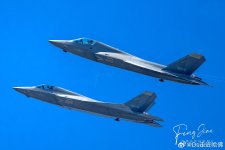
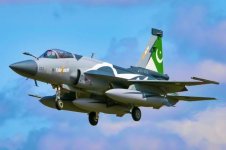
Chinese SAC - FC-31/J-35 5th Gen Stealth Aircraft

With the 6th generation aircraft prototypes already flying, does it make sense to procure more 5th generation designs in large numbers rather than going to 6th generation?

I'm unsure on how the intended force structure is meant to be, but wouldn't that make more sense?

@Deino @Michael

China even today is manufacturing 4/4.5/4.5+ generation fighter jets. You should be asking, when china is already moving towards 6G, doesn't it make more sense to replace all the 4/4.5 generation jets with 5G as well and have 1500+ 5G fighter jets ?
 
With the 6th generation aircraft prototypes already flying, does it make sense to procure more 5th generation designs in large numbers rather than going to 6th generation?

I'm unsure on how the intended force structure is meant to be, but wouldn't that make more sense?

@Deino @Michael
Fifth gen are going to be the backbone of the armed forces.
 
China even today is manufacturing 4/4.5/4.5+ generation fighter jets. You should be asking, when china is already moving towards 6G, doesn't it make more sense to replace all the 4/4.5 generation jets with 5G as well and have 1500+ 5G fighter jets ?
early J10A, Su-27, J11A, J-7, J-8, JH-7, a lots to be replaced.
 
Chinese Navy Confirms J-35 Carrier Based Stealth Fighters Have Joined the Fleet


Asia-Pacific , Aircraft and Anti-Aircraft
Military Watch Magazine Editorial Staff
July-18th-2025
Chinese PLA Navy J-35 Fighters
The Chinese People’s Liberation Army Navy has released the first images of a pair of serial production J-35 fifth generation fighters that have joined the service’s fleet, with the new class of aircraft expected to operate from land bases and as part of future carrier air wings. This occurred less than two weeks after the release of the first images of land based variants of the J-35 in service in the People’s Liberation Army Air Force. Unlike the Air Force, which has operated J-20 fifth generation fighters since February 2017, the J-35’s entry into service marks the first time the Navy fields aircraft with advanced stealth capabilities. The fighter’s service entry closely follows the Navy’s confirmed operationalisation of the J-15B ‘4+ generation’ fighter, which is a considerably heavier aircraft intended to operate alongside the J-35 as part of a high-low combination.

J-15B (top) and J-35 Fighters
 
With the 6th generation aircraft prototypes already flying, does it make sense to procure more 5th generation designs in large numbers rather than going to 6th generation?
I'm unsure on how the intended force structure is meant to be, but wouldn't that make more sense?
@Deino @Michael
The development of military industry is quite different from that of civilian industry. The military industry does not exclusively seek technological sophistication. That is, it is not the case that the more advanced a weapon is, the better it is.

China's 6th-Gen fighters have completed their first flight, but they still have a lot of immature technology and imperfect features. This will require researchers to continue working on them for many years.
China's J-20 completed its first flight in 2011. But until today, Chinese researchers are still working on it.
 
According to public information, China's military equipment mainly considers the following points: 1. The international situation and the situation of neighboring countries. 2. Equipment that the military believes is necessary to ensure deterrence. 3. The maintenance and development needs of major domestic arms suppliers. A state of balance and healthy competition needs to be maintained. 4. The affordability of the national economy. 5. The speed of technological development.
This involves comprehensive consideration and mutual constraints.
For example: The Chinese Air Force only wants heavy fighters. Considering the affordability of the national economy and the situation of major military suppliers, the Air Force has to buy J10 even if it is not happy. It is impossible to meet the Air Force's desire to use all heavy fighters, but it must also meet most of the Air Force's requirements for heavy fighters in order to ensure national security needs. At the same time, the speed of technological progress is also considered. Any advanced fighter is already behind when it comes off the production line. Therefore, military equipment will only be updated at an appropriate rate to ensure the rationality and economy of the technology during the use cycle of the equipment.
 
Egypt? I think uncle Sam will not agree.
And why not Iran ?
Pakistan is the actual potential customer... It's just time game .. when Pakistan want to induct them .. possibly they want to wait for there maturity like J10C or Z10M
 
Regarding the planned production of the J-35 series fighters, it is unlikely that there will be clear news at present.

According to information from other channels, My analysis is:
The maximum production capacity that the PLA's J-35 series fighters (naval version and air force version) can support does not exceed 240 aircraft/year.
The maximum production capacity that the FC-31/J-35 foreign trade version can support does not exceed 48 aircraft/year.
This is the current theoretical limit. That is, the maximum number that the relevant industrial chain planning can support is not the actual production volume. If the relevant industrial chain increases the relevant planned production capacity, the number will continue to rise.
48 export aircraft is not bad at all...

Any customer that will induct it initially will probably go at max order under 100 ... So they can wait for few years
 
Regarding the planned production of the J-35 series fighters, it is unlikely that there will be clear news at present.

According to information from other channels, My analysis is:
The maximum production capacity that the PLA's J-35 series fighters (naval version and air force version) can support does not exceed 240 aircraft/year.
The maximum production capacity that the FC-31/J-35 foreign trade version can support does not exceed 48 aircraft/year.
This is the current theoretical limit. That is, the maximum number that the relevant industrial chain planning can support is not the actual production volume. If the relevant industrial chain increases the relevant planned production capacity, the number will continue to rise.

But it Must be reminded, this is Not the current production rate but the maximum output when the new Factory is working on full Level and it isn’t Ready yet.

By the way, just a nice image for the weekend.

IMG_2784.jpeg
 
48 export aircraft is not bad at all...
Any customer that will induct it initially will probably go at max order under 100 ... So they can wait for few years
But it Must be reminded, this is Not the current production rate but the maximum output when the new Factory is working on full Level and it isn’t Ready yet.
YES.
My analysis has set the precondition “theoretical limit value”. This is not actual production.

It's like:
Manufacturer of tires for car factories. They can only produce a maximum of 50,000 tires a year. So, the corresponding automobile factory can only produce a maximum of 10,000 cars a year (5 tires per car).
In reality, the automobile factory may produce 5,000 or 8,000 cars, but it cannot produce more than 10,000 cars.
 
A first brief analysis ... J-35 vs J-35A in details!Most obvious at first sight:

- the engines or at least exhaust nozzles are totally different (@Michael and info?)
- both now use the same smaller rudder (unlike seen on naval prototypes)
- both have different luneburg lenses

View attachment 135576

Nice analysis mate
 
But it Must be reminded, this is Not the current production rate but the maximum output when the new Factory is working on full Level and it isn’t Ready yet.

By the way, just a nice image for the weekend.

View attachment 135761

I can't wait to see these puppies in Pakistani Airforce "war paint" !
 

Users who are viewing this thread

Pakistan Defence Latest

Country Watch Latest

Latest Posts

Back
Top