Turkish Missile Programs

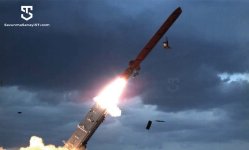
Roketsan 300-ER air launched Ballistic Missile


Range : 500+ km
Speed : supersonic
Length : 5 m
Diameter : 370 mm
Weight : 900 kg
Guidance : GNSS + INS + TV Camera seeker

UCAVs and Fighter Jets will carry 300-ER air launched Ballistic Missile
1753202250309.png

Unique in NATO
70+ km IHA-122 supersonic Missile
150+ km IHA-230 supersonic Missile
500+ km 300-ER supersonic Missile

good luck to enemy Air Defense Systems
 
Any info on BVR program Goktug / Bozdogan, etc? They tried the new seeker over a year ago in an effort to develop a Meteor like platform?

GOKDOGAN BVR Missile entered the inventory ( equivalent to AIM-120C5/7 )
( Solid-state active radar seeker technology )

GOKBORA air to air missile is similar to METEOR Missile with ramjet engine
but GOKBORA using AESA seeker developed by ASELSAN and will be delivered soon

GOKBORA : AESA seeker as like Chinese PL-21
METEOR : Active Anti-Air Seeker

GOKBORA : 3.75 m
METEOR : 3.65 m

GOKBORA : 180 mm
METEOR : 178 mm

GOKBORA : solid-fuel RamJet engine
METEOR : solid-fuel RamJet engine


And TUBITAK-SAGE develops GOKHAN BVR missile which is using a liquid-fuel
ramjet engine

GOKHAN missile is bigger than both METEOR and GOKBORA
 
GOKDOGAN BVR Missile entered the inventory ( equivalent to AIM-120C5/7 )
( Solid-state active radar seeker technology )

GOKBORA air to air missile is similar to METEOR Missile with ramjet engine
but GOKBORA using AESA seeker developed by ASELSAN and will be delivered soon

GOKBORA : AESA seeker as like Chinese PL-21
METEOR : Active Anti-Air Seeker

GOKBORA : 3.75 m
METEOR : 3.65 m

GOKBORA : 180 mm
METEOR : 178 mm

GOKBORA : solid-fuel RamJet engine
METEOR : solid-fuel RamJet engine


And TUBITAK-SAGE develops GOKHAN BVR missile which is using a liquid-fuel
ramjet engine

GOKHAN missile is bigger than both METEOR and GOKBORA
Bro would you be visiting the defence expo, if u do, do stroll around and take pics.
 
GOKDOGAN BVR Missile entered the inventory ( equivalent to AIM-120C5/7 )
( Solid-state active radar seeker technology )

GOKBORA air to air missile is similar to METEOR Missile with ramjet engine
but GOKBORA using AESA seeker developed by ASELSAN and will be delivered soon

GOKBORA : AESA seeker as like Chinese PL-21
METEOR : Active Anti-Air Seeker

GOKBORA : 3.75 m
METEOR : 3.65 m

GOKBORA : 180 mm
METEOR : 178 mm

GOKBORA : solid-fuel RamJet engine
METEOR : solid-fuel RamJet engine


And TUBITAK-SAGE develops GOKHAN BVR missile which is using a liquid-fuel
ramjet engine

GOKHAN missile is bigger than both METEOR and GOKBORA

Was Pakistan a partner in Gokhan or Gokdogan? There were news that we stopped our FAAZ BVR program to JD with Turkiye on one of their BVR projects so that we can use economies of scale.

What's the range of Gokbora and Gokhan? Any links with more details?
 
Land Forces Commander General Selçuk Bayraktaroğlu:
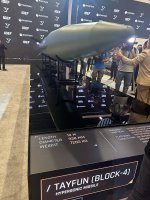
(TAYFUN Block-4 Ballistic Missile)


We will have this system in our inventory by the end of this year. It will be a crucial deterrent.

As its range and speed increase, its deterrent effect will be global.

To view this content we will need your consent to set third party cookies.
For more detailed information, see our cookies page.


TAYFUN Block4 hypersonic Ballistic Missile will enter the inventory by the end of 2025

Length : 10 m
Diameter : 938 mm
Weight : 7.200 kg
1753207790209.jpeg

Ground based hypersonic Ballistic Missiles in NATO
-- American DARK EAGLE ( speed of mach 5 )
-- Turkish TAYFUN Block1 ( speed of mach 5.2 )
-- Turkish TAYFUN Block4 ( estimated maximum speed of mach 6-8 )

also CENK Ballistic Missile on the way
1753208327252.png

Turkiye focused on guidance systems for pinpoint accuracy
Turkish TAYFUN Ballistic Missile hit the target with pinpoint accuracy ( below 1 meter )
To view this content we will need your consent to set third party cookies.
For more detailed information, see our cookies page.
 
Last edited:
Gokhan use gel fuel
Gel fuel based AAMs, Are you sure about this
I have read multiple reports and Research paper on Gel fuel for Ramjet motors, even the most promising boron loaded gel fuel have not gone beyond laboratory tests, let alone being ready for testing on a missile

Even if you somehow start using gel fuel in missiles, AAMs by their very nature need fast turnaround times something that's not possible with liquid or gel based fuels as they need long health check-ups before being loaded onto the aircraft.
Since Gel based fuels have a nasty tendency of crystallization they need these constant health checks which negatively affect their turnaround time specially in air warfare where every second counts


The only type of Gel fuel that have been tested and are under use are GRMs (these don't work on the Ramjet principal and carry their own oxidisers) and even they are limited to DACS thrusters

Roketsan 300-ER air launched Ballistic Missile


Range : 500+ km
Speed : supersonic
Length : 5 m
Diameter : 370 mm
Weight : 900 kg
900 kg missile has 500 kg range, must be one hell of a propellent, Color me skeptical 🤔
 
Last edited:
Physics, bro.
Calculate the Isp of the missile's SRM by yourself bro and then comeback later to me.
Even the most lightweight ALBMs with similar range weigh around 1.5 tons, so do tell me what sort of physics is happening here.
Even if we assume a 100 kg warhead and rest of the 800 kg as fuel you still wouldn't have the required Isp to reach 500 km
 
Last edited:
Calculate the Isp of the missile's SRM by yourself bro and then comeback later to me.
Even the most lightweight ALBMs with similar range weigh around 1.5 tons, so do tell me what sort of physics is happening here.
Even if we assume a 100 kg warhead and rest of the 800 kg as fuel you still wouldn't have the required Isp to reach 500 km

Okey, since I don't know that much about math and physics, I asked a friend who does. (Chatgpt) :LOL:

The claim that a 900 kg, 5-meter long, 370 mm diameter air-launched ballistic missile like the Roketsan 300-ER can reach 500+ km is actually technically sound. Here's a simplified breakdown of the physics and engineering behind it:


📌 1. Fuel Volume & Mass:
A cylinder of 5 m length and 370 mm diameter has a total volume of about 0.538 m³. Assuming roughly 60% of the internal space is fuel, that's around 0.32 m³ of solid propellant. With an average solid propellant density of ~1700 kg/m³, that gives us about 540 kg of fuel.


📌 2. Specific Impulse & Delta-V:
Typical solid rocket motors have a specific impulse (ISP) of ~220 seconds, which corresponds to an exhaust velocity of around 2158 m/s.
Using the Tsiolkovsky rocket equation:

ΔV=2158⋅ln⁡(900/360)≈2000 m/s\Delta V = 2158 \cdot \ln(900 / 360) \approx 2000 \, m/sΔV=2158⋅ln(900/360)≈2000m/s
So this missile is capable of delivering approximately 2000 m/s of delta-v, assuming a dry mass of 360 kg.


📌 3. Ballistic Performance:
At 2000 m/s, a missile launched at optimal angle in near-vacuum conditions (which is achievable from high-altitude air-launch) can easily reach 500 km or more in range. Air-launch offers significant benefits:


  • Higher starting altitude (less drag)
  • Initial velocity boost from carrier aircraft
  • Reduced fuel expenditure during boost phase

📌 4. Real-World Comparison:
For perspective, the Iskander-M missile weighs around 4 tons and reaches ~380 km from ground launch. The 300-ER, being much lighter and launched from altitude, gains a major efficiency advantage despite using similar solid-fuel propulsion.


✅ Conclusion:
A 900 kg, air-launched ballistic missile reaching 500+ km is not only plausible, but expected with the right design. The skepticism likely comes from comparing this system to heavier, ground-launched missiles, which is not a valid baseline for an air-launched optimized platform.
 
Gel fuel based AAMs, Are you sure about this
I didn't call Gökhan an AAM. Their lengths and diameters are very different. Gökbora is approximately 3.75 meters, while Gökhan is approximately 5 meters. Like Brahmos, Gökhan is an anti-ship missile.

Initially, it was thought that the technology used in Gökhan could also be used to develop an AAM missile. Later, it became clear that this wasn't possible, and the Gökhan project was launched.

As for crystallization, I believe a solid catalyst containing nanoparticle boron is mixed into the gel. This additive prevents crystallization while also facilitating combustion.
 
Last edited:

Users who are viewing this thread

Pakistan Defence Latest

Latest Posts

Back
Top