Chinese 6th Generation Aircraft News & Discussions

What exactly do you mean? The video only said that China has begun the research on 7th generation aircraft. It talks about an oblique detonation engine, which they successfully tested, albeit still a proof of concept and far away from a production model. Every generation of aircraft starts with the engine, the heart of a fighter. So why did you call it BS?
Holy shit.

Okay, you're clearly trolling. I'm moving on.
 
You'd be hard pressed to find a modern combat jet that does not use a turbofan. F-22, F-35, F-16, F-15, SU-30, J-10, Rafale, Eurofighter, all of them.


As opposed to the ailerons?
we talking of 6.gen fighter aircraft. all of those are 4. or 5.gen planes. I was under the impression, 6.gen is a high speed plane, then turbojet is more suitable. if lower speed for long period of time turbofan is best because of lower fuel consumption, resulting in higher range. like passenger aircraft.
ailerons are mounted on wing trailing edge, not on wing tip.
but I am telecoms engineer, not aviation.
can’t tell if right or wrong, good or bad.
just give my opinions
 
we talking of 6.gen fighter aircraft. all of those are 4. or 5.gen planes. I was under the impression, 6.gen is a high speed plane, then turbojet is more suitable. if lower speed for long period of time turbofan is best because of lower fuel consumption, resulting in higher range. like passenger aircraft.
ailerons are mounted on wing trailing edge, not on wing tip.
but I am telecoms engineer, not aviation.
can’t tell if right or wrong, good or bad.
just give my opinions
1. To date, no country has proposed a complete standard for 6th-Gen fighters, nor is there any argument in favor of the idea that 6th-Gen fighters must be high-speed fighters (Mach 3+).

2, under modern industrial technology and scientific research conditions, we have a lot of better ways to make the vehicle reach high speed flight (Mach 3+) status. The turbojet engine is a completely outdated technology due to its extremely low combustion efficiency. Now the developed countries are researching pulse explosion engines or rotary explosion engines. This is the direction of the future.
 
1. To date, no country has proposed a complete standard for 6th-Gen fighters, nor is there any argument in favor of the idea that 6th-Gen fighters must be high-speed fighters (Mach 3+).

2, under modern industrial technology and scientific research conditions, we have a lot of better ways to make the vehicle reach high speed flight (Mach 3+) status. The turbojet engine is a completely outdated technology due to its extremely low combustion efficiency. Now the developed countries are researching pulse explosion engines or rotary explosion engines. This is the direction of the future.
from what I see turbojet is not outdated at all, or at least not the core principle. these pulse explosions and rotating explosions engines still require high pressured air (high oxygen flow) to burn injected fuels. I think you need multiple fan blades in a row.
that would be a technical challenge. those engines would require special alloy to withstand multiple gas explosions. maybe people can copy some alloys used for moon rockets.
 
The J10 made its maiden flight in 1996. The J20 project was launched in 1998, and its maiden flight in 2011. The J36 and J50 projects were launched in 2012 (presumably). The J36 and J50 will make their maiden flights in 2024. Therefore, it is reasonable to speculate that the seventh-generation fighter jet project should have been approved by now.
 
we talking of 6.gen fighter aircraft. all of those are 4. or 5.gen planes. I was under the impression, 6.gen is a high speed plane, then turbojet is more suitable. if lower speed for long period of time turbofan is best because of lower fuel consumption, resulting in higher range. like passenger aircraft.
ailerons are mounted on wing trailing edge, not on wing tip.
but I am telecoms engineer, not aviation.
can’t tell if right or wrong, good or bad.
just give my opinions

Just discussing as well.

Turbojets are not inherently faster than turbofans. Low-bypass turbofans can match and exceed turbojets in Thrust. The two engine options for the 6th Gen F-47, GE XA102 and PW XA103, are also turbofans. Adaptive Cycle turbofans, to be exact.

I'm sure the Chinese must have tested the new wing tip against ailerons for signature returns. The J-20 and the F-47 seem to have no issues with their massive canards.

from what I see turbojet is not outdated at all, or at least not the core principle. these pulse explosions and rotating explosions engines still require high pressured air (high oxygen flow) to burn injected fuels. I think you need multiple fan blades in a row.
that would be a technical challenge. those engines would require special alloy to withstand multiple gas explosions. maybe people can copy some alloys used for moon rockets.

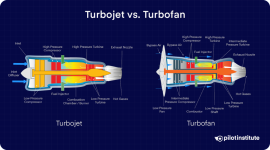
What you've described is a jet engine. All jet engines have this same core principle; Turbojets, Turbofans, Turboprops, and Turboshafts. A turbofan, in simplest terms, is a turbojet fitted with a large fan and a nacelle to push bypass flow around the core for additional thrust. Michael is correct, turbojets are outdated tech.

1753968973238.png
 
Last edited:
from what I see turbojet is not outdated at all, or at least not the core principle. these pulse explosions and rotating explosions engines still require high pressured air (high oxygen flow) to burn injected fuels. I think you need multiple fan blades in a row.
Turbojets are not inherently faster than turbofans. Low-bypass turbofans can match and exceed turbojets in Thrust. The two engine options for the 6th Gen F-47, GE XA102 and PW XA103, are also turbofans. Adaptive Cycle turbofans, to be exact.
All of these engines are chemical engines. They convert the energy generated by the chemical reaction of fuel into propulsion.

Turbojets offer excellent high-speed performance, but poor low-speed performance. Furthermore, their fuel conversion efficiency is low.
The turbofan engine is essentially an upgraded version of the turbojet engine.
It consumes very little fuel at low speeds, but its high-speed performance is inferior to that of a turbojet. However, engineers have designed afterburners for it. When the turbofan engine is in afterburner, its high-speed performance is even better than that of a turbojet.

Turbojets are simple in structure and low in cost. Therefore, they still have a wide range of applications in certain areas, such as expendable high-speed drones and missiles. Modern manned fighter jets are essentially all powered by turbofan engines.

As for the next generation of fighter jets, there are currently no clear standards.
 
All of these engines are chemical engines. They convert the energy generated by the chemical reaction of fuel into propulsion.

Turbojets offer excellent high-speed performance, but poor low-speed performance. Furthermore, their fuel conversion efficiency is low.
The turbofan engine is essentially an upgraded version of the turbojet engine.
It consumes very little fuel at low speeds, but its high-speed performance is inferior to that of a turbojet. However, engineers have designed afterburners for it. When the turbofan engine is in afterburner, its high-speed performance is even better than that of a turbojet.

Turbojets are simple in structure and low in cost. Therefore, they still have a wide range of applications in certain areas, such as expendable high-speed drones and missiles. Modern manned fighter jets are essentially all powered by turbofan engines.

As for the next generation of fighter jets, there are currently no clear standards.
I don’t know. the $1 million question is what you want, what 6.gen fighter aircraft should be?

in terms of engine as we are on it the thrust depends on how fast the gas flame exists the engine rear. if the speed of this gas flame is higher than Mach 1 then thrust increases, you hear the supersonic sound.
so if you want a good result of all metrics, low fuel consumption, high speed then the combi of pulse, rotating explosion engine, using a copper alloy may be the solution. that’s the NASA is experimenting.
engineers take a clue from inner rotate gun. that’s how I see it.
I think 6.gen fighter aircraft with that engine could fly Mach 3. the challenge is the durability. such engines require extreme high quality alloys. still not exist today.
turbofan engine won’t fly that speed. simple the exit flame, exit bypass airflow are not that high speed.
 
I don’t know. the $1 million question is what you want, what 6.gen fighter aircraft should be?

in terms of engine as we are on it the thrust depends on how fast the gas flame exists the engine rear. if the speed of this gas flame is higher than Mach 1 then thrust increases, you hear the supersonic sound.
so if you want a good result of all metrics, low fuel consumption, high speed then the combi of pulse, rotating explosion engine, using a copper alloy may be the solution. that’s the NASA is experimenting.
engineers take a clue from inner rotate gun. that’s how I see it.
I think 6.gen fighter aircraft with that engine could fly Mach 3. the challenge is the durability. such engines require extreme high quality alloys. still not exist today.
turbofan engine won’t fly that speed. simple the exit flame, exit bypass airflow are not that high speed.
believe me, none of the sixth gen whether Eastern or Western will be flying at Mach 3.
 
believe me, none of the sixth gen whether Eastern or Western will be flying at Mach 3.
if so then thing is easier I think.
people can take F22 as base and start from there. more stealth, more fuel efficiency, more lightweight. but such aircraft would be 5++.gen fighter aircraft. no quantum leap in aircraft design and engine.
 
Guys … can we stick to the topic please? Discussions on US 5th generation vs 7th generation Chinese fighters, Mach numbers and turbofan vs. Turbojet engines is irrelevant!
 
if so then thing is easier I think.
people can take F22 as base and start from there. more stealth, more fuel efficiency, more lightweight. but such aircraft would be 5++.gen fighter aircraft. no quantum leap in aircraft design and engine.
Despite all other important factors, "more stealth" as you called it alone takes huge technological leap, to make a supersonic tailess plane maneuverable is beyond your imagination, and we have seen both EU projects are not tailess, you should put a big question mark on those.
 
Last edited:
Despite all other important factors, "more stealth" as you called it alone takes huge technological leap, to make a supersonic tailess plane maneuverable is beyond your imagination, and we have seen both EU projects are not tailess, you should put a big question mark on those.
to return to initial question what kind of 6.gen aircraft you want?
I think much depends on actual threat or future potential threat.
as for Europe as you mentioned the threat is Russia (who else?), so from tfe public sources the future franco german FCAS next gen aircraft is supposed to be
delta wing, capped canards
double turbofan engines, afterburner, adjustable fan blades
range more important than stealth
for China I think a 6.gen aircraft would be totally different.
 
range more important than stealth
for China I think a 6.gen aircraft would be totally different.
I don't know why these two are contradicted, as far as I know, long range and full specturm stealth are basic elements for both Chinese projects.
 

Users who are viewing this thread

Latest Posts

Back
Top