‘There is only one player’: why China is becoming a world leader in green energy
As US reneges on climate breakdown pledges, China’s response to crisis will shape geopolitics and our future
Jonathan Watts Global environment writer
Sun 7 Sep 2025 09.00 BST
Chinese power took on an old-fashioned hue in the past week with a
huge military parade, a gathering of former allies Russia and North Korea, and President Xi Jinping’s defiant vow not to be intimidated by bullies.
Soldiers march during a military parade marking the 80th anniversary of victory over Japan and the end of World War II, in Tiananmen Square in Beijing, China. Photograph: Lintao Zhang/Getty Images
That display reminded many of the cold war, but it captured only a fraction of China’s far greater modern influence, primarily built on a formidable economy, dramatic advancements in renewable energy, and a willingness to engage globally with the greatest crisis facing humanity: climate breakdown.
In that sense, the tanks, cannon and missiles that filed past Tiananmen Square may well prove less important in reshaping the world order than the wind turbines, solar panels and electric cars that are churning out of Chinese factories on to fields and roads all over the planet. They are the reason China has already won the battle for the energy of the 21st century.
If history is any guide, the country that dominates energy usually dominates economics and politics, which is why it is not just old war allies that are cosying up to Beijing. Narendra Modi, the president of longtime rival India, also visited China last week for the biggest ever meeting of the Shanghai Cooperation Organisation along with dozens of other regional leaders. The European Commission president, Ursula
von der Leyen, led a delegation to Beijing this summer to coordinate climate policy. The Brazilian executive secretary of Cop30 will visit next week with a similar mission, knowing the success or failure of the annual climate summit now depends on China more than any other nation.
Expectations for Chinese climate leadership are rising in tandem with dismay at the US, which will attend Cop30 as an observer and disrupter that, under Donald Trump, appears to be trying to lurch backwards towards a 20th century comfort zone of oil, gas and coal.
The contrast could become even more striking once China confirms it has reached a
positive tipping point after which it will irreversibly shift away from fossil fuels. Last year, the world’s biggest carbon emitter registered a very slight decline in greenhouse gas output. Many analysts
believe this means the country’s carbon use will peak this year or very soon. If that is confirmed, it would be a moment of considerably greater significance than Donald Trump’s decision to withdraw from UN climate negotiations.
The timing will be clearer when China unveils its revised nationally determined contribution (NDC), the climate actions plans countries promised to provide under the Paris agreement. This announcement, expected before next month’s UN general assembly, will be one of this year’s most eagerly watched declarations because no other country has been able to match China’s power to make or break the Paris targets to hold global heating between 1.5C and 2C.
But how real are the hopes China will step up and show greater leadership on finance and emission cuts, as well as renewable manufacturing?
There have been false dawns in the past. Coal – the most polluting of fossil fuels – drove China’s supercharged economic growth for most of the past three decades, though production declined for a few years in the wake of the global financial crisis and plateaued briefly during the Covid lockdown. Whether predictions of peak carbon prove more substantial this time will depend on the Beijing leadership’s next five-year plan, a domestic policy document for 2026-2030 being drawn up by the leadership in Beijing.
Speculation about the priorities continues to swirl. On one side is caution and a sense of justice that China should not try to step into the void left by the US because that would allow the latter to escape its responsibility as the world’s biggest historic emitter. On the other is geopolitical ambition and the momentum of an economy increasingly reliant on renewable energy investment for growth.
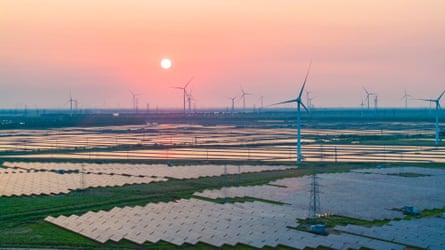
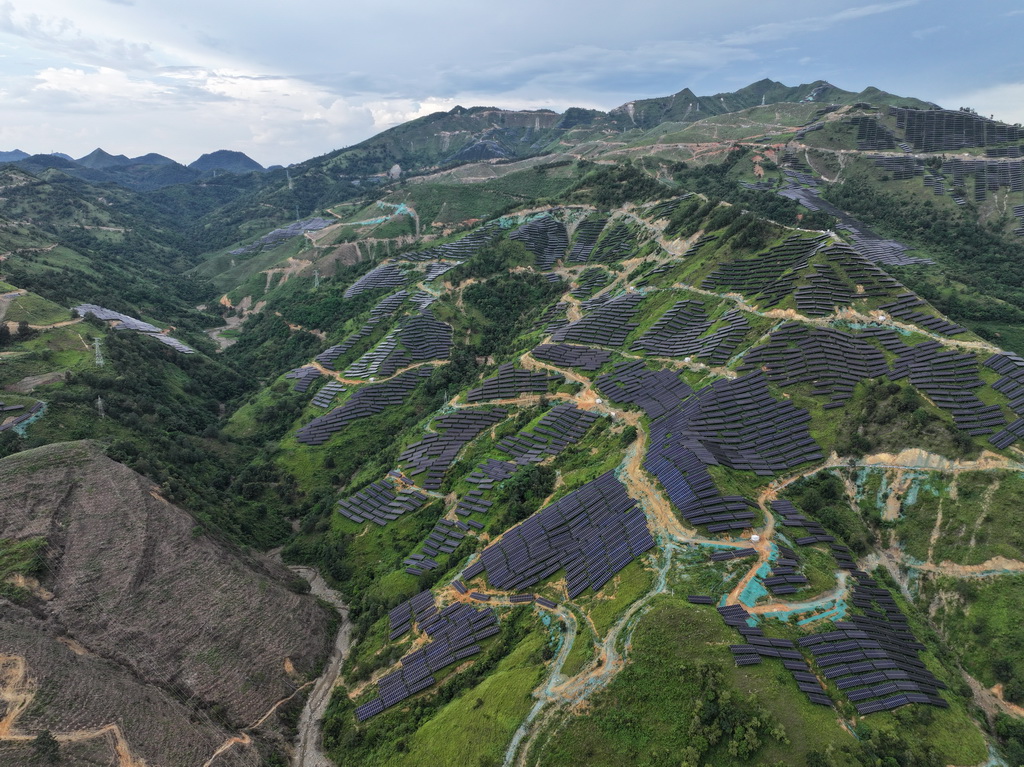
While China’s overall GDP expansion is slowing, the speed of cleantech investment remains breathtakingly fast. Last year, the amount of wind and solar under construction was double the rest of the world combined, helping China
to reach an installed capacity of 1,200GW six years ahead of the government’s schedule.
The country is similarly ascendant in supplying overseas markets with renewable technology. Last year for the first time, the top four wind turbine makers in the world were all Chinese. It is a
similar story of majority market share for the manufacture and export of photovoltaic cells and electric vehicles.
When it comes to clean energy, it no longer makes sense to talk about competition, says Li Shuo, the director of China Climate Hub at
the Asia Society. “There is only one player. The US is not even in the room. I have full confidence that dynamic will continue.”
In the run-up to Belém, the contrast with the US looks ever more stark and is likely to shape geopolitics for decades to come. Under Trump, the US has shut down climate research centres, promised to drill for more gas and declared this to be “the moment” for coal. Meanwhile, $22bn in clean energy projects have been cancelled and wind power
investment has shrunk to its lowest level in a decade.
Wind turbines above photovoltaic panels operate at the tidal flat industry demonstration base in Yancheng City, Jiangsu Province. Photograph: NurPhoto/Getty Images
China may not be in favour of multiparty democracy at home, but on the global stage its officials have made clear it will be a champion of multilateral decision making.
Xi has not tried to fill the void left by Trump, but he has presented himself – and China – as a reliable and constructive partner, particularly on the climate issue: “However the world may change, China will not slow down its climate actions, will not reduce its support for international cooperation, and will not cease its efforts to build a community with a shared future for mankind,” he
said this year.
Before previous Cops, senior US and Chinese negotiations often held a bilateral meeting to ensure the world’s two biggest emitters were on the same page. This year, China held separate climate talks with the EU and affirmed they would
work together to achieve a successful Cop30 with “ambitious and equitable” outcomes.
Von der Leyen called the joint declaration a big step forward. “Together, the European Union and China must uphold the Paris agreement. Now more than ever,” she said.
As US reneges on climate breakdown pledges, China’s response to crisis will shape geopolitics and our future

www.theguardian.com


 cointelegraph.com