Chinese Naval Platform & PLAN discussions

Beijingwalker

VIP Member
Joined
Nov 4, 2011
Messages
92,041
Reaction score
112,967
Reputation
2,154.6
Country of Origin
Country of Residence

China's Navy is Using Quantity to Build Quality
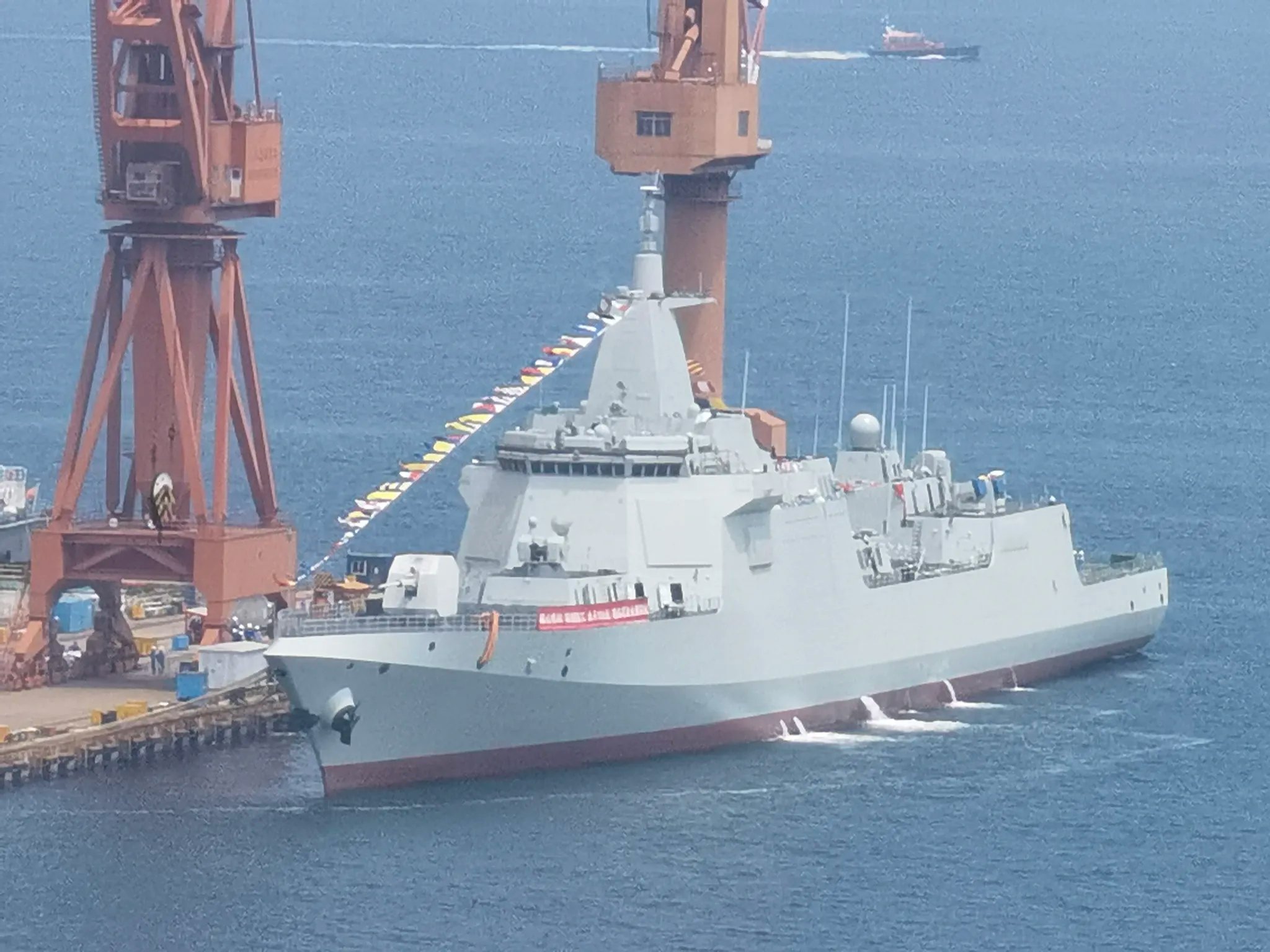
A new PLA Navy destroyer at delivery from China State Shipbuilding Corporation (CSSC file image)


A new PLA Navy destroyer at delivery from China State Shipbuilding Corporation (CSSC file image)
PUBLISHED FEB 18, 2024 6:01 PM BY CIMSEC
By Matthew Hipple

The United States Navy holds up quality as the firebreak against the People’s Liberation Army Navy (PLAN) dominant fleet size and overwhelming industrial capacity. But the development and maintenance of professional skills to fight wars, build ships, and maintain fleets requires material, time, and people – in a word, quantity, for which the PLAN holds the undeniable advantage.

The cliché that “quantity has a quality all its own” improperly frames the advantages conferred upon America’s PLAN adversary by the size of its navy and its various supporting enterprises. Quantity is not merely an attribute with which to bury one’s opponent; quantity pragmatically applied provides individuals and entire professional classes the opportunity to cultivate and cement quality.

Without the opportunity afforded by scale, the U.S. Navy will fall behind an adversary with a world of opportunity to explore new skills, new systems, and grow its force-wide professionalism. The potential qualitative impact of quantity shows at every level – from the shipyards to fleet training for individual sailors.

The Maritime Industry and a Nation’s Maritime Character
The Office of Naval Intelligence (ONI) recently assessed that the China’s shipbuilding industry fields 232 times the shipbuilding capacity of the United States, representing almost 50% of total global shipbuilding capacity. To stark quantitative differences like these, the U.S. Navy responds, “in many ways our shipbuilders are better shipbuilders, that’s why we have a more modern, more capable, more lethal Navy.”
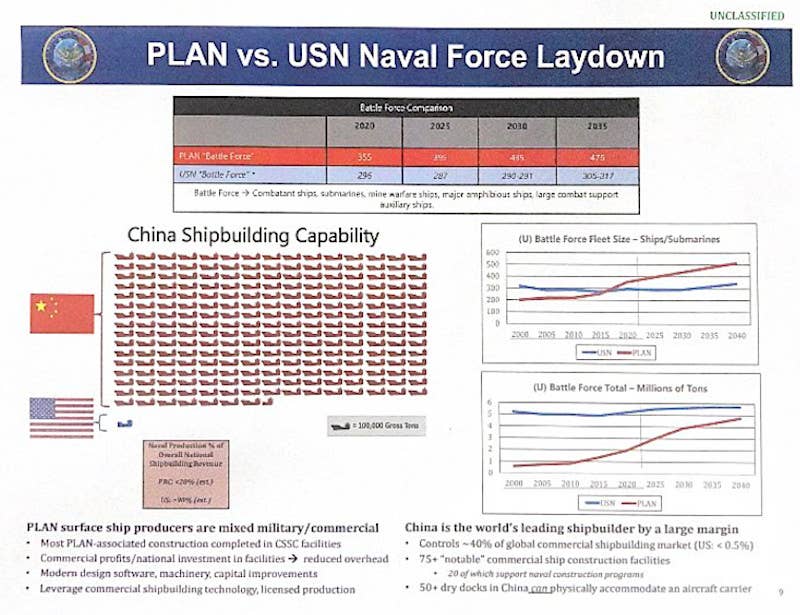
ONI-PLAN-vs-USN-Force-Laydown-Slide-cropped.jpg

An unclassified slide from the Office of Naval Intelligence (ONI) highlighting differences between U.S. Navy and PLA Navy shipbuilding capacity, ship count, and overall tonnage. (U.S. Navy graphic)

Unfortunately, these snapshots of quantitative position fail to account for the rate of qualitative improvement required for China to achieve this feat of material and professional development – from backwater to backbone.

China’s modern shipbuilding behemoth is only 20 years old, the result of a deliberate Chinese Communist Party (CCP) campaign of maritime expansion begun in response to the US Navy’s Summer Pulse 2004 exercise when China represented only around 10% of global ship production.

In the time between LCS program initiation in 2004 and the final mission package reaching initial operating capability in 2023, the CCP revolutionized an entire industry and supporting professional class. Meanwhile, 20 years of mismanaged shipbuilding plans – have left American shipbuilders without the demand needed to sustain itself, its professional community, or meet naval demand.

John Konrad of GCaptain estimates that making “an American shipyard professional takes about 3-5 years.” Although the communal professional improvement of China’s shipyard workers will take longer due to their extreme individual specialization compared to more broadly skilled Western shipyard workers – the China’s shipbuilding cadre have that opportunity to improve with the scale of their enterprise.

And ultimately, specialized workers who exist are superior to theoretically higher quality generalists who do not.

But shipbuilding is just a piece of that qualitative puzzle solved by the scale of China’s maritime industry. There is a maritime quality to China’s population that America has left behind. As Mahan notes, “in point of population, it is not only the grand total, but the number following the sea, or at least readily available for employment on ship-board and for the creation of naval material, that must be counted.” Mahan goes on to say that this is a quality of,

“staying power… which is even greater than appears on the surface; for a great shipping afloat necessarily employs, besides the crews, a large number of people engaged in the various handicrafts which facilitate the making and repairing of naval material, or following other callings more or less closely connected with the water and with craft of all kinds.”


But even in front-facing maritime industries, America falls behind, as evidenced by the Maritime Administration (MARAD) finally sounding the alarm on mariners available for the ready reserve fleet in a war against a thoroughly maritime nation with a maritime militia and weaponized commercial fleet.

These maritime qualities expand beyond mariners and their supporting maritime industry. From commercial electronics to drone manufacturing, China fields vast and ever-improving professional communities in pursuits related to the development, sustainment, and operation of a modern Navy. Mahan recognized that “such kindred callings give an undoubted aptitude for the sea from the outset.”

Even industries unassociated with naval warfare provide those with the character and skill needed to support the fleet. Mahan notes a particularly canny English mariner, Sir Edward Pellew, who, “when the war broke out in 1793… Eager to get to sea and unable to fill his complement otherwise than with landsmen, he instructed his officers to seek for Cornish miners; reasoning from the conditions and dangers of their calling… would quickly fit into the demands of sea life. The result showed his sagacity… he was fortunate enough to capture the first frigate taken in the war in single combat.” China’s multitude of industries provides such individuals experienced in the conditions and wielding the skills sufficient to make useful mariners.

The U.S. Navy highlighting contemporary quality recalls Mahan’s unnamed French officer, who after “extolling the high state of efficiency of the French fleet… goes on to say: ‘Behind the squadron of 21 ships-of-the-line which we could then assemble, there was no reserve.’”

China certainly displays Mahan’s qualities for a maritime nation’s industrial character and its relation to the sea. The CCP’s groundwork of capacity is now well laid to improve the qualitative muscles at sea, opportunities well in excess of the U.S. Navy’s.

Practice Makes Perfect – But How, When, and With What?
When faced with the ever-growing size of the PLAN, a common U.S. Navy response is that, “they script their people to fight, we actually train our people to think.” While valid, the United States Navy has had its own past struggles with training quality and scripting. Meanwhile, the PLAN pursues improvements in the quality and accurate assessment of its combat exercises.

Only nine years ago the surface fleet founded the Surface and Mine Warfare Development Center (SMWDC) to repair decades of atrophy in tactical and operational training and expertise. Still, scripts and constraints continued to erode junior officers’ desire to command while early command opportunities decrease. From my own experience, experienced, post-command mentors wondered aloud if seeking command at sea was and is worth the ever-shrinking margin of actual command exercised against a sea of requirements.

Ship for ship, the U.S. Navy is still better than America’s PLAN adversaries. U.S. Navy waterfront leadership’s resentment of administrative leashes indicates they still strive for independence and know what right looks like.

However, institutionally the U.S. Navy fails to detect the diminishing opportunities for excellence that its size and those leashes provide, and how the opposite opportunity is now offered to America’s principal adversary. The diminished size of the U.S. fleet against growing operational requirements requires leadership to impose ever greater oversight and ever smaller margins of independence, while the PLAN’s mere size allows broad new opportunities for autonomy and professional growth if they want to pursue it.

To demonstrate these narrow margins, during the roll-out of the 36-month Optimized Fleet Response Plan, my officemates and I at the Surface Forces Atlantic Commander’s Action Group did a loose internal analysis projecting the cycle over time. We determined that scenarios existed in which the margins imposed by the historically low fleet size in 2014-2015 were such that major exercises would suffer.

Our limited quantity imposed clear potential limitations on our ability to generate quality – highlighting how a lack of capacity can force greater invasive or disruptive acts to ensure the fleet-level schedule meets basic requirements.

Those invasive acts further limit a commanding officer’s ability to exercise their own judgment and build trust with their crew, as exercised during “CO’s time” – the time underway free of outside direction where a ship’s captain independently sets the agenda and priorities for training or testing.

There is no data I know of tracking the availability and use of “CO’s time,” but over the past decade I have heard its absence lamented in greater volume every year. As an operations officer (OPS), my CO tasked me with clawing back what little time I could for us to set our own destiny.

Even after triple-stacking requirements just to meet our timetable, I cannot recall ever having succeeded. I have yet to meet a CO or a fellow OPS with a success story on this front. The fleet’s limited numbers often force condensation and scripting of training by necessity, precluding greater independent opportunities for teams to develop and exercise their tactical creativity.

Additionally, the U.S. Navy’s often minimalist approach to procurement shows how limited quantity limits development of quality in arenas like tactical and technical development. As an example, the 10-years-behind-schedule LCS Mine Counter-Measures (MCM) Mission Package (MP) has still yet to certify Full Operating Capability. When I was OPS with LCS Crew 206 in 2020, when the package was only seven years behind schedule, we could only field a single unmanned surface vessel (USV) for limited periods to conduct basic testing – let alone tactical development.

This was after the disastrous attempt to base the MCM mission package off the Remote Multi Mission Vehicle (RMMV) – a corner-cutting approach that tried to repurpose a program from 1999 for DDGs into an LCS minehunting system into the 2020’s.

Among numerous other programmatic issues, the paucity of resources always limited the speed of development. The U.S. Navy is making strides learning from that failure on the unmanned front with CTF 59 in Bahrain, USV DIV One in San Diego, and a new approach for 4th Fleet. Nonetheless, the US Navy remains well short of needed manned surface vessels. As the qualitative lag in the MCM MP caused by a paucity of USV assets demonstrates, the same applies to manned surface vessels. But unlike the U.S. Navy, the PLAN has nothing if not extra ships, ordnance, and unmanned systems to train and experiment with.

Our Advantage Is Our People – If We Can Get Them To School
Finally, the ultimate advantage of the U.S. Navy against the PLAN is that its sailors are better on their feet. But to be better improvisers, they need training they can stand by – a lesson learned during the lost decade replacing in-person schools with CD-based SWOS-in-a-box and online GMTs.

While the U.S. Navy has greatly improve the availability and quality of training today, getting to this training demands adequate capacity: enough ships to fulfill fleet requirements while giving COs and crews the space to learn and enough sailors to cover the watch while shipmates are at school. The lack of the former is discussed above, and the 22,000 gapped at-sea billets underscore the continuing lack of the latter.

With overtasked, undermanned ships – a force cut to the bone against ever-increasing global demand for conventional maritime forces – ships are caught in a Catch-22: they need to send their sailors to school, but the persistent demands of security, engineering, maintenance, administration, domestic fleet tasking, and the like means there are very few sailors to spare.

Here, LCS shows a world that could have been, had the fleet not hamstrung its future manning with the ill-conceived Perform-to-Serve cuts. For a time, the Blue-Gold model showed what a properly manned command could do - with time for sailors to attend school, watchteams available for a month to fight entire virtual wars in the simulator, opportunity to focus on personal and family health, and opportunities to assist other crews as necessary while training along the way.

In our case, LCS Crew 206 sent 12 sailors to train on and test the USV with the prime contractor and Naval Sea Systems Command’s LCS Mission Modules program office (PMS-420) in Panama City. Properly resourced, these well-trained and well-practiced sailors achieve feats like USS Charleston’s 26-month deployment.

Unfortunately, contemporary manning gaps have made proper resourcing of any manning model a challenge. Geography also exacts an asymmetric toll: While a San Diego-based warship takes a month to cross to the Western Pacific and another month to return, a PLAN vessel can steam around Taiwan to conduct a Restriction of Navigation Operation (RONOP) on a whim. Across the roughly 425 combatants of the PLAN, that home field advantage grants years of extra operating time, which then provides the PLAN greater opportunity for professional development at every level. Whether that opportunity is properly utilized is another question – but its potential must be recognized.

Quality is Molded From Quantity
Quantity may be a quality all its own but quantity is, in jargon terms, a “force multiplier.” Quantity is opportunity – exposure to new skills, repetition and practice of old skills, and chance to develop both. Quantity is bandwidth – the capacity to cover requirements while still supporting schools, training, technical and tactical development, and innovation. The U.S. Navy may field a relative advantage in quality today but the main adversary fields capacity that enables an opportunity to overtake.

The U.S. Navy’s historically diminished size combined with the constraints necessary to maximize that diminished force’s availability paves a path to relative diminished quality against a PLAN which is growing and improving every day. If the U.S. Navy is truly serious about honing a cognitive combat edge against its numerically superior opponent, then it must recognize, advocate for, and invest in the quantity necessary to cultivate quality.

There are no silver bullets for the Navy’s most likely adversary; they are communists, not werewolves. The U.S. Navy is going to need, in laymen’s terms, “more” – not merely to fight the next war, but enough to keep cultivating in ourselves the skills and mindset to win it.
 
Source:
Not Applicable
@Beijingwalker why do keep creating new threads with the same theme? Aren't you diluting your own content? We have a dozen threads on Chinese rail, Chinese shipbuilding, NEV’s.…Tibet…Xinjiang…and the list goes on and on…
 
All PLAN related stuff will be merged here!
 

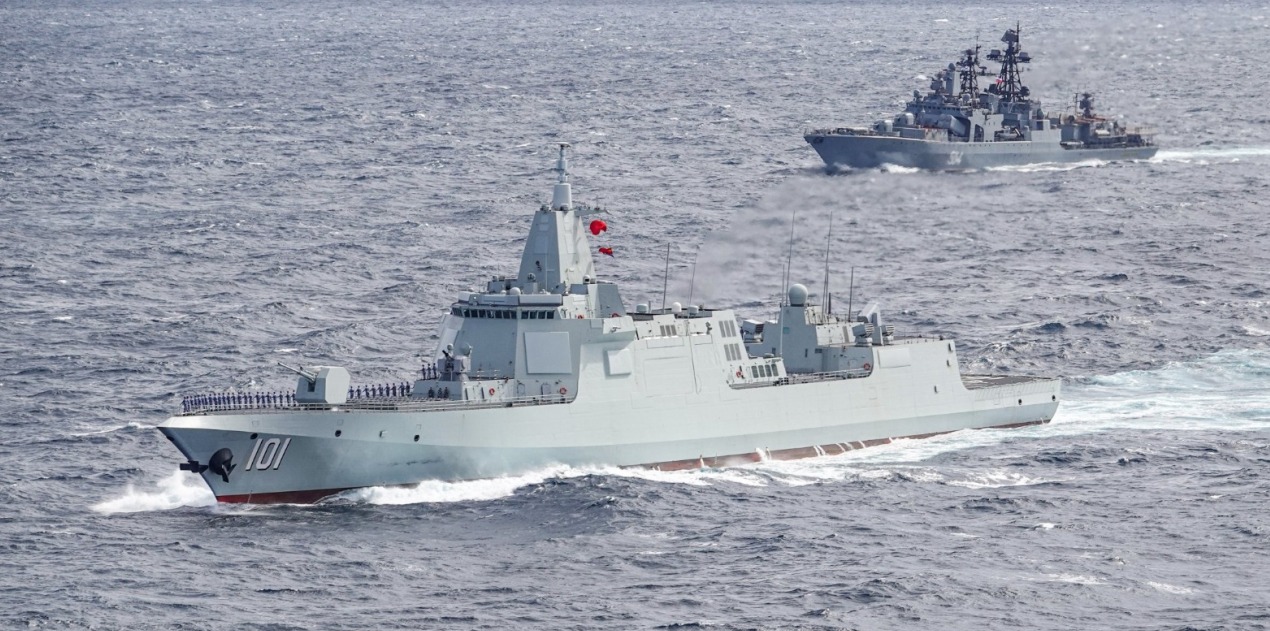
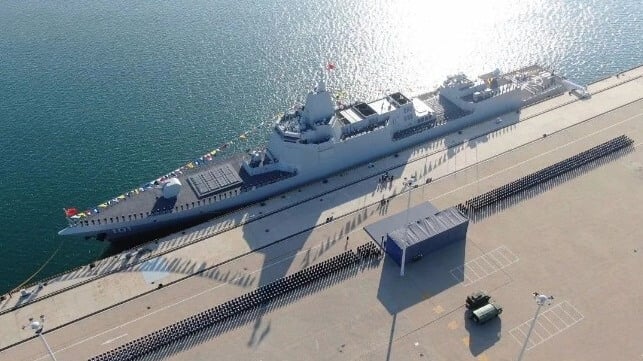
China’s Newest Type-055 Destroyer Ready To Roar; Last Of The 8th Warship Achieves Ops Capability​

By Sakshi Tiwari
February 20, 2024

With the last of the class achieving operational capability, all eight warships in this class that are currently in service are now prepared for deployment, experts told Chinese state publication Global Times.

China Central Television (CCTV) carried a broadcast last week announcing that the Type 055 large destroyers Xianyang and Yan’an, which are part of the PLA Southern Theater Command’s navy, went on a combat readiness training mission in an undisclosed location of the South China Sea during the Spring Festival holidays.

The eighth and most recent Type 055 heavy destroyer of the PLA Navy, the Xianyang, was commissioned last summer. In the latest drills, the Yan’an executed simulated missile attacks on suspected marine targets, and the Xianyang was assigned to independently counter mock aerial targets.

“When I first saw the Xianyang, it was just an empty shell in the shipyard. I have witnessed with my own eyes its delivery, tests, trials, and commissioning. Now, after the full-course training program over the past year, we have achieved operational capability,” Chen Fashun, a crew member on the Xianyang, said in the CCTV report.

To view this content we will need your consent to set third party cookies.
For more detailed information, see our cookies page.


The Xianyang Type 055 vessel debuted on state television on April 21, 2023, to commemorate the Chinese Navy’s 74th anniversary. All eight of these ships are part of the People’s Liberation Army Navy’s Northern and Southern Commands. The primary purpose of the Type 055 destroyers is to give the Shandong (CV-17) and Liaoning (CV-16) Chinese carriers a strong capacity for area air defense.

The development comes during mounting tensions in the South China Sea between China and the Philippines. For instance, the Philippine Coast Guard accused China Coast Guard (CCG) ships of engaging in “dangerous” maneuvers over the weekend.


Following that, tensions erupted in another disputed territory: the Scarborough Shoal. China accused the Philippines of carrying out unwarranted provocations by “illegally entering the waters of Huangyan Island (China’s name for the shoal)” on the last day of the Chinese New Year holiday. On its part, Manila accused Beijing of using cyanide to destroy the Scarborough Shoal, which also remains contested between the two countries.

There have been frequent stand-offs between Chinese and Philippines vessels in recent months, with both sides asserting their territorial claims and trading barbs. Manila has taken some decisive steps, like announcing the expansion of its presence in Batanes Island, which overlooks Taiwan, and deploying a warship off the waters of Palawan island facing the South China Sea to “protect its maritime interests.”

Against that backdrop, the Chinese military announced earlier this month that it was conducting routine naval and air forces patrols in the South China Sea ahead of the Lunar New Year Eve holidays. “Troops in the theatre remain on high alert at all times and will resolutely defend national sovereignty, security, and maritime rights and interests,” the statement said.

彩云香江 on X: PLA Navy's eighth Type 055 destroyer Xianyang will soon be commissioned. 🇨🇳 https://t.co/sOISLnmDY4 / X
PLA Navy’s eighth Type 055 destroyer, Xianyang (via Platform X)

The announcement about the latest drills and Xianyang becoming operational is significant. The Type 055s can also serve as flagships for surface action groups when operating outside of carrier groups, acting as command and control centers of other destroyers and frigates. This essentially means that the Type-055 destroyers are likely to be used by the Chinese PLAN to project power.

The PLA Navy’s first powerful destroyer, the Type 055 ‘Nanchang’ was recognized as a “role model” on January 8 by the Chinese Communist Party committee of the PLA Navy after it completed several challenging missions, including combat drills in which it was tasked with fending off mock attacks by foreign forces. The United States has formally acknowledged the combat prowess of the vessel and the challenge it poses to the US Navy on multiple occasions.

Type 055 Vessels: A Force to Reckon With?

With a displacement of over 12,000 tons, the Type 055 is regarded by analysts, citing publicly available information, as one of the most potent classes of multirole warships in the world as it can host air defense, anti-ship, anti-submarine, and land attack missiles.

Additionally, praises have also been heaped over the exceptional situational awareness provided by its advanced radars, sensors, and data link systems integrated into its mast.

Large destroyers of Type 055 are capable of leading a group of warships in far-sea operations or escorting aircraft carriers. Chinese analysts contend these warships will be crucial in defending China’s interests in development, security, sovereignty, and territorial integrity.

A report published in CNN, which cautioned against a burgeoning Chinese naval power and ship-building capacity, also noted, “But it’s not just the increasing vastness of the Chinese navy that has raised concerns. Some of the ships China is churning out arguably have greater firepower than some of their US counterparts.”

TYPE-55-CHINA
PLAN Nanchang Type 055 Destroyer (via Platform X)
Type-055 was cited as an example to back up the argument and highlight the genuine threat that the vessel poses to the United States and its allies, who remain on a collision course with China. “Take China’s Type 055, in many eyes, the world’s premier destroyer,” the report exclaimed.

China started producing the Type-055 in 2014, and the Xianyang, its eighth, was put into service last year, all in less than ten years. The US, in contrast, has been building Zumwalt-class destroyers far more slowly: only two of them have gone into service five years after construction started.

In comparison to the destroyers of the preceding generation, the Type-055 large destroyer is a massive platform that can carry a lot of equipment and remain at sea for extended periods. It is larger than conventional destroyers with a displacement of 12,000 to 13,000 tons and comparable in size to the Ticonderoga class of cruisers of the US Navy. Additionally, compared to the US Navy’s AEGIS cruisers, they are about a quarter more significant in size.

With 112 vertical launch system (VLS) cells, it has greater surface-to-air and anti-ship missile firing capacity than the US Navy’s newest destroyer, the Arleigh Burke class, which has 96. It also boasts sophisticated anti-submarine and radio armament.

The Chinese warship is believed to be capable of firing at least HQ-16 and HQ-9 surface-to-air missiles, the YJ-18 and CJ-10 families of land-attack and anti-ship cruise missiles, the Yu-8 rocket-assisted torpedo, and the YJ-83 anti-ship cruise missile.

Adding to US concerns, Chinese observers speculate that China could likely build and commission more Type 055 destroyers.

India Shows China Its Maritime Ambitions

What does Chinese muscle-flexing mean to India?

India wants to establish itself as a global power with growing maritime ambitions. The deployment of three guided missile destroyers and reconnaissance aircraft to counter the Yemen-based Houthi rebels disrupting ships in the key Red Sea trading route could be regarded as a veiled message to China.

AP quoted former Vice Admiral Anil Kumar Chawla, who was head of India’s southern naval command, saying, “We are not doing it only out of altruism. Unless you are a maritime power, you can never aspire to be a global power.” India was positioning itself “as a global player today, an upcoming global power,” he said.

Chawla went on to say: “It is a message to China that, look, we can deploy such a large force here (the Red Sea). This is our backyard. Though we don’t own it, we are probably the most capable and responsible resident naval power,” Chawla said.
 
My guess is 12. 4 per fleet. China has 3 fleets: Yellow Sea, East Sea, South Sea.
The first batch of 8 had been finished, the next batch will be massively upgraded, no one knows how many of them will be built and whether they will be still called Type-55 due to the big change.
 
The first batch of 8 had been finished, the next batch will be massively upgraded, no one knows how many of them will be built and whether they will be still called Type-55 due to the big change.

What changes are speculated?
 
What changes are speculated?
Many, at least in dozens, for example, railguns will be stardard weapons installed on the ships of the second batch.


按照目前第一批次055的性能优势以及对第二批055的猜测,届时中国下一代驱逐舰或将吸取055优点,同时新增更多现在没有的新技术,例如激光武器、全电推进系统、微波武器、导弹“即插即用随时打”模块化设计.

Google translate

According to the current performance advantages of the first batch of 055 and speculation about the second batch of 055, China's next generation destroyer may absorb the advantages of 055 and add more new technologies that are not available now, such as laser weapons, all-electric propulsion systems, "Plug and play, ready to fire" modular design of microwave weapons and missiles.
 
@Beijingwalker why do keep creating new threads with the same theme? Aren't you diluting your own content? We have a dozen threads on Chinese rail, Chinese shipbuilding, NEV’s.…Tibet…Xinjiang…and the list goes on and on…
What do we need subforums for if everything can be merged into just a few threads?
 

China to build More and more New Type 055 destroyers and the number is estimated to reach 36 ships

To view this content we will need your consent to set third party cookies.
For more detailed information, see our cookies page.


With the first batch of eight Type 055 destroyers entering full service, the strength of the Chinese Navy is rapidly rising.

This new generation of destroyers has high hopes and is hailed as the pinnacle of surface combatants. Its performance and armament have surpassed the Aegis destroyers of the United States, Japan, South Korea and other countries, becoming one of the most advanced surface warships in the world, setting sail for the Chinese navy to sail across the oceans.
 
What do we need subforums for if everything can be merged into just a few threads?
Ok, I can check with forum management for you.
Do you have a proposal for sub-forum classification?
- China Infrastructure
- China mass transit
- Xinjiang and Tibet
- ?
- ?
 

NAVAL AVIATION TRAINING​

  1. Aviation Features
  2. Naval Aviation Training


By Andreas Rupprecht 22nd February 2018
FEATURE


CHINA
img_46-1_81.jpg

JL-8Hs previously assigned to the former Naval Aviation Air Academy’s 4th Training Regiment were recently reassigned to the Naval Aviation University’s 2nd and 3rd Training Regiments. Top.81 Forum
img_46-2_48.jpg

Two-seat J-15s have been in Chinese Naval Aviation service since 2012. The type is thought to be fielded as a dedicated electronic warfare aircraft, similar to the American EA-18G Growler. Top.81 Forum
CHINESE NAVAL Aviation is dramatically increasing its capability and expanding its roles as clearly demonstrated by the already routine training cruises of its Type 001 aircraft carrier, the Liaoning (16).
Launch of the first Type 002 carrier at Dalian in April 2017, and rumours about the first true supercarrier currently under construction at the Shanghai shipyard is further evidence.
Consequently, focus is most often on the modernisation of hardware, since it is visually more spectacular and easier to follow:
Chinese photographers continue to publish images of the carriers and the new aircraft types operating with the People’s Liberation Army Navy (PLAN).
However, the latest developments in tactics and training are probably more important for the future outcome of any potential operational use of Chinese carriers. Frequent reports in the Chinese media imply the People’s Liberation Army is demonstrating increased confidence in its capabilities and training. Both the People’s Liberation Army Air Force (PLAAF) and the PLAN are actively developing more realistic training and flight school programmes more akin to Western concepts.
This report should provide a brief overview of the latest developments in the PLAN’s training programmes.+
img_46-3_21.jpg

If Chinese Naval Aviation student pilots seek to aim high, flying the J-15 multirole fighter off a carrier might well suffice. A J-15 approached the flight deck of the Liaoning (16). CDF Forum
img_47-1_65.jpg

Flown by the 1st Training Regiment based at Huludao, the CJ-6 is used for basic flight training. Bai Wei
Evolution and reforms
Prior to 2012, training was different for Naval Aviation bomber, transport, and helicopter aviator cadets, who started at the Naval Aviation Engineering Academy before transitioning to the Naval Aviation Academy, whereas fighter and fighter-bomber pilots were trained by the PLAAF before assignment to Naval Aviation. Following reform in December 2017, various naval flying and engineering schools were merged into the People’s Liberation Army Navy Aviation University, an academy responsible for training aviation and command specialties, including bomber, fighter, fighterbomber, helicopter, and transport pilots and navigators.
The Naval Aviation’s training system remains unchanged and is arranged into three phases; phase 1, academic education and basic flight training, phase 2, professional aviation education and transition training, and phase 3, combat transition training.
Flight training starts in the piston engine-powered CJ-6A, transitions through the JL-8H and later JL- 9H, and finally dedicated trainervariants of operational types like the J-10AS, J-11BS and JH-7A.
Trainee bomber pilots start in the Y-5, transition to the HYJ-7 and finally their operational type, the H-6G.
Despite the changes made to Naval Aviation’s training programmes few details are known.
Based on what little information is available, it appears that PLAN front-line pilots log an average of around 125 hours per year. Most units fly three days per week and each training sortie for a combat aircraft averages around 45 minutes; missions for bombers are longer. Back in 2002, to meet its ambitions for modern naval warfare, the PLAN implemented its Outline of Military Training and Evaluation or OMTE, which adjusted several aspects. Most of all it contains the inclusion of more rigorous and realistic training scenarios in order to simulate a combat situation. Pilots were also required to take greater responsibility for developing their own flight training plans, rather than merely implementing ones developed by the headquarters.
A recent example was Exercise Golden Helmet which involved J-11BH jets, and was said to be the most challenging aerial combat assessment in recent years.
img_47-2_42.jpg

CJ-6s undergoing flight line maintenance. Bai Wei
img_48-1_83.jpg

The JL-9G was developed for training Navy pilots to launch and recover on a simulated land-based carrier deck, but due to structural issues, the JL-9G is unsuitable for arrested landings.
 
Top.81 Forum
img_48-2_53.jpg

The newly created Naval Aviation University reportedly accepted the first JL-10H in the last quarter of 2017. Three have been seen during early 2018. SDF Forum
Aircraft types
Despite training reforms and the introduction of modern types, one major weak point is the age of its current equipment. The oldest type in PLAN service is the Hongdu CJ- 6, which entered development in late 1957. The CJ-6 was expected to be replaced by the new CJ-7 trainer, which was cancelled, and a request for proposal was issued for a new generation primary trainer.
Next in line for replacement is the JL-8H jet-powered primary trainer; initiated in 1986 under a joint development between Hongdu and the Pakistan Aeronautical Complex.
Currently, the most important lead-in fighter trainer is the Guizhou JL-9H, which is based on the earlier JJ-7-design featuring a new front fuselage with a solid nose for housing a radar, side air inlets, a new double delta wing, and modern integrated avionics and cockpit. However, the JL-9H still uses the old WP-13F(C) turbojet and a mechanical, rather than a flyby wire, flight control system.
Another variant, the JL-9G, was planned as a dedicated carrier deck trainer. It features extensive modifications including strengthened landing gears and enlarged wings, and a diverterless supersonic-inlet, but due to structural issues the JL-9G is unsuitable for arrested landings and is only used for simulated ski-jump take-offs. A new generation carrier-capable advanced trainer is reportedly under development.
The Hongdu JL-10 advanced jet trainer, a heavily modified Yak- 130 jointly developed with Russia, entered service with the PLAN in late 2017.
img_48-3_16.jpg

The 1st Training Regiment based at Jiyuan, the former Naval Aviation Training Base, was the first unit to operate the JL-9H in 2011 as an advanced jet trainer. CDF Forum
img_49-1_70.jpg

Former Russian Navy aircraft carrier Varyag was officially handed over to the PLAN on September 25, 2012 and renamed Liaoning. The carrier is currently used mostly for training. Top.81 Forum
img_49-2_40.jpg

The J-15 is based on Russian Naval Aviation’s Su-33 using the same structural configuration and flight control system, but most of its systems are domestically produced. The radar and weapon systems were originally developed for the J-11B. Two, of the 24 aircraft built, were lost. SDF Forum
Issues and uncertainties
While much can be achieved by implementing a more modern training system and streamlining, especially with the use of simulators, the biggest weakness in the PLAN’s system is a lack of adequate training aircraft both in numbers and capabilities. Equally problematic is the number of different types used to train pilots.
The vintage CJ-6 is at best suitable for screening and basic flight training, and the JL-8H remains a good functional basic jet trainer, but still lacks a digital cockpit. However, lack of a digital cockpit leaves a gap to all of the types flown by students thereafter; the same is true for the JL-8H advanced jet trainer. The situation will in part be rectified with the introduction of the JL-10H, but this is a high-performance aircraft. Consequently, a modern trainer used for screening and/or an advanced turboprop trainer with a digital cockpit is required to replace the CJ-6 and JL-8H and give students continuity in preparing to fly frontline combat types.
Lack of a true carrier-capable trainer is another significant issue for the PLAN, made more challenging while the few valuable J-15 carriercapable fighters have to be used for all advanced training, including the higher risk carrier flight deck training. Once the J-15S dedicated trainer variant was planned, but the plan seems to be either delayed or abandoned in favour of a new carriercapable trainer, which remains several years away.
Given its current issues and challenges, Naval Aviation leadership has recognised that the current training syllabus is no longer adequate and needs reform. Leadership also recognises the need for modern types, especially since PLAN is adapting to operational procedures used by the United States.
img_49-3_16.jpg

Since the JL-9G can only simulate launching from the carrier’s ski-jump and cannot practice arrested landings, the type is expected to be replaced by a new carrier-capable trainer in the future. Top.81 Forum
Thumbnail

Originally published in AIR International Magazine​


Users who are viewing this thread

Back
Top