India Lucky Not To Lose More Than Four Rafales

images
 
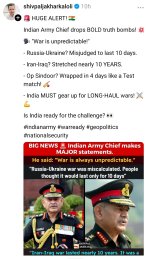
Haha! - indians already discrediting upcoming edition of AFM.

View attachment 146240
They know the access he has been given - this is just start of the campaign.
They will be going legally after him, key publishing , denying AFM all Indian access. Then try to buy KP out, you never know if they may even go to life threats
 
They know the access he has been given - this is just start of the campaign.
They will be going legally after him, key publishing , denying AFM all Indian access. Then try to buy KP out, you never know if they may even go to life threats

Out next week right?

Cope gonna be hard....so hard they are now trying to preempt it
 
The Pakistani military's decision to shoot down only some Indian fighter jets in the air battle on May 7 was a correct one.

Consider this: if the Pakistani military commander had chosen to shoot down all of the dozens of Indian fighter jets, what kind of personal honor would he have received? What kind of power and historical recognition would he have received? As a mature, top-level official, would he have foreseen the widespread questioning and criticism he would face from both the government and the public if he had decided to release most of the Indian fighter jets?

We all know the answer. At the time, the decision to shoot down all Indian fighter jets was in the best interests of the Pakistani military commander. If do that, he would become the greatest air force officer in Pakistani history, and might even rise to the highest power in a future military government.

So why didn't Pakistani military commanders do this? Because it would be in Pakistan's best national interest to only shoot down some of the Indian fighter jets.

Because all global powers, including the United States and Russia, will not accept the balance in South Asia being broken and the Pakistan-China camp controlling South Asia and the Indian Ocean.

Should the Pakistani military inflict a sufficiently severe blow on Indian forces to upset this equilibrium, Western nations led by the United States would inevitably conclude that China is poised to assert strong influence and control over South Asia through Pakistan. At that point, the West would undoubtedly provide unconditional aid to India, plunging India and Pakistan into a protracted, high-intensity border conflict.

This is the true reason why the Pakistani government chose to shoot down only some Indian fighter jets during the May 7 air battle, rather than all of them.

Had Pakistan downed dozens of Indian aircraft, the Indian government would have been unable to conceal the losses, and populist sentiment would inevitably escalate the conflict into a full-scale, high-intensity war.

Western nations would also conclude that the strategic balance in South Asia had been disrupted, leading to comprehensive aid for India—much like the joint U.S.-Soviet support for India in 1962. At that point, the nations embroiled in a war of attrition would be China, Pakistan, and India—not Russia and Ukraine. Russia will definitely cease fire with NATO and jointly assist India.
 
The Pakistani military's decision to shoot down only some Indian fighter jets in the air battle on May 7 was a correct one.

Consider this: if the Pakistani military commander had chosen to shoot down all of the dozens of Indian fighter jets, what kind of personal honor would he have received? What kind of power and historical recognition would he have received? As a mature, top-level official, would he have foreseen the widespread questioning and criticism he would face from both the government and the public if he had decided to release most of the Indian fighter jets?

We all know the answer. At the time, the decision to shoot down all Indian fighter jets was in the best interests of the Pakistani military commander. If do that, he would become the greatest air force officer in Pakistani history, and might even rise to the highest power in a future military government.

So why didn't Pakistani military commanders do this? Because it would be in Pakistan's best national interest to only shoot down some of the Indian fighter jets.

Because all global powers, including the United States and Russia, will not accept the balance in South Asia being broken and the Pakistan-China camp controlling South Asia and the Indian Ocean.

Should the Pakistani military inflict a sufficiently severe blow on Indian forces to upset this equilibrium, Western nations led by the United States would inevitably conclude that China is poised to assert strong influence and control over South Asia through Pakistan. At that point, the West would undoubtedly provide unconditional aid to India, plunging India and Pakistan into a protracted, high-intensity border conflict.

This is the true reason why the Pakistani government chose to shoot down only some Indian fighter jets during the May 7 air battle, rather than all of them.

Had Pakistan downed dozens of Indian aircraft, the Indian government would have been unable to conceal the losses, and populist sentiment would inevitably escalate the conflict into a full-scale, high-intensity war.

Western nations would also conclude that the strategic balance in South Asia had been disrupted, leading to comprehensive aid for India—much like the joint U.S.-Soviet support for India in 1962. At that point, the nations embroiled in a war of attrition would be China, Pakistan, and India—not Russia and Ukraine. Russia will definitely cease fire with NATO and jointly assist India.
Fascinating and nuanced insights. It is certainly plausible.

However, the status quo is also not to Pakistan's benefit.

The question is, what outcome is worse: slow and calibrated malevolence from our eastern neighbour designed to cause death and destruction, or a large scale war which also brings death and destruction?
 

Users who are viewing this thread

Country Watch Latest

Latest Posts

Back
Top