QUWA
" The first serious endeavor toward an indigenous fighter was Project Sabre II in the late 1980s. This ambitious program aimed to re-engineer the Chinese F-7 airframe with a powerful American General Electric F404 engine and Western avionics, with Grumman serving as the primary systems integrator. Conceptually similar to the Northrop F-20 Tigershark’s redevelopment of the F-5, Sabre II was a pragmatic attempt to create a modern, lightweight fighter. However, the imposition of the Pressler Amendment sanctions in 1990 abruptly killed the project and halted the delivery of new F-16s, leaving the PAF in a critical capability gap.
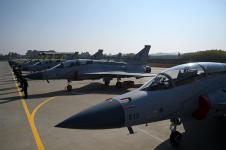
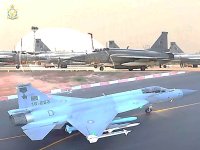
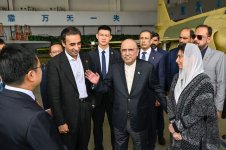
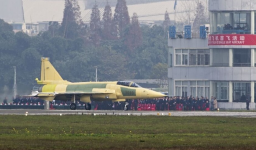
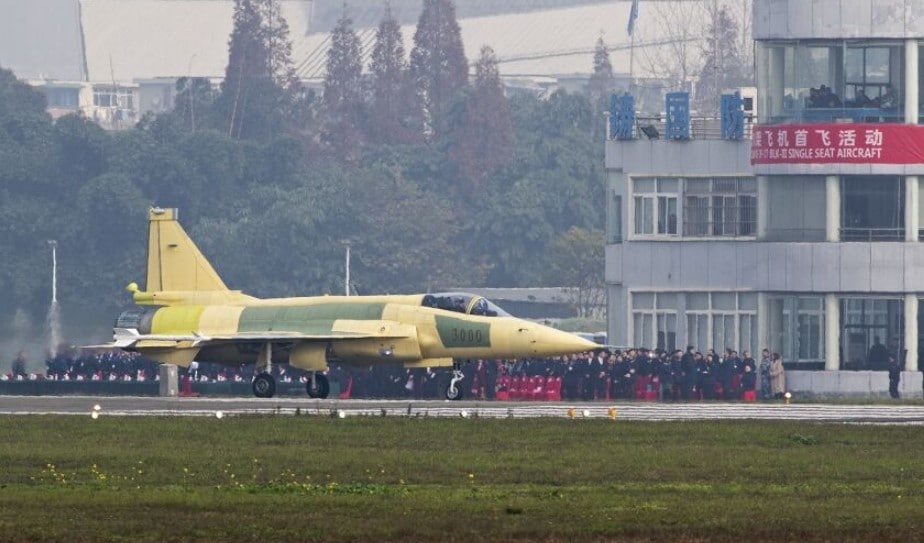
This strategic isolation proved to be the catalyst for the JF-17. With Western suppliers out of the picture, the PAF deepened its existing partnership with China’s Chengdu Aerospace Corporation (CAC). After years of negotiations, a formal contract was signed in June 1999 for the co-design, co-development, and co-production of a new fighter, then known as the Super-7 or FC-1. The objective was clear: to develop an affordable and sanction-proof workhorse to replace the PAF’s large but aging fleets of A-5s, F-7Ps, and Mirages in the numbers required to maintain credible conventional deterrence.
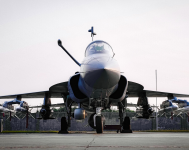
Disciplined Program Management
Perhaps the most critical factor in the JF-17’s success was the PAF’s disciplined and pragmatic approach to program management, a stark contrast to the troubled development of India’s HAL Tejas. When new US sanctions in 1999 blocked the planned integration of Western avionics, the PAF made the pivotal decision to decouple the airframe and avionics development streams. Instead of allowing the program to stall while searching for new subsystems, the PAF instructed CAC to focus solely on maturing the airframe, while it explored avionics options in parallel. This decision prevented catastrophic delays and ultimately led to the adoption of a mature avionics suite derived from China’s J-10 program.
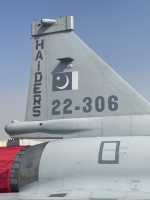
This philosophy of incremental, risk-managed development defined the program’s entire lifecycle. The PAF adopted a block-based production strategy, inducting the aircraft in batches of 50 and introducing new capabilities with each successive variant.
- Block 1 served as the baseline, establishing the production line and getting a capable, modern aircraft into service quickly.
- Block 2 introduced key enhancements such as an air-to-air refueling probe and an improved Environmental Control System (ECS), while also fielding the dual-seat JF-17B trainer. The JF-17B itself served as an aerodynamic testbed for the subsequent Block 3.
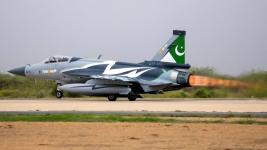
- Block 3 represents a generational leap, incorporating a modern Active Electronically Scanned Array (AESA) radar, a new Helmet-Mounted Display and Sight (HMD/S), and an advanced digital fly-by-wire flight control system.
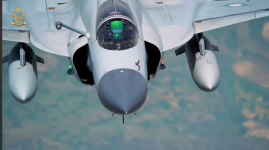
This iterative approach ensured that the program was never held hostage by a single, undeveloped technology. It allowed the PAF to field a credible capability in the near term while methodically building toward its ultimate requirements, all while absorbing technology and building indigenous industrial capacity at a manageable pace.
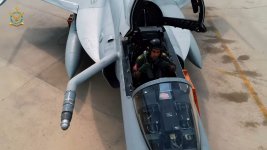
Building True Self-Reliance
A common critique of the JF-17 program questions its “indigenous” credentials, pointing to its foreign-sourced engine and other key components. This view, however, conflates the distinct concepts of an Original Equipment Manufacturer’s (OEM) capability with a nation’s overall industrial base. The PAF’s primary strategic goal was not 100% turnkey production, but rather securing its supply chain from the threat of Western political coercion.
Viewed through this lens, the program has been an unmitigated success. Through a comprehensive Transfer of Technology (ToT) agreement, Pakistan Aeronautical Complex (PAC) Kamra now manufactures approximately 60% of the JF-17’s airframe, including critical components like the wings and vertical tail. Furthermore, PAC has progressively localized the production of key avionics, including the mission computer, the KLJ-7 radar, and the head-up display. This deep involvement in manufacturing and systems integration gives the PAF sovereign control over the aircraft’s maintenance, overhaul, and crucially, its weapons integration — a level of autonomy it never had with Western platforms. The capacity and expertise built through the JF-17 program have served as the direct foundation for more ambitious national projects,
such as the National Aerospace Science and Technology Park (NASTP).







 Federal cabinet gives nod to imposition of emergency in KP; summary sent to president (31 Viewers)

 SpaceX launches 21 Northrop Grumman satellites for US military data network (1 Viewer)


