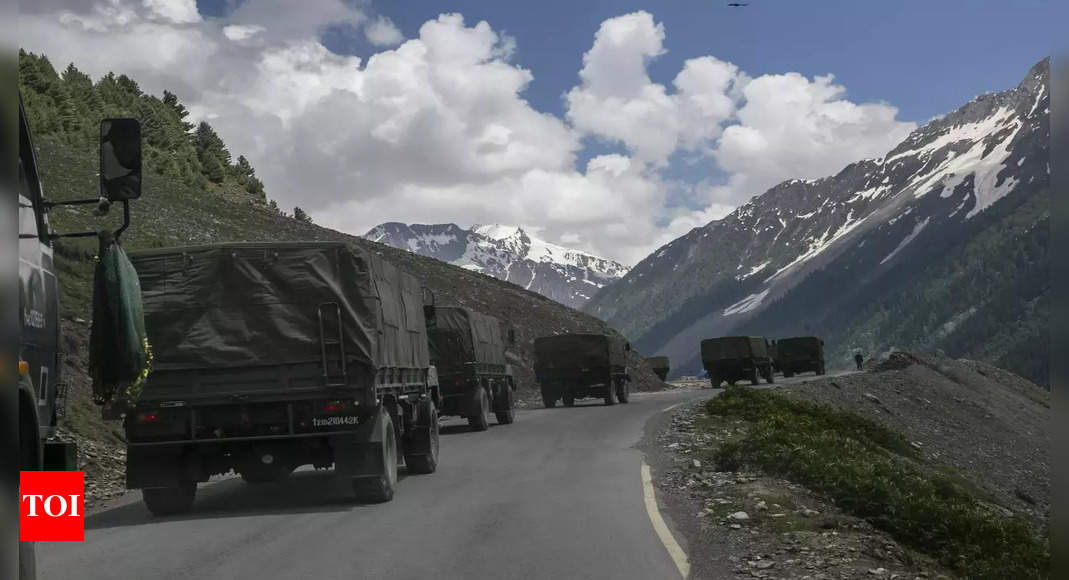
Work begins on India's strategic highway on China frontier in Arunachal Pradesh; will give Indian forces hawk-eye view of LAC

Pakistan certainly stands with China. India will have to fight a two front war. ☺️

Why do you want Pakistan to always act as a side actor?

Remember, - Side actors mostly die in movies, dramas, and programs, regardless of which country makes them. Lead actors just drop some tears and live happily.

you do always need to remember - china will never want to lose major cities for Pakistan if Pakistan goes to war with India. On the other hand, It would be foolish if Pakistan wanted to lose major cities for China.
 
POSTERS ARE ADVISED TO KINDLY DESIST FROM OFF TOPIC POSTS

KEEP IT RELEVANT TO THE THREAD TOPIC
 
Centre allocates Rs 2,378 crore for construction of part of frontier highway in Arunachal Pradesh

Itanagar, Feb 12 (PTI) Union Minister Nitin Gadkari said the Centre has sanctioned Rs 2,378.72 crore for the construction of two sections of the frontier highway with a total length of 93 kilometres in Arunachal Pradesh.

The development of road infrastructure aims at strengthening connectivity to border areas and fostering socio-economic growth in the region, he said.

Sharing the information on X on Sunday, Nitin Gadkari said, “In Arunachal Pradesh, an allocation of Rs 2,098.81 crore has been sanctioned for the construction of the Bomdila-Nafra-Lada Section covering 78.3 kilometres and Rs 279.91 crore for the 15.4 kilometre-long Lada-Sarli section (Package 7) of NH-913 (Frontier Highway) on EPC mode.”

The advancement of the frontier highway segment will establish crucial road infrastructure, connecting significant river basins, thereby enabling the development of numerous hydropower projects in the state, the minister of road transport and highways said.

Notably, the greenfield road will link uninhabited or sparsely populated areas of Upper Arunachal, presenting significant tourism potential.

It is expected to accommodate a substantial increase in traffic due to the anticipated growth in tourism activities, the minister added.

Earlier this month, Gadkari has approved the allocation of Rs 3,890.45 crore for the construction of three sections of the NH-913.

Expressing his delight, Chief Minister Pema Khandu has extended his gratitude to Prime Minister Narendra Modi and Gadkari for the development.

"Gratitude to Hon Prime Minister Shri @narendramodi ji and Hon Union Minister for Road Transport and Highways Shri @nitin_gadkari ji for their continued support to ensure last mile connectivity in upper Arunachal Pradesh,” Khandu posted in X.

Union Earth Sciences Minister Kiren Rijiju, who represents the Western parliamentary constituency in Arunachal Pradesh, wrote on X, “Another huge amount sanctioned for Frontier Highway- Nafra-Lada-Sarli segments of West Kameng - Bichom - East Kameng & Kurung Kumey Dists (districts). It's one of most difficult & ambitious Highways granted by PM Narendra Modi ji for Arunachal Pradesh. My dream is becoming a reality!”

The Arunachal frontier highway, connecting Bomdila in the north-west part of the state to Vijaynagar in the southeast of the state includes an 800 km greenfield section and a network of new tunnels and bridges.

The total length of the highway would be 1,748 km.

@Pingle @CallSignMaverick @indushek @protean @ApexWarrior @Archie
 

In a turnaround from its decades-old policy of being wary of strengthening road connectivity along the Line of Actual Control (LAC) for fear of Chinese aggression, India is now in the middle of a massive border infrastructure push. Before 2014, the basic infrastructure of the Northeast received little attention. "At that time, those in the government used to say that there is a security concern to carry out development up to the border area."​


But the policy is completely changed now under the Modi government. The idea is to fast-track the ongoing projects and initiate new ones. The Centre has focused on fast-tracking road air connectivity projects and building adequate infrastructure in the country's strategically located state in the extreme northeast corner.

China has been a constant threat to India along the Line of Actual Control (LAC). The December 2022 clash between the Indian Army and China's People's Liberation Army (PLA) in the Tawang sector of Arunachal Pradesh has brought the spotlight back on the need to develop infrastructure in Arunachal Pradesh which has been grossly neglected for decades.

There has been a lot of push on the infrastructure development along the LAC, especially in the Northeast. Considering the role of Arunachal Pradesh from the national security perspective, modern infrastructure has been built in the state. As of February 2022, projects worth Rs 14,032 crore were in progress in the state. The much-awaited, much-talked-about Sela Tunnel project, said to be the World's longest bi-lane tunnel at a height of 13,700 feet, is nearing completion. The 100-metre-long steel arch Siyom Bridge over River Siyom, inaugurated in Jan 2023, is of great significance not just for the region's people but also for the defence forces as it would facilitate the movement of heavy artillery and defence forces along the India-China border. The bridge built by the Border Roads Organisation (BRO) is on the Along-Yingkiong Road.

The Siyom Bridge has easily transported heavy, long-range weapons like the howitzer and the Bofors gun. Earlier, these heavy guns had to be airlifted. It was extremely cumbersome and exposed the weaponry to the enemy. The bridge has become a boon for the defence forces, making moving forces and heavy artillery more convenient. Constructed by Project Brahmank, part of BRO, the bridge has also improved road communication to the strategically important Upper Siang district and beyond through Along.

The BRO has constructed 64 roads of 3,097 km in Arunachal Pradesh in the last five years, the Modi government informed the Parliament in Dec 2022.

The Sela Tunnel project is one of the very strategically important projects not just for Arunachal Pradesh but for India as a whole. Initiated in 2018, the project is expected to open in January. Being built at a height of 13,700 feet, this strategic project has main and escape tunnels of 1,555 metres long each, besides a shorter tunnel of 980 m and about 1.2 km of road. The tunnel will ensure that the Chinese cannot monitor traffic movement in the area. The tunnel, which is said to be the longest bi-lane tunnel in the World, is expected to be ready by July this year. Along with the Nechiphu tunnel on the 317-km long Balipara-Charduar-Tawang (BCT) road that leads to West Kameng and Tawang districts of Arunachal Pradesh, the project will ensure that both defence and private vehicles will have all-weather connectivity.

Arunachal Frontier Highway is one of the country's biggest and toughest projects. The 2,000-km-long road project would begin from Mago in Arunachal Pradesh, adjacent to Bhutan, and pass through Tawang, Upper Subansiri, Tuting, Mechuka, Upper Siang, Debang Valley, Desali, Chaglagam, Kibithu, Dong, before ending at Vijayanagar near the Myanmar border. The project was envisaged by the Army in 2012.

With this project, Arunachal Pradesh will get three national highways — the Frontier Highway, the Trans-Arunachal Highway, and the East-West Industrial Corridor Highway. Six vertical and diagonal inter-highway corridors totalling 2,178 km will be built to provide missing interconnectivity between the three highways and faster access to border areas.

The corridors include 402 km-long Thelamara-Tawang-Nelia Highway, the 391 km-long Itakhola-Pakke-Kessang-Seppa-Parsi Parlo Highway, 285 km-long Gogamukh-Taliha-Tato Highway, 398 km-long Akajan-Jorging-Pango Highway, 298 km-long Pasighat-Bishing Highway, and the 404 km-long Kanubari-Longding Highway.

The Arunachal Frontier Highway will be a huge capability jump for the military since it will allow seamless and faster movement of men and equipment to the border as and when needed for induction and de-induction.

The Twin Tunnel under the Brahmaputra is another big project that is important for the military and defence forces. The 15.6-km twin tunnel under the mighty Brahmaputra River will cut travel time between Assam and Arunachal Pradesh.

Hollongi Airport in 2022 was a landmark year for Arunachal Pradesh as the state got its first greenfield airport, the Donyi Polo Airport, developed by the Airports Authority of India at an estimated cost of Rs 645 crore. Inaugurated by PM Modi, the airport, with eight check-in counters, can accommodate around 200 passengers during peak hours. Spread over a 4,100 sq m area, Donyi Polo Airport is equipped with all modern passenger facilities. The airport has a 2,300-meter-long runway suitable for landing and take-off of Boeing 747.


India's 'first village' Kibithoo in Arunachal Pradesh

Prime Minister Shri Narendra Modi has changed people's approach towards border villages. PM Modi has emphasized that Kibithoo, in Arunachal Pradesh, should not be termed as India's last village but the first village as the Sun's rays fall first in this village in the country.

Now, people visiting the border area know Kibithoo in Arunachal Pradesh not as the last village but as the first village in India. Kibithoo is India's easternmost forward post, along the border with China. Kibithoo is part of a government-approved Vibrant Villages Programme (VVP) as a Centrally Sponsored Scheme on February 15, 2023, for comprehensive development of the select villages in 46 blocks in 19 districts of abutting northern border in the States of Arunachal Pradesh, Himachal Pradesh, Sikkim, Uttarakhand and UT of Ladakh. In the first phase, 662 villages have been identified for priority coverage, which includes 455 villages in Arunachal Pradesh. The programme envisages focused areas of interventions in the select villages to create opportunities for livelihood generation through the promotion of tourism & cultural heritage, skill development & entrepreneurship, and development of cooperative societies, including agriculture/horticulture, cultivation of medicinal plants/herbs, etc.

The interventions also include providing road connectivity to unconnected villages, housing & village infrastructures, renewable energy, television & telecom connectivity. The programme aims to create sufficient incentives for people to stay in the selected villages. The earlier governments never cared about the infrastructure development on the border. After Narendra Modi became the Prime Minister, significant progress has been made in border area infrastructure, and the PM has ensured the transformation of the last village of India into the first village.

Further, to promote exporting agriculture and allied sector products from Arunachal Pradesh, the state Agriculture Marketing Board has inked an MoU with Dubai-based Lulu Hypermarket. The MoU was signed in 2023 to supply oranges and vegetables to Gulf countries. The collaboration will open new avenues for the agricultural community in Arunachal Pradesh, creating opportunities for farmers and producers to expand their reach and showcase their products globally. The collaboration is part of the larger scheme to foster economic growth, boost exports and enhance the overall well-being of the farmers of the Northeast.
 
Last edited:
The big guns are ready to boom if required in this high-altitude region
To view this content we will need your consent to set third party cookies.
For more detailed information, see our cookies page.


The stark reality.

Anytime big guns go booming, India will regret not just using sticks and stones to fight China


According to Praveen Sahney, the Editor of the Force Magazine, the Indian Army has no clue or capability to counter the Chinese offensive in the post-modern war domains; so, the IA leadership has dived into a make-believe world of their own to convey peace to their minds in particular and the Indian folks in general.

The Major points in this video presentation:

  • China considers it a matter of sovereignty what India considers a border dispute
  • The Indian army preparations are for a type of war that won't happen at the first place
  • The analogy of a war b/w China and India is that of b/w the USA and Iraq in 1991: a major power vs a medium power
  • Cyber and EM spectrum can be pointedly used by China to wage a whole-nation war to dent the Indian will to fight at the political and military levels
  • A robotic warfare can be waged by China via air and land based drones to conduct precision strikes of all sorts to achieve the operational level goals with a minimum number of boots on the battlefield
  • The enormous Chinese military industrial complex can dwarf the import-driven Indian capabilities; so, no question on the war being short or long
  • 24/7 Chinese surveillance on the Indian strategic assets means nuclear button is no option; even when India lost 2K km2 a couple of years back she didn't threat China with nuclear strikes
  • Etc.
To view this content we will need your consent to set third party cookies.
For more detailed information, see our cookies page.
 
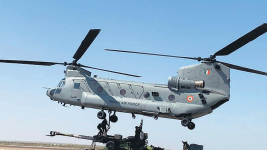
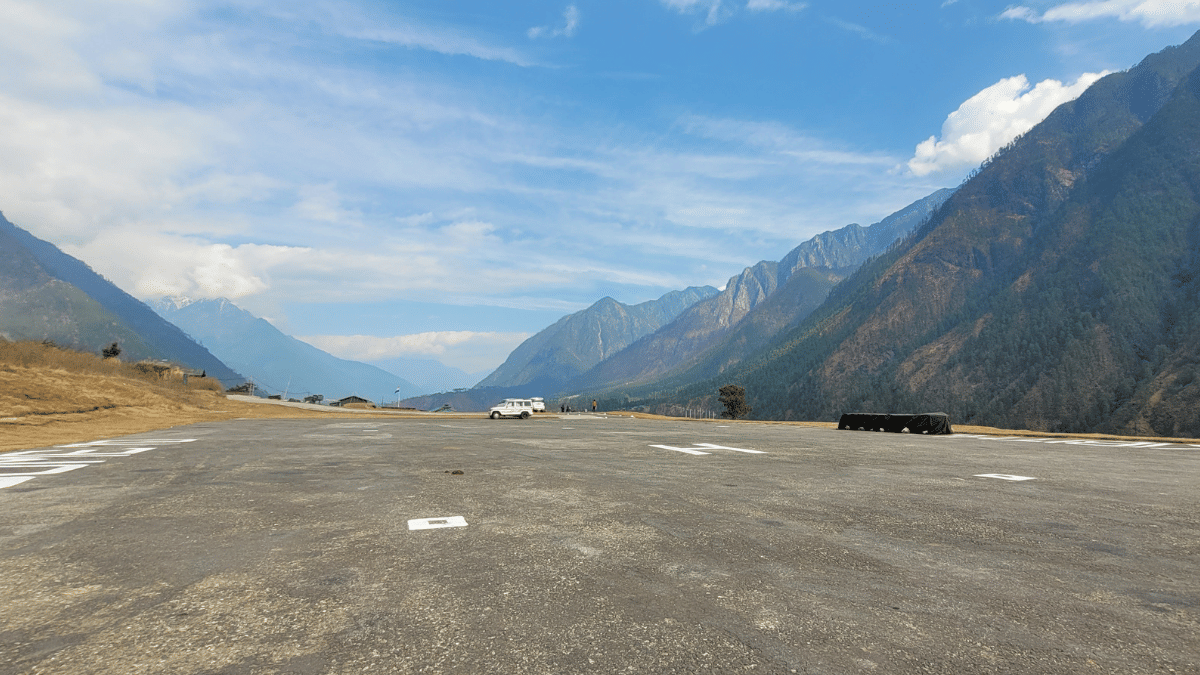
In Arunachal, 9 Chinook-specific helipads built & 6 more under-construction to create ‘air bridge’
1708678992164.png
Walong, Arunachal Pradesh: Efforts to boost air connectivity in Arunachal Pradesh are in full swing with nine helipads already constructed and six more under construction in the Indian Army’s 3 Corps area.

Sources told ThePrint that the idea was to facilitate an ‘air bridge’ — an air route to deliver troops, weapons and logistics from one place to another by means of air transport — in times of need due to poor road connectivity.

They said all seven valleys in the state have been connected with Chinook-specific helipads to ensure aerial connectivity, which is needed for carrying out quick sorties to forward areas in a shorter time.

The Indian Air Force (IAF) currently operates 15 Chinook helicopters procured from the US.

A source, explaining why Chinooks are deployed in the area, said they are a “force multiplier” due to its load-carrying capabilities. The helicopters can carry the Indian Field Gun (IFG), the Light Field Gun (LFG) and the M777 Howitzers in underslung mode, thus enabling transport of firepower to forward areas.

The M777 Howitzers — 155 mm, 39-calibre towed artillery guns, weighing about 4,000 kg — procured from the US, have been deployed in the forward areas of Arunachal Pradesh after a standoff between India and China began along the Line of Actual Control (LAC).

The Indian Army currently operates the Mi17V5 and Advanced Light Helicopters (ALH). However, none of these can carry as much load as the Chinooks. Earlier, the helipads were constructed with Cheetah and Chetak specifications. Now, the newly-constructed, larger helipads will be able to accommodate Chinooks.

According to sources, the Cheetah and Chetak used for reconnaissance and observation, have the capacity to carry two to three people, while the ALH can carry around 8 to 10 personnel.

The Chinook, though, can carry up to 45 troops and has a load capability of 10 tonnes underslung.

Chinooks will also come in handy for the construction of tracks in forward areas to transport cranes, among other plant machinery.

Sources also said that in times of war, “enemy action” can lead to roads being cut off. During such times, a robust air-transport system will help in creating an air bridge.

Boosting road infra

Other than ramping up infrastructure, the unit deployed in forward areas has been equipped with 31 new weapons and equipment including small arms, such as the 7.62 mm Negev Light Machine Guns, 7.62 mm Sig Sauer, Sako TRG 42 precision rifle and Light Weight RL Mk-IV, a source told ThePrint.

Furthermore, sources said that new generation equipment has been inducted for “augmentation and upgradation” of communication infrastructure. Satellite terminals for remote and forward areas, and portable communication terminals for smooth and seamless communication to forward areas have been inducted by the Army, a source said.

A 3,000-km road infrastructure is also under planning, with construction in some areas — apart from the state’s Kameng area — already under way. The state is divided into Kameng area on the west and then the ‘rest of Arunachal Pradesh’, or RALP.

In addition, 1,750 km of road network for inter-valley connectivity has been approved as part of the Arunachal Frontier Highway, and the Trans Arunachal Highway is almost completed.

Moreover, a number of operational tracks are being undertaken to ensure connectivity in forward areas. A total of 34 new bridges have been constructed in the entire 3 Corps zone while another three are under construction.
 
Of course we always know countries expand and contract, Qing dynasty lost around 4 million square kilometers to Russia and central Asian countries, but we didn't try to get them back

It is not like you had a chance of getting anything back
 
In Arunachal, 9 Chinook-specific helipads built & 6 more under-construction to create ‘air bridge’
View attachment 21319
Walong, Arunachal Pradesh: Efforts to boost air connectivity in Arunachal Pradesh are in full swing with nine helipads already constructed and six more under construction in the Indian Army’s 3 Corps area.

Sources told ThePrint that the idea was to facilitate an ‘air bridge’ — an air route to deliver troops, weapons and logistics from one place to another by means of air transport — in times of need due to poor road connectivity.

They said all seven valleys in the state have been connected with Chinook-specific helipads to ensure aerial connectivity, which is needed for carrying out quick sorties to forward areas in a shorter time.

The Indian Air Force (IAF) currently operates 15 Chinook helicopters procured from the US.

A source, explaining why Chinooks are deployed in the area, said they are a “force multiplier” due to its load-carrying capabilities. The helicopters can carry the Indian Field Gun (IFG), the Light Field Gun (LFG) and the M777 Howitzers in underslung mode, thus enabling transport of firepower to forward areas.

The M777 Howitzers — 155 mm, 39-calibre towed artillery guns, weighing about 4,000 kg — procured from the US, have been deployed in the forward areas of Arunachal Pradesh after a standoff between India and China began along the Line of Actual Control (LAC).

The Indian Army currently operates the Mi17V5 and Advanced Light Helicopters (ALH). However, none of these can carry as much load as the Chinooks. Earlier, the helipads were constructed with Cheetah and Chetak specifications. Now, the newly-constructed, larger helipads will be able to accommodate Chinooks.

According to sources, the Cheetah and Chetak used for reconnaissance and observation, have the capacity to carry two to three people, while the ALH can carry around 8 to 10 personnel.

The Chinook, though, can carry up to 45 troops and has a load capability of 10 tonnes underslung.

Chinooks will also come in handy for the construction of tracks in forward areas to transport cranes, among other plant machinery.

Sources also said that in times of war, “enemy action” can lead to roads being cut off. During such times, a robust air-transport system will help in creating an air bridge.

Boosting road infra

Other than ramping up infrastructure, the unit deployed in forward areas has been equipped with 31 new weapons and equipment including small arms, such as the 7.62 mm Negev Light Machine Guns, 7.62 mm Sig Sauer, Sako TRG 42 precision rifle and Light Weight RL Mk-IV, a source told ThePrint.

Furthermore, sources said that new generation equipment has been inducted for “augmentation and upgradation” of communication infrastructure. Satellite terminals for remote and forward areas, and portable communication terminals for smooth and seamless communication to forward areas have been inducted by the Army, a source said.

A 3,000-km road infrastructure is also under planning, with construction in some areas — apart from the state’s Kameng area — already under way. The state is divided into Kameng area on the west and then the ‘rest of Arunachal Pradesh’, or RALP.

In addition, 1,750 km of road network for inter-valley connectivity has been approved as part of the Arunachal Frontier Highway, and the Trans Arunachal Highway is almost completed.

Moreover, a number of operational tracks are being undertaken to ensure connectivity in forward areas. A total of 34 new bridges have been constructed in the entire 3 Corps zone while another three are under construction.
I think Chinooks have been a spectacular acquisition as it helps us move thousands of troops rapidly to the frontier, something the PLA can only dream off. Probably need to station some Predators in Arunachal as well as GPS-ing on Gagan signals from dedicated Geosynchronous satellites. Network all this with base stations setup with the newly commissioned 5G towers and optic fiber backhaul infra laid as part of the road infra in Arunachal and we have a very robust pre-emption. Of course with the recent economic contraction and significant technological denial from the west, China no longer has the power posture it used to have. So, we do have some time to get all this working in top shape.
 
Pushing one of its flagship projects before the announcement of the Lok Sabha polls, the government has allocated a massive sum of over Rs 17,000 crore for various stretches of the Frontier Highway in Arunachal Pradesh since February 6. Close to Rs 13,350 crore was allocated in the last 12 days alone, according to the Ministry of Road Transport and Highways data analysed by News18.

The Frontier Highway, termed as National Highway-913, is a 1,700 km highway passing through uninhabited or sparsely-populated areas of Arunachal Pradesh. It will have an 800 km greenfield section apart from new tunnels and bridges along the India-China border. The highway will also ease the movement of the defence forces and their supplies.

These highway stretches hold promise for enhanced connectivity to border areas. It is critical not just for socio-economic growth in the region but also a measure to curb migration and facilitate reverse migration towards the border areas of the state.

It will start from Bomdila and pass through Nafra, Huri, and Monigong. At some points, the road is very close to the LAC – less than 20 km from the international borders. The road will end in Vijaynagar – near the India-Myanmar border.

The highway, expected to be completed by 2027, will link some of the important locations in the state – Tawang, Mechuka, Tuting, Kibithoo, and Dong. Its total cost is expected to be around Rs 40,000 crore.

In the last few weeks, the ministry has sanctioned funds for over 770 km of this highway.

On Tuesday, the ministry allocated Rs 6,621.62 crore for the 265.49 km section of the highway for the construction of eight packages transitioning to an intermediate lane configuration.

Union Minister Nitin Gadkari said the funds were allocated for the six packages ranging for Huri-Taliha section, Bile-Migging section, Kharsang-Maio-Gandhigram-Vijaynagar section, and Bomdila-Nafra-Lada section.

Gadkari said these stretches play a vital role in establishing essential road infrastructure connecting significant river basins, thereby enabling the development of numerous Hydropower projects within the state.

“This predominantly greenfield road is designed to link uninhabited and sparsely populated areas of upper Arunachal, making it conducive to tourism and anticipating a substantial increase in traffic due to heightened tourism activities in the future,” the minister added.

On February 29, the ministry allocated Rs 6,728.33 crore for constructing eight stretches on NH-913 as intermediate lane road, spanning 305.50 km.

On February 6, the ministry approved around Rs 3,891 crore in three parts for the highway, including Rs 1,014.59 crore for the construction of the 61.55 km Kharsang-Miao-Vijaynagar–Gandhigram section of the Frontier Highway.
 
Last edited:
Centre Approves ₹ 28,229 Crore For 1,637 Km Arunachal Frontier Highway Along LAC

Aalo:
The Centre has sanctioned ₹ 28,229 crore for constructing the 1,637 km Arunachal Frontier Highway connecting 12 districts of the state along the Line of Actual Control (LAC) on the India-China international border, a top official said.

The ambitious project to be built at an estimated cost of ₹ 40,000 crore is seen as a move to counter China's aggression in Arunachal Pradesh, besides contributing to the socio-economic development of the border state.

The highway is being constructed along the 'India-Tibet-China-Myanmar' border and the road project will be as close as 20 km from the LAC and international borders.

It will start from Bomdila and pass through Nafra, Huri and Monigong towns, which are closer to the LAC or the McMahon Line, and conclude in Vijaynagar near the India-Myanmar border.

"The Centre has sanctioned ₹ 28,229 crore for the Arunachal Frontier Highway, which will connect 1,683 villages. The national highway being built parallel to the MacMohan Line will be completed by 2027," Chief Engineer of Border Roads Organisation (BRO) and head of Project Brahmank, Subhash Chandra Lunia, said.

He said work is under progress for constructing the 198 km stretch (Tato-Tuting) of the Arunachal Frontier National Highway-913.

After 2014, the budget for BRO's work in various states has been doubled for road development and maintenance as compared to the previous years, the official said.

Stating that work is underway on projects under the Brahmank Project in Arunachal Pradesh, Lunia said construction and maintenance of road infrastructure is being done in Siang, Upper Siang, West Siang and Shi-Yomi districts along with maintenance of four roads in Assam's Dhemaji district.

In 2022-23 and 2023-24, the Brahmank Project constructed a 100-metre span arch bridge on Siom River on Along-Yingkiong road. The construction of Siom bridge was completed in a record time of 180 days and opened for traffic, he said.

Lunia also said that from the day of establishment of the Brahmank Project till today, construction of 17 roads has been completed, whose total length is 496 km.

Along with this, the construction of 42 permanent bridges and 11 modular bridges has also been completed.

The official also said the BRO has always been at the forefront of construction of roads/bridges in favourable and unfavourable weather conditions for the last many years in the state.

Under Brahmank Project, BRO is committed to provide all-weather connectivity to the soldiers as well as the public.
 
Centre Approves ₹ 28,229 Crore For 1,637 Km Arunachal Frontier Highway Along LAC

Aalo:
The Centre has sanctioned ₹ 28,229 crore for constructing the 1,637 km Arunachal Frontier Highway connecting 12 districts of the state along the Line of Actual Control (LAC) on the India-China international border, a top official said.

The ambitious project to be built at an estimated cost of ₹ 40,000 crore is seen as a move to counter China's aggression in Arunachal Pradesh, besides contributing to the socio-economic development of the border state.

The highway is being constructed along the 'India-Tibet-China-Myanmar' border and the road project will be as close as 20 km from the LAC and international borders.

It will start from Bomdila and pass through Nafra, Huri and Monigong towns, which are closer to the LAC or the McMahon Line, and conclude in Vijaynagar near the India-Myanmar border.

"The Centre has sanctioned ₹ 28,229 crore for the Arunachal Frontier Highway, which will connect 1,683 villages. The national highway being built parallel to the MacMohan Line will be completed by 2027," Chief Engineer of Border Roads Organisation (BRO) and head of Project Brahmank, Subhash Chandra Lunia, said.

He said work is under progress for constructing the 198 km stretch (Tato-Tuting) of the Arunachal Frontier National Highway-913.

After 2014, the budget for BRO's work in various states has been doubled for road development and maintenance as compared to the previous years, the official said.

Stating that work is underway on projects under the Brahmank Project in Arunachal Pradesh, Lunia said construction and maintenance of road infrastructure is being done in Siang, Upper Siang, West Siang and Shi-Yomi districts along with maintenance of four roads in Assam's Dhemaji district.

In 2022-23 and 2023-24, the Brahmank Project constructed a 100-metre span arch bridge on Siom River on Along-Yingkiong road. The construction of Siom bridge was completed in a record time of 180 days and opened for traffic, he said.

Lunia also said that from the day of establishment of the Brahmank Project till today, construction of 17 roads has been completed, whose total length is 496 km.

Along with this, the construction of 42 permanent bridges and 11 modular bridges has also been completed.

The official also said the BRO has always been at the forefront of construction of roads/bridges in favourable and unfavourable weather conditions for the last many years in the state.

Under Brahmank Project, BRO is committed to provide all-weather connectivity to the soldiers as well as the public.
What will a highway running parallel to the Line of Actual Control (LAC) achieve? Perhaps troops and materials can be moved laterally, but the movement will be limited by the dimensions of the highway, and by its slopes and gradients. Furthermore, if there is a PLA attack at one point, and troops are rushed to reinforce the defences there from another location near the LAC, that only thins out the defence on the LAC; there is no practical reinforcement, no additional numbers are added to the numbers guarding the LAC.

OTOH roads to critical points on the LAC radiating out from base camps would make far more sense. This would allow reinforcement without disturbing the other defended points, and withdrawal from vulnerable points without endangering the entire line held.
 

Users who are viewing this thread

Pakistan Defence Latest

Back
Top