
Navigation
Install the app
How to install the app on iOS
Follow along with the video below to see how to install our site as a web app on your home screen.
Note: This feature may not be available in some browsers.
More options
Style variation
You are using an out of date browser. It may not display this or other websites correctly.
You should upgrade or use an alternative browser.
You should upgrade or use an alternative browser.
Indian Missiles and Guided Munitions
- Thread starter indushek
- Start date
More options
Who Replied?

Faceless
Registered Member
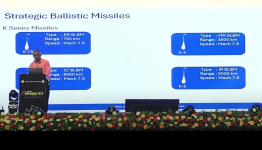
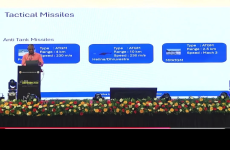
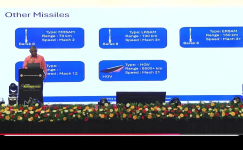
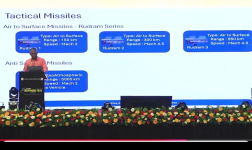
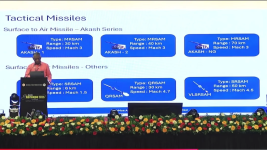
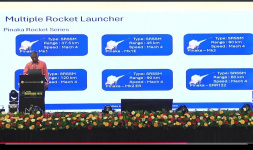
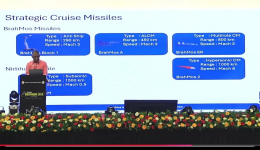
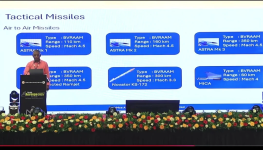
I was just about to post these, thanks for doing it already, however mandatory caution, do not take these numbers from any of these slides super seriously,
These slides are from Kerala Technology Expo (KTX) 2025 presentation by a retired Brahmos Aerospace MD Anthony Joseph and while it's true he has more access to such information than most of us, Its also very clear that since most of these are DRDO projects with no Brahmos Aerospace involvement, most data presented here is taken from the internet with slight modifications based on insider knowledge.
Thus, I would suggest to excercise caution and don't take these slides seriously as it looks like a hastily put together presentation for a low level event.
Compared to tresure trove of data we see from DRDO folks in IIT lecture halls, this data here is nothing.
No 100 km (LRSAM) or 150 km (ERSAM) variant of Barak 8 exists,
LR-LACM/Nirbhay's range is wrong,
K-15's range is wrong,
Helina's range is wrong
ASAT missile's range is wrong
Akash NG's range is wrong
VLSRSAM's range is wrong
Brahmos 2 is a dead project
KS 172 is a dead project
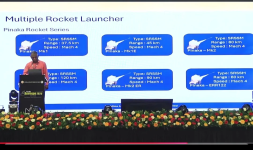
The only 100% correct and new info here are the details of Pinaka MLRS and the Indian HGV, yes that thing will have a 5000+ km range
Last edited:
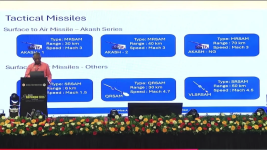
I was just about to post these, thanks for doing it already, however mandatory caution, do not take these numbers from any of these slides super seriously,
These slides are from Kerala Technology Expo (KTX) 2025 presentation by a retired Brahmos Aerospace MD Anthony Joseph and while it's true he has more access to such information than most of us, Its also very clear that since most of these are DRDO projects with no Brahmos Aerospace involvement, most data presented here is taken from the internet with slight modifications based on insider knowledge.
Thus, I would suggest to excercise caution and don't take these slides seriously as it looks like a hastily put together presentation for a low level event.
Compared to tresure trove of data we see from DRDO folks in IIT lecture halls, this data here is nothing.
No 100 km (LRSAM)

Barak 8 - Wikipedia
"The missile has maximum speed of Mach 2 with a maximum operational range of 70 km, which was later increased to ~90 km, which was later further increased to 100 km."
or 150 km (ERSAM) variant of Barak 8 exists,

Project Kusha - Wikipedia
"As of August 2024, DRDO was about to start the fabrication process of 5 M1 missiles (range of 150 km). DRDO has also placed order for 20 sets of airframes, 20 sets of rocket motors, 50 sets of kill vehicles (warhead), onboard & ground transceivers for telemetry."
Rest of the post, you can do a google and correct yourself.
Faceless
Registered Member
Good luck with those wikipedia figures I am sure those are super accurate.Barak 8 - Wikipedia
en.wikipedia.org
"The missile has maximum speed of Mach 2 with a maximum operational range of 70 km, which was later increased to ~90 km, which was later further increased to 100 km."
Project Kusha - Wikipedia
"As of August 2024, DRDO was about to start the fabrication process of 5 M1 missiles (range of 150 km). DRDO has also placed order for 20 sets of airframes, 20 sets of rocket motors, 50 sets of kill vehicles (warhead), onboard & ground transceivers for telemetry."
Rest of the post, you can do a google and correct yourself.
If you want to delude yourself into believing these figures then you are welcome, I like to stay grounded in reality.
The post literally has Barak 8 with 150 km range written there but instead of accepting those figures are wrong you are doing unnecessary mental gymnastics to prove he was talking about Project Kusha

south block 2
Banned
Barak 8 - Wikipedia
"The missile has maximum speed of Mach 2 with a maximum operational range of 70 km, which was later increased to ~90 km, which was later further increased to 100 km."
Project Kusha - Wikipedia
"As of August 2024, DRDO was about to start the fabrication process of 5 M1 missiles (range of 150 km). DRDO has also placed order for 20 sets of airframes, 20 sets of rocket motors, 50 sets of kill vehicles (warhead), onboard & ground transceivers for telemetry."
Rest of the post, you can do a google and correct yourself.
Good luck with those wikipedia figures I am sure those are super accurate.
If you want to delude yourself into believing these figures then you are welcome, I like to stay grounded in reality.
The post literally has Barak 8 with 150 km range written there but instead of accepting those figures are wrong you are doing unnecessary mental gymnastics to prove he was talking about Project Kusha
Barak 8 real Max speed is between Mach 5-7....that dual pulse motor does it job quite effectively at terminal stage.

Rational Philosopher
Trusted Member


This is a good thread, instead of spamming stupid arguments in unrelated threads Indian members should keep this updated
Faceless
Registered Member
Brahmos NG Brochure from Aero India 2025

Key Features
• Reduced dimensions & weight for widespread usage
• Advanced Next-Generation Stealth
• Greater effectiveness against ECCM
• Supersonic speed throughout the flight
• State of the art Ramjet Engine
• Modernised Satellite Navigation System
• Can be adopted on m Multi Airborne platforms
• Incorporation of state of the art technology
• Higher indigenous content
Specifications
• Mass : ≈ 1300 kg
• Speed : Mach 3
• Service Ceiling : 50,000 ft
• Guidence : INS/GPS/GLONASS/IRNSS
• Length : 5.5m
Unknown Origin Slide on Brahmos NG
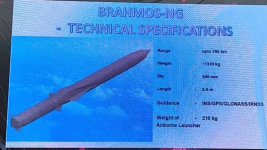
Brahmos NG Technical Specifications
• Range : upto 290 km
• Mass : 1330 kg
• Diameter : 540 mm
• Length : 5.6 m
• Guidence : INS/GPS/GLONASS/IRNSS
• Weight of Airborne Launcher : 210 kg
Key Features
• Reduced dimensions & weight for widespread usage
• Advanced Next-Generation Stealth
• Greater effectiveness against ECCM
• Supersonic speed throughout the flight
• State of the art Ramjet Engine
• Modernised Satellite Navigation System
• Can be adopted on m Multi Airborne platforms
• Incorporation of state of the art technology
• Higher indigenous content
Specifications
• Mass : ≈ 1300 kg
• Speed : Mach 3
• Service Ceiling : 50,000 ft
• Guidence : INS/GPS/GLONASS/IRNSS
• Length : 5.5m
Unknown Origin Slide on Brahmos NG
Brahmos NG Technical Specifications
• Range : upto 290 km
• Mass : 1330 kg
• Diameter : 540 mm
• Length : 5.6 m
• Guidence : INS/GPS/GLONASS/IRNSS
• Weight of Airborne Launcher : 210 kg
Faceless
Registered Member
Rudram 1 Brochure from Defence Expo 2022
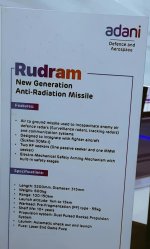
Features
• Air to ground missile used to incapacitate enemy air defence radars (Surveillance radars, tracking radars and communication systems)
• Designed to integrate with fighter aircraft (Sukhoi 30Mki)
• Two RF seekers (One passive seeker and one MMW seeker)
• Electro-Mechanical Safety Arming Mechanism with built-in safety stages
Specifications
Length: 5200mm
Diameter: 315mm
Weight: 600kg
Range: 100-150km
Launch altitude: 1km to 15km
Warhead: Pre-Fragmentation (PF) type - 55kg
Shelf life: 10+ years
Propulsion system: Dual Pulsed Rocket Propulsion System
Launch: Automatic check out and launch
Fuze: Laser End Game Fuze
Rudram 1 NGARM (New Generation Anti-Radiation Missile) Brochure from a technical seminar in Aero India 2021

Main Features
• NGARM is India's first Anti-Radiation Missile and state of the art Air to Surface weapon system developed with a primary role of offensive suppression of enemy air defences at ranges of upto 200 km for Indian Air Force.
• Missile has unique dual seeker system comprising of Passive Homing Head and Milli Meter Wave active seeker.
• Missile utilizes dual-pulse long-duration solid propulsion
New Technologies
• Passive Homing Head & MMW Seekers
• Ultra-Wideband Radome
• Two Way Data Link
• Laser Proximity Fuze
Technical Specifications
Platform : Sukhoi-30MKI
Range : 15-200 km
Altitude : 0.5-15 km
Weight : Less than 600 kg
Warhead : 60 kg
Mid Course Guidance : PHH & INGPS
Terminal Guidance : MMW Seeker
Launcher : AKU-58AE (modified)
Targets :Surveillance and Fire Control Radars
NGARM Brochure from Defence Expo 2020

New Generation Anti-Radiation Missile NGARM is first Indian Anti-radiation missile designed and developed by DRDO.
Features
• Target includes surveillance Radars, Fire control radars, communication radars.
• Developed Indigenously.
• Powered by Dual pulse solid propulsion system
• Inertial and Seeker based Guidance
• Designed to be launched from fighter aircrafts
Rudram 1 Brochure from Vigyan Vaibhav 2025
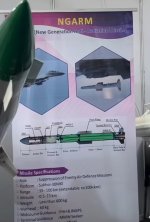
Missile Specifications
Role : Suppression of Enemy Air Defence Missions
Platform : Sukhoi 30MKI
Range : 15-100 km (extendable to 200+km)
Altitude : 0.5-15 km
Weight : Less than 600 kg
Warhead: 60 kg
Midcourse Guidance : PHH & INS GPS
Terminal Guidance : MMW Seeker
Launcher : AKU-58AE (modified)
Targets : Surveillance and Fire Control Radars
Current Status
• Full mission range of 100km demonstrated-range proven
• Captive performance evaluation of PHH and MMW conducted - Detection and Tracking performance satisfactory
• Project in Advanced stage of flight trial to demonstrate full configuration
Development cum Production Partner identified
Features
• Air to ground missile used to incapacitate enemy air defence radars (Surveillance radars, tracking radars and communication systems)
• Designed to integrate with fighter aircraft (Sukhoi 30Mki)
• Two RF seekers (One passive seeker and one MMW seeker)
• Electro-Mechanical Safety Arming Mechanism with built-in safety stages
Specifications
Length: 5200mm
Diameter: 315mm
Weight: 600kg
Range: 100-150km
Launch altitude: 1km to 15km
Warhead: Pre-Fragmentation (PF) type - 55kg
Shelf life: 10+ years
Propulsion system: Dual Pulsed Rocket Propulsion System
Launch: Automatic check out and launch
Fuze: Laser End Game Fuze
Rudram 1 NGARM (New Generation Anti-Radiation Missile) Brochure from a technical seminar in Aero India 2021
Main Features
• NGARM is India's first Anti-Radiation Missile and state of the art Air to Surface weapon system developed with a primary role of offensive suppression of enemy air defences at ranges of upto 200 km for Indian Air Force.
• Missile has unique dual seeker system comprising of Passive Homing Head and Milli Meter Wave active seeker.
• Missile utilizes dual-pulse long-duration solid propulsion
New Technologies
• Passive Homing Head & MMW Seekers
• Ultra-Wideband Radome
• Two Way Data Link
• Laser Proximity Fuze
Technical Specifications
Platform : Sukhoi-30MKI
Range : 15-200 km
Altitude : 0.5-15 km
Weight : Less than 600 kg
Warhead : 60 kg
Mid Course Guidance : PHH & INGPS
Terminal Guidance : MMW Seeker
Launcher : AKU-58AE (modified)
Targets :Surveillance and Fire Control Radars
NGARM Brochure from Defence Expo 2020
New Generation Anti-Radiation Missile NGARM is first Indian Anti-radiation missile designed and developed by DRDO.
Features
• Target includes surveillance Radars, Fire control radars, communication radars.
• Developed Indigenously.
• Powered by Dual pulse solid propulsion system
• Inertial and Seeker based Guidance
• Designed to be launched from fighter aircrafts
Rudram 1 Brochure from Vigyan Vaibhav 2025
Missile Specifications
Role : Suppression of Enemy Air Defence Missions
Platform : Sukhoi 30MKI
Range : 15-100 km (extendable to 200+km)
Altitude : 0.5-15 km
Weight : Less than 600 kg
Warhead: 60 kg
Midcourse Guidance : PHH & INS GPS
Terminal Guidance : MMW Seeker
Launcher : AKU-58AE (modified)
Targets : Surveillance and Fire Control Radars
Current Status
• Full mission range of 100km demonstrated-range proven
• Captive performance evaluation of PHH and MMW conducted - Detection and Tracking performance satisfactory
• Project in Advanced stage of flight trial to demonstrate full configuration
Development cum Production Partner identified
Last edited:
Faceless
Registered Member
Rudram 2 Brochure from Defence Expo 2022
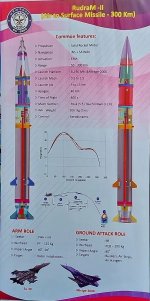
Common features:
Propulsion : Solid Rocket Motor
Navigation : INS + SATNAV
Actuation : EMA
Range : 50-300 Km
Launch Platform : Su 30MKI & Mirage 2000
Launch Mach : 0.5 to 1.5
Launch Alt : 3 to 15 Km
Apogee : 40 km
Time of Flight : 400sec
Mach number : Peak (5.5) Touchdown (>1.0)
WH Weight : 200 Kg class
Control : Aerodynamic
ARM Role
Seeker : PHH+IIR
Warhead : PF-155 Kg
Impact Angle : 40°-50°
Target : Radar Installations
Ground Attack Role
Seeker : IIR
Warhead : PCB-200 Kg
Impact Angle : 80°
Target : Bunkers, Air Strips, Hangars
Rudram 2 Brochure from Vigyan Vaibhav 2025
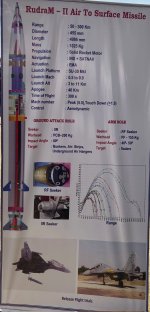
Specifications
Range : 50 - 300 km
Diameter : 455 mm
Length : 4995 mm
Mass : 1025 kg
Propulsion : Solid Rocket Motor
Navigation : INS + SATNAV
Actuation : EMA
Launch Platform : Su 30MKI
Launch Mach : 0.5 to 0.9
Launch Alt : 3 to 11 Km
Apogee : 40 km
Time of Flight : 300sec
Mach number : Peak (5.5) Touchdown (>1.0)
WH Weight : 200 Kg class
Control : Aerodynamic
Ground Attack Role
Seeker : IIR
Warhead : PCB-200 Kg
Impact Angle : 80°
Target : Bunkers, Air Strips, Hangars
ARM Role
Seeker : RF seeker
Warhead : PF-155 Kg
Impact Angle : 40°-50°
Target : Radar Installations
Common features:
Propulsion : Solid Rocket Motor
Navigation : INS + SATNAV
Actuation : EMA
Range : 50-300 Km
Launch Platform : Su 30MKI & Mirage 2000
Launch Mach : 0.5 to 1.5
Launch Alt : 3 to 15 Km
Apogee : 40 km
Time of Flight : 400sec
Mach number : Peak (5.5) Touchdown (>1.0)
WH Weight : 200 Kg class
Control : Aerodynamic
ARM Role
Seeker : PHH+IIR
Warhead : PF-155 Kg
Impact Angle : 40°-50°
Target : Radar Installations
Ground Attack Role
Seeker : IIR
Warhead : PCB-200 Kg
Impact Angle : 80°
Target : Bunkers, Air Strips, Hangars
Rudram 2 Brochure from Vigyan Vaibhav 2025
Specifications
Range : 50 - 300 km
Diameter : 455 mm
Length : 4995 mm
Mass : 1025 kg
Propulsion : Solid Rocket Motor
Navigation : INS + SATNAV
Actuation : EMA
Launch Platform : Su 30MKI
Launch Mach : 0.5 to 0.9
Launch Alt : 3 to 11 Km
Apogee : 40 km
Time of Flight : 300sec
Mach number : Peak (5.5) Touchdown (>1.0)
WH Weight : 200 Kg class
Control : Aerodynamic
Ground Attack Role
Seeker : IIR
Warhead : PCB-200 Kg
Impact Angle : 80°
Target : Bunkers, Air Strips, Hangars
ARM Role
Seeker : RF seeker
Warhead : PF-155 Kg
Impact Angle : 40°-50°
Target : Radar Installations
Faceless
Registered Member
Rudram 3 Brochure from Vigyan Vaibhav 2025
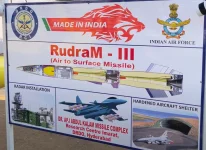
Rudram 3 Brochure from Defence Expo 2022
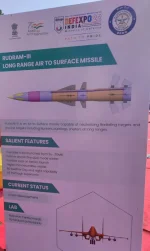
RudraM- 3 is an Air to Surface missile capable of neutralizing Radiating targets and ground targets including Bunkers, Buildings, Shelters at long ranges.
SALIENT FEATURES
Capable to be launched trom Su-30mki
Passive and Active dual mode seeker
Possible lock on before launch
Highly manoeuvrable missile
All weather Day and night capability
All thorough supersonic
CURRENT STATUS
Under Devlopment
LAB
Research Centre Imarat Hyderabad as Nodal Lab
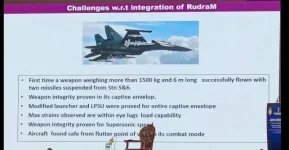
A slide on Rudram 3 from Aero India 2025
Unknown Origin Schematics of Rudram 3 (possibly for a scale model)
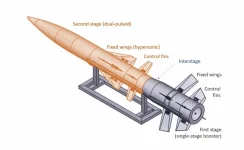
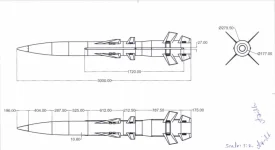
Projected Specifications (My guestimates)
Range : 500- 550 km
Diameter : 560 mm
Length : 6000 mm
Mass : 1.5 ton
Propulsion : 2 Stage Solid Rocket Motor
Navigation : INS + SATNAV
Actuation : EMA
Launch Platform : Su 30MKI
Launch Mach : ?
Launch Alt : ?
Apogee : ?
Time of Flight : ?
Mach number : ?
WH Weight : 150 Kg class (125 kg PCB warhead)
Control : Aerodynamic
Rudram 3 Brochure from Defence Expo 2022
RudraM- 3 is an Air to Surface missile capable of neutralizing Radiating targets and ground targets including Bunkers, Buildings, Shelters at long ranges.
SALIENT FEATURES
Capable to be launched trom Su-30mki
Passive and Active dual mode seeker
Possible lock on before launch
Highly manoeuvrable missile
All weather Day and night capability
All thorough supersonic
CURRENT STATUS
Under Devlopment
LAB
Research Centre Imarat Hyderabad as Nodal Lab
A slide on Rudram 3 from Aero India 2025
Unknown Origin Schematics of Rudram 3 (possibly for a scale model)
Projected Specifications (My guestimates)
Range : 500- 550 km
Diameter : 560 mm
Length : 6000 mm
Mass : 1.5 ton
Propulsion : 2 Stage Solid Rocket Motor
Navigation : INS + SATNAV
Actuation : EMA
Launch Platform : Su 30MKI
Launch Mach : ?
Launch Alt : ?
Apogee : ?
Time of Flight : ?
Mach number : ?
WH Weight : 150 Kg class (125 kg PCB warhead)
Control : Aerodynamic
Faceless
Registered Member
NASM MR Brochure from Aero India 2025

Naval Anti-Ship Missile : Medium Range (NASM MR)
KEY FEATURES
AESA SEEKER
• Anti-Missile Defence (AMD) Capable
• All Weather Operation
ANTI-JAM NAVIGATION
• Anti-Jam Satellite Aided Midcourse Inertial Navigation with adaptive way points
MISSION FLEXIBILITY
• In flight target update, Re-targeting & Mission Abort
TRAJECTORY
• Low - Low stealth Trajectory profile in High Sea States
• Pop Up
• High G Quicker Skid to Turn terminal Maneuvers with super Sea Skim
• Accelerate to higher Mach at target impact
SPECIFICATION
RANGE : Medium range (Sea Skimming)
PYLON / LAUNCHER INTERFACE : NATO standard 30-inch Lug Spacing
MIL-STD-1760 Electrical Interface
GUIDANCE : Mid-course INS + GPS + RADALT
Terminal AESA RF Seeker
DATA LINK : Full Range Two-way Data Link (salvo of 4 missiles)
SPEED : High Sub-Sonic Sea skimming
WARHEAD : High Energy Density PCB (Insensitive Munition)
Images of NASM MR mockup from Aero India 2025


Naval Anti-Ship Missile : Medium Range (NASM MR)
KEY FEATURES
AESA SEEKER
• Anti-Missile Defence (AMD) Capable
• All Weather Operation
ANTI-JAM NAVIGATION
• Anti-Jam Satellite Aided Midcourse Inertial Navigation with adaptive way points
MISSION FLEXIBILITY
• In flight target update, Re-targeting & Mission Abort
TRAJECTORY
• Low - Low stealth Trajectory profile in High Sea States
• Pop Up
• High G Quicker Skid to Turn terminal Maneuvers with super Sea Skim
• Accelerate to higher Mach at target impact
SPECIFICATION
RANGE : Medium range (Sea Skimming)
PYLON / LAUNCHER INTERFACE : NATO standard 30-inch Lug Spacing
MIL-STD-1760 Electrical Interface
GUIDANCE : Mid-course INS + GPS + RADALT
Terminal AESA RF Seeker
DATA LINK : Full Range Two-way Data Link (salvo of 4 missiles)
SPEED : High Sub-Sonic Sea skimming
WARHEAD : High Energy Density PCB (Insensitive Munition)
Images of NASM MR mockup from Aero India 2025

kimjongun
Registered Member
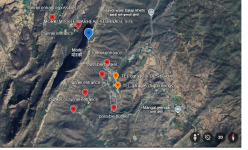
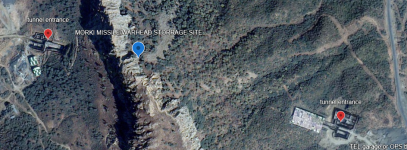
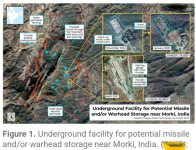
Morki missile and warhead storage site RAJASTHAN
27°57'33"N 75°46'47"E
- Has multiple tunnels reaching into the mountain
- Has TEL/vehicle garages with high ceiling
- Has three different types of fences and perimeters for security
- High security year round with large watch towers
CallSignMaverick
Banned
CATS Hunter stealth ALCM

- Weight: 600 kg.
- Range: 250–300 km.
- Engine: Single HAL PTAE-7 turbojet engine.
- Payload: 250 kg warhead (either unitary or cluster munitions).
- Guidance: Features multiple global navigation satellite systems (GNSS), terrain contour matching (TERCOM), and an imaging seeker.
- Engine: HAL PTAE-7 Turbojet
Users who are viewing this thread
Total: 1 (members: 0, guests: 1)
Pakistan Defence Latest
-

-

-
-
 Pakistan blocks airspace for Russian flight carrying Bangladesh's nuclear fuel (2 Viewers)
- Latest: Musings
-
 PAF pilot highlights how chinese J10C fighters have left US F16's Obsolete (2 Viewers)
- Latest: imadul
Country Watch Latest
-
Greek media lays out first 24 hours of hypothetical clash with Türkiye (16 Viewers)
- Latest: bengalcdn
-
-

-
-

Latest Posts
-
Greek media lays out first 24 hours of hypothetical clash with Türkiye (16 Viewers)
- Latest: bengalcdn
-

-
India explores China’s Hotan corridor as Pakistan airspace ban drags on (14 Viewers)
- Latest: retaxis
-
-