When Pasifika Weep for Empire
What our grief for Charlie Kirk exposes about faith, survival, and misplaced allegiance
Marli Olive Wesley
Sep 13, 2025
The Contradiction
“E pala maʻa, a e le pala upu.” The stones will decay, but words will not. Our people know the weight of words. They can bind us or free us. They can carry memory or carry chains. Too often, the words we hold closest are not ours at all, but the polished language of empire dressed up as truth.
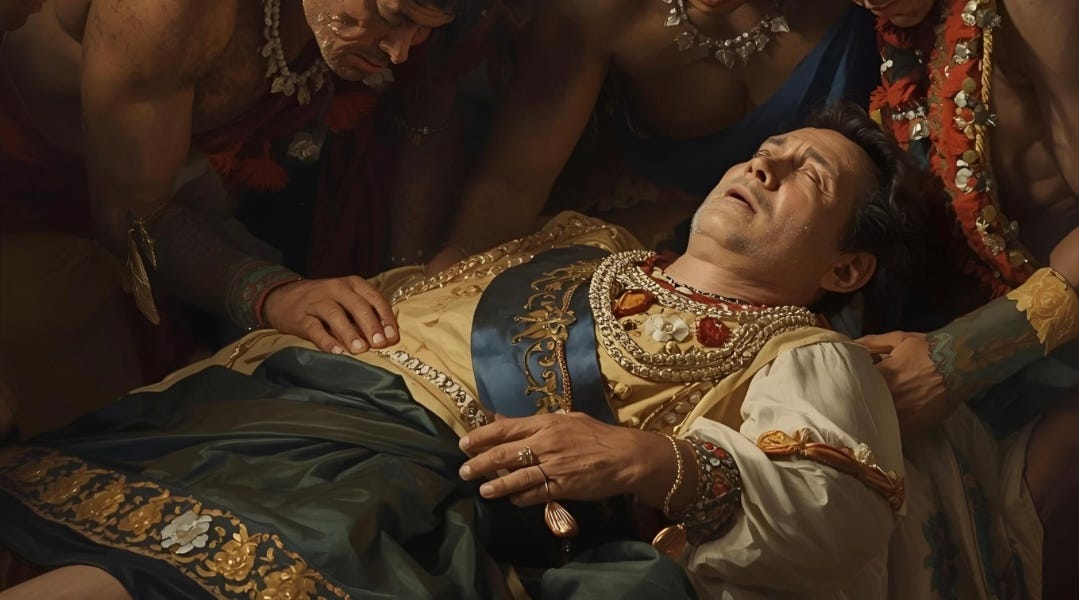
I had already planned to write about this, but the recent assassination of Charlie Kirk forced the conversation forward. What startled me most was not his death, but the reaction I saw from my own people. Across social media, Pasifika — mostly Sāmoans and Tongans — posted their shock, grief, even defense of him. Many called him a man of God. Many pointed out that he was a husband, a father. His legacy of stoking division and feeding ideologies hostile to us was softened, excused, even erased by those labels.
That odd mixture of grief and reverence struck me. Odd, because they were mourning someone who spent his career building platforms that make life harder for immigrants, for the poor, for queer people, for people of color — including us. Not surprising, because colonialism has conditioned us for centuries to equate Christianity with goodness, authority with safety, and obedience with holiness.
But what does it say about us, as a people and as a collective, that the title of “Christian,” “father,” or “husband” can so easily wash away the harm a man has done? That we overlook the substance of his life’s work because the words fit the mold of respectability we’ve been trained to honor?
This is the contradiction. We are a people who have endured land theft, blackbirding, nuclear testing, deportation, and exile. We know what it means to be on the receiving end of empire’s violence. Yet again and again, we align ourselves with those who uphold the very systems that shrink us. For some, this feels like faithfulness. For others, discipline. For many, tradition. But beneath it all lies obedience — drilled into us by mission schools, sanctified in church pews, hardened in migration.
And now, in the age of podcasts and YouTube, we inherit the same obedience through voices that promise order, masculinity, and clarity, even though they would never fight for our freedom. Each time we repeat their words, we risk forgetting that our ancestors left us a vocabulary of dignity, of resistance, of liberation — words strong enough to chart our own course.
Colonial Authority and Missionary Christianity
Empire never worked alone. It carried soldiers, yes, but its sharpest weapon was the missionary. Where muskets failed, the pulpit succeeded. In villages across the Pacific, faith was tied to discipline, salvation was tied to submission, and obedience was elevated to the highest virtue.
Mission schools drilled this lesson early: respect the teacher, obey the pastor, honor the government. It was framed as morality, but it was also preparation. Children grew into colonial subjects who could be counted on to labor, to follow orders, to keep quiet. Chiefs and matai were redefined under foreign eyes — their authority flattened into tools of administration, stripped of its old fluidity and covenantal balance.
Over time, holiness and obedience became indistinguishable. To disobey was not just rebellion against a colonial officer or a missionary, it was rebellion against God himself. This fusion carved deep grooves in our thinking, grooves we still walk in generations later. Even in diaspora, the lesson lingers: be respectable, keep your head down, and maybe you will be spared.
But survival is not the same as freedom. And the question still hangs heavy:
what inheritance are we protecting when we mistake silence for faith? Did our ancestors shed blood to be remembered as obedient, or as dignified?
Conservatism Through the Pulpit
For generations, the church has been our anchor. It is where we gather for worship, where we raise funds for funerals and weddings, where we teach children to stand and speak. It has been our safety net when the state failed us, our gathering place when the village felt far away. In diaspora, it has been the one place where we are not foreign but at home.
But the church is also where conservatism has taken root and flourished. Sermons on obedience, order, and morality echo colonial lessons. Ideas of family are frozen into rigid hierarchies where men lead and women submit, where queerness is demonized, and where questioning authority is equated with sin. This framing did not come from the fale or the faleʻaitu, it came from imported theologies that were weaponized against us.
Pastors have become more than spiritual guides — they are political actors, shaping how congregations vote, what policies they support, and who they see as enemies. In the pulpit, conservative talking points about discipline, “traditional values,” and “the dangers of modern society” are sanctified with scripture. And so, Pasifika communities find themselves repeating the very language that denies them full humanity in the countries they live in.
This is the paradox: the church sustains us, yet it also ties us tightly to systems that exploit us. It provides community, but it also polices who belongs. It gives us refuge, but at the price of obedience to ideologies that keep us small.
The harder question is this:
if the church has been our survival, do we dare ask whether it has also been our chain?
Diaspora, Immigration, and Respectability
When our people migrated — to Aotearoa, to Australia, to the United States — we entered new systems of power where survival meant being seen as “good immigrants.” Respectability became our shield. Work hard, stay quiet, go to church, keep your family in line. That was the unwritten bargain with governments and employers who still saw us as outsiders.
In these host countries, Pasifika were policed and racialized alongside Black and Brown communities, yet often told to aspire to be different from them. To prove we were disciplined, moral, and trustworthy. In schools, on job sites, and in courtrooms, being respectable could mean the difference between a second chance and deportation. That pressure hardened into a habit, and the habit became identity.
Right-wing ideologies of self-reliance and meritocracy found fertile ground here. They spoke to the immigrant dream: if you work harder, if you discipline yourself, if you obey the law, you will rise. And many of our families, exhausted from racism and poverty, wanted to believe it. It felt like a promise of stability, even when the systems were never built for us to fully belong.
But respectability is a fragile shield. It does not stop a police officer from pulling us over. It does not stop a boss from paying us less. It does not stop governments from deporting our youth back to islands they have never known. Respectability bends us toward obedience, but it cannot protect us from exclusion.
The question that lingers is this:
when we spend generations proving our worth to systems that will never see us as equal, whose future are we really building — theirs or ours?
What Right-Wing Pundits Do
Before we can understand why Pasifika people gravitate toward them, we need to be clear about who right-wing pundits are and what they do. They are not just entertainers. They are cultural brokers for empire. Their job is to make systems of inequality look natural, to package white supremacy as common sense, and to dress obedience in the language of freedom.
Some, like Charlie Kirk and Ben Shapiro, work through sharp political commentary. They flood airwaves and social media with talking points that deny systemic racism, demonize immigrants, attack public education, and celebrate aggressive policing. They uphold empire by defending borders, militaries, and laws that criminalize dissent.
Others, like Jordan Peterson or Joe Rogan, cloak their ideology in self-help and lifestyle talk. They emphasize discipline, responsibility, toughness — values that resonate deeply with Pasifika communities — but they redirect them toward protecting hierarchies of gender, race, and nation. They uphold empire by convincing people that inequality is not structural, but natural.
Then there are figures like Andrew Tate, who operate through shock, bravado, and hyper-masculinity. They sell a vision of male dominance that degrades women, dismisses queerness, and prizes control over care. They uphold empire by reinforcing patriarchy — a system that always feeds back into colonial control.
And finally, voices like Candace Owens bridge politics and religion, weaving scripture into nationalism, convincing people that obedience to empire is faithfulness to God.
Each of these levels works together. Some sow doubt about racism. Some glorify hierarchy. Some weaponize masculinity. Some sanctify nationalism. But all of them lead back to the same place: empire strengthened, white supremacy normalized, obedience rewarded.
This is what makes them so dangerous. They don’t need to wear uniforms or hold office. They shape imaginations. They decide what sounds like wisdom. And when our people echo their words, we are not just repeating opinions — we are carrying an entire structure of empire in our mouths.
The General Appeal of Right-Wing Pundits
Now the sermon streams through podcasts, TikTok clips, and YouTube channels. Charlie Kirk, Joe Rogan, Ben Shapiro, Jordan Peterson, Andrew Tate, Candace Owens — these are the new voices echoing in our cars, our gyms, our living rooms. They speak in ways that feel plain, confident, and certain. In a world of chaos, they offer order. In a world of doubt, they promise clarity.
For Pasifika people, that message lands with force. Many of us already grew up hearing about discipline, respect, and tradition from our parents and pastors. Rogan wraps it in casual conversation, Shapiro in sharp debate, Peterson in psychology, Tate in bravado, Owens in fire and scripture. Each sells the same product: strength through obedience to a particular vision of order.
The contradiction is that this order is not designed with us in mind. These pundits rail against immigrants, against welfare, against multiculturalism. They resent the very policies that have allowed our communities to survive abroad. Yet Pasifika people repeat their words anyway, drawn to the familiarity of “tough love” and the comfort of hearing our frustrations packaged as truth.
It is easy to see why. Our men, in particular, hear Jordan Peterson talk about purpose and feel understood. They hear Andrew Tate boast about power and feel vindicated. They hear Joe Rogan talk about being a fighter and feel recognized. These pundits know the hunger for belonging and the ache of dislocation — and they exploit it.
But we must be honest: when we amplify these voices, we are not reclaiming strength. We are borrowing language from men who have no place for us in their future. And every time we carry their words, we carry a weight that does not belong to us, but still drags us down.
Why Charlie Kirk Represented White Supremacy
Charlie Kirk’s entire platform was built on denying systemic racism, mocking movements for Black and Brown lives, and defending the very structures that keep white supremacy intact. He called white privilege a myth. He framed welfare as dependency. He championed policing and border enforcement as moral imperatives. He positioned himself as a defender of “Western civilization” — a phrase that has always been code for white dominance.
And he did not whisper these views in a corner. He spoke them to millions. Kirk had
over 5 million followers on X, more than 9 million followers on Instagram, and a podcast and radio show with over 500,000 monthly listeners. His words were not idle opinions. They shaped conversations, reinforced policies, and gave cover to politicians who used his talking points to justify legislation.
This is white supremacy not in hoods and burning crosses, but in rhetoric polished to sound like common sense. It is the steady erasure of histories like ours, the normalization of exclusion, the centering of whiteness as the only horizon. When Kirk railed against immigration, when he undermined public education, when he sanctified nationalism through Christianity, he was not speaking for us. He was speaking against us.
And yet, in his death, many of our people excused this legacy. They remembered him as a man of God, a husband, a father. Those labels softened the truth of his public work. But being a husband does not erase the harm he caused. Being a father does not undo the policies he defended. Being a Christian does not sanctify a career built on division.
Some will say: as Christians, we are called to grace. That we should offer sympathy no matter what. But grace does not mean blindness. Grace does not mean pretending harm was never done. Grace is not silence in the face of oppression. To extend grace without truth is not compassion — it is complicity. It is siding with empire while convincing ourselves we are siding with God.
Others will say:
he was only speaking his opinion — it’s free speech. But free speech is not harmless when it reaches millions. Words shape laws. Words shape culture. Words have power. To dismiss Kirk’s rhetoric as “just opinion” ignores the way empire has always worked: first by winning hearts and minds, then by passing laws to match.
The harder question is not who Charlie Kirk was in private. The question is why our people are so willing to excuse who he was in public.
Why do we let the labels of “Christian,” “father,” and “husband” outweigh the fact that he stood on platforms that denied our dignity?
Pasifika Men: A Special Case
The pull is not only general. It is sharpest among our men. Pasifika masculinity has been unsettled for generations. Once it was tied to land, to navigation, to the covenant of
feagaiga between brothers and sisters, to the service of family and village. Colonization, wage labor, and migration fractured that. Men were recast as workers, soldiers, and breadwinners. Their worth measured in how much they could provide, not how deeply they could serve.
Into that void step figures like Jordan Peterson, Andrew Tate, Joe Rogan. They offer scripts for how to be strong, disciplined, respected. They promise brotherhood, purpose, and control. For young Pasifika men searching for anchors, these messages feel familiar. They echo the calls for toughness they already hear from coaches, fathers, pastors. But instead of rooting that strength in service and covenant, they twist it toward dominance and individualism.
This is where the distortion cuts deepest. Our indigenous models of manhood were never about control. They were about balance. The
feagaiga bound men to honor, protect, and serve their sisters. Chiefs were not rulers but caretakers. Orators were measured not by volume but by wisdom and restraint. Strength was proven in how you held responsibility, not how you imposed it.
When Pasifika men echo Tate’s bravado or Peterson’s hierarchies, they are not reclaiming tradition. They are rehearsing a script written far from our shores, one that prizes control over care and obedience over covenant. And yet the hunger for purpose is real. The question is whether we will fill it with imported models of dominance, or return to the ones that once made us whole.
Generational Tensions
This divide is not only about ideology, it is also about generations. Elders, both on the islands and in diaspora, often lean toward conservatism because the church has been their anchor. For them, faith and survival were intertwined. They endured migration, labor, and racism by clinging to the pulpit and to discipline. Obedience, in their eyes, kept the family together and gave their children a chance to live with less struggle than they did.
But younger Pasifika are reading the world differently. Many have grown up in activist circles, ethnic studies classrooms, queer collectives, and online spaces where obedience is not seen as holiness but as surrender. They are questioning the authority of pastors who preach against their friends. They are pushing back against the politicians who use “family values” to strip away rights. They are saying out loud what their elders often swallow:
that alignment with empire is not the only way to survive.
This clash plays out at dinner tables, in church meetings, in how families respond to protests, elections, or even funerals. It is not simply a gap in age. It is a gap in imagination. The older generation sees risk in questioning authority. The younger sees risk in remaining silent.
And here lies the tension that will shape our future:
will the next generation inherit the habits of obedience, or will they recover the courage of dignity? Will they be silenced by the respectability their parents fought for, or will they speak words strong enough to carry us past survival and into freedom?
Closing the Circle
We have to name the contradiction for what it is. We are a people who have weathered empire’s blows and yet defend its walls. We inherit traditions of covenant and care, yet we bend ourselves toward obedience to voices that do not see us. We are heirs to navigators, rebels, and chiefs who reimagined the world, yet too often we hand our allegiance to men who would erase us from theirs.
To close the circle is not to romanticize the past. Our ancestors were not perfect. But they did not survive by obedience alone. They survived by dignity, by resistance, by refusing to be folded completely into the systems that sought to swallow them. Their words — not Kirk’s, not Rogan’s, not Shapiro’s, not Peterson’s — are the words that last, the ones that still have power to steer us forward.
The challenge for us is not whether we will continue to survive. We know how to do that. The challenge is whether we will mistake survival for freedom. Whether we will keep repeating the borrowed slogans of empire or reclaim our own words, our own compass, our own imagination.
So I ask again:
Are we inheritors of voyagers and rebels, or caretakers of chains?
What our grief for Charlie Kirk exposes about faith, survival, and misplaced allegiance

marliwesley.substack.com