Chinese Aircraft Carriers - Liaoning, Shandong, Fujian and the future

To view this content we will need your consent to set third party cookies.
For more detailed information, see our cookies page.
 
To view this content we will need your consent to set third party cookies.
For more detailed information, see our cookies page.


Auto-translated by Grok
Synthetic aperture radar images show the Shandong and Fujian Type 69 docked at the Yulin Naval Base in Sanya.
 
To view this content we will need your consent to set third party cookies.
For more detailed information, see our cookies page.


Auto-translated by Grok
Synthetic aperture radar images show the Shandong and Fujian Type 69 docked at the Yulin Naval Base in Sanya.

Type 69. HAHAHAHAHAHA
 

China starts building Type 004 nuclear aircraft carrier to rival U.S. Navy’s Ford-class​


China started building its fourth aircraft carrier, the nuclear-powered Type 004, analysts confirmed on September 29, 2025. Built to rival the U.S. Navy’s Ford-class, the warship could shift the balance of power in the Indo-Pacific.

Chinese military analysts confirmed on September 29, 2025, that Beijing has begun construction on its fourth aircraft carrier, the nuclear-powered Type 004. The vessel will feature electromagnetic catapults and an advanced carrier air wing, designed to rival the U.S. Navy’s Ford-class. The move is significant because it signals a direct challenge to American naval dominance and raises new security concerns in the Indo-Pacific.

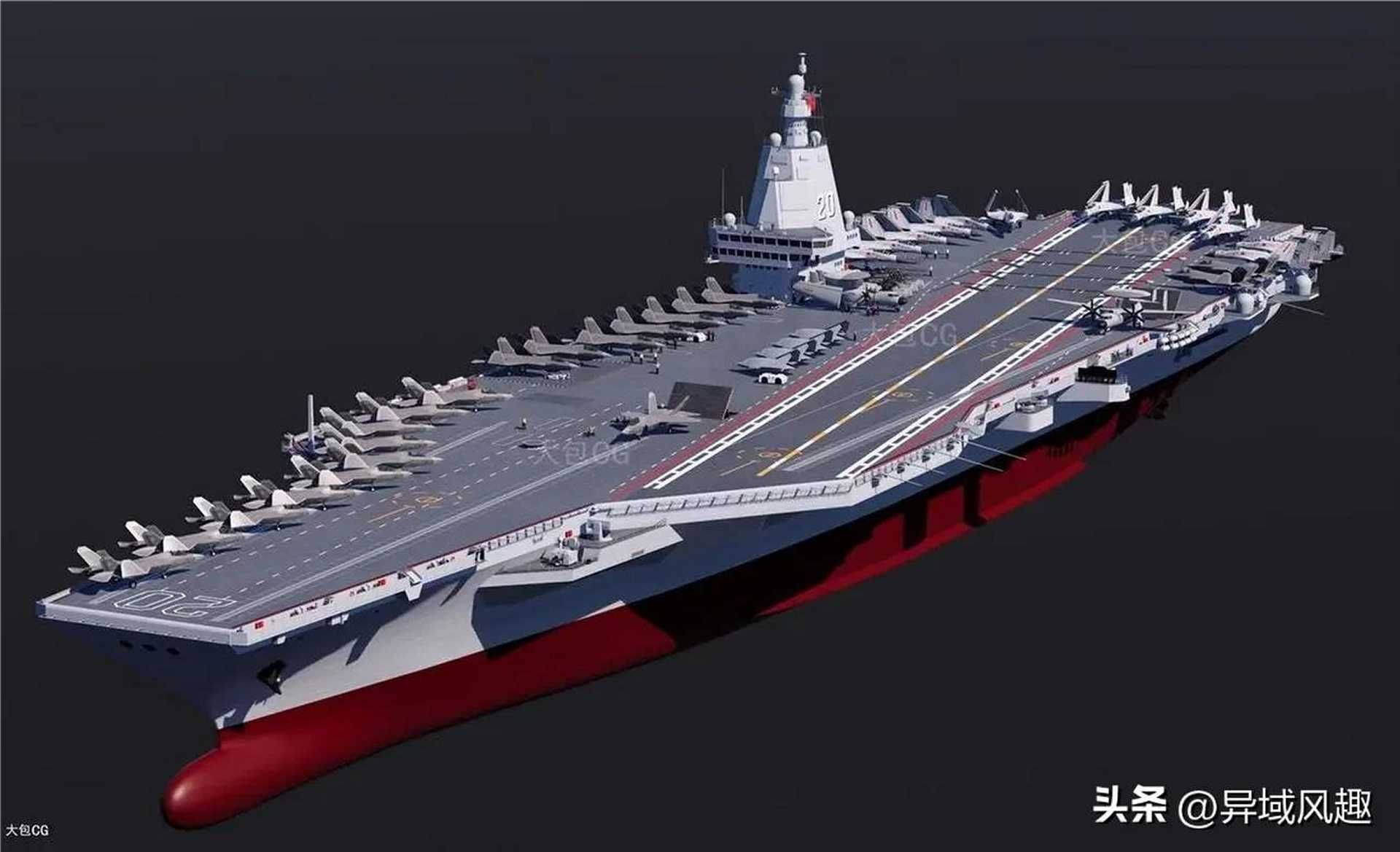
China_starts_building_Type_004_nuclear_aircraft_carrier_to_rival_U.S._Navys_Ford-class_1920_001-e4a23839.jpeg

Artist rendering of China's next-generation aircraft carrier Type 004, featuring a full-length CATOBAR flight deck, electromagnetic catapults, and an expanded island superstructure. The nuclear-powered supercarrier is designed to operate over 90 fixed-wing aircraft, including J-15T strike fighters and stealth J-35 jets, marking a dramatic leap in the PLA Navy's blue-water power projection capabilities. (Picture source: China social network)

The Chinese Type 004 and the U.S. Navy Gerald R. Ford-class share key next-generation features, yet they diverge significantly in terms of technological maturity and mission integration. Both vessels exceed 100,000 tons in displacement and adopt electromagnetic catapult systems, with EMALS on the Ford and a domestically developed equivalent aboard the Type 004. Each carrier is powered by nuclear propulsion, with the Ford-class using two A1B reactors that generate over 700 megawatts of power. In contrast, Chinese defense sources suggest that the Type 004 will feature twin pressurized water reactors, estimated to produce around 450 to 500 megawatts combined. The Ford-class supports an air wing of approximately 75 aircraft, including F-35C stealth fighters, E-2D Advanced Hawkeye AEW&C aircraft, and EA-18G Growlers for electronic warfare.

In contrast, the Chinese Type 004 is expected to carry over 90 aircraft, favoring numerical strength with a mix of J-15T heavy strike fighters, fifth-generation J-35 stealth jets, KJ-600 AEW platforms, and future unmanned systems. The Ford-class benefits from advanced arresting gear, highly automated weapons elevators, and a next-generation flight deck designed to support up to 160 sorties per day in surge conditions. While the Type 004 may aim to match these performance benchmarks, its actual operational effectiveness will depend on the PLAN’s ability to master complex deck operations, logistical sustainment at sea, and integrated joint force command, areas where the U.S. Navy maintains a decisive institutional advantage.

Early assessments from Chinese defense sources suggest the new carrier will displace between 110,000 and 120,000 tons, placing it firmly in the category of a full-scale supercarrier. Construction has reportedly commenced at the Dalian Shipyard, where satellite imagery and insider leaks reveal modular assembly of hull sections and specialized catapult launch infrastructure. Once operational, the Type 004 will carry more than 90 fixed-wing aircraft, including an expected mix of 24 to 30 J-15T catapult-launched heavy fighters and over 20 stealthy J-35 multirole combat aircraft, specifically designed for carrier-based operations and low-observable strike missions.

The warship’s nuclear propulsion system, a first for any Chinese surface combatant, is believed to be based on a navalized derivative of China’s Longwei pressurized-water reactor series, offering nearly unlimited operational range. This will enable PLAN carrier strike groups to sustain operations far beyond China's littoral zones, extending Beijing’s maritime reach across the Pacific and potentially into the Indian Ocean and beyond. With a full CATOBAR flight deck and high-tempo sortie generation capabilities, the Type 004 is being engineered for extended power projection, fleet air defense, and contested sea control, key attributes in any future conflict scenario with a peer adversary.

The implications for the United States Navy are immediate and serious. For decades, American supercarriers have maintained uncontested dominance across the world’s oceans, backed by a sophisticated network of logistics, carrier air wings, and integrated escort formations. The emergence of a Chinese nuclear-powered carrier with a comparable displacement and aviation capacity suggests the beginning of a true blue-water competition. While the U.S. Navy still maintains an edge in operational experience and advanced technologies such as the F-35C and E-2D Advanced Hawkeye, the rapid pace of Chinese carrier development threatens to narrow that gap.
 
For the first time, the PLANS-17 „Shandong“ together with the PLANS-18 „Fujian“ on the same pier at Sanya.

IMG_4158.jpeg
 
A bigger and better image, I see flags strung above Shandong? Ok, National Day celebration maybe?
To view this content we will need your consent to set third party cookies.
For more detailed information, see our cookies page.
 
To view this content we will need your consent to set third party cookies.
For more detailed information, see our cookies page.
 
Slowly, slowly ... again a new image showing the island superstructure mock-up at Huangjiahu at Wuhan supposedly representing the 004 aircraft carrier.Cannot wait for finally clear images showing the dry-dock at Dalian.(Via @Captain小潇 on Weibo)

IMG_4169.jpeg
 
Assuming three carriers for each of China's three fleets, that would require nine carriers in total. Would this be a reasonable plan?
 
I hope there is a 003A aircraft carrier, a perfect conventional-powered aircraft carrier.
 
Assuming three carriers for each of China's three fleets, that would require nine carriers in total. Would this be a reasonable plan?

No … China has not the same global or to say imperialistic ambitions like the US
 
from : 兰墨飞花_星海入梦日出烟燧

the US can buy newest steam catapult from China.

Good news: The Donald wants to revive steam catapults.
Bad news: The last American steam catapult company went bankrupt in 2020.
Good news: Its Chinese joint venture with Babcock & Wilcox still existed.
Bad news: That JV was acquired long ago and is now a State-Owned Enterprise in Beijing.

Cool Fact:

The world's newest steam catapult is currently in China, though not on a warship. It's located at the Navy's carrier-based pilot training center in Xingcheng, Liaoning. In 2014, China built two steam catapults at this center, complete with two water storage tanks and auxiliary facilities simulating boiler and steam turbine room structures. After numerous tests, China's steam catapults fully met operational requirements. When the 003 aircraft carrier began construction, it was originally planned to be equipped with steam catapults.

In 2015, the man, Academician Ma, arrived, bringing with him the newly developed electromagnetic catapult.

In 2016, an electromagnetic catapult was built next to the steam catapults at the Xingcheng training center. Coincidentally, the catapult-capable J-15 fighter also made its first flight that year. Thus, in Xingcheng, the steam catapult and electromagnetic catapult underwent multiple rounds of testing. In 2018, Academician Ma made breakthroughs in supercapacitors and medium-voltage DC systems, bringing the electromagnetic catapult to its fully realized state and demonstrating its superior capabilities.

The electromagnetic catapult is one-third smaller in size and weighs only 200 tons. It doesn't require extensive high-temperature, high-pressure pipelines or complex lubrication systems. Its startup time is just over ten minutes, and maintenance intervals are longer. In comparison, a steam catapult, operating at a rate of two launches per minute, would exhaust its high-pressure steam after about 16 minutes and require a 25-minute wait to resume launches. Daily cleaning alone requires about 200 personnel. The electromagnetic catapult increases daily launch capacity by approximately 30% and requires significantly fewer personnel. Additionally, the electromagnetic catapult can adjust thrust based on aircraft type, ensuring better launch performance and efficiency.

Consequently, construction on the 003 carrier was halted to redesign the plans, switching entirely to electromagnetic catapults. This change increased the construction period by about a year and a half. Due to their smaller size and weight, the Type 076 amphibious assault ship is also equipped with an electromagnetic catapult – something that would not have been feasible with a steam catapult.

The newest US steam catapult is on the USS George H.W. Bush, the last Nimitz-class carrier, launched in 2006. The sole US manufacturer of steam catapults, Babcock & Wilcox (BW), filed for bankruptcy and was liquidated in 2020. Outside of China, there are no suppliers left in the world for steam catapults.

Regarding the number of electromagnetic catapults deployed, China is also leading. It has already equipped the Fujian aircraft carrier and the Sichuan amphibious assault ship. The construction progress of the US USS John F. Kennedy was reportedly negative last year because parts were cannibalized for the USS Gerald R. Ford. It's possible its launch date might be later than China's 004 aircraft carrier. Furthermore, there will certainly be more than one Type 076 amphibious assault ship. In the future, the number of electromagnetic catapults will inevitably be higher in China.

If you think steam catapults are better, China is currently the only country that can build them.
If you think electromagnetic catapults are better, China is the only country capable of deploying them on a large scale.
 

Users who are viewing this thread

Latest Posts

Back
Top