Japan Defence and General News Discussions

She's just Japan's version of SerpentZA.

Maybe we should call her an ungrateful liar and demand she get kicked out of the country.
Where is your mind, buddy, She doesn't devote her whole channel on a single purpose to demonize Japan, does she?
 
As with everywhere else, third world immigration.
 
1760266810690.png
The long list of countries that have had female prime ministers and presidents includes many of Japan’s neighbours – South Korea, Taiwan, the Philippines, Thailand, Burma, Bangladesh.

So the fact that Japan, a country that began industrialising 150 years ago, is set to get its first female prime minister is not the great blow for equality it might once have seemed. All the more so when you find out that, like her great political idol, Margaret Thatcher, Sanae Takaichi, isn’t exactly a standard bearer for feminism.

“I will abandon any notion of work-life balance,” Takaichi, 64, promised as she accepted the presidency of the ruling Liberal Democratic Party (LDP) last weekend. “I will work and I will work and I will work.”

“Her special gift, people say, is doing without sleep,” says Tomohiko Taniguchi, a close political ally and confidant of Takaichi. Again, echoes of Thatcher, who was reputed to need just four hours of sleep a night.

A young Takaichi is reported to have met her political idol in the 1990s when Thatcher visited Japan. “The encounter seems to have left a lasting impression,” says Taniguchi. “Whenever she embarks on a policy sure to make half the country her adversary she will surely hear Thatcher’s words resounding in her ears – the lady is not for turning.”

She is going to need all her tenacity and determination if she is to make it to the prime minister’s office.

Negotiations to secure enough votes in parliament are bogged down. The LDP needs the support of a smaller centrist party called Komeito. Its leader is objecting to Takaichi’s assertion that when she becomes prime minister, she will continue to pay homage at Japan’s most controversial religious site – the Yasukuni shrine in Tokyo.

The shrine honours Japan’s war dead – including a number of convicted war criminals. A visit from a sitting Japanese prime minister is a red rag to China and South Korea – both of which suffered extreme brutality at the hands of the Imperial Japanese Army.

This hardline image clashes somewhat with pictures of Takaichi as a young woman. They show her wearing motorcycle leathers astride a large Kawasaki Z400 motorcycle. After class she would reportedly dash off to band practice – a punk band in which she played the drums.

Somehow this punk-loving biker with a penchant for karaoke, evolved into what some now describe as a tightly disciplined workaholic with far-right views on history, the imperial household and immigration. She is reportedly even more right-wing than her great political mentor, and Japan’s longest-serving postwar prime minister, Shinzo Abe, who was assassinated in 2022.

“I was told that when she ran for the leadership in 2024 the US state department did not want her,” says Prof Koichi Nakano of Tokyo’s Sophia university, a longtime critic of the right-wing LDP.

“South Korea also complained that they couldn’t work with her. But this time around it seems the people in the state department that manage US-Japan relations are gone, and Donald Trump couldn’t care less.”

one of article images

There is actually a good reason to believe Takaichi may get along with the US president better than her luckless predecessor – outgoing prime minister Shigeru Ishiba whose name Trump repeatedly failed to remember.

“Trump knows well that Takaichi is a protege of Abe – a man Trump admired,” says Taniguchi, “and ideologically they share common ground as social conservatives and opponents of woke culture.”

‘They share common ground as social conservatives and opponents of woke culture’
Prof Tomohiko Taniguchi

Trump and Abe were an unlikely duo when they first met back in 2016 – but they formed a genuine lasting friendship – much of it based around their common love of golf. “Whether she can make the most of that affinity will depend on her nerve and skill,” says Taniguchi, a professor at the University of Tsukuba.

One thing Trump is unlikely to object to is Takaichi’s attitude to immigrants. But a Japan led by her is a disquieting prospect for many of its growing foreign-born population.

By western standards that population is still tiny, about 3% of Japan’s total. But it is growing fast. So is the number of tourists arriving here, which could hit 40 million this year. A lot of Japanese people don’t like it. And rightwing politicians are fanning this disquiet by pointing to incidents of foreigners committing crimes or misbehaving.

Takaichi says that once in office she will establish new rules to screen foreign investment in Japan and will review rules that allow foreigners to buy land in Japan, particularly the Chinese.

“They are picking up on small issues and blowing them out of proportion,” says Prof Nakano. “It is not based on fact or careful analysis, it is a typical case of populist politics. But it has now resulted in official government policy framing foreigners as a problem.”
 
3.95 millions foreigners, most from China, Vietnam and Korea
makes up 5 percent
that’s still little.
no reason to panic
hundreds thousands Japanese, Koreans, millions of Chinese live in Vietnam, and we don’t complain.

 
3.95 millions foreigners, most from China, Vietnam and Korea
makes up 5 percent
that’s still little.
no reason to panic
hundreds thousands Japanese, Koreans, millions of Chinese live in Vietnam, and we don’t complain.


Perhaps all the foreigners need to leave.
 

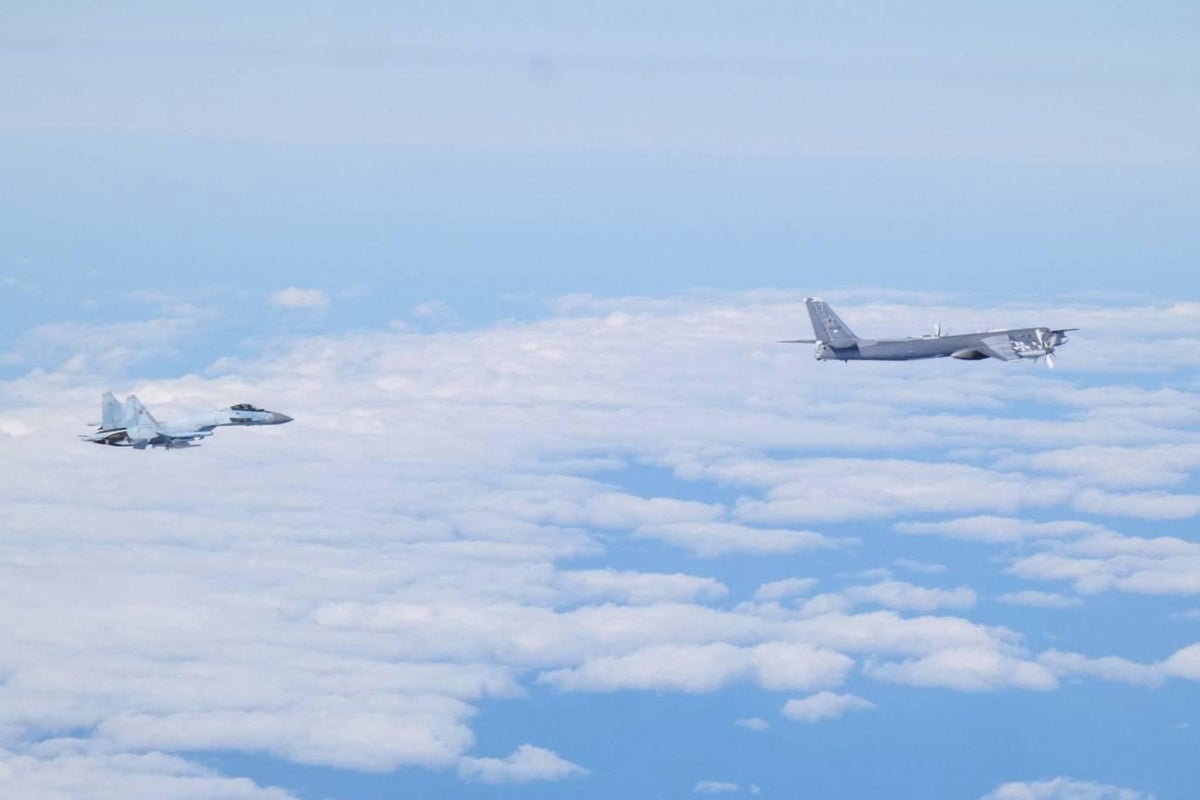
Russia says the bombers completed a routine flight over ‘neutral’ international waters​

Alisha Rahaman Sarkar
Saturday 25 October 2025 14:56 BST
Comments

Video Player Placeholder

poster.jpg


Related: Coalition of the Willing leaders urge more pressure on Russia to end Ukraine war
Japan scrambled fighter jets to monitor nuclear-capable Russian warplanes that flew over international waters along the edge of Japanese airspace off its coast.

Defence Minister Shinjiro Koizumi said Japan’s air force launched the jets in response to Russian bombers approaching the Sea of Japan.

Read more here
 
It must be about this which gives me bad clues about role of Japan in that part of the world

US B-1 Bombers Put on Show of Force Against Russia​


Japan is acting as guarding dog of US interests. How low Japan has gone, a cause of sadness.

In WW2 they killed hundreds of innocent Chinese citizens and now they are guarding US interests. Despite existence of amazing capabilities and potentials of smart Japanese people, its leadership has always been on the wrong side of history.

Japan should introduce itself as a neutral party instead of being loyal puppy of one side, if any dignity was remaining in these former Samurais
 

Mogami-class frigate selected for the Navy’s new general purpose frigates​


The Albanese Government is accelerating the delivery of a larger and more lethal surface combatant fleet with the selection of the upgraded Japanese Mogami-class frigate as the preferred platform for the Royal Australian Navy’s future fleet of general purpose frigates.

Following a rigorous and competitive tender process, Mitsubishi Heavy Industries’ Mogami-class frigate was assessed as best able to quickly meet the capability requirements and strategic needs of the Australian Defence Force (ADF).

The upgraded Mogami-class frigate boasts a range of up to 10,000 nautical miles, a 32 Cell Vertical Launch System, and is fitted with surface-to-air missiles and anti-ship missiles.

The decision comes months ahead of schedule – reflecting the Albanese Government’s commitment to transforming the ADF into a more integrated, focussed force.

The Government acknowledges the competitive, high-quality proposal submitted by Thyssenkrupp Marine Systems, and thank them for their commitment and professionalism throughout this procurement process.

Defence will now proceed with the next stage of the procurement process with Mitsubishi Heavy Industries, with the aim to enter early into binding, commercial contracts with Mitsubishi Heavy Industries and the government of Japan in 2026.

The Government’s response to the Independent Analysis of Navy’s Surface Combatant Fleet outlined that the first three general purpose frigates would be built offshore. This accelerated program will see the first three frigates built in Japan – with the first scheduled to be delivered to Australia in 2029 and operational in 2030.

That means, under the Albanese Government, the Navy will receive its first new surface combatant five years earlier than planned by the former Coalition government.

Successful consolidation of the Henderson precinct in Western Australia will enable the remainder of the build to be constructed locally, in line with the Albanese Government’s commitment to continuous naval shipbuilding.

Over the next two decades, tens of billions of dollars will be invested in defence capabilities in the West, supporting in the order of 10,000 well-paid, high-skilled jobs. This forms part of the Albanese Government’s $55 billion investment over the decade for Navy’s surface combatant fleet.

Australia’s new general purpose frigates will replace the Anzac-class frigates and will be equipped for undersea warfare and air defence.

Alongside the Hunter-class frigates and the upgraded Hobart-class destroyers and advanced missile investments, the general purpose frigates will be an essential part of the Albanese Government’s plan to more than double the size of Navy’s surface combatant fleet.

Quotes attributable to Deputy Prime Minister, Richard Marles:

“This announcement is another example of the Albanese Government’s focus on investing in the capabilities we need now and into the future, to meet Australia’s strategic circumstances.

“The upgraded Mogami-class frigate will help secure our maritime trade routes and our northern approaches as part of a larger and more lethal naval surface combatant fleet.

“The Albanese Government is delivering these commitments at pace, as part of our sustained commitment to continuous naval shipbuilding in the West – driving jobs, investment and infrastructure for decades to come.

“We thank both Mitsubishi Heavy Industries and Thyssenkrupp Marine Systems, as well as the governments of Japan and Germany for their focus and cooperation throughout this procurement process.”

Quotes attributable to Minister for Defence Industry, Pat Conroy:

“Today, we are taking another step towards delivering a much larger and more lethal Navy, with stealth frigates that will reassure our allies and deter our adversaries.

“The upgraded Mogami‑class frigate is the best option for our Navy, boosting its capability to put to sea.

“It will take our general purpose frigates from being able to fire 32 air defence missiles to 128 missiles, giving our sailors the cutting‑edge weapons and combat systems they need to prevail in an increasingly complex environment.

“This decision comes months ahead of schedule, reinforcing our commitment to deliver of capability at speed and at a lower overall cost to taxpayers. It makes good on our commitment to deliver four times as many warships in the next 10 years compared to the plan inherited by the former Coalition government.”

Media note:

Imagery is available at: http://images.defence.gov.au/S20252081
 

November 3, 2025 (Mainichi Japan)


Tokyo. (Mainichi)
Tokyo. (Mainichi)
TOKYO (Kyodo) -- Foreign residents accounted for more than 10 percent of the population in 27 municipalities across Japan as of January, with ratios in most surpassing levels that a national research institute had projected would not be reached until 2070 for the country as a whole, government data showed Sunday.

As more people from abroad settle in Japan as essential workers amid growing labor shortages, the number of foreign residents stood at 3.76 million as of the end of last year, up a record 350,000 from a year earlier, according to resident register data and immigration statistics.

Municipalities with foreign resident populations above the national average of 3 percent are notably industrial areas or tourist destinations.

The National Institute of Population and Social Security Research projected in 2023 that foreign residents would make up 10.8 percent of Japan's population by 2070.

An analysis of data covering 1,892 municipalities and administrative wards found that the village of Shimukappu in Hokkaido had the highest proportion of foreign nationals at 36.6 percent.

It was followed by Akaigawa, also in Hokkaido, Ikuno Ward in Osaka, Oizumi in Gunma Prefecture, and Kutchan in Hokkaido, all of which had foreign populations exceeding 20 percent.

The 27 municipalities across 13 of Japan's 47 prefectures included not only industrial zones and tourist spots but also areas with long-established foreign resident communities.

Nearly 80 percent of them have already exceeded the 10.8 percent foreigner population projection by the national research institute.

Meanwhile, a total of 151 municipalities across 27 prefectures had foreign residents exceeding 5 percent of their population, while only two villages had zero foreign residents.

Until the 1960s, the number of foreign residents in Japan hovered around 600,000. After a 1990 revision of the immigration law allowed people of Japanese descent to live in Japan as long-term residents, the increase became more pronounced.

Although the number fell due to layoffs and return migration during the 2008 global financial crisis, it later rose again. After falling during the COVID-19 pandemic, the population is now in what is considered a third phase of expansion.

In recent years, the introduction of a specified skilled workers visa and other immigration system revisions have further accelerated the growth of foreign resident populations.

Resort hotels line the coastline in Onna, Okinawa Prefecture, where foreign residents account for 12.4 percent of the population. According to the village, the share of foreign residents has increased since the establishment of a graduate university 13 years ago, with many now working in hotels and restaurants.

"We have not seen an increase in problems. It seems we are coexisting well," a village official
 
Seems there is hope.
in the article there is no info who are the new foreigners to Japan?
 
Seems there is hope.
in the article there is no info who are the new foreigners to Japan?
Probably white if I had to guess, perhaps Koreans and SEAs too
 
Seems there is hope.
in the article there is no info who are the new foreigners to Japan?
Maybe they will take in large number of Vietnamese, haha, I think that's what you like.
 
Japan’s population is projected to decline sharply over the next 50 years due to a combination of record-low birth rates, rapid aging, and limited immigration. These trends are already accelerating and pose major social and economic challenges.
 

Users who are viewing this thread

Pakistan Defence Latest

Back
Top