No one can be trusted with the entire geography of Afghanistan, especially when it is clear and proven time and again that whoever is at the forefront of leading Afghanistan, at any given time, practices a form of religion, which is very extreme and starkly contrasts with the form of religion that is practised in Pakistan or Iran.
Balkanization of Afghanistan Is the only viable solution to the 8 decades old threat that is posed on our western border. Division along ethnic lines ensures that there are many centres of power, and that no single sect of religion / ethnicity is strong enough to pose any real threat to our country.
If there is credible evidence that our enemies have invested heavily in Afghanistan, that a Muslim is taking the help of a non-Muslim, against a Muslim neighbour, then what kind of Islamic ideology, is preventing us from a full force attack against Afghanistan?
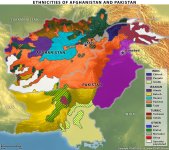
The extremist ideology that is practised by the militants in Afghanistan, aligns with some sections of our society that poses a credible threat and must be eliminated with a blitzkrieg. The geography of Afghanistan should be Balkanized into different ethnicities, with the provinces bordering Pakistan, being annexed, of course, after a quick referendum, and becoming a part of Pakistan, uniting the majority of the Pashtun and Baloch factions, from across the border.
Tajiks, Uzbeks, Kyrgyz and hazara population should be allowed to become independent or if they choose, to be a part of their countries of origin, bordering Afghanistan, should be allowed to become part of that specific country. The bigger land that is left to the extremists to govern, the more chances that Pakistan might be pinned down on the western border for eternity, bleeding Pakistan by a thousand cuts / wounds.
If I were to annotate this (in words) to show the Afghan provinces most aligned with Pakistan:
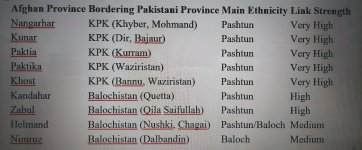
1. The Pashtun belt in Afghanistan (south & southeast), especially provinces like Nangarhar, Kunar, Paktia, Paktika, Khost, Kandahar, Zabul, Helmand, align with Pakistan’s Khyber Pakhtunkhwa & Balochistan.
2. The Baloch areas (in southwestern Afghanistan: Nimruz, parts of Helmand, etc.) align with Pakistani Balochistan.
With the Help of AI, the following should become part of Pakistan:
Afghan Provinces Closely Aligned with

Pakistan
Because Afghanistan and Pakistan share a 2,640 km border (the Durand Line), several Afghan provinces directly connect — ethnically, linguistically, and economically — with adjacent Pakistani regions.
________________________________________
1. Nangarhar Province
• Bordering Pakistani areas: Khyber Pakhtunkhwa (Khyber & Mohmand Districts)
• Dominant ethnicity: Pashtun (99%) — tribes like Mohmand, Shinwari, and Khogyani straddle both sides of the border.
• Cultural link: Very strong — same language (Pashto), same tribal structures, and heavy cross-border movement for trade and family ties.
• Closest Pakistani correlation: Peshawar region.
________________________________________
2. Kunar Province
• Bordering: Khyber Pakhtunkhwa (Dir, Chitral, Bajaur)
• Ethnicity: Pashtun, with Nuristani minorities.
• Link strength: Very high — linguistically and tribally connected; strong cultural overlap.
• Closest Pakistani correlation: Bajaur and Lower Dir.
________________________________________
3. Paktia Province
• Bordering: Kurram District (KPK)
• Ethnicity: Pashtun (Ghilzai and Zadran tribes)
• Connection: Cross-border tribal intermarriages; similar dialects and cultural customs.
• Closest Pakistani correlation: Parachinar area.
________________________________________
4. Paktika Province
• Bordering: South Waziristan (KPK) and North Waziristan
• Ethnicity: Pashtun (Ghilzai and Wazir tribes)
• Connection: Tribal overlap (Wazir and Mehsud tribes live on both sides).
• Closest Pakistani correlation: Waziristan regions.
________________________________________
5. Khost Province
• Bordering: North Waziristan
• Ethnicity: Pashtun (Zadran, Mangal)
• Connection: Same tribal confederations and cross-border kinship.
• Closest Pakistani correlation: Bannu–Miranshah belt.
________________________________________
6. Kandahar Province
• Bordering: Balochistan (Quetta–Chaman region)
• Ethnicity: Pashtun (mainly Durrani confederation)
• Connection: Historical trade route; strong kinship with Pashtuns in Quetta and Zhob.
• Closest Pakistani correlation: Quetta Division.
________________________________________
7. Helmand Province
• Bordering: Balochistan (Nushki and Chagai areas)
• Ethnicity: Pashtun (Noorzai, Alizai) with minority Baloch tribes.
• Connection: Trade and nomadic migration between Helmand and Pakistani Balochistan.
• Closest Pakistani correlation: Nushki and Dalbandin.
________________________________________
8. Nimruz Province
• Bordering: Balochistan (Chagai District) and Iran
• Ethnicity: Baloch (majority) with Pashtun and Brahui minorities.
• Connection: Shared Baloch culture and language across Pakistan’s and Iran’s borders.
• Closest Pakistani correlation: Dalbandin and Taftan region.
________________________________________
9. Zabul Province
• Bordering: Balochistan (Qila Saifullah region)
• Ethnicity: Pashtun (Hotak, Tokhi)
• Connection: Linguistic and tribal continuity with Pakistani Balochistan Pashtuns.
• Closest Pakistani correlation: Qila Saifullah and Loralai.
________________________________________
10. Kunar–Nangarhar–Paktia–Paktika–Khost–Kandahar–Zabul–Helmand–Nimruz

These nine provinces form Afghanistan’s southeastern and southern belt, which:
• Shares direct borders with Pakistan.
• Is predominantly Pashtun (plus Baloch in the southwest).
• Has deep cultural, linguistic, and tribal overlap with Pakistan’s Khyber Pakhtunkhwa and Balochistan provinces.