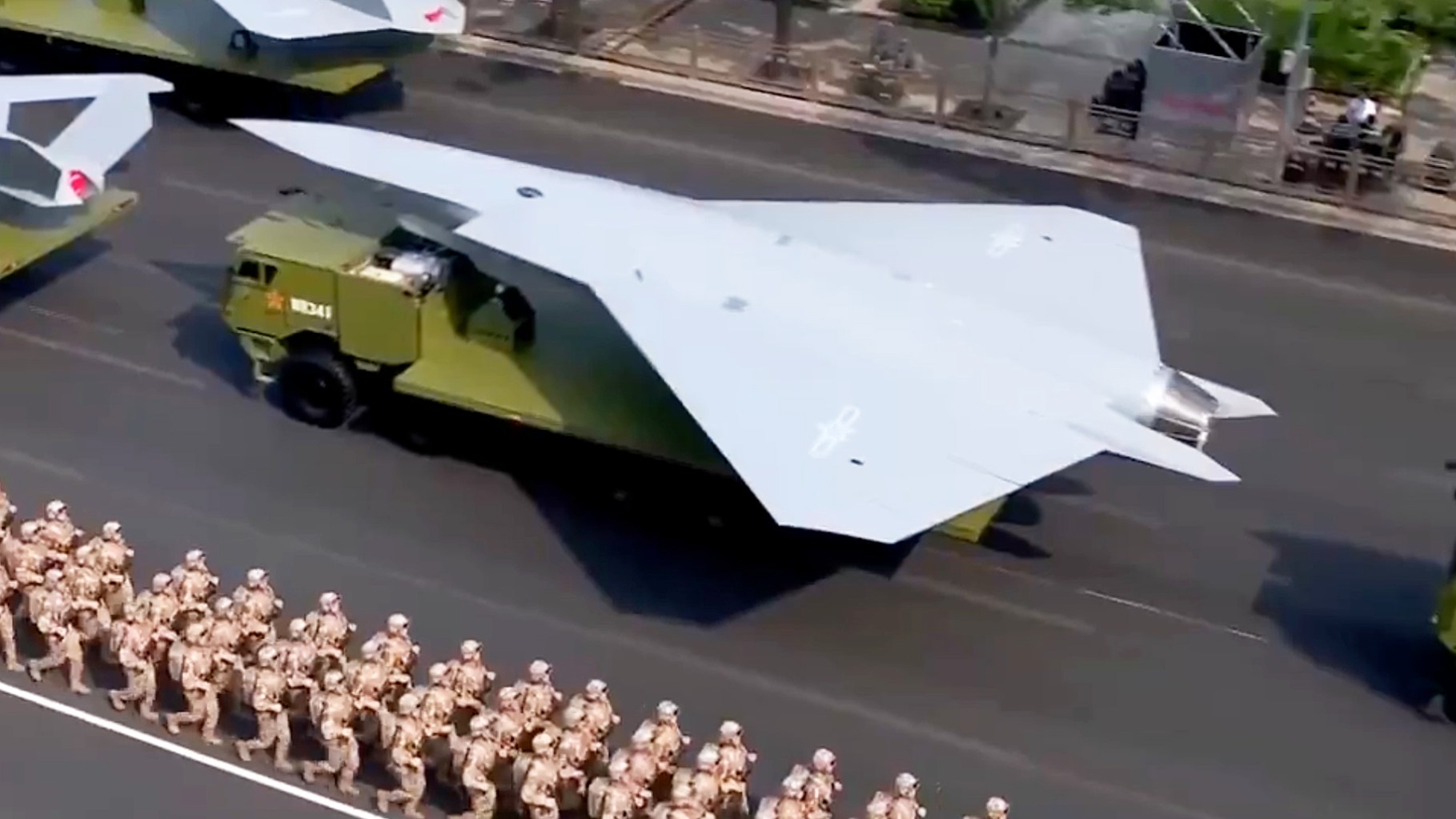
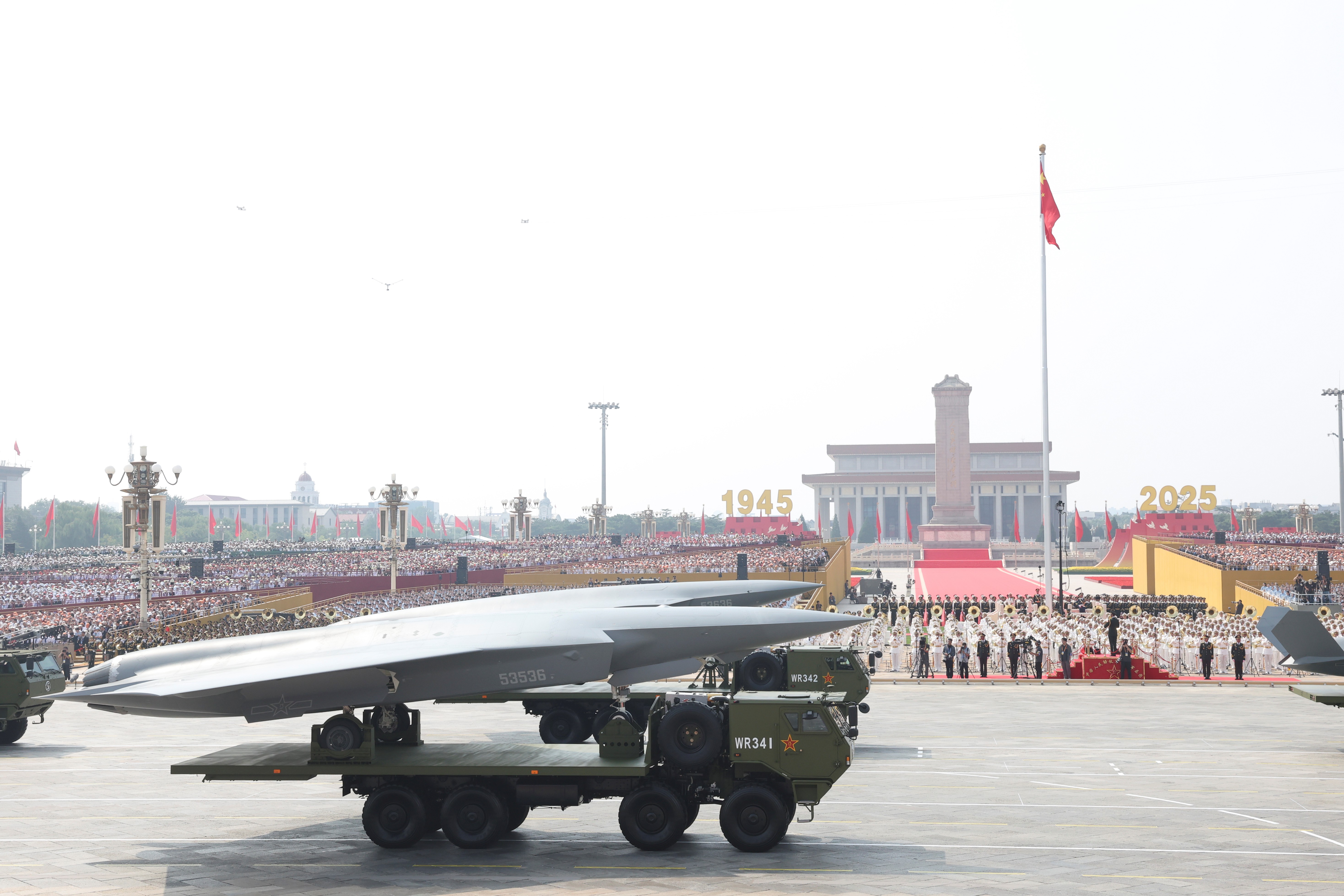
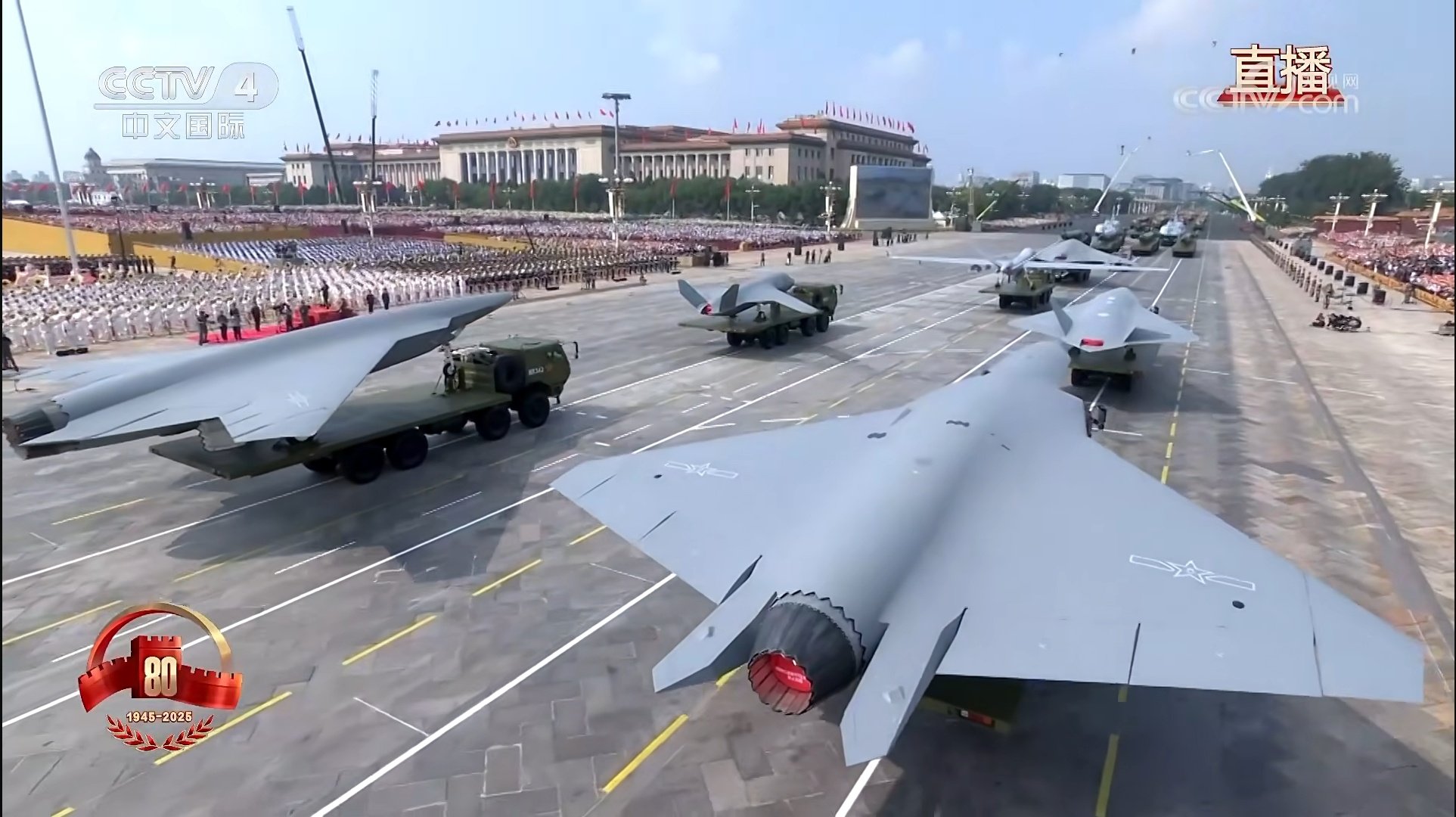
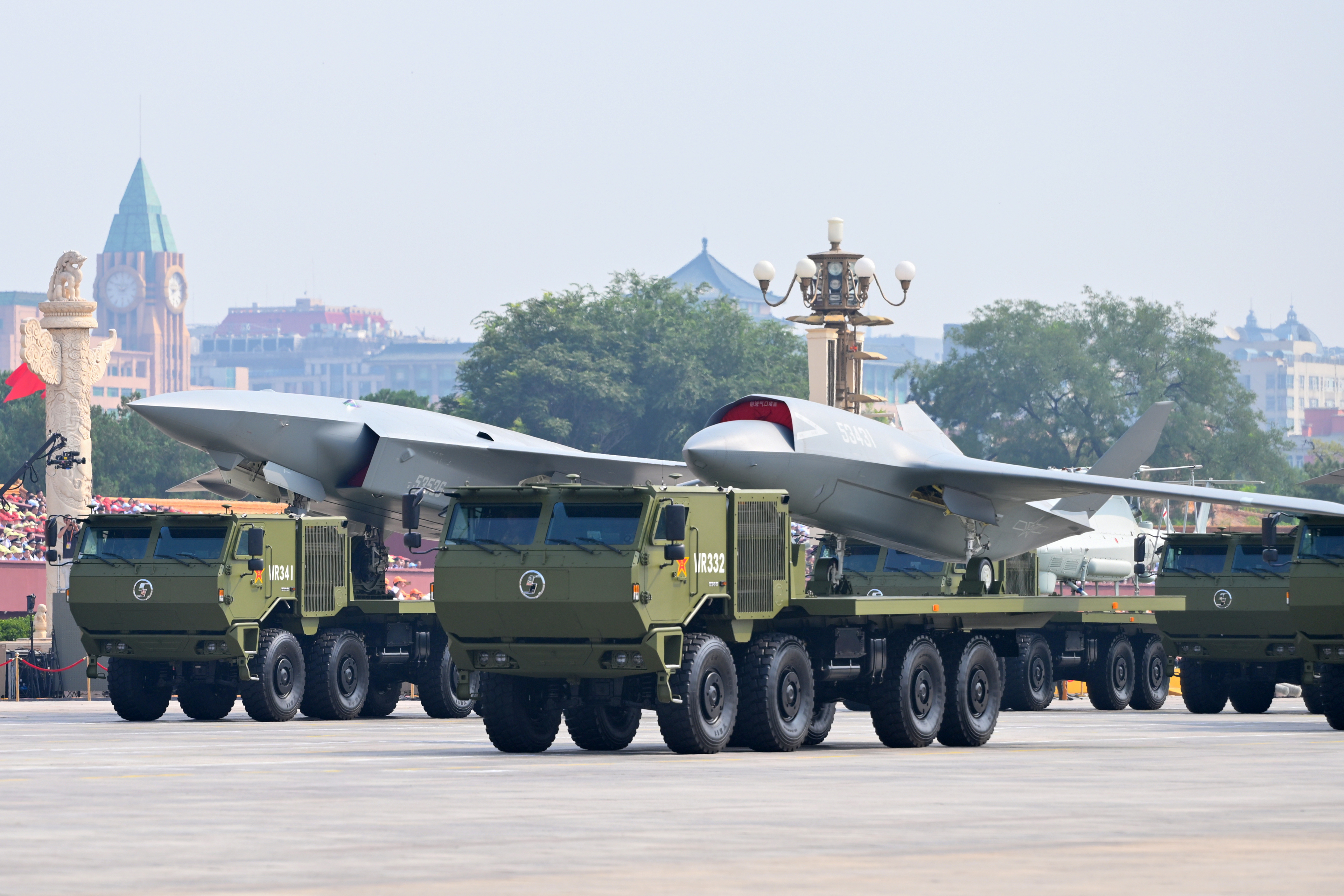
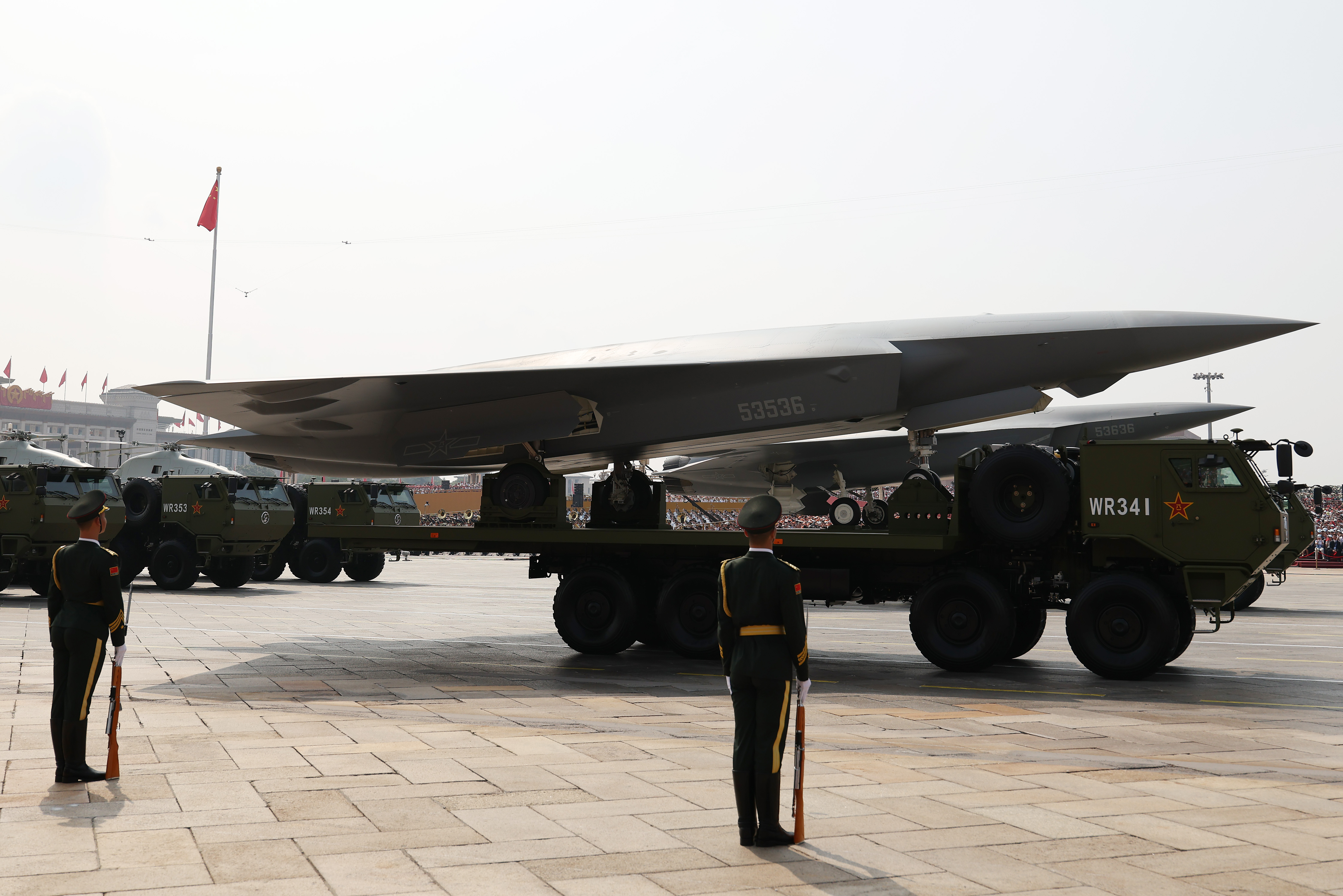
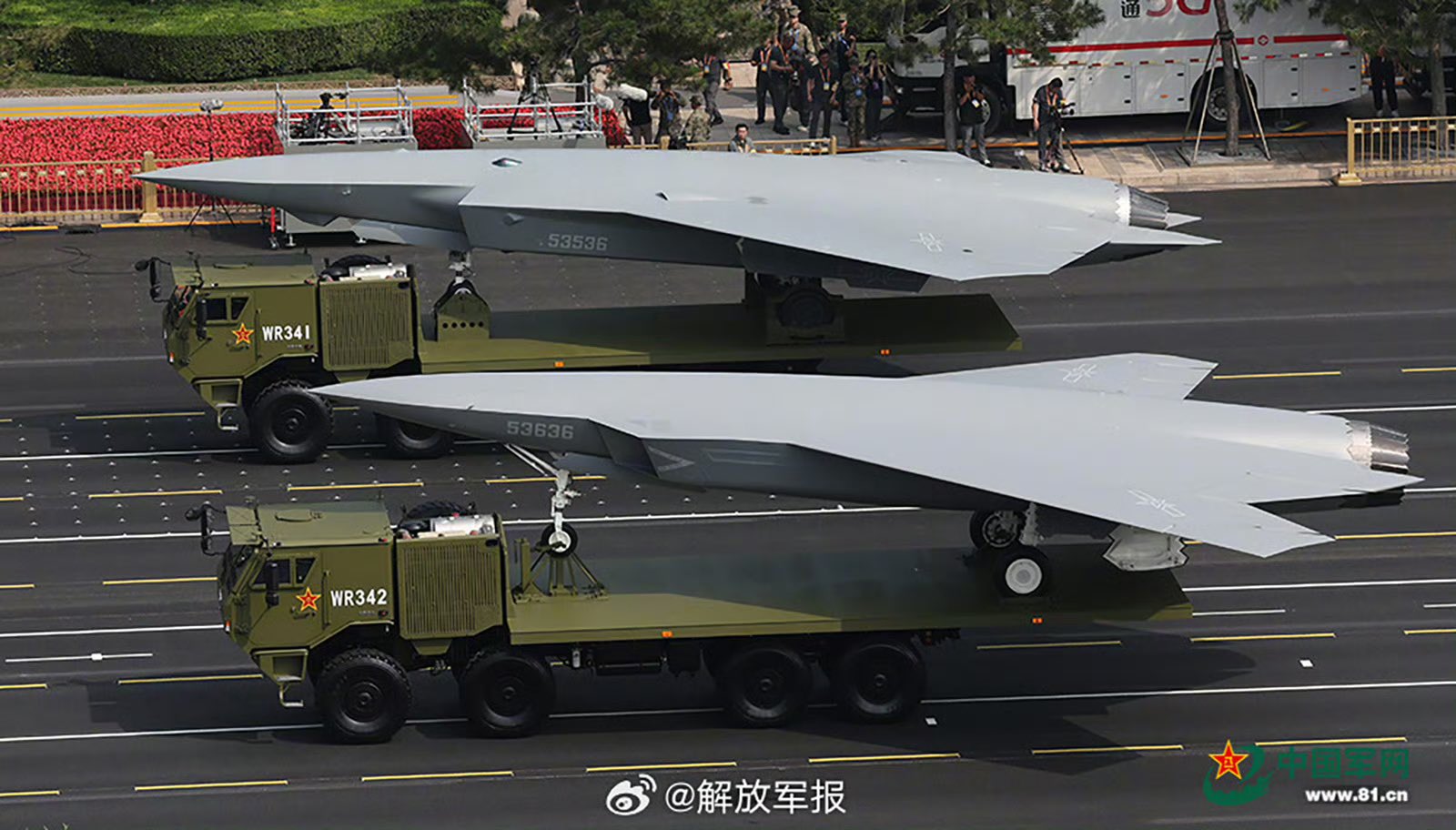
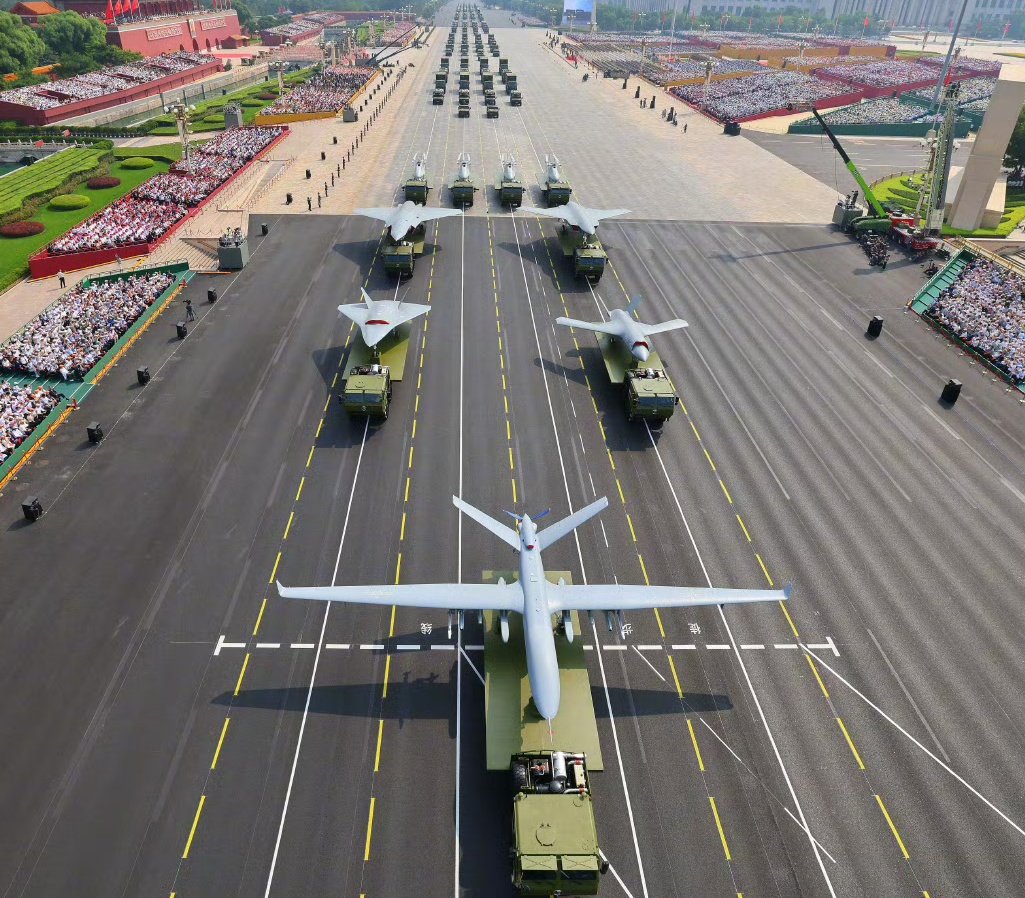
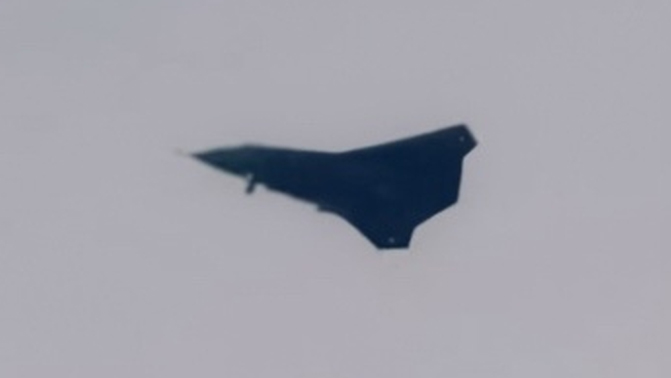
In the third row of this part of the parade, we get another good view of the different wing shapes of the Type A (right) and Type B (left) UCAV designs.
via Chinese internet
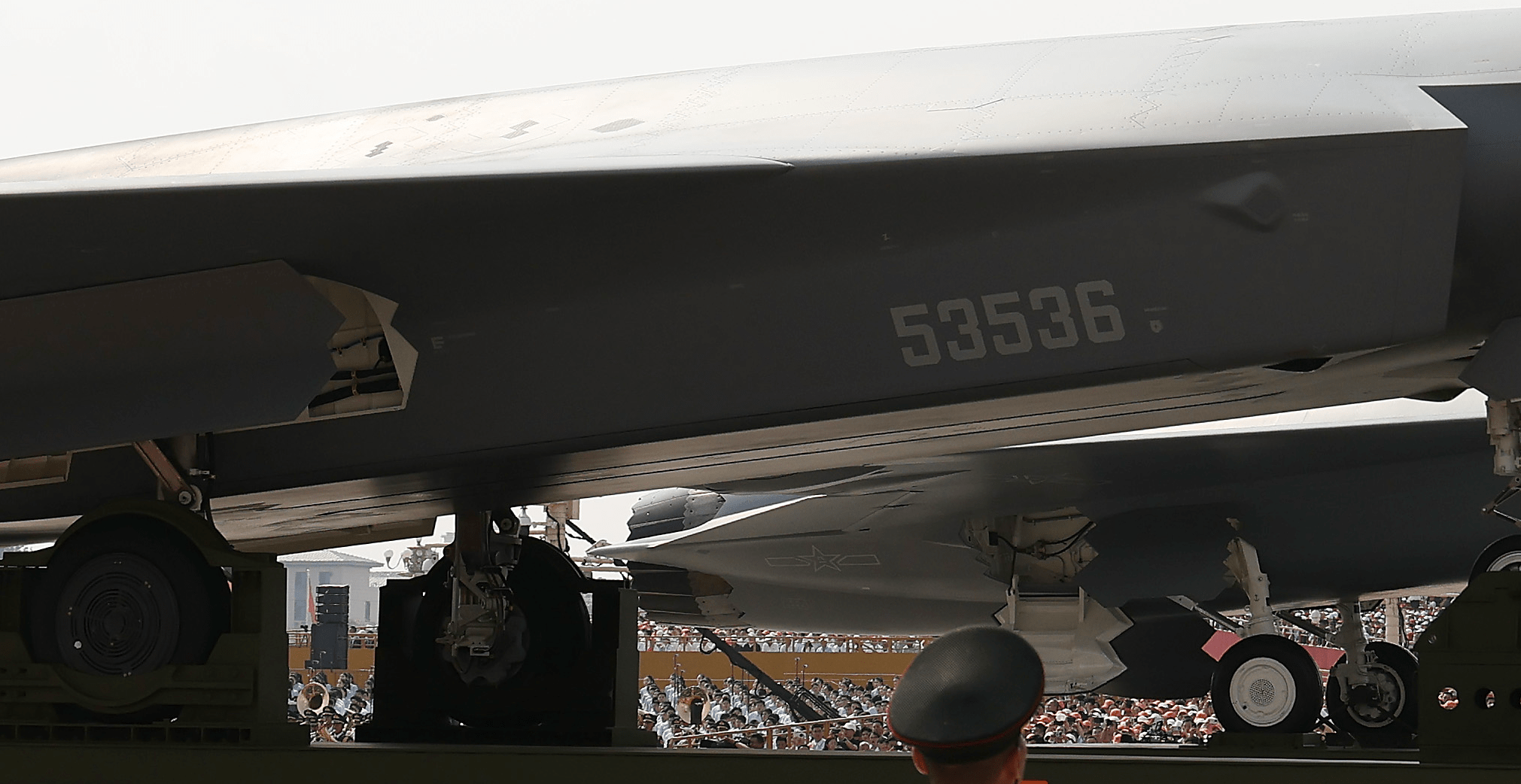
At this point, it’s worth noting that we don’t know for sure what the nature of these two new drones in the parade is, but they appear to be real aircraft, potentially even flight-capable. If they are mock-ups, they include a remarkable level of detail, down to an open access panel seen aft of the main landing gear on the Type A. Traditionally, mock-ups have been regularly shown at many major Chinese military parades in the past.
As it is, there is very little to indicate the status of the designs, in terms of where they are in their development cycle or whether they are even intended for operational service or are (currently) intended to serve as prototypes or demonstrators. Both the Type A and B drones shown in the parade had serial numbers applied that refer to an actual operational unit of the People’s Liberation Army Air Force (PLAAF). However, that’s not to say that one or both are currently operational, and there is no evidence, publicly available, of these drones having been fielded in any meaningful way.
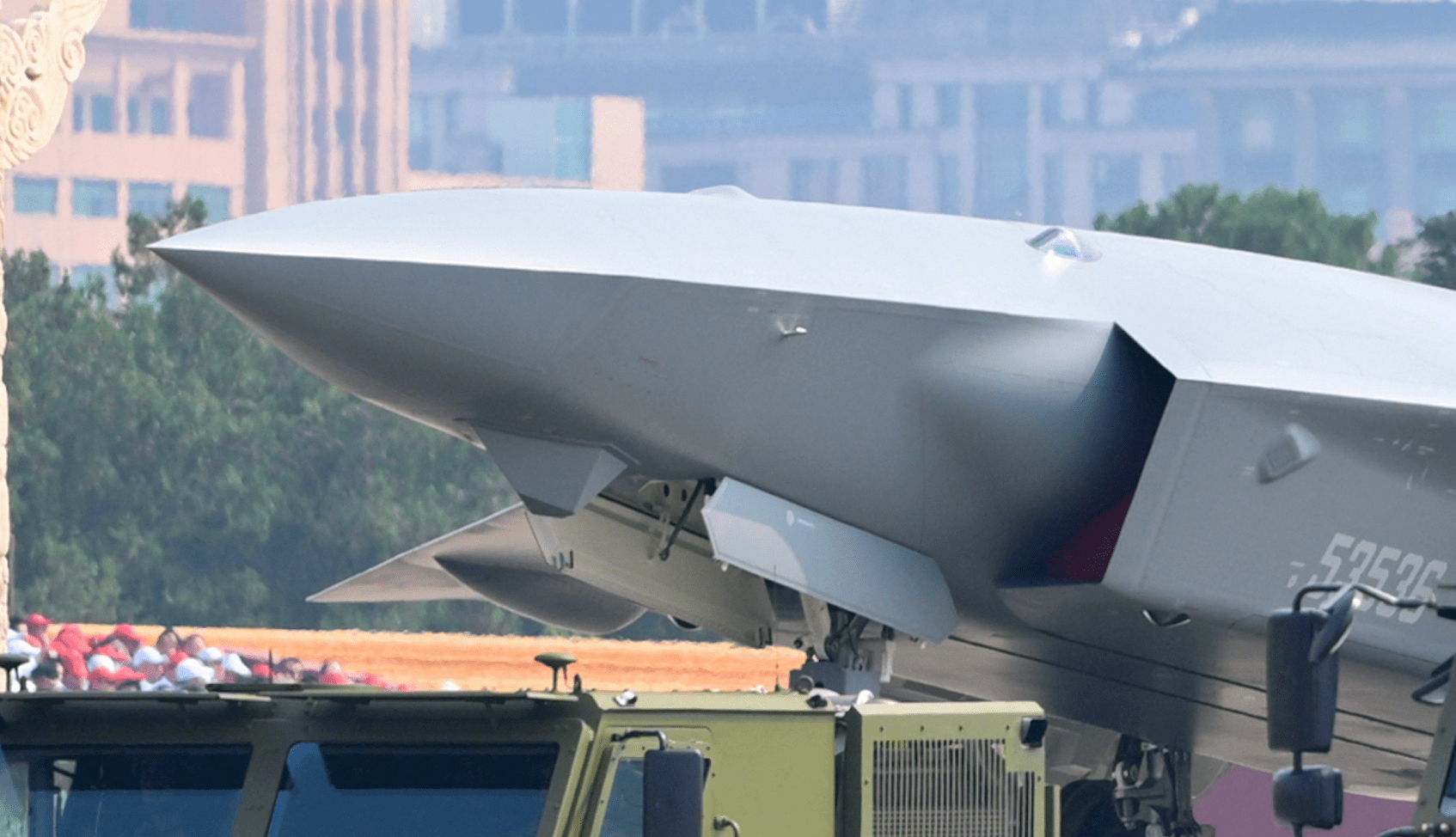
The Type A (nearest camera) and Type B UCAVs during the parade. The 53x3x serial numbers are the same as those used by a brigade of the PLAAF within the Western Theater Command.
Photo by Zhang Lei/VCG via Getty Images VCG
At the same time, it’s certainly the case that many previous designs that have appeared as parade mock-ups, including drones, have matured into very real capabilities. Of these,
the GJ-11 is among the best-known examples and had been flying for years in a less-refined form prior to its parade debut.
Like the GJ-11, the new Type B drone
appears to be intended for a UCAV role, although very likely it is also intended to have collaborative capabilities.
However, while other newly emerged Chinese drone designs more closely approximate our understanding of CCAs or CCA-type platforms, the Type B’s size and apparent complexity do indeed point more to its being a fighter-like UCAV. CCA concepts are typically more focused on some form of affordability for ‘combat mass’ — clearly not a driver for the Type A and B. For CCAs, such decisions come at the expense of payload, stealthiness, range, and especially performance. While CCAs are generally more intended for cooperative employment, true UCAVs are understood to be more capable of independent operation, or at least be designed with an eye toward that in the future.
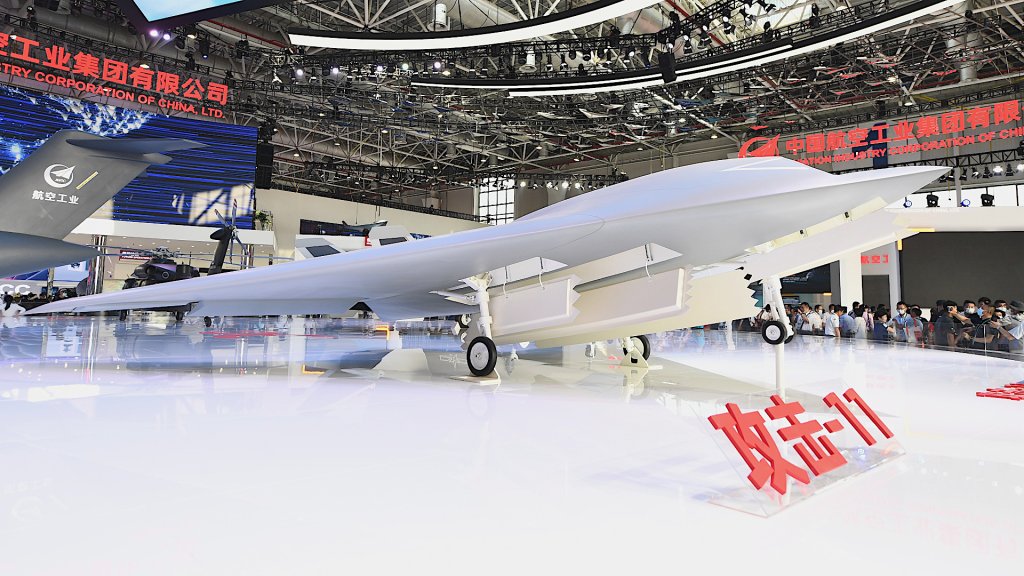
UCAVs are clearly an area in which China is also devoting extensive resources, with a steady flow of drones in this class having been noted under flight test, in satellite imagery, and in the form of scale models and mock-ups. Most prominent among these is perhaps the aforementioned GJ-11, a stealthy flying-wing UCAV, development of which has continued, refining it in the process,
with a growing eye toward future
shipboard operations.
A model of a Chinese GJ-11 Sharp Sword flying-wing UCAV on display.
Yang Suping/VCG via Getty Images Yang Suping/VCG via Getty Images
By now, it’s fairly clear that the GJ-11 is designed primarily for strike missions, with the munitions carried in a pair of internal bays, as well as performing intelligence, surveillance, and reconnaissance (ISR) tasks. Sharp Swords have also been depicted
launching decoys and carrying out what appear to be electronic warfare attacks.
The GJ-11 is just one of a number of flying-wing designs that Chinese companies
have been working on publicly
in recent years.
While also stealthy, the new drone’s apparent high-performance design focus could well point to it being envisioned for more fighter-like missions, including direct air combat with other platforms. As well as fighter-like roles, the Type B would also be able to carry out more ‘traditional’ UCAV missions, such as strike and ISR. Once again, the degree to which it might operate collaboratively in support of crewed fighters remains unclear, but this is certainly an area of study in China right now, including teaming UCAVs with crewed J-20 stealth fighters.
We have previously explored how the
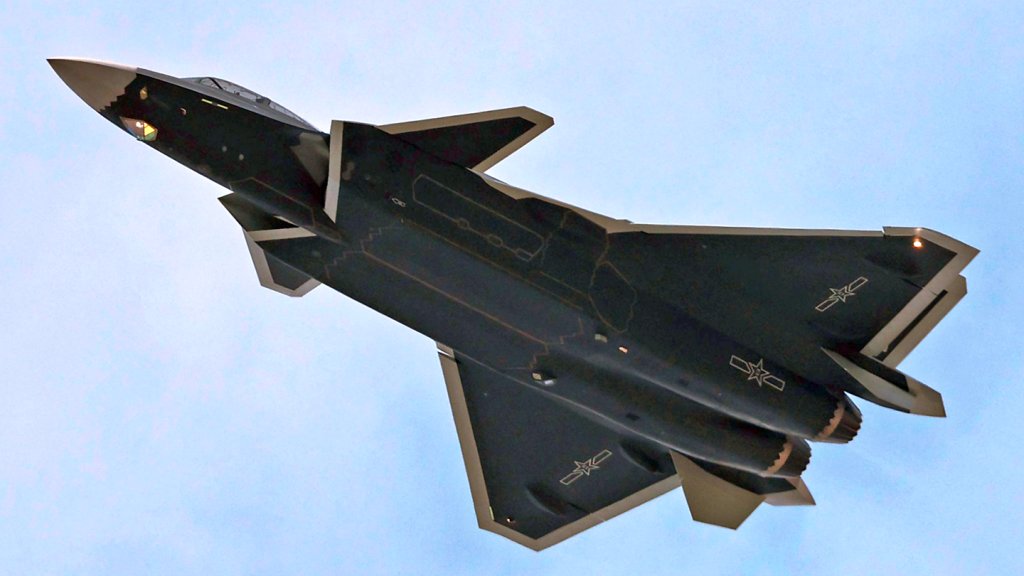
two-seat version of the J-20 that first emerged in 2021 could be especially well-suited to the airborne drone controller role.
The latest two-seat J-20S configuration, which includes a revised dark paint scheme.
via X
Again, it’s unclear if the overall concept of the new Chinese fighter-like drone is based on a ‘loyal wingman’-type drone companion to crewed fighters, or if the drone will be controlled from a ground station, or even if it will be expected to shoot down hostile aircraft with some degree of autonomy. However, while the latter point is one that the U.S. Air Force, in particular,
is increasingly grappling with, China appears to have far fewer qualms about autonomous vehicles making such life-and-death decisions.