Navigation
Install the app
How to install the app on iOS
Follow along with the video below to see how to install our site as a web app on your home screen.
Note: This feature may not be available in some browsers.
More options
Style variation
You are using an out of date browser. It may not display this or other websites correctly.
You should upgrade or use an alternative browser.
You should upgrade or use an alternative browser.
Afghan women / Girls bar from education and job.
- Thread starter ghazi52
- Start date
More options
Who Replied?


ghazi52
THINK TANK: CONSULTANT
- Thread starter
- #182
Taliban's new marriage separation decree draws UN criticism
Official decree permits annulment of child marriage contracts in Afghanistan, raising UN concerns
AFP
May 21, 2026
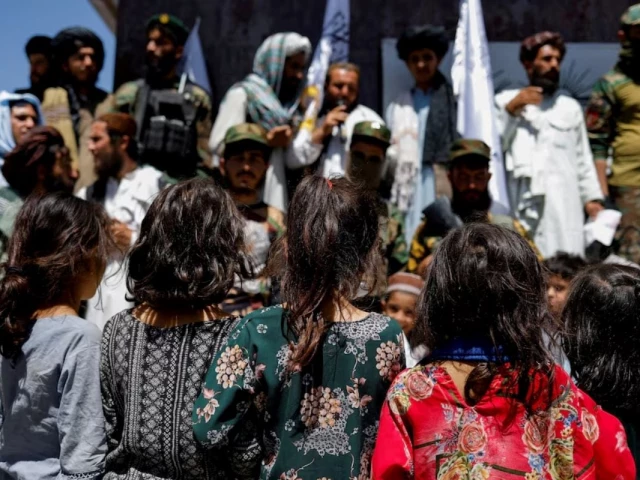
Afghan girls look at Taliban supporters on the second anniversary of the fall of Kabul on a street near the US embassy in Kabul, Afghanistan, August 15, 2023. REUTERS
The Taliban government's new decree governing the separation of spouses "reinforces systemic discrimination" and erodes the rights of Afghan women and girls, the United Nations said on Thursday.
Published in mid-May, the 31-article code sets out various grounds for separation in Afghanistan, including a husband's prolonged disappearance, "incompatibility" between couples, renunciation of Islam and "failure on the part of the husband".
The decree, which appeared in the country's Official Gazette, also states that marriage contracts drawn up by relatives "on behalf of a minor boy or girl" can be annulled, which suggests child marriage is permitted in Afghanistan, according to the UN.
In most cases, the procedures for women seeking a separation are more complicated than those for men.
The document, approved by Supreme Leader Hibatullah Akhundzada, "is part of a broader and deeply concerning trajectory in which the rights of Afghan women and girls are being eroded", said Georgette Gagnon, deputy special representative of the UN secretary-general.
It "further entrenches systemic discrimination in law and practice", the UN statement said, adding that women and girls are denied "autonomy, opportunities and access to justice".
Since returning to power in 2021, the Taliban government has banned girls from continuing their education beyond primary school, walking in parks and going to gyms, swimming pools or beauty salons.
They are required to cover themselves from head to toe and are barred from many jobs.
Any breach of the rules can result in arrest and imprisonment.
ghazi52
THINK TANK: CONSULTANT
- Thread starter
- #183
The UN's Afghanistan mission (UNAMA) said that following a decree issued in 2021 in which the Taliban authorities had "recognised certain rights for women, including women's consent to marriage", subsequent legislation has ultimately eroded those protections.
Article 5 of the decree has drawn widespread criticism.
It sets out the procedures for the separation of minors whose family members enter into a marriage contract on their behalf, which "implies that child marriage is permitted", according to UNAMA.
"If any relative other than the father or grandfather concludes a marriage contract on behalf of a minor boy or a minor girl with a compatible spouse and for a customary dower, the contract shall be valid," the decree says, before outlining how the boy or girl can choose to annul at puberty if approved by a court.
According to a traditional practice that has been in place in some families in Afghanistan for decades, parents promise that their child will marry a child from the other family.
However, the marriage contract is only concluded later, as sexual relations before puberty are prohibited under Islamic law.
Article 5 of the decree has drawn widespread criticism.
It sets out the procedures for the separation of minors whose family members enter into a marriage contract on their behalf, which "implies that child marriage is permitted", according to UNAMA.
"If any relative other than the father or grandfather concludes a marriage contract on behalf of a minor boy or a minor girl with a compatible spouse and for a customary dower, the contract shall be valid," the decree says, before outlining how the boy or girl can choose to annul at puberty if approved by a court.
According to a traditional practice that has been in place in some families in Afghanistan for decades, parents promise that their child will marry a child from the other family.
However, the marriage contract is only concluded later, as sexual relations before puberty are prohibited under Islamic law.
ghazi52
THINK TANK: CONSULTANT
- Thread starter
- #184
UN urges Afghan Taliban to end arrests of women over dress rules
- 'We remind the de facto authorities that all people have the right to freedom of movement and that all persons, both women and men,' UNAMA says
June 8, 2026
KABUL: The United Nations mission in Afghanistan has expressed concern over the arrest and detention of women in a western province for allegedly failing to comply with “dress requirements” and urged Taliban authorities to treat all people equally.
The United Nations Assistance Mission in Afghanistan (UNAMA) did not specify how many women had been affected, though local media reported last week that at least 21 women and girls were detained in Herat province.
The Afghan Taliban did not respond to Reuters request for comment.
“UNAMA is concerned over multiple arrests and detentions of women in Herat…for alleged non-compliance with dress requirements, which raises serious human rights concerns,” UNAMA said in a post on X late on Sunday.


ghazi52
THINK TANK: CONSULTANT
- Thread starter
- #186
UNAMA voices concern over reported detention of women in Herat
The Frontier Post

HERAT (Ariana News): The United Nations Assistance Mission in Afghanistan (UNAMA) has expressed concern over reports that several women in Herat province have been detained for allegedly failing to comply with dress requirements, warning that the incidents raise serious human rights concerns.
In a statement issued on Sunday, UNAMA said it had received reports of multiple arrests and detentions of women in Herat linked to alleged violations of dress regulations and was closely monitoring the situation.
“UNAMA is concerned over multiple arrests and detentions of women in Herat for alleged non-compliance with dress requirements, which raises serious human rights concerns,” the mission said.
The UN mission reiterated that freedom of movement is a fundamental right and stressed that both women and men are entitled to equal protection under the law.
The statement comes as the rights of women and girls in Afghanistan continue to be a key issue in discussions between the Islamic Emirate and the international community. International organizations have repeatedly called for the protection of fundamental rights, while the Islamic Emirate maintains that women’s rights are safeguarded in accordance with Sharia law.
Authorities have not yet publicly responded to UNAMA’s statement.

Distant_Observer
Trusted Member

RescueRanger
Meme Lord
Talib = students... The irony in all of this is delicious.
ghazi52
THINK TANK: CONSULTANT
- Thread starter
- #189
After detentions, Taliban impose new restrictions on girls’ schools in Herat
by The Frontier Post

HERAT (Amu tv): Taliban have imposed new restrictions on girls’ schools and religious seminaries in Herat, according to local sources, as their crackdown on women and public dissent continues to draw domestic and international scrutiny.
Sources told Amu TV on Saturday that Taliban morality police, or the PVPV enforcers, have warned administrators at several girls’ educational institutions that they could face closure if students are found not complying with Taliban-mandated dress requirements.
According to the sources, the requirements include wearing a prayer chador, face covering and socks. Taliban morality enforcers have also reportedly warned older female students, whom “authorities” consider to have reached puberty, not to attend school or religious classes without the prescribed attire.
Several families in Herat said similar warnings had been delivered to school administrators in recent days. Some parents said even young girls have been told they will not be allowed to attend classes unless they wear the required clothing.
The measures come days after Taliban detained at least 30 women in Herat over alleged violations of dress regulations, sparking rare public protests and a widening international backlash.
Some girls in Herat told Amu TV that fear of arrest has led them to avoid public spaces and leave their homes only when necessary.
Growing concern over restrictions
The latest restrictions coincide with reports of broader enforcement efforts targeting women across the province.
Doctors Without Borders, MSF, said on Friday that one of its female staff members in Herat was detained for two days after being accused of violating Taliban dress requirements while traveling to work at an MSF-supported hospital.
ghazi52
THINK TANK: CONSULTANT
- Thread starter
- #190
Amnesty says new Taliban decree institutionalizes child marriag
The Frontier Post

KABUL (Amu tv): A new Taliban decree governing marital separation effectively legitimizes child marriage and further strips women and girls of their rights and autonomy, Amnesty International said in a legal analysis of the measure.
The decree, known as Decree No. 18, the “Code on Judicial Separation of Spouses,” was published in the Taliban’s official gazette on May 14 and sets out the circumstances under which women and girls may seek separation from their husbands.
According to Amnesty International, the code preserves marriages arranged during childhood, limits the ability of women and girls to challenge such unions and strengthens the authority of male relatives over marriage decisions.
“This code further compounds the already dismal situation for the rights of women and girls in Afghanistan,” Isabelle Lassee, Amnesty International’s deputy regional director for South Asia, said in a statement.
“It effectively strips them of all autonomy by eliminating any notion of consent, granting male relatives control over marital arrangements, and providing minimal avenues to challenge forced unions.”
The rights group said the decree institutionalizes practices that facilitate child marriage, including provisions that allow fathers and grandfathers broad authority to arrange marriages for minors.
ghazi52
THINK TANK: CONSULTANT
- Thread starter
- #191
Among the provisions cited by Amnesty is a clause that interprets a girl’s silence after reaching puberty as consent to marriage, a standard the organization said increases the risk of coercion and forced marriage.
The decree also recognizes some marriages arranged by extended family members as legally valid under certain circumstances.
Amnesty said the measure reinforces a male guardianship system that treats women as subjects of male authority rather than independent rights holders.
“The code reinforces a male guardianship system that centralizes authority over women’s personal lives,” Lassee said.
The organization argued that the decree violates international human rights standards protecting individuals from child and forced marriage and guaranteeing equality in marriage.
The decree also recognizes some marriages arranged by extended family members as legally valid under certain circumstances.
Amnesty said the measure reinforces a male guardianship system that treats women as subjects of male authority rather than independent rights holders.
“The code reinforces a male guardianship system that centralizes authority over women’s personal lives,” Lassee said.
The organization argued that the decree violates international human rights standards protecting individuals from child and forced marriage and guaranteeing equality in marriage.
ghazi52
THINK TANK: CONSULTANT
- Thread starter
- #192
New barriers to separation
The decree also imposes significant legal obstacles on girls and women seeking to challenge or dissolve marriages, Amnesty said.
According to Amnesty, girls can contest marriages only through court approval and only after reaching puberty. Men, by contrast, generally retain the ability to divorce unilaterally without comparable judicial or procedural requirements.
The organization said the disparity reflects systematic gender discrimination within the Taliban’s legal framework.
Prior to the decree’s publication, marital disputes and separations were handled through a combination of Taliban religious decrees, interpretations of Hanafi jurisprudence and rulings by Taliban judges.
Amnesty said the new code formally codifies practices that had previously been applied inconsistently.
The decree also imposes significant legal obstacles on girls and women seeking to challenge or dissolve marriages, Amnesty said.
According to Amnesty, girls can contest marriages only through court approval and only after reaching puberty. Men, by contrast, generally retain the ability to divorce unilaterally without comparable judicial or procedural requirements.
The organization said the disparity reflects systematic gender discrimination within the Taliban’s legal framework.
Prior to the decree’s publication, marital disputes and separations were handled through a combination of Taliban religious decrees, interpretations of Hanafi jurisprudence and rulings by Taliban judges.
Amnesty said the new code formally codifies practices that had previously been applied inconsistently.
ghazi52
THINK TANK: CONSULTANT
- Thread starter
- #193
Part of broader restrictions
The decree is the latest in a series of measures imposed by the Taliban since returning to power in August 2021.
According to UN figures cited by Amnesty International, the Taliban have issued more than 470 decrees, directives and orders since their takeover, including at least 79 specifically targeting women and girls.
Those measures include bans on secondary and university education for girls, restrictions on women’s employment, limitations on travel and public participation, and increasingly strict rules governing dress and movement.
The decree has also drawn concern from UN officials.
Earlier this month, Georgette Gagnon, the acting head of the United Nations Assistance Mission in Afghanistan, told the UN Security Council that Decree No. 18 violates core principles of the Convention on the Elimination of All Forms of Discrimination Against Women and children’s rights protections.
She said the measure was among a series of Taliban actions that are institutionalizing a system increasingly at odds with Afghanistan’s international human rights obligations.
The decree is the latest in a series of measures imposed by the Taliban since returning to power in August 2021.
According to UN figures cited by Amnesty International, the Taliban have issued more than 470 decrees, directives and orders since their takeover, including at least 79 specifically targeting women and girls.
Those measures include bans on secondary and university education for girls, restrictions on women’s employment, limitations on travel and public participation, and increasingly strict rules governing dress and movement.
The decree has also drawn concern from UN officials.
Earlier this month, Georgette Gagnon, the acting head of the United Nations Assistance Mission in Afghanistan, told the UN Security Council that Decree No. 18 violates core principles of the Convention on the Elimination of All Forms of Discrimination Against Women and children’s rights protections.
She said the measure was among a series of Taliban actions that are institutionalizing a system increasingly at odds with Afghanistan’s international human rights obligations.
ghazi52
THINK TANK: CONSULTANT
- Thread starter
- #194
Before the Taliban’s return to power, Afghanistan’s civil code set the legal age of marriage for girls at 16, while marriages involving girls younger than 15 were criminalized under the 2009 Law on the Elimination of Violence Against Women.
Those legal protections, along with family courts and institutions dedicated to addressing violence against women and child marriage, were dismantled after the Taliban takeover.
Amnesty International called on governments and international organizations to increase diplomatic pressure on the Taliban and demand the reversal of laws and policies that discriminate against women and girls.
The organization also urged the restoration of legal protections and judicial mechanisms aimed at safeguarding women’s rights in Afghanistan.
Those legal protections, along with family courts and institutions dedicated to addressing violence against women and child marriage, were dismantled after the Taliban takeover.
Amnesty International called on governments and international organizations to increase diplomatic pressure on the Taliban and demand the reversal of laws and policies that discriminate against women and girls.
The organization also urged the restoration of legal protections and judicial mechanisms aimed at safeguarding women’s rights in Afghanistan.
ghazi52
THINK TANK: CONSULTANT
- Thread starter
- #195
West Afghanistan female dress-code crackdown hits businesses
The Frontier Post

HERAT (AFP) : Businesses in Afghanistan’s western city of Herat have suffered from a downturn in female customers opting to stay home following a recent crackdown by morality police on women’s attire, according to shopkeepers, drivers and residents.
Dozens of women were detained by the Taliban government’s morality police in early June on accusations they were violating official dress codes by not wearing the body-cloaking chador or burqa.
A rare protest against the restrictions was violently dispersed with at least two people killed, according to the United Nations.
“Since those incidents occurred… there were no women in the markets,” 26-year-old Ramin Ghafoori, a Herat-based businessman who runs a tailoring shop, told AFP.
Female shoppers dominate the customer base of the normally bustling markets in Herat, Afghanistan’s western commercial hub and one of its largest cities.
“Ninety percent of our sales are to women, women come to buy even for men,” said Nazeer Ahmad Azimi, who runs a shoe store, noting men were often too busy to shop, occupied in the job opportunities that have shrunk for women.
He estimated that the recent ramp-up of enforcement in restrictions on women had halved the turnover in the city’s markets.
A spokesman for Herat’s city administration did not immediately respond to a request for comment on the fallout of restrictions.
Users who are viewing this thread
Total: 1 (members: 0, guests: 1)
Pakistan Defence Latest


Country Watch Latest


Latest Posts
-

-
 Makkah Defence Alliance: Turkey, Saudi Arabia, and Pakistan, news & updates (66 Viewers)
- Latest: Oldenwisdom...قول بزرگ
-
-

-
