Navigation
Install the app
How to install the app on iOS
Follow along with the video below to see how to install our site as a web app on your home screen.
Note: This feature may not be available in some browsers.
More options
Style variation
You are using an out of date browser. It may not display this or other websites correctly.
You should upgrade or use an alternative browser.
You should upgrade or use an alternative browser.
AI, Software, Coding, Internet Security Thread
- Thread starter Indos
- Start date
More options
Who Replied?

Indos
INT'L MOD
- Thread starter
- #50
The Double-Edged Sword of AI in the Energy Sector
By Haley Zaremba - Oct 13, 2024, 2:00 PM CDT- AI's rapid growth is driving a significant increase in energy consumption, posing a potential threat to power grids.
- However, AI can also be a powerful tool for improving grid efficiency, managing renewable energy sources, and developing advanced energy storage solutions.
- The future of energy grids depends on balancing the risks and rewards of AI integration, ensuring its benefits are harnessed while mitigating its potential negative impacts.

AI could cause a catastrophic collapse of under-prepared electric grids and walk back advancements in the decarbonization of the tech industry – or, it could be the sector’s saving grace.
Artificial Intelligence requires a stunning amount of energy to train and power its complex computations. As the sector explodes, the computational power necessary to sustain its growth is doubling every 100 days, approximately. Experts project that at a global level, the AI secor alone will be responsible for 3.5 percent of all energy consumption by 2030. In the United States, the energy consumption of data centers by 2030 will be about 9%, about double its current rate, driven in large part by domestic AI growth. These blistering growth rates will have major implications for national and international energy security, greenhouse gas emissions, and the economy.
“When you look at the numbers, it is staggering,” Jason Shaw, chairman of the Georgia Public Service Commission, an electricity regulator, told the Washington Post earlier this year. “It makes you scratch your head and wonder how we ended up in this situation. How were the projections that far off? This has created a challenge like we have never seen before.”
Despite the major and unprecedented challenges that AI poses to power grids, it could also be a key tool for improving them and bringing them up to speed for the electrification era. The United States Department of Energy (DoE) has noted that AI could be invaluable in managing smart grids capable of handling huge inflows and outflows of variable energies like wind and solar, but introduces significant risks if deployed ‘naïvely.’ Furthermore, “machine learning could help electric utilities improve permitting and siting, reliability, resilience and grid planning,” the DoE report posits.
And now, AI is being used to efficiently identify solutions to one of the clean energy transition’s trickiest problems – reliable and cost-effective long-term energy storage. One team of researchers from Pacific Northwest National Laboratory (PNNL) and Argonne National Laboratory have used AI to help narrow down potential combinations of solvents for flow-battery models that are three times more efficient than current models. Instead of using AI to help them conduct more experiments faster, the team used AI technology to rapidly eliminate thousands of potential combinations and narrow in on the ones worth testing out in the lab.
"I'm excited to see the future of collaboration between AI researchers and materials scientists," said Karl Mueller, a co-author of the study and the Director of the Program Development Office for the Physical and Computational Sciences Directorate. "Accelerating materials discovery is critical to solving energy storage problems."
In other applications, AI is being used to make battery storage systems smarter through its use in energy demand management, arbitrage (a.k.a. time shifting to match supply of renewable energy with demand), weather forecasting, and predictive maintenance. A number of start-ups have been cropping up in recent years to pilot these approaches, and the fast-growing AI energy storage market is on track to reach US$11 billion by 2026.
These approaches are also being introduced on a smaller scale, within electric vehicle systems, to improve EV energy storage capabilities. “The integration of Artificial Intelligence (AI) in Energy Storage Systems (ESS) for Electric Vehicles (EVs) has emerged as a pivotal solution to address the challenges of energy efficiency, battery degradation, and optimal power management,” reads a scientific paper published in May in Electronics.
All of these advances are extremely promising for stabilizing energy grids in an era of unprecedented strain and rapid growth of electrification coupled with a rise in variable energy sources. However, the risks of increased AI use remain dire, not just in terms of runaway energy consumption and associated greenhouse gas emissions, but also for cybersecurity and use in real-world situations which can sharply diverge from statistical modeling, like extreme weather events.
By Haley Zaremba for Oilprice.com

The Double-Edged Sword of AI in the Energy Sector | OilPrice.com
AI's impact on energy grids, offering both challenges and opportunities, is explored in this article.
 oilprice.com
Indos
INT'L MOD
- Thread starter
- #53
Artificial Intelligence
Shareshare
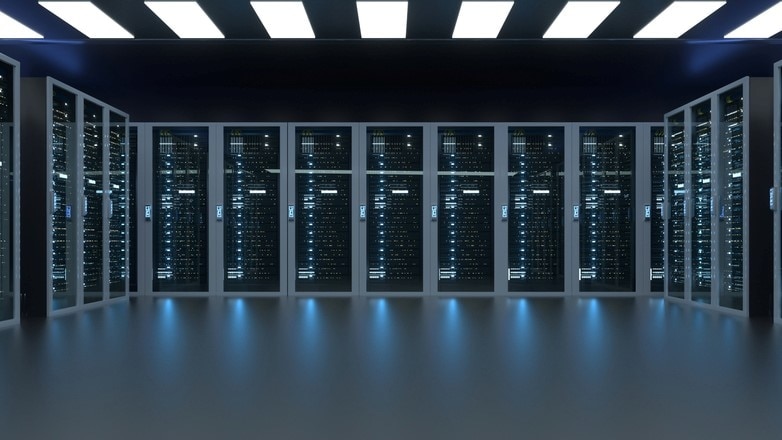
On average, a ChatGPT query needs nearly 10 times as much electricity to process as a Google search. In that difference lies a coming sea change in how the US, Europe, and the world at large will consume power — and how much that will cost.
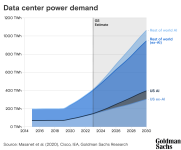
For years, data centers displayed a remarkably stable appetite for power, even as their workloads mounted. Now, as the pace of efficiency gains in electricity use slows and the AI revolution gathers steam, Goldman Sachs Research estimates that data center power demand will grow 160% by 2030.
At present, data centers worldwide consume 1-2% of overall power, but this percentage will likely rise to 3-4% by the end of the decade. In the US and Europe, this increased demand will help drive the kind of electricity growth that hasn’t been seen in a generation. Along the way, the carbon dioxide emissions of data centers may more than double between 2022 and 2030.
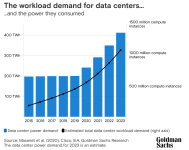
But since 2020, the efficiency gains appear to have dwindled, and the power consumed by data centers has risen. Some AI innovations will boost computing speed faster than they ramp up their electricity use, but the widening use of AI will still imply an increase in the technology’s consumption of power. A single ChatGPT query requires 2.9 watt-hours of electricity, compared with 0.3 watt-hours for a Google search, according to the International Energy Agency. Goldman Sachs Research estimates the overall increase in data center power consumption from AI to be on the order of 200 terawatt-hours per year between 2023 and 2030. By 2028, our analysts expect AI to represent about 19% of data center power demand.
In tandem, the expected rise of data center carbon dioxide emissions will represent a “social cost” of $125-140 billion (at present value), our analysts believe. “Conversations with technology companies indicate continued confidence in driving down energy intensity but less confidence in meeting absolute emissions forecasts on account of rising demand,” they write. They expect substantial investments by tech firms to underwrite new renewables and commercialize emerging nuclear generation capabilities. And AI may also provide benefits by accelerating innovation — for example, in health care, agriculture, education, or in emissions-reducing energy efficiencies.
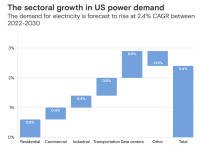
That kind of spike in power demand hasn’t been seen in the US since the early years of this century. It will be stoked partly by electrification and industrial reshoring, but also by AI. Data centers will use 8% of US power by 2030, compared with 3% in 2022.
US utilities will need to invest around $50 billion in new generation capacity just to support data centers alone. In addition, our analysts expect incremental data center power consumption in the US will drive around 3.3 billion cubic feet per day of new natural gas demand by 2030, which will require new pipeline capacity to be built.
Going forward, between 2023 and 2033, thanks to both the expansion of data centers and an acceleration of electrification, Europe’s power demand could grow by 40% and perhaps even 50%, according to Goldman Sachs Research. At the moment, around 15% of the world’s data centers are located in Europe. By 2030, the power needs of these data centers will match the current total consumption of Portugal, Greece, and the Netherlands combined.
Data center power demand will rise in two kinds of European countries, our analysts write. The first sort is those with cheap and abundant power from nuclear, hydro, wind, or solar sources, such as the Nordic nations, Spain and France. The second kind will include countries with large financial services and tech companies, which offer tax breaks or other incentives to attract data centers. The latter category includes Germany, the UK, and Ireland.
Europe has the oldest power grid in the world, so keeping new data centers electrified will require more investment. Our analysts expect nearly €800 billion ($861 billion) in spending on transmission and distribution over the coming decade, as well as nearly €850 billion in investment on solar, onshore wind, and offshore wind energy.
This article is being provided for educational purposes only. The information contained in this article does not constitute a recommendation from any Goldman Sachs entity to the recipient, and Goldman Sachs is not providing any financial, economic, legal, investment, accounting, or tax advice through this article or to its recipient. Neither Goldman Sachs nor any of its affiliates makes any representation or warranty, express or implied, as to the accuracy or completeness of the statements or any information contained in this article and any liability therefore (including in respect of direct, indirect, or consequential loss or damage) is expressly disclaimed.
 www.goldmansachs.com
AI is poised to drive 160% increase in data center power demand
May 14, 2024Shareshare
On average, a ChatGPT query needs nearly 10 times as much electricity to process as a Google search. In that difference lies a coming sea change in how the US, Europe, and the world at large will consume power — and how much that will cost.
For years, data centers displayed a remarkably stable appetite for power, even as their workloads mounted. Now, as the pace of efficiency gains in electricity use slows and the AI revolution gathers steam, Goldman Sachs Research estimates that data center power demand will grow 160% by 2030.
At present, data centers worldwide consume 1-2% of overall power, but this percentage will likely rise to 3-4% by the end of the decade. In the US and Europe, this increased demand will help drive the kind of electricity growth that hasn’t been seen in a generation. Along the way, the carbon dioxide emissions of data centers may more than double between 2022 and 2030.
How much power do data centers consume?
In a series of three reports, Goldman Sachs Research analysts lay out the US, European, and global implications of this spike in electricity demand. It isn’t that our demand for data has been meager in the recent past. In fact, data center workloads nearly tripled between 2015 and 2019. Through that period, though, data centers’ demand for power remained flattish, at about 200 terawatt-hours per year. In part, this was because data centers kept growing more efficient in how they used the power they drew, according to the Goldman Sachs Research reports, led by Carly Davenport, Alberto Gandolfi, and Brian Singer.But since 2020, the efficiency gains appear to have dwindled, and the power consumed by data centers has risen. Some AI innovations will boost computing speed faster than they ramp up their electricity use, but the widening use of AI will still imply an increase in the technology’s consumption of power. A single ChatGPT query requires 2.9 watt-hours of electricity, compared with 0.3 watt-hours for a Google search, according to the International Energy Agency. Goldman Sachs Research estimates the overall increase in data center power consumption from AI to be on the order of 200 terawatt-hours per year between 2023 and 2030. By 2028, our analysts expect AI to represent about 19% of data center power demand.
In tandem, the expected rise of data center carbon dioxide emissions will represent a “social cost” of $125-140 billion (at present value), our analysts believe. “Conversations with technology companies indicate continued confidence in driving down energy intensity but less confidence in meeting absolute emissions forecasts on account of rising demand,” they write. They expect substantial investments by tech firms to underwrite new renewables and commercialize emerging nuclear generation capabilities. And AI may also provide benefits by accelerating innovation — for example, in health care, agriculture, education, or in emissions-reducing energy efficiencies.
US electricity demand is set to surge
Over the last decade, US power demand growth has been roughly zero, even though the population and its economic activity have increased. Efficiencies have helped; one example is the LED light, which drives lower power use. But that is set to change. Between 2022 and 2030, the demand for power will rise roughly 2.4%, Goldman Sachs Research estimates — and around 0.9 percent points of that figure will be tied to data centers.That kind of spike in power demand hasn’t been seen in the US since the early years of this century. It will be stoked partly by electrification and industrial reshoring, but also by AI. Data centers will use 8% of US power by 2030, compared with 3% in 2022.
US utilities will need to invest around $50 billion in new generation capacity just to support data centers alone. In addition, our analysts expect incremental data center power consumption in the US will drive around 3.3 billion cubic feet per day of new natural gas demand by 2030, which will require new pipeline capacity to be built.
Europe needs $1 trillion-plus to prepare its power grid for AI
Over the past 15 years, Europe’s power demand has been severely hit by a sequence of shocks: the global financial crisis, the covid pandemic, and the energy crisis triggered by the war in Ukraine. But it has also suffered due to a slower-than-expected pick up in electrification and the ongoing de-industrialization of the European economy. As a result, since a 2008 peak, electricity demand has cumulatively declined by nearly 10%.Going forward, between 2023 and 2033, thanks to both the expansion of data centers and an acceleration of electrification, Europe’s power demand could grow by 40% and perhaps even 50%, according to Goldman Sachs Research. At the moment, around 15% of the world’s data centers are located in Europe. By 2030, the power needs of these data centers will match the current total consumption of Portugal, Greece, and the Netherlands combined.
Data center power demand will rise in two kinds of European countries, our analysts write. The first sort is those with cheap and abundant power from nuclear, hydro, wind, or solar sources, such as the Nordic nations, Spain and France. The second kind will include countries with large financial services and tech companies, which offer tax breaks or other incentives to attract data centers. The latter category includes Germany, the UK, and Ireland.
Europe has the oldest power grid in the world, so keeping new data centers electrified will require more investment. Our analysts expect nearly €800 billion ($861 billion) in spending on transmission and distribution over the coming decade, as well as nearly €850 billion in investment on solar, onshore wind, and offshore wind energy.
This article is being provided for educational purposes only. The information contained in this article does not constitute a recommendation from any Goldman Sachs entity to the recipient, and Goldman Sachs is not providing any financial, economic, legal, investment, accounting, or tax advice through this article or to its recipient. Neither Goldman Sachs nor any of its affiliates makes any representation or warranty, express or implied, as to the accuracy or completeness of the statements or any information contained in this article and any liability therefore (including in respect of direct, indirect, or consequential loss or damage) is expressly disclaimed.
AI is poised to drive 160% increase in data center power demand
www.goldmansachs.com
 🛠
🛠 [3D Animated Teardown]
 ⌨⌨🛠
⌨⌨🛠Users who are viewing this thread
Total: 1 (members: 0, guests: 1)


Country Watch Latest


Latest Posts
-
-
Pakistani Gunners Own Shot May Have Done Them In After Firing Point Blank Into an Earthen Berm Barely 5 Feet Away (23 Viewers)
- Latest: indo17787
-
-
-