AI, Software, Coding, Internet Security Thread

Tech giants are putting $500bn into 'Stargate' to build up AI in US​

8 hours ago


João da Silva, Natalie Sherman & Imran Rahman-Jones
Business reporters & technology reporter

To view this content we will need your consent to set third party cookies.
For more detailed information, see our cookies page.


The creator of ChatGPT, OpenAI, is teaming up with another US tech giant, a Japanese investment firm and an Emirati sovereign wealth fund to build $500bn (£405bn) of artificial intelligence (AI) infrastructure in the United States.

The new company, called The Stargate Project, was announced at the White House by President Donald Trump who billed it "the largest AI infrastructure project by far in history" and said it would help keep "the future of technology" in the US.

But Elon Musk - both a top adviser to Trump and rival to OpenAI CEO Sam Altman - on Wednesday said the venture does not "actually have the money" it has pledged to invest.

Investment in AI is currently exploding, driving demand for new data centres while also raising concerns about the huge amounts of water and power the facilities require.

The venture is a partnership between OpenAI, Oracle, Japan's Softbank - led by Masayoshi Son - and MGX, a tech investment arm of the United Arab Emirates government.

The companies said the new venture, which was in the works before Trump took office, had $100bn in funding available immediately, with the rest to come over four years, creating an estimated 100,000 jobs.

Commenting on a post on X where OpenAI detailed the plans, Musk, who owns the platform, wrote "They don't actually have the money."

"SoftBank has well under $10B secured. I have that on good authority," he added.

Musk, however, did not provide any details or substantiation for how he had arrived at the much smaller amount.

Altman then replied: "Wrong, as you surely know."

"Want to come visit the first site already under way?" Altman added. "This is great for the country. I realize what is great for the country isn't always what's optimal for your companies, but in your new role I hope you'll mostly put US first."

Musk is spearheading Trump's government efficiency efforts and will closely advise Trump on spending. He, though, has also been feuding with Altman since leaving OpenAI's board in 2018 and launching his own AI start-up.

A source close to Stargate said it was not clear where Musk had gotten his information and that the company was well-positioned to deploy $100 bn.

Stargate's first data centre is under construction in Texas, according to Oracle's chief technology officer, Larry Ellison, and more will be built in other US locations.

"I think this will be the most important project of this era," said Altman at Trump's Tuesday announcement, standing alongside the President at the White House.

"We wouldn't be able to do this without you, Mr President," he added, even though the project was underway before Trump won November's election.

'Most important project of this era'​

The US is already the world leader in AI investment, vastly outspending any other country, and its big tech companies have been making major investments into data centres in the last year.

Microsoft, one of the OpenAI's major backers, said earlier this month it was on track to invest $80bn to build out AI-focused data centres this year.

It is also involved in a $100bn venture that includes BlackRock and MGX and is focused on making AI data centre investments.

Amazon has been pouring money into the centres at a similar scale, announcing two projects worth about $10bn each in just the last two months.

In a report last year, McKinsey said that global demand for data centre capacity would more than triple by 2030, growing between 19% and 27% annually by 2030.

For developers to meet that demand, the consultancy estimated that at least twice the capacity would have to be built by 2030 as has been constructed since 2000.

But analysts have warned that the process is likely to be bogged down by issues such as power and land constraints and permitting.

Trump, who has claimed credit for fostering business investment, promised he would intervene to help the industry.

"I'm going to help a lot through emergency declarations because we have an emergency," he said, stressing the importance of keeping AI in the US.

Trump said his government would "make it possible for them to get that production done very easily."

Mushrooming demand​

OpenAI has long called for more investment into data centres for AI. The Information, a technology news website, first reported on the Stargate project in March last year.

Other technology partners include British chipmaker Arm, US chipmaker Nvidia and Microsoft, which already has a partnership with OpenAI.

Along with Musk's scepticism about funding for the specific project, there are growing concerns generally about the data centres taxing energy supplies and questions about the role of foreign investors.

In one of his final acts in the White House, former President Joe Biden put forward rules that would restrict exports of AI-related chips to dozens of countries around the world, saying the move would help the US control the industry.

He also issued orders related to the development of data centres on government land, which spotlighted a role for clean energy in powering the centres.

 
To view this content we will need your consent to set third party cookies.
For more detailed information, see our cookies page.


Microsoft CEO Satya Nadella on $500B Stargate project: Our partnership with OpenAI continues​

 
To view this content we will need your consent to set third party cookies.
For more detailed information, see our cookies page.


OpenAI Product Chief on Trump’s ‘Stargate,’ New AI Models and Agents | WSJ​


To view this content we will need your consent to set third party cookies.
For more detailed information, see our cookies page.


Anthropic CEO: More confident than ever that we're 'very close' to powerful AI capabilities​


To view this content we will need your consent to set third party cookies.
For more detailed information, see our cookies page.


Inside Anthropic's Race to Build a Smarter Claude and Human-Level AI | WSJ​

 
Last edited:
To view this content we will need your consent to set third party cookies.
For more detailed information, see our cookies page.


Salesforce CEO Marc Benioff: Don't think Microsoft will use OpenAI in the future​


To view this content we will need your consent to set third party cookies.
For more detailed information, see our cookies page.


Bridgewater's Ray Dalio: The applications of AI are under-discounted​

 
To view this content we will need your consent to set third party cookies.
For more detailed information, see our cookies page.


The Big AI Reset Is Here - Build Wealth & Get Ahead While Others Fall Behind | Marc Andreessen​

 
To view this content we will need your consent to set third party cookies.
For more detailed information, see our cookies page.


OpenAI launches preview of 'Operator' AI agent​


To view this content we will need your consent to set third party cookies.
For more detailed information, see our cookies page.
 
To view this content we will need your consent to set third party cookies.
For more detailed information, see our cookies page.


12 Beginner Python Projects - Coding Course​

 
To view this content we will need your consent to set third party cookies.
For more detailed information, see our cookies page.


How China’s New AI Model DeepSeek Is Threatening U.S. Dominance​


To view this content we will need your consent to set third party cookies.
For more detailed information, see our cookies page.


DeepSeek R1 Fully Tested - Insane Performance​


To view this content we will need your consent to set third party cookies.
For more detailed information, see our cookies page.


Scale AI CEO Alexandr Wang on U.S.-China AI race: We need to unleash U.S. energy to enable AI boom​


To view this content we will need your consent to set third party cookies.
For more detailed information, see our cookies page.


DeepSeek-R1, Mistral IPO, FrontierMath controversy, and IDC code assistant report​

 
Last edited:
To view this content we will need your consent to set third party cookies.
For more detailed information, see our cookies page.


AI Revolution: Why This Is The Best Time To Start A Startup​


To view this content we will need your consent to set third party cookies.
For more detailed information, see our cookies page.


Hugging Face co-founder: The next step in AI will be applications​


To view this content we will need your consent to set third party cookies.
For more detailed information, see our cookies page.


Benchmark's Bill Gurley: Microsoft-OpenAI deal sounds like one of the most complex of all time​


To view this content we will need your consent to set third party cookies.
For more detailed information, see our cookies page.


Microsoft Will 'Compete Aggressively' With OpenAI, Says Salesforce CEO​

 
Last edited:
To view this content we will need your consent to set third party cookies.
For more detailed information, see our cookies page.


I tried OpenAI new ChatGPT Agent - Operator for Web Design!​

 
I got this from DeepSeek,

GitHub's embedded Copilot, powered by OpenAI's Codex, is an AI-powered tool designed to assist developers in writing code more efficiently. Here’s how it helps:

1. **Code Suggestions**: Copilot provides real-time code suggestions as you type. It can complete lines of code, suggest entire functions, or even generate boilerplate code based on the context of your work.

2. **Context Awareness**: It understands the context of the code you're working on, including comments and function names, to offer relevant suggestions. This means it can generate code that aligns with the intended functionality described in your comments or variable names.

3. **Learning from Public Code**: Copilot has been trained on a vast corpus of publicly available code, which allows it to offer suggestions that are syntactically correct and often align with best practices.

4. **Multiple Languages Support**: It supports a wide range of programming languages and frameworks, making it versatile for different types of development projects.

5. **Error Reduction**: By suggesting code that is likely to be correct, Copilot can help reduce syntax errors and typos, which can save time during the debugging process.

6. **Learning Tool**: For new developers, Copilot can serve as a learning tool, exposing them to different coding patterns and practices as they work on their projects.

7. **Boosting Productivity**: By automating the writing of repetitive code, Copilot allows developers to focus on more complex and creative aspects of their projects, potentially increasing overall productivity.

8. **Integration with GitHub**: Since it's integrated directly into GitHub, it works seamlessly with repositories, pull requests, and other GitHub features, making it a convenient tool for teams already using GitHub for version control and collaboration.

9. **Customization**: Developers can train Copilot on their own codebases to make its suggestions more tailored to their specific coding style and project requirements.

10. **Pair Programming**: It can act as a virtual pair programmer, offering a second set of "eyes" on the code and providing alternative solutions or approaches to problems.

While Copilot can be a powerful tool, it's important to note that it's not infallible. The suggestions it provides should always be reviewed and tested by the developer to ensure they meet the project's requirements and standards. Additionally, there are considerations around licensing and the potential for generating code that may be too similar to the training data, which could raise intellectual property concerns.

MY COMMENT:
The thing is most of the GitHub AI is configured to learn the developer work, context, and with AIG on the way will pick up the nuances, God help SW developing jobs!
Software is looking more like low hanging fruit.
 
To view this content we will need your consent to set third party cookies.
For more detailed information, see our cookies page.


How China's DeepSeek upends the AI status quo​


To view this content we will need your consent to set third party cookies.
For more detailed information, see our cookies page.


Are the DeepSeek fears real?​


To view this content we will need your consent to set third party cookies.
For more detailed information, see our cookies page.


How DeepSeek achieved its AI breakthrough, Benchmark partner Chetan Puttagunta explains​


To view this content we will need your consent to set third party cookies.
For more detailed information, see our cookies page.


How DeepSeek Changes AI Research & Silicon Valley​

 
Last edited:

Enterprises are hitting a 'speed limit' in deploying Gen AI - here's why​


Many C-suite executives have been cheerleaders for their company's work in AI despite slow progress, finds Deloitte's latest survey.


Written by Tiernan Ray, Senior Contributing Writer
Jan. 27, 2025 at 11:10 a.m. PT

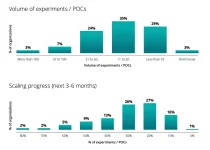
Three months after a prior survey of chief information officers, the latest data shows the majority of companies are not ready to put their generative artificial intelligence (Gen AI) into production, according to the new report by consulting giant Deloitte.

More than two-thirds of global corporate executives surveyed said that fewer than one-third of Gen AI experiments "will be fully scaled in the next three to six months," states the report, entitled "Now Decides Next: Generating a New Future" and compiled by lead author Ranjit Bawa, Deloitte's head of US strategy and the firm's CTO.


Also: Could your job be at risk due to AI? Do this before it's too late

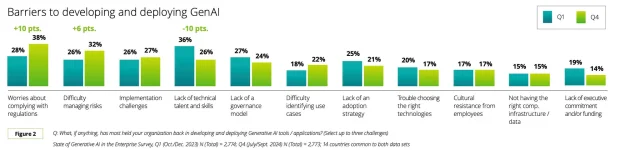
The report identifies institutional barriers that have arisen that block Gen AI deployment, including "regulatory uncertainty and risk management." Among all the barriers to deployment, "Worries about complying with regulations" tops the list -- the same factor that was at the top of the list a year ago.

Among those asked what has held back Gen AI in their organization, 38% cited the regulatory issue, up from 28% a year earlier.

1738036034932.webp
Deloitte Consulting LLC

Because of regulatory risk, and risks with compliance issues, "There is a speed limit" to AI deployment, states the report.

"Gen AI technology continues to advance at incredible speed," Bawa and team relate. "However, most organizations are moving at the speed of organizations, not at the speed of technology," the report finds.

"No matter how quickly the technology advances -- or how hard the companies producing Gen AI technology push -- organizational change in an enterprise can only happen so fast."

The regulatory issue, the report states, makes clear "respondents' unease about which use cases will be acceptable, and to what extent their organizations will be held accountable for Gen AI-related problems."

The study is the fourth quarterly report by Deloitte since the firm began conducting the study. The latest iteration was conducted in July through September, and received 2,773 responses from "senior leaders in their organizations and included board and C-suite members, and those at the president, vice president, and director level," from 14 countries, including the US, UK, Brazil, Germany, Japan, Singapore, and Australia, and across industries including energy, finance, healthcare, and media and telecom.


The previous report, released over the summer, related that "70% of respondents said their organization has moved 30% or fewer of their generative AI experiments into production."

1738036130271.webp

It seems many companies are still struggling. The new report has strikingly similar findings: "Over two-thirds of respondents said that 30% or fewer of their current experiments will be fully scaled in the next three to six months."


Although enterprises have seen "encouraging returns" on their initial AI investment, writes Bawa, they "have learned that creating value with Gen AI -- and deploying it at scale -- is hard work."

Also: AI software startups set to take over $12 trillion US services industry

Companies are being tenacious in that struggle, but it's going to take time.

"The vast majority of organizations we surveyed are taking a realistic perspective and showing sustained commitment in their quest for value from Gen AI," the report relates. "However, it might be a multiyear journey for some organizations to reach full-scale deployment and achieve the ROI they are looking for."

1738036177967.webp

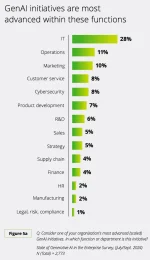
Some of the corporate functions that have seen the best ROI, Bawa and team note, are those that were prioritized for Gen AI implementation.

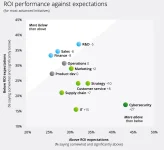
For example, "IT," "operations," and "marketing" are the three areas that are furthest along in Gen AI use. Also, IT and marketing each have seen ROI above expectations. Cybersecurity, the fifth-highest priority for Gen AI among survey respondents, has seen the greatest upside in ROI of all uses, the report notes.

1738036210990.webp

As the report notes, "Relative to other types of advanced Gen AI initiatives, those focused on cybersecurity are far more likely to be exceeding their ROI expectations, with 44% of cybersecurity initiatives delivering an ROI somewhat or significantly above expectations versus only 17% that are delivering an ROI somewhat or significantly below expectations (a 27-point gap).

"On the other hand, with advanced Gen AI implementations in functions such as sales, finance, and R&D, more respondents reported ROI below expectations than reported ROI above expectations," the report continues. "This suggests some challenges have yet to be overcome in those areas."


Amidst the challenges, Bawa and team warn that many C-suite executives have been "cheerleaders," trumpeting their company's work in AI despite the slow progress.

Also: The open-source tools that could disrupt the entire IT incident management market

"Relative to leaders outside of the C-suite, CxOs tend to express a rosier view of their organization's GenAI investments -- and how easily and quickly GenAI's barriers will be addressed and value achieved," the report relates.


"It's critical that CxOs move on from being cheerleaders to being champions for achieving organizational efficiency and market competitiveness."

Despite the slow pace, Deloitte's CTO is confident in the continued development, and ultimate deployment, of Gen AI.

"GenAI and AI broadly is our reality -- it's not going away," writes Bawa.

Gen AI is ultimately like the Internet, cloud computing, and mobile waves that preceded it, he asserts. Those "transformational opportunities weren't uncovered overnight," he says, "but as they became pervasive, they drove significant disruption to business and technology capabilities, and also triggered many new business models, new products and services, new partnerships, and new ways of working and countless other innovations that led to the next wave across industries."

 
Last edited:

AI software startups set to take over $12 trillion US services industry​


Areas resistant to automation - like legal services and healthcare - are attracting novel applications that could even displace human workers, according to a Bank of America report.

Written by Tiernan Ray, Senior Contributing Writer
Dec. 18, 2024 at 8:49 a.m. PT

It's old news by now that business processes are being transformed into artificial intelligence (AI) operations. Companies such as Salesforce, Hubspot, and Microsoft unveiled a slew of AI "agent" capabilities this year for business functions such as customer service and sales.

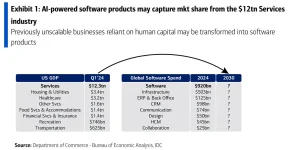
Now, a wave of privately backed software firms are using AI to build brand-new applications from the ground up, to re-invent areas traditionally resistant to technology such as legal services and healthcare, according to Bank of America.

1738036741209.webp

"We expect AI-native startups to proliferate over the next several years and increasingly cannibalize the significantly larger $12.3 trillion US Services industry," writes the firm's software and services analyst, Alkesh Shah, in a December 13 report based on a virtual conference held last week to discuss trends in AI.

Also: Microsoft introduces 10 AI agents for sales, finance, supply chain in Dynamics 365


Shah likens the latest crop of venture-backed startups to the Internet's early days, stating that they are "emerging like it's 1996."

The startups featured at the conference include San Francisco-based Hippocratic AI, founded in 2022, which uses large language models to automate non-diagnostic healthcare tasks such as assessment of individuals to determine the need for an emergency room visit.

The analysts heard from Hippocratic's co-founder and CEO Munjal Shah that "adoption is ramping and agents receive high satisfaction scores, while costing significantly less at $9-10/hour vs $50-90/hour for human nurses."

The company claims AI-based software can perform some tasks better than human nurses can, such as identifying which over-the-counter drugs may be unsafe for a given patient, or what dosages of such medications could prove toxic.

Another startup, vLex of Barcelona, Spain, uses large language models to, among other things, generate hypothetical arguments that opposing counsel in a lawsuit might use, to help lawyers and paralegals strategize.


The company's software, Vincent AI, can also speed searching through numerous documents. "The time required to analyze privacy law regulations across seven different countries could be reduced to minutes from weeks," write the Bank of America analysts. The Vincent AI platform has two million users among eight of the world's top ten law firms.

Both companies are examples of automation that may start to eat into human jobs, writes Shah. "It may become increasingly difficult to compete with AI agents. According to the US Bureau of Labor Statistics, there are approximately 3.3 million registered nurses ($41/hour average pay), 55,000 medical scribes ($18/hour average pay), 859,000 lawyers ($70/hour average pay), and 366,000 paralegals and legal assistants ($29/hour average pay)."


Also: Enterprises are struggling with what to do with Gen AI, say venture capitalists

The Bank of America report suggests that, broadly speaking, uses of generative AI are starting to move beyond the sales and customer "experience" domain to incorporate more "vertical" functions specific to industries.

The rise of commercial software packages focused on AI may help bridge the divide for the large portion of enterprises that struggle on their own to know how best to use the technology.


Enterprises are struggling with what to do with Gen AI, say venture capitalists​


Despite some uncertainty, enterprise investments in applications soared eight-fold in 2024, with spending on AI-generated code leading the way.


Written by Tiernan Ray, Senior Contributing Writer
Dec. 3, 2024 at 3:02 a.m. PT


This year, there's been a huge enterprise investment in artificial intelligence (AI), nearing $14 billion. However, a significant proportion of companies are unsure what they're doing with the technology, according to a survey of businesses by venture capital firm Menlo Ventures.

"More than a third of our survey respondents do not have a clear vision for how generative AI will be implemented across their organizations," write the authors of the report, Menlo Ventures partners Tim Tully and Joff Redfern, and investor Derek Xiao, who used the help of Anthropic's Claude Sonnet 3.5 large language model (LLM) to compile the report.


Also: AWS says its AI data centers just got even more efficient - here's how

The full report, 2024: The State of Generative AI in the Enterprise, can be read on the Menlo Ventures website. The survey was conducted in September and October and is based on responses from 600 IT decision-makers.

The report is the latest output from Tully, Redfern, and Xiao, who also offered a perspective on AI agents in September.


Also: The journey to fully autonomous AI agents and the venture capitalists funding them

The authors suggest the uncertainty around generative AI (Gen AI) indicates that "we're still in the early stages of a large-scale transformation".

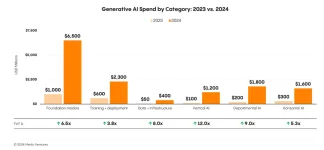
Indeed, the lack of clarity on AI strategy is just one element of an otherwise very positive piece. Leaving aside spending on AI chips from Nvidia and others, spending on "foundation models, model training + deployment, AI-specific data infrastructure, and new generative AI applications" totaled $13.8 billion in 2024, the authors relate, more than six times as much as 2023's total ($2.3bn).

"This spike in spending reflects a wave of organizational optimism," the authors write. "72% of decision-makers anticipate broader adoption of generative AI tools in the near future."

The biggest single category of AI spending by those enterprises is foundation models, the LLMs developed by Anthroptic, OpenAI, and others, which soared from $1bn in 2023 to $6.8 billion this year. The smallest spending was on data and infrastructure, at $400 million.


Also: Snowflake customers eke out early gains from Gen AI applications

However, the biggest single increase is for AI applications, which rose eight-fold to $4.6 billion. That figure includes three categories: vertical AI, departmental AI, and horizontal AI.

1738037982853.webp
The biggest single category of AI spending is foundation models.
Menlo Ventures


The application category is "heating up", the researchers write.

"While foundation model investments still dominate enterprise generative AI spend, the application layer is now growing faster," they write, "benefiting from coalescing design patterns at the infrastructure level. Companies are creating substantial value by using these tools to optimize workflows across sectors, paving the way for broader innovation."


The dominant use cases, by prominence, include code generation via code copilots, including Microsoft's GitHub Copilot, currently on course to reach $300 million in annual revenue. Next are support chatbots, followed by enterprise search and retrieval, and automatically generated meeting summaries.

Also: AI isn't hitting a wall, it's just getting too smart for benchmarks, says Anthropic

Menlo has a direct financial interest in AI spending, as the firm backs many startups in the area, including Anthropic and vector database maker Pinecone.


In fact, Anthropic is gaining ground against OpenAI, the authors relate, winning converts from GPT to Claude.

"Among closed-source models, OpenAI's early mover advantage has eroded somewhat, with enterprise market share dropping from 50% to 34%," they relate. "The primary beneficiary has been Anthropic, which doubled its enterprise presence from 12% to 24% as some enterprises switched from GPT-4 to Claude 3.5 Sonnet when the new model became state-of-the-art."


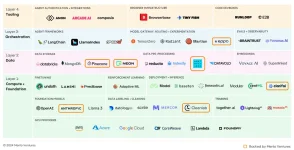
The most forward-looking part of the report covers what Tully, Redfern, and Xiao refer to as the "Modern AI Stack", layers of infrastructure technology used to build applications.

1738038048194.webp
The Modern AI Stack and its layers.
Menlo Ventures


The researchers report that "enterprises [are] coalescing around the core building blocks that comprise the runtime architectures of most production AI systems."

That approach includes the foundation models, data services riding above them, such as Pinecone, software development frameworks for orchestrating AI agents, such as LangChain, and, at the very top, integration tools, such as those from Composio.


Also: How LangChain turns Gen AI into a genuinely useful assistant

The report offers three predictions for the year ahead.

First, AI agents are poised to "disrupt" the $400bn enterprise software market, led by platforms such as Clay and Forge, "tackling complex, multi-step tasks that go beyond the capabilities of current systems focused on content generation and knowledge retrieval."

Second, established software firms could be disrupted just like textbook seller Chegg and IT discussions firm Stack Overflow have been. "IT outsourcing firms like Cognizant and legacy automation players like UiPath should brace for AI-native challengers moving into their market. Over time, even software giants like Salesforce and Autodesk will face AI-native challengers," write Tully, Redfern, and Xiao.


Third, there will be "a massive talent drought" as AI systems become more prevalent, running against a lack of data scientists and subject domain experts. "Brace for soaring competition and 2-3x salary premiums for already well-paid AI-skilled enterprise architects," the researchers predict.


Users who are viewing this thread

Back
Top