Navigation
Install the app
How to install the app on iOS
Follow along with the video below to see how to install our site as a web app on your home screen.
Note: This feature may not be available in some browsers.
More options
Style variation
You are using an out of date browser. It may not display this or other websites correctly.
You should upgrade or use an alternative browser.
You should upgrade or use an alternative browser.
AI, Software, Coding, Internet Security Thread
- Thread starter Indos
- Start date
More options
Who Replied?

Indos
INT'L MOD
- Thread starter
- #334
"The Future of Work Is Human-Centered AI. All We Need Is a Shift in Mindset," Says Calvin Chu of Eden Strategy Institute
The conversation on artificial intelligence (AI) is stuck in a cycle of extremes. On one side, AI is framed as a job-destroying force, automating roles out of existence and replacing human creativity.
By Entrepreneur UK Staff
May 8, 2025
Entrepreneur UK Staff
6–8 minutes
Opinions expressed by Entrepreneur contributors are their own.
You're reading Entrepreneur United Kingdom, an international franchise of Entrepreneur Media.

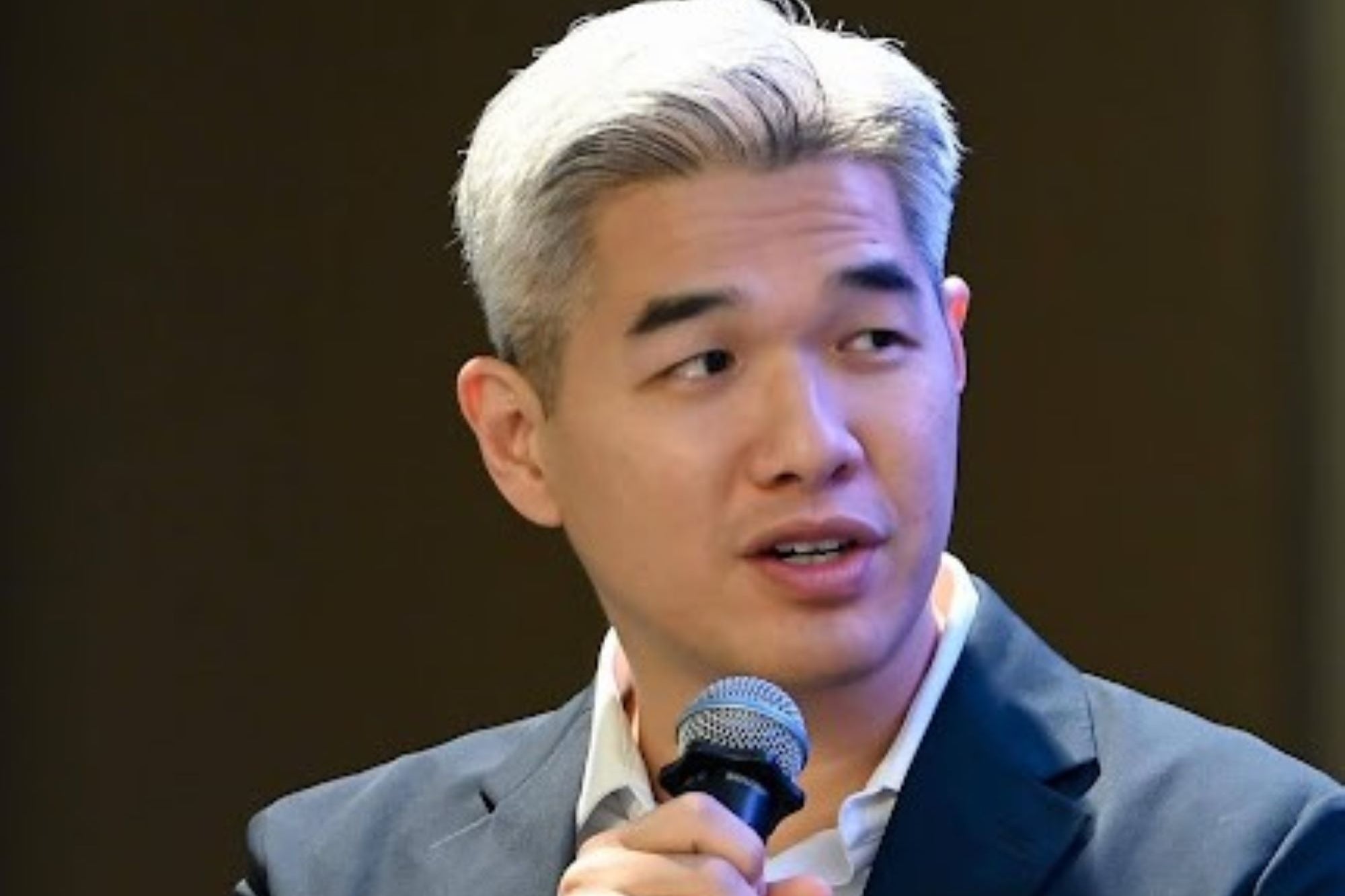
Eden Strategy Institute Founder of Eden Strategy Institute, Calvin Chu
On the other, it is hailed as an innovation catalyst, one that allows anyone to start a business overnight, generate high-quality content effortlessly, and redefine industries. Both narratives miss the truth: AI can neither become an existential threat nor can it become a magic bullet. It is, in the end, a tool, and, like any other tool, its impact depends on how one uses it.
The future of work isn't about resisting AI or blindly embracing it. Instead, it requires a shift in mindset—one that moves from fear and skepticism to collaboration and opportunity. Calvin Chu, founder of Eden Strategy Institute, has dedicated his career to helping businesses and societies navigate technological change. His message is clear. The organizations and individuals that thrive in the AI era will be those who evolve alongside it, leveraging AI as a strategic collaborator rather than an adversary.
Since the landmark Frey and Osborne study from Oxford in 2013, researchers have been dissecting how technology reshapes job roles. The study broke down occupations into component skills and analyzed which of those skills were most susceptible to automation. Tasks that require high accuracy, rapid processing, or repetitive execution, such as data entry, financial modeling, and even aspects of legal research, are the easiest to automate.
Yet, the study also highlighted a key insight. The most resilient and valuable job skills in the AI era are distinctly human. Creativity, critical thinking, emotional intelligence, problem-solving, and collaboration (often called 21st-century competencies) will define success in the future workforce. AI can generate content, synthesize knowledge, and process vast amounts of data. However, it cannot replace human ingenuity, contextual judgment, or the ability to connect with the audience on an emotional level.
As per Chu, the challenge isn't technical. It's psychological. AI adoption requires a shift in how people perceive their roles, capabilities, and future potential. Many workers hesitate to embrace AI, not because of a lack of access or knowledge, but because they don't see themselves as capable of adapting.
This is where mindset becomes the most significant barrier to AI-driven progress. Eden Strategy Institute has spent years working with organizations, from government agencies to corporations, to help employees and leaders develop a growth-oriented, adaptive approach to technology. The key, Chu believes, starts with self-belief.
He explains: "When people think they can't learn new skills or that AI will inevitably replace them, they disengage. But when they begin to experience small wins, whether it's using AI to enhance their work, streamline a redundant process, or even to generate insights, they start gaining confidence. The victim mindset changes to confident individuals and active participants in walking alongside present scenarios."
Eden has embedded these principles into its work, like the large-scale workforce transformation programs. The institute recognizes that AI adoption must go beyond training sessions and digital upskilling. As Chu states, "The first step is addressing human motivation and identity."
One of the most overlooked skills in AI adoption is the ability to understand the right prompts and critically assess AI-generated outputs. Tools can produce essays, code, music, and even synthetic podcasts at lightning speed. But these tools are only as effective as the people using them.
Chu has experimented with these tools firsthand. He highlights the importance of prompt engineering—the ability to ask the right questions and frame problems effectively. He says: "The real value lies not just in using AI but in knowing how to direct it. The people who thrive will be those who can creatively prompt AI to generate new ideas, refine solutions, and push boundaries. It's not just about what AI can do; it's about how humans interact with it. AI not only brings our creativity to life but also stretches the limitations of our own imagination. It gives us the power to create to our hearts' content."
Similarly, critical thinking is more crucial than ever. AI can generate convincing content. However, without human discernment, misinformation and low-quality work can proliferate. Businesses must empower employees to analyze, refine, and apply AI-generated outputs effectively rather than relying on AI as an unquestioned authority.
Chu envisions a future where AI empowers people to enter new industries, start businesses, and create entirely new professions that didn't exist before. He explains: "Instead of fearing AI-driven job displacement, we should be asking: 'What new roles and opportunities will AI create? How can we prepare ourselves and the next generation to thrive in this evolving landscape?' The organizations that embrace this shift will not only survive but lead in the future economy."
The outdated notion that education ends in our 20s is no longer sustainable. Lifelong learning is now a necessity, not a luxury. Governments and organizations worldwide are investing in continuous education, but adoption remains a challenge. Singapore, for example, provides financial credits for lifelong learning, offering citizens access to thousands of training programs. Yet, many individuals hesitate to enroll, not due to lack of resources but because they don't see the need or believe they can succeed in new areas. This highlights a critical insight: Policy and infrastructure alone aren't enough. People need to see themselves as capable of change.
Chu emphasizes, "When individuals experience small successes, whether it's learning a new skill, applying AI in their work, or adapting to a new role, they build momentum. This shift in self-perception and identity transformation is what will ultimately drive long-term growth." According to Chu, businesses that focus on upskilling, creativity, and human-AI collaboration will gain a competitive edge. Individuals who embrace continuous learning and shift their mindset from fear to empowerment will be the architects of new industries. Moreover, societies that invest in inclusive AI adoption will see broader economic and social benefits.
As Calvin Chu and Eden Strategy Institute continue their mission of driving positive societal impact, their message is clear. The future of work is not AI vs. humans—it's AI with humans. The only real limitation is mindset.
"The Future of Work Is Human-Centered AI. All We Need Is a Shift in Mindset," Says Calvin Chu of Eden Strategy Institute | Entrepreneur
The conversation on artificial intelligence (AI) is stuck in a cycle of extremes. On one side, AI is framed as a job-destroying force, automating roles out of existence and replacing human creativity.
 www.entrepreneur.com
Indos
INT'L MOD
- Thread starter
- #335
We need to start thinking of AI as “normal”
As technologists frame AI as either utopian or dystopian, two researchers offer a third option.
By
James O'Donnellarchive page
April 29, 2025

Right now, despite its ubiquity, AI is seen as anything but a normal technology. There is talk of AI systems that will soon merit the term “superintelligence,” and the former CEO of Google recently suggested we control AI models the way we control uranium and other nuclear weapons materials. Anthropic is dedicating time and money to study AI “welfare,” including what rights AI models may be entitled to. Meanwhile, such models are moving into disciplines that feel distinctly human, from making music to providing therapy.
No wonder that anyone pondering AI's future tends to fall into either a utopian or a dystopian camp. While OpenAI’s Sam Altman muses that AI’s impact will feel more like the Renaissance than the Industrial Revolution, over half of Americans are more concerned than excited about AI’s future. (That half includes a few friends of mine, who at a party recently speculated whether AI-resistant communities might emerge—modern-day Mennonites, carving out spaces where AI is limited by choice, not necessity.)
So against this backdrop, a recent essay by two AI researchers at Princeton felt quite provocative. Arvind Narayanan, who directs the university’s Center for Information Technology Policy, and doctoral candidate Sayash Kapoor wrote a 40-page plea for everyone to calm down and think of AI as a normal technology. This runs opposite to the “common tendency to treat it akin to a separate species, a highly autonomous, potentially superintelligent entity.”
Instead, according to the researchers, AI is a general-purpose technology whose application might be better compared to the drawn-out adoption of electricity or the internet than to nuclear weapons—though they concede this is in some ways a flawed analogy.
The core point, Kapoor says, is that we need to start differentiating between the rapid development of AI methods—the flashy and impressive displays of what AI can do in the lab—and what comes from the actual applications of AI, which in historical examples of other technologies lag behind by decades.
“Much of the discussion of AI’s societal impacts ignores this process of adoption,” Kapoor told me, “and expects societal impacts to occur at the speed of technological development.” In other words, the adoption of useful artificial intelligence, in his view, will be less of a tsunami and more of a trickle.
In the essay, the pair make some other bracing arguments: terms like “superintelligence” are so incoherent and speculative that we shouldn’t use them; AI won’t automate everything but will birth a category of human labor that monitors, verifies, and supervises AI; and we should focus more on AI’s likelihood to worsen current problems in society than the possibility of it creating new ones.
“AI supercharges capitalism,” Narayanan says. It has the capacity to either help or hurt inequality, labor markets, the free press, and democratic backsliding, depending on how it's deployed, he says.
There’s one alarming deployment of AI that the authors leave out, though: the use of AI by militaries. That, of course, is picking up rapidly, raising alarms that life and death decisions are increasingly being aided by AI. The authors exclude that use from their essay because it’s hard to analyze without access to classified information, but they say their research on the subject is forthcoming.
One of the biggest implications of treating AI as “normal” is that it would upend the position that both the Biden administration and now the Trump White House have taken: Building the best AI is a national security priority, and the federal government should take a range of actions—limiting what chips can be exported to China, dedicating more energy to data centers—to make that happen. In their paper, the two authors refer to US-China “AI arms race” rhetoric as “shrill.”
“The arms race framing verges on absurd,” Narayanan says. The knowledge it takes to build powerful AI models spreads quickly and is already being undertaken by researchers around the world, he says, and “it is not feasible to keep secrets at that scale.”
So what policies do the authors propose? Rather than planning around sci-fi fears, Kapoor talks about “strengthening democratic institutions, increasing technical expertise in government, improving AI literacy, and incentivizing defenders to adopt AI.”
By contrast to policies aimed at controlling AI superintelligence or winning the arms race, these recommendations sound totally boring. And that’s kind of the point.
This story originally appeared in The Algorithm, our weekly newsletter on AI. To get stories like this in your inbox first, sign up here.

We need to start thinking of AI as “normal”
As technologists frame AI as either utopian or dystopian, two researchers offer a third option.
 www.technologyreview.com
Indos
INT'L MOD
- Thread starter
- #339
OpenAI brings GPT-4.1 and 4.1 mini to ChatGPT — what enterprises should know
Carl Franzen
May 14, 2025 4:46 PM
9–11 minutes
Join our daily and weekly newsletters for the latest updates and exclusive content on industry-leading AI coverage. Learn More
OpenAI is rolling out GPT-4.1, its new non-reasoning large language model (LLM) that balances high performance with lower cost, to users of ChatGPT. The company is beginning with its paying subscribers on ChatGPT Plus, Pro, and Team, with Enterprise and Education user access expected in the coming weeks.
It’s also adding GPT-4.1 mini, which replaces GPT-4o mini as the default for all ChatGPT users, including those on the free tier. The “mini” version provides a smaller-scale parameter and thus, less powerful version with similar safety standards.
The models are both available via the “more models” dropdown selection in the top corner of the chat window within ChatGPT, giving users flexibility to choose between GPT-4.1, GPT-4.1 mini, and reasoning models such as o3, o4-mini, and o4-mini-high.

Initially intended for use only by third-party software and AI developers through OpenAI’s application programming interface (API), GPT-4.1 was added to ChatGPT following strong user feedback.
OpenAI post training research lead Michelle Pokrass confirmed on X the shift was driven by demand, writing: “we were initially planning on keeping this model api only but you all wanted it in chatgpt
 happy coding!”
OpenAI Chief Product Officer Kevin Weil posted on X saying: “We built it for developers, so it’s very good at coding and instruction following—give it a try!”
An enterprise-focused model
GPT-4.1 was designed from the ground up for enterprise-grade practicality.Launched in April 2025 alongside GPT-4.1 mini and nano, this model family prioritized developer needs and production use cases.
GPT-4.1 delivers a 21.4-point improvement over GPT-4o on the SWE-bench Verified software engineering benchmark, and a 10.5-point gain on instruction-following tasks in Scale’s MultiChallenge benchmark. It also reduces verbosity by 50% compared to other models, a trait enterprise users praised during early testing.
Context, speed, and model access
GPT-4.1 supports the standard context windows for ChatGPT: 8,000 tokens for free users, 32,000 tokens for Plus users, and 128,000 tokens for Pro users.According to developer Angel Bogado posting on X, these limits match those used by earlier ChatGPT models, though plans are underway to increase context size further.
While the API versions of GPT-4.1 can process up to one million tokens, this expanded capacity is not yet available in ChatGPT, though future support has been hinted at.
This extended context capability allows API users to feed entire codebases or large legal and financial documents into the model—useful for reviewing multi-document contracts or analyzing large log files.
OpenAI has acknowledged some performance degradation with extremely large inputs, but enterprise test cases suggest solid performance up to several hundred thousand tokens.
Evaluations and safety
OpenAI has also launched a Safety Evaluations Hub website to give users access to key performance metrics across models.GPT-4.1 shows solid results across these evaluations. In factual accuracy tests, it scored 0.40 on the SimpleQA benchmark and 0.63 on PersonQA, outperforming several predecessors.
It also scored 0.99 on OpenAI’s “not unsafe” measure in standard refusal tests, and 0.86 on more challenging prompts.
However, in the StrongReject jailbreak test—an academic benchmark for safety under adversarial conditions—GPT-4.1 scored 0.23, behind models like GPT-4o-mini and o3.
That said, it scored a strong 0.96 on human-sourced jailbreak prompts, indicating more robust real-world safety under typical use.
In instruction adherence, GPT-4.1 follows OpenAI’s defined hierarchy (system over developer, developer over user messages) with a score of 0.71 for resolving system vs. user message conflicts. It also performs well in safeguarding protected phrases and avoiding solution giveaways in tutoring scenarios.
Contextualizing GPT-4.1 against predecessors
The release of GPT-4.1 comes after scrutiny around GPT-4.5, which debuted in February 2025 as a research preview. That model emphasized better unsupervised learning, a richer knowledge base, and reduced hallucinations—falling from 61.8% in GPT-4o to 37.1%. It also showcased improvements in emotional nuance and long-form writing, but many users found the enhancements subtle.Despite these gains, GPT-4.5 drew criticism for its high price — up to $180 per million output tokens via API —and for underwhelming performance in math and coding benchmarks relative to OpenAI’s o-series models. Industry figures noted that while GPT-4.5 was stronger in general conversation and content generation, it underperformed in developer-specific applications.
By contrast, GPT-4.1 is intended as a faster, more focused alternative. While it lacks GPT-4.5’s breadth of knowledge and extensive emotional modeling, it is better tuned for practical coding assistance and adheres more reliably to user instructions.
On OpenAI’s API, GPT-4.1 is currently priced at $2.00 per million input tokens, $0.50 per million cached input tokens, and $8.00 per million output tokens.
For those seeking a balance between speed and intelligence at a lower cost, GPT-4.1 mini is available at $0.40 per million input tokens, $0.10 per million cached input tokens, and $1.60 per million output tokens.
Google’s Flash-Lite and Flash models are available starting at $0.075–$0.10 per million input tokens and $0.30–$0.40 per million output tokens, less than a tenth the cost of GPT-4.1’s base rates.
But while GPT-4.1 is priced higher, it offers stronger software engineering benchmarks and more precise instruction following, which may be critical for enterprise deployment scenarios requiring reliability over cost. Ultimately, OpenAI’s GPT-4.1 delivers a premium experience for precision and development performance, while Google’s Gemini models appeal to cost-conscious enterprises needing flexible model tiers and multimodal capabilities.
What It means for enterprise decision makers
The introduction of GPT-4.1 brings specific benefits to enterprise teams managing LLM deployment, orchestration, and data operations:- AI Engineers overseeing LLM deployment can expect improved speed and instruction adherence. For teams managing the full LLM lifecycle—from model fine-tuning to troubleshooting—GPT-4.1 offers a more responsive and efficient toolset. It’s particularly suitable for lean teams under pressure to ship high-performing models quickly without compromising safety or compliance.
- AI orchestration leads focused on scalable pipeline design will appreciate GPT-4.1’s robustness against most user-induced failures and its strong performance in message hierarchy tests. This makes it easier to integrate into orchestration systems that prioritize consistency, model validation, and operational reliability.
- Data engineers responsible for maintaining high data quality and integrating new tools will benefit from GPT-4.1’s lower hallucination rate and higher factual accuracy. Its more predictable output behavior aids in building dependable data workflows, even when team resources are constrained.
- IT security professionals tasked with embedding security across DevOps pipelines may find value in GPT-4.1’s resistance to common jailbreaks and its controlled output behavior. While its academic jailbreak resistance score leaves room for improvement, the model’s high performance against human-sourced exploits helps support safe integration into internal tools.
A new step forward
While GPT-4.5 represented a scaling milestone in model development, GPT-4.1 centers on utility. It is not the most expensive or the most multimodal, but it delivers meaningful gains in areas that matter to enterprises: accuracy, deployment efficiency, and cost.This repositioning reflects a broader industry trend—away from building the biggest models at any cost, and toward making capable models more accessible and adaptable. GPT-4.1 meets that need, offering a flexible, production-ready tool for teams trying to embed AI deeper into their business operations.
As OpenAI continues to evolve its model offerings, GPT-4.1 represents a step forward in democratizing advanced AI for enterprise environments. For decision-makers balancing capability with ROI, it offers a clearer path to deployment without sacrificing performance or safety.
Daily insights on business use cases with VB Daily
If you want to impress your boss, VB Daily has you covered. We give you the inside scoop on what companies are doing with generative AI, from regulatory shifts to practical deployments, so you can share insights for maximum ROI.

OpenAI brings GPT-4.1 and 4.1 mini to ChatGPT — what enterprises should know
As OpenAI continues to evolve its model offerings, GPT-4.1 represents a step forward in democratizing advanced AI for enterprise environments
 venturebeat.com
Indos
INT'L MOD
- Thread starter
- #340
OpenAI Introduces GPT‑4.1 Family with Enhanced Performance and Long-Context Support
by Robert Krzaczyński
May 12, 2025
4–5 minutes
OpenAI has released a new family of language models—GPT‑4.1, GPT‑4.1 mini, and GPT‑4.1 nano—available via its API. The models improve on GPT‑4o and GPT‑4.5 across several technical benchmarks and introduce support for up to 1 million tokens of context.
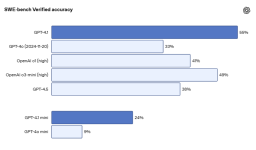
According to OpenAI, GPT‑4.1 improves coding capabilities, instruction following, and long-context comprehension. On the SWE-bench Verified benchmark, which measures real-world software engineering tasks, GPT‑4.1 achieves 54.6% accuracy. This is a 21-point increase over GPT‑4o (33.2%) and 26.6 points higher than GPT‑4.5. The model also shows a 10.5-point improvement over GPT‑4o on Scale’s MultiChallenge instruction benchmark.
Source: OpenAI Blog
OpenAI also tested the model’s ability to process extended inputs. All models in the GPT‑4.1 family can handle up to 1 million tokens. Internal evaluations, including OpenAI-MRCR and Graphwalks, indicate that GPT‑4.1 performs reliably across long-context tasks, such as retrieving and reasoning over dispersed information. For example, GPT‑4.1 scored 61.7% on Graphwalks, a benchmark for multi-hop reasoning, compared to 42% for GPT‑4o.

Source: OpenAI Blog
In addition to the main model, GPT‑4.1 mini offers similar performance at lower latency and cost. OpenAI says it matches or exceeds GPT‑4o on most intelligence evaluations while reducing cost by 83%. GPT‑4.1 nano is the smallest and fastest in the series. It is designed for simpler tasks like classification and autocomplete, but still posts high scores, such as 80.1% on MMLU and 50.3% on GPQA.
The company also emphasized improvements in code editing. In Aider’s polyglot benchmark, which tests the ability to generate diffs rather than full-file rewrites, GPT‑4.1 outperforms all previous models, including GPT‑4.5. The model produces fewer unnecessary edits, decreasing from 9% in GPT‑4o to 2% in GPT‑4.1.
OpenAI confirmed that GPT‑4.5 Preview will be deprecated on July 14, 2025. The company cited cost and performance improvements in GPT‑4.1 as reasons for the transition. This aligns with speculation in the community about the temporary nature of GPT‑4.5. One Reddit user commented:
GPT-4.5 was just a preview, not even a 'public beta.' It was just to see what they were (or are) doing regarding new models. Since it is not an official version, it could be said that GPT-4.5 'never' existed, and that is why the new version is GPT-4.1… During the period in which it was available, OpenAI was collecting data… to make, perhaps, a more capable and not so expensive distilled model, which ended up being GPT-4.1.
Pricing has also been adjusted. GPT‑4.1 is around 26% cheaper than GPT‑4o for typical queries. Prompt caching discounts have been raised to 75%, and long-context usage no longer incurs additional charges beyond standard per-token costs.
The GPT‑4.1 family is now accessible via the OpenAI API. It is not yet available in ChatGPT, where updates to GPT‑4o are ongoing.

OpenAI Introduces GPT‑4.1 Family with Enhanced Performance and Long-Context Support
OpenAI has released a new family of language models—GPT‑4.1, GPT‑4.1 mini, and GPT‑4.1 nano—available via its API. The models improve on GPT‑4o and GPT‑4.5 across several technical benchmarks and introduce support for up to 1 million tokens of context.
 www.infoq.com
Indos
INT'L MOD
- Thread starter
- #342
Microsoft's fired AI director to 6,000 laid off employees along with her: "These are people who…"
TOI Tech Desk
3–4 minutes

Microsoft layoffs 2025 hit 6,000 employees worldwide, including AI Director Gabriela de Queiroz. As the tech giant pushes deeper into artificial intelligence, industry experts question the decision. Find out why even AI leaders weren’t safe from Microsoft’s sudden cuts.
Microsoft announced last week that it is laying off approximately 6,000 employees, nearly 3% of its global workforce—in what marks the company's second-largest job reduction in its history. Among those affected was Gabriela de Queiroz, Director of Artificial Intelligence for Microsoft for Startups, who shared the "bittersweet news" of her departure on social media.
"I was impacted by Microsoft's latest round of layoffs. Am I sad? Absolutely. I'm heartbroken to see so many talented people I've had the honor of working with being let go. These are people who cared deeply, went above and beyond, and truly made a difference," Gabriela de Queiroz wrote on X (formerly known as Twitter), alongside a picture of herself smiling.
The layoffs come as Microsoft aggressively pushes into artificial intelligence, with CEO revealing in April that AI now writes up to 30% of code in some Microsoft projects. Software engineers bore the brunt of the cuts, representing over 40% of the approximately 2,000 positions eliminated in Washington state alone, according to Bloomberg analysis.
To those also affected—you're not alone, we're at least 6,000, says Microsoft's fired AI director
Despite being asked to stop work immediately and set an out-of-office message, Gabriela de Queiroz chose to stay longer. "I chose to stay a little longer—showing up for meetings, saying goodbye, wrapping up what I could. That felt right to me," she explained in her social media posts.
The irony of laying off an AI director while the company invests heavily in AI technology wasn't lost on industry observers. One Microsoft vice president recently told his team to use AI chatbots to generate half their computer code, up from the current 20-30%, before more than a dozen engineers on his team were subsequently laid off.
"But if you know me, you know I always look at the bright side. I'm an optimist at heart. That hasn't changed. My smile, my gratitude, my belief that each day is a gift—that's all still here," de Queiroz wrote, maintaining her positive outlook despite the circumstances.
The cuts affect all levels, teams, and geographies as Microsoft streamlines operations and reduces management layers. "What's next? I don't know yet. It's too soon to say. But I trust that something good will come out of this," de Queiroz concluded, addressing fellow impacted employees: "To those also affected—you're not alone. We are at least 6,000."

Microsoft Layoffs: Microsoft's fired AI director to 6,000 laid off employees along with her: "These are people who…" | - The Times of India
Technology News: Microsoft recently laid off approximately 6,000 employees, impacting various levels and teams. Gabriela de Queiroz, Director of AI for Startups, was a
 timesofindia.indiatimes.com
Last edited:
Users who are viewing this thread
Total: 2 (members: 0, guests: 2)
Pakistan Defence Latest
-
-

-
-
PTI Murad Saeed in Afghanistan, was 'controlling KP govt' from there: Rana Sanaullah (3 Viewers)
- Latest: Prophecy


