AMCA News and Discussion

Talks for GE’s engine for India's 5th-gen fighter project AMCA hit roadblock as US giant ‘raises cost by 3 times’​

Surendra Singh / TNN / Jun 27, 2026, 11:39 IST

NEW DELHI: India’s negotiations with US’s General Electric (GE) over the F414 fighter jet engine have hit a roadblock after the cost of the proposed US engine for India’s Advanced Medium Combat Aircraft (AMCA) rose sharply, raising concerns about timelines for the country’s most-ambitious fifth-generation fighter programme.

“The F414 engine was initially estimated to cost around Rs 70-80 crore per unit, but GE has now quoted prices almost three times higher,” a DRDO source told TOI.

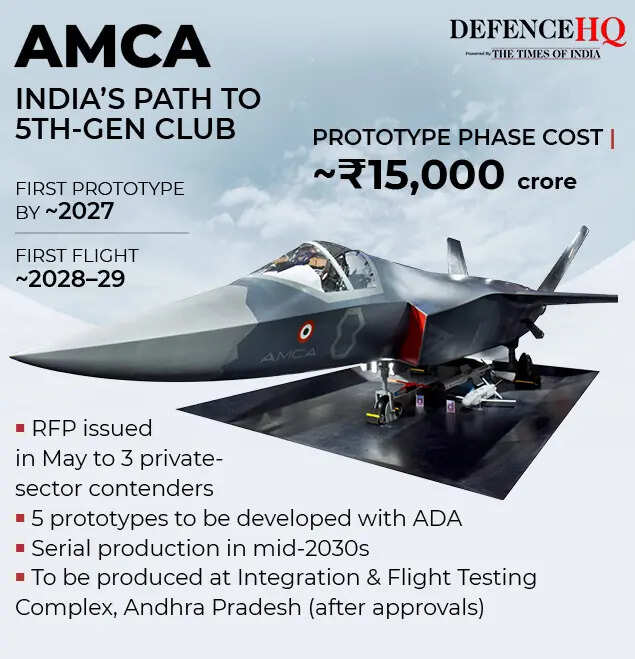
Aeronautical Development Agency (ADA), nodal agency for AMCA project, requires 15 F414 engines for five flying prototypes. As ADA has frozen the airframe design of AMCA around the engine, GE knows that India’s engine options for its new stealth aircraft are limited.

amca-indias-path-to-5th-gen-club.jpg


As India’s own Kaveri engine project is no more meant for the stealth fighter jet and is only confined to unmanned aerial vehicle ‘Ghatak’, govt, which has kept Rs 15,000 crore initial budget for the project, is likely to face cost escalation if it is compelled to buy the F414 engine at a higher cost.

The same F414 engine has also been planned to power the indigenous HAL-produced Tejas Mk-2.4-5-generation fighter jet later.

Under the Request for Proposal (RFP) issued last month, the final selected industry partner out of the three shortlisted companies — Tata Advanced Systems, an L&T-BEL-Dynamatic consortium, and a Bharat Forge-BEML consortium — is expected to achieve the aircraft’s maiden flight within 30 months of contract signing.

The AMCA project aims to achieve air superiority through supercruise capabilities and AI-assisted avionics. The advanced fighter will feature advanced radar-absorbent materials, serpentine air intakes, and internal weapons bays for low observability. Once ready, it will carry 1,500 kg of internal weapons and 5,500 kg externally.

The five prototypes are expected to undertake 1,800 test sorties in seven years to validate the fighter’s flight-control systems, stealth characteristics, sensors, radar, weapons integration and propulsion performance. Changing the F414 engine at this juncture is not an option with AMCA. The first batch of AMCA is expected to be ready around 2034 or 2035.

China is already operating two primary fifth-generation stealth fighter jets, Chengdu J-20 and the Shenyang J-35, and Pakistan is also planning to buy 40 Chinese J-35 stealth aircraft.


To view this content we will need your consent to set third party cookies.
For more detailed information, see our cookies page.


lol - it is worse than just the AMCA...
 
To view this content we will need your consent to set third party cookies.
For more detailed information, see our cookies page.

just no, the amca is stuck with the ge-f414 and the tejas with the f404 and even then other manufacturers are getting allocations before india

best bet cut your losses and go for the m88 for both which will also power the rafales too.

the engineering base from one engine which compliments 3 aircraft is masterstroke of a move.

but then again india is india....
 
just no, the amca is stuck with the ge-f414 and the tejas with the f404 and even then other manufacturers are getting allocations before india

best bet cut your losses and go for the m88 for both which will also power the rafales too.

the engineering base from one engine which compliments 3 aircraft is masterstroke of a move.

but then again india is india....
F414 is to be license-built in India and the aircraft is designed around it. You just can't swap engines randomly. This joint engine project is for Mk2 AMCA in future. That is 2040s.
 
F414 is to be license-built in India and the aircraft is designed around it. You just can't swap engines randomly. This joint engine project is for Mk2 AMCA in future. That is 2040s.
f414 cost went up 3x recently, and they want $400 million upfront too. and even then the sensitive hot section will still be imported from the usa.

fyi the rafale used f404 engines during development whilst the m88 was being worked.

theres plenty of examples of aircraft using different engines:t-50, f15, f16,f18 jf-17,
even the gripen went from the f404 to the 414.

important to know the engines are different but there in the same class with same or similar dimensions and thrust capabilities.
 
f414 cost went up 3x recently, and they want $400 million upfront too. and even then the sensitive hot section will still be imported from the usa.

fyi the rafale used f404 engines during development whilst the m88 was being worked.

theres plenty of examples of aircraft using different engines:t-50, f15, f16,f18 jf-17,
even the gripen went from the f404 to the 414.

important to know the engines are different but there in the same class with same or similar dimensions and thrust capabilities.
The cost didn't went up 3x, that is a separate contract being negotiated by ADA for a few engines. And the comparison is with costs decade(s) ago. F414 is derived from F404 so dimensions aren't a constraint.
 
To view this content we will need your consent to set third party cookies.
For more detailed information, see our cookies page.


AI slop of something that is far from looking like AMCA plus AI slop of a high-bypass non-afterburning turbofan.
 
To view this content we will need your consent to set third party cookies.
For more detailed information, see our cookies page.

IF private sector will get involved, Project will go smoothly.

Example - TATA
Some major programmes include:

🇺🇸 US aircraft companies
  • Boeing AH-64 Apache – Tata manufactures the complete fuselage and other structures in Hyderabad. These are supplied into Boeing's global production, including aircraft for the US Army.
  • Boeing CH-47 Chinook – Tata makes important structural components.
  • Boeing P-8 Poseidon – Tata supplies components including the tail cone and other assemblies.
  • Boeing 787 Dreamliner – Tata manufactures thousands of components, including composite floor beams and other structures.
  • Boeing 737/737 MAX – Tata manufactures and assembles several components, including vertical fins and fan cowls.
  • Lockheed Martin C-130J Super Hercules – Tata is the global single-source supplier of the C-130J empennage (tail assembly).
  • Lockheed Martin F-16 – Tata manufactures several wing and structural components.
  • Sikorsky S-92 – Tata manufactures and assembles helicopter cabins and other aerospace components.
🇪🇺 Airbus
Tata also supplies Airbus. Its programmes include A320, A350, A330 and A220, with Tata producing structural components, panels, doors and other assemblies.

And this is becoming bigger: Tata is also manufacturing the Airbus C295 in India for the Indian Air Force, with the first Indian-made aircraft planned to roll out in September 2026.

So yes, Tata has become deeply integrated into the global aerospace supply chain. In fact, Tata says its aerospace business supplies programmes involving Boeing, Airbus, Lockheed Martin, Sikorsky and Pilatus, among others.

One interesting point: some Tata-made parts from India actually go into aircraft assembled in the USA, such as the Apache fuselage being shipped to Boeing's Mesa, Arizona facility for final integration
 

Users who are viewing this thread

Back
Top