Armament of the Russian Army

The Vepr-12 “Hammer” smoothbore self-loading carbine was received by the Russian engineering troops; they are already being used near Avdeevka in mine clearance groups. The soldier will talk about him further. The main area of application of the Hammer shotgun is the destruction of drones and the neutralization of anti-personnel mines. Russian smoothbore self-loading carbine Vepr-12 "Hammer, developed based on the design of the Kalashnikov light machine gun. The carbine is intended for hunting, competitions, self-defense, and also for use as a service weapon. Vepr-12 carbines are quite popular and are supplied to the armed forces of 17 NATO countries since 2012. The Vepr-12 carbine, 12x76 mm caliber, is equipped with a folding stock, has an elongated barrel, which increases the accuracy and destructive power of the weapon. The carbine can be equipped with a collimator, thermal imaging sight and other devices, it is equipped with a Picatinny rail. The carbine is designed for 10 rounds and has a mass of about 4 kilograms. The firing range of the Vepr-12 carbine is up to 100 meters. The price of the Vepr-12 "Hammer" carbine is about 70,000 thousand rubles or $750

To view this content we will need your consent to set third party cookies.
For more detailed information, see our cookies page.
 
Rostec is accelerating the first serial deliveries of the newest anti-aircraft artillery system "Derivation-PVO" to the troops, industrial director of the State Corporation Bekhan Ozdoev announced on April 8. The self-propelled anti-aircraft gun was created by Uralvagonzavod specialists on the basis of the BMP-3, and is a fusion of the combat capabilities of well-known ZAK "Pantsir-S" and "Tunguska". In the West, the complex was called a "hellish thresher". ZAK "Derivation-PVO" is the only anti-aircraft system in the world that hits air targets with 57-mm cannons and is equipped with artillery fire control equipment. For the first time, the complex was introduced in 2018. The Derivation-PVO anti-aircraft complex is capable of firing ammunition with controlled detonation for the most effective combat against air targets. It is known that in the head part of such a projectile there is a “steering mechanism” and folding rudders. In the aft part there is a laser radiation receiver and a folding stabilizer. The central part of the ammunition body is filled with explosive material, about 400 g. A guided projectile weighing about 2 kg is controlled by a laser beam. The 2S38 complex is primarily designed to combat UAVs, cruise missiles and aircraft weapons in the near zone; it is equipped with a passive reconnaissance and targeting system. The detection range of air targets is up to 10 thousand meters. The automatic cannon of the uninhabited combat module "Baikal" is capable of firing several types of ammunition, remotely detonated and controlled - at a distance of up to 9000 meters and an altitude of up to 4500 meters. The maximum range of destruction of ground targets and surface targets is 14,500 meters. Rate of fire – 120 rounds per minute. The complex is capable of operating in conditions of optical and electronic countermeasures from the enemy. "Derivation-PVO" can automatically "select" ammunition for a specific object, work autonomously and according to target designations from a remote command post. ZAK "Derivatsiya-PVO" reaches a speed of up to 70 km/h and has a range of up to 600 km, the crew of the complex is 2 people.

To view this content we will need your consent to set third party cookies.
For more detailed information, see our cookies page.
 
The Vepr-12 “Hammer” smoothbore self-loading carbine was received by the Russian engineering troops; they are already being used near Avdeevka in mine clearance groups. The soldier will talk about him further. The main area of application of the Hammer shotgun is the destruction of drones and the neutralization of anti-personnel mines. Russian smoothbore self-loading carbine Vepr-12 "Hammer, developed based on the design of the Kalashnikov light machine gun. The carbine is intended for hunting, competitions, self-defense, and also for use as a service weapon. Vepr-12 carbines are quite popular and are supplied to the armed forces of 17 NATO countries since 2012. The Vepr-12 carbine, 12x76 mm caliber, is equipped with a folding stock, has an elongated barrel, which increases the accuracy and destructive power of the weapon. The carbine can be equipped with a collimator, thermal imaging sight and other devices, it is equipped with a Picatinny rail. The carbine is designed for 10 rounds and has a mass of about 4 kilograms. The firing range of the Vepr-12 carbine is up to 100 meters. The price of the Vepr-12 "Hammer" carbine is about 70,000 thousand rubles or $750

To view this content we will need your consent to set third party cookies.
For more detailed information, see our cookies page.


That's a heck of a weapon. I guess you can basically call it an automatic shotgun. Quite the massive magazine to hold 10 shotgun cartridges with that elongate barrel seems right at the limit. Any longer and it would probably be too awkward. But a wild concept that's basically an AK-47 Shotgun with a 10-round banana clip and a super elongated barrel.

It sounds just like a shotgun, too. I guess it depends on the cartridges used whether it's it'll be used for anti-drone shooting or mine-clearing. I'm also surprised he said it's already used is many NATO countries lol.
 
Gradually, news about drones and UAVs is beginning to displace traditional types of weapons, and every year there will be more and more of them. Information has appeared about a new Russian homemade remote-controlled robotic platform, which we previously showed, they are already being used by troops. Unlike many drones, this is already a working prototype. The ground drone is called NRTC "Courier", this project is being implemented with the support of military commander Chengis Dambiev and Boris Rozhin. Technical information can be seen on the screen. The “Courier” robot is multifunctional; it can be equipped with an AGS-17 “Plamya” grenade launcher, a “Kord” machine gun, RPG-7 grenade launchers, ATGMs, RPO “Shmel-M” and other weapons. The robot can use an unknown model of electronic warfare power up to 560 W. In addition, the robot installs TM-62 and TM-83 anti-tank mines, working as a mine layer. The robot has a camera mounted on a rod and has armor plates, but their thickness is unknown. The robot control range is up to 10 km, autonomy is up to 72 hours. The robot weighs 250 kg, is equipped with an asynchronous electric motor with a power of 6 kW and can reach speeds of up to 35 km/h.

To view this content we will need your consent to set third party cookies.
For more detailed information, see our cookies page.
 
Episodes of assembly and testing at the test site of the Russian T-90M Proryv tank at the Uralvagonzavod tank plant. The plant currently operates three shifts, seven days a week. The production of T-90M Proryv tanks is growing, they are gradually displacing the modernized T-72B3 tanks from the assembly line, the number of tanks produced is not reported. The video shows episodes of the assembly of the T-90M “Breakthrough” tank, its transmission assembled at the factory, installation of the turret, and the autoloader of the carousel-type tank. The T-90M “Breakthrough” tank is constantly being modernized, it has already been reinforced on the nose bottom shield with additional armor for protection against mines, dynamic protection has been added to the turret, frontal protection has been improved, they say that there is already a new transmission. Improvements are not always officially reported. Each tank is tested at the factory test site, which will be shown at the end of the video. The main armament of the T-90M tank is a 125 mm smoothbore gun. The firing range of the gun with armor-piercing cumulative and sub-caliber ammunition is 4,000 meters, with guided missile ammunition - 5,000 meters, and with high-explosive fragmentation ammunition along a ballistic trajectory - up to 10,000 meters.

To view this content we will need your consent to set third party cookies.
For more detailed information, see our cookies page.
 
Russian engineering units have begun using the new Patrol-IV armored vehicle. Armored vehicles of the "Patrol" family appeared in 2014, they are produced by the company "Astace", there are medical, police, military and special modifications of the vehicles. The Patrol-IV armored vehicle is built on the KAMA3-5350 chassis and has fourth class armor according to OTT 9.1.12. The crew of the armored vehicle is protected from damage by small arms of 5.45 mm and 7.62 mm caliber. Detonations of explosives weighing up to 6 kg, under the wheels of a car, or detonations of explosives up to 10 kg, two meters from the car. High molecular weight polyethylene panels are installed inside the machine to protect against splinters. The vehicle can be equipped with mesh and lattice screens for protection against RPGs. It is possible to install a turret with a machine gun. The vehicle is capable of carrying 11 people with a driver and is equipped with a KAMAZ-740.30 engine with a power of 260 hp. Load capacity 3000 kg.

To view this content we will need your consent to set third party cookies.
For more detailed information, see our cookies page.
 
Episodes of assembly and testing at the test site of the Russian T-90M Proryv tank at the Uralvagonzavod tank plant. The plant currently operates three shifts, seven days a week. The production of T-90M Proryv tanks is growing, they are gradually displacing the modernized T-72B3 tanks from the assembly line, the number of tanks produced is not reported. The video shows episodes of the assembly of the T-90M “Breakthrough” tank, its transmission assembled at the factory, installation of the turret, and the autoloader of the carousel-type tank. The T-90M “Breakthrough” tank is constantly being modernized, it has already been reinforced on the nose bottom shield with additional armor for protection against mines, dynamic protection has been added to the turret, frontal protection has been improved, they say that there is already a new transmission. Improvements are not always officially reported. Each tank is tested at the factory test site, which will be shown at the end of the video. The main armament of the T-90M tank is a 125 mm smoothbore gun. The firing range of the gun with armor-piercing cumulative and sub-caliber ammunition is 4,000 meters, with guided missile ammunition - 5,000 meters, and with high-explosive fragmentation ammunition along a ballistic trajectory - up to 10,000 meters.

To view this content we will need your consent to set third party cookies.
For more detailed information, see our cookies page.


That's a good look at how much work goes into building & assembling a tank of that caliber. Just the turret alone and all the mechanisms involved from the ring gears to the circular rotating platform to all the complex electrical wiring and automated fire control system and so on, it's really remarkable.

We're supposed to be starting a ToT for the T-90MS in Egypt. They signed a MOU but not sure where it's at ATM. Might've taken an unfortunate backseat due to the ever so frustrating CAATSA bill as I'm sure the US isn't happy that Egypt built 1,100 M1A1 Abrams and has over 3,000 M60A3s and a bunch of T-55s/62s and now wants to assemble 500 T-90MS lol.

Supposed to look something like this.

00c8ccde939b38a58a4154bf919b01bb.JPG
 
The Rybinsk Shipyard company and the Kalashnikov concern demonstrated the launching of the Russian hovercraft "Haska-10" of project 03660 onto the ice. The vessel was designed as a civilian transport, but the navy is also showing interest in this project. They plan to use it in the Arctic, Siberia and the Far East. The hovercraft was first shown in 2020 and is currently undergoing sea trials. Flexible skegs – rubber-fabric cylinders of high elongation – are attached to the sides of the vessel’s hull; this is the first time this has been done in Russia on ships of this displacement. The vessel is equipped with 2 1500 hp engines. and reaches a speed of up to 40 knots, has a range of up to 400 miles with an autonomy of up to three days. Total - vessel displacement is 45 tons, payload - 9.3 tons, crew 3 people.

To view this content we will need your consent to set third party cookies.
For more detailed information, see our cookies page.
 
Engineers from the Kurgan enterprise MobiDik showed the Russian unmanned mine clearance system Chelnok. The Chelnok mine clearing robot is designed to make passages in minefields and is equipped with a UR-83P mine clearing unit. The remotely controlled robot sapper "Shuttle" allows you to make passages in minefields 6 meters wide and 115 meters long, consisting of anti-tank anti-track mines and anti-tank anti-bottom mines with a pin target sensor. The firing range of the mine clearance charge is up to 440 meters. The installation is controlled via cable, remotely or through a repeater on a UAV. The Chelnok mine clearance robot is equipped with two electric motors with a total power of 100 kW and weighs 1350 kg without the UR-83P. The Shuttle installation is capable of operating for up to 6 hours and reaches speeds of up to 50 km/h, with a cruising range of at least 30 kilometers.

To view this content we will need your consent to set third party cookies.
For more detailed information, see our cookies page.
 
The Russian Ministry of Defense showed robotic equipment. Promising examples of military robotic equipment were shown in Russia. It is worth noting that this is not homemade military equipment, but factory products. New samples of military equipment were shown at the Patriot convention and exhibition center and were inspected by the Russian Minister of Defense. In total, more than 30 promising models of weapons, military, special equipment and military-technical equipment from 18 Russian industrial enterprises were presented. Reportedly, by the end of next month the first 30 prototypes will be manufactured for delivery to the troops. Models of military equipment are not reported. Multi-purpose robotic vehicles on wheeled and tracked chassis were shown. Equipment for transporting supplies, evacuating the wounded and using it as a platform for mounting various work equipment and weapons, a line of robotic multifunctional platforms. The head of the Russian military department noted that the presented promising ground-based medical robotic complex is in great demand and should be delivered to the troops as soon as possible.

To view this content we will need your consent to set third party cookies.
For more detailed information, see our cookies page.
 
The Russian Kurganmashzavod announced that it is ready for serial production of the modernized 2S25M self-propelled anti-tank gun. The vehicle has passed state tests and is recommended for adoption by the Russian army. The vehicle was developed for the Airborne Forces as a replacement for the PT-76 light amphibious tanks. The design bureau developing the vehicle did not have the authority to develop tanks, so the tank was designated as an “anti-tank self-propelled artillery gun.” The 2S25 Sprut-SD vehicle was put into service in 2005, after many disputes it was sent for modernization, after which it received the index 2S25M Sprut-SDM1. The modernized tank is equipped with additional protection, grilles and armored screens, after which its weight became 20 tons. The 2S25M tank is equipped with a 125 mm 2A75-1 cannon. The gun is stabilized in two planes, equipped with an automatic loader and provides a rate of fire of up to seven rounds per minute. The range of destruction of a target with this weapon is over 5 km. The tank is also equipped with a 7.62-mm PKT machine gun and an optical-electronic suppression complex. Tests have shown that the vehicle is not inferior in firepower to tanks of the T-90 type, and in terms of mobility on land and water it is at the level of the BMD-4M. The light tank "Sprut-SDM1" has a crew of three people and can reach speeds of up to 70 km/h on land and up to 10 km/h in water, the vehicle's cruising range is 500 km.

To view this content we will need your consent to set third party cookies.
For more detailed information, see our cookies page.
 
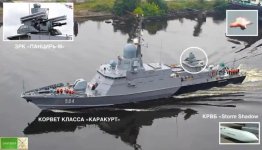
Russia uses the “Pantsir-M” maritime air defense system for the first time and successfully destroys the British-made “Storm Shadow” cruise missile

1713513518113.jpeg
 
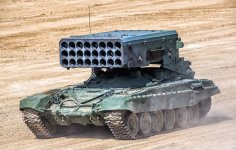
Assembly of T-80BVM tanks, inspection of the Omsktransmash tank plant. Footage of the visit by the Russian Minister of Defense to the T-80BVM tank production plant in the Omsk region. In the video you can see the assembly of T-80BVM tanks, gas turbine engines GTD-1250 or GTD-1500 at the Omsktransmash tank plant. The plant management reported that all T-80BVM tanks, while still on the assembly line, are equipped with the “Cape” camouflage system and a protective visor, also called a barbecue. It is worth noting that the tanks still do not have protection for the base of the turret and the engine compartment from FPV drones, these are the vulnerable spots of the tank, the main damage to tanks now occurs in these places. Despite the skepticism about the T-14 Armata tank, it is being produced and is being mastered by cadets; one of the new tanks will be shown at the end of the video, along with the T-90M Proryv tank, on which the Relikt dynamic protection was installed. The company’s management also reported to the minister about an increase in the production of heavy flamethrower systems TOS-1A “Solntsepek” by 2.5 times. This was achieved through the expansion of production capacity, the transition to a 24-hour work schedule and an increase in personnel by 1,200 people in 2023.
Summing up, the minister noted that the company promptly solves all assigned tasks. To date, the issue with the production and supply of new engines of higher power has been resolved.

To view this content we will need your consent to set third party cookies.
For more detailed information, see our cookies page.
 

Users who are viewing this thread

Country Watch Latest

Latest Posts

Back
Top